Wednesday, April 25, 2012

The Inter-Sudan War, Part 4

In Part 1, we considered the initial spark that ignited open hostilities between Sudan and South Sudan, recalling that:

International Criminal Court Prosecutor Luis Moreno-Ocampo has stated that Bashir invents conflict to create a better negotiating position, according to March, 2009 Wikileaked cable. Consequently, we could expect Bashir to generate some kind of crisis, through a false-flag operation if necessary; however, given the tensions, he really only needs to wait for an inevitable incident, then blow it out of proportion.

[snip]

If the goal is not a thorough military defeat of the south, but rather a conflict to improve his negotiating position, and in particular a conflict under somewhat ambiguous circumstances so as to not galvanize any kind of international response, Bashir could pull this off quite easily. Such a scenario would be consistent with what we have seen in Sudan, it would be consistent with what we know of Bashir, and it would be consistent with Lt. Gen. Moi's observations. This might be leveraged by Bashir into more control over Sudan's oil exports which, coupled with a growing gold-mining industry in the north, would seem to secure Khartoum's position for the foreseeable future.

And, I think this is what is happening. As Governor Taban Deng said back in May, South Sudan is already at war.


In Part 2, we reviewed information from previous posts and various articles, coming to the conclusion that Sudan's President Bashir had been planning and preparing for contingencies to leverage incidents with South Sudan into more control of Sudanese oil (pumped in the South, but piped for export through the North), and into a more ethnically-cleansed Sudan. We also considered that such incidents could be fabricated, though this was not necessary, as, given the tension along the border with the south, a suitable incident would inevitably arise. We finished by asking some questions:

This is shaping up as a fight between 1) bad guys like Bashir and jihadists and 2) infidels and takfir like Gaddafi.

So, why is Obama supporting the rebels against Gaddafi who, by extension, may very well find themselves allied to Bashir?

And, why is Obama doing essentially nothing about Bashir's ethnic cleansing in Abyei and Southern Kordofan?


Of course, Gaddafi is dead and jihadist power in Libya (and Egypt) grows daily - and Syria is in turmoil... the jihadists are winning.


Sudan's President Omar Hassan Ahmad al-Bashir


In Part 3 we reviewed what is going in Kordofan, and saw how it is clearly an effort to eliminate a main opposition group from Sudan. One source cited took pains to claim this was not a Muslim/infidel sort of thing, but of course, I disagree: Bashir is very much into Islamic imperialism which, typical of such imperialistic ideologies, will be a springboard for Bashir himself to consolidate his own power. Bashir's jihad is being conducted via his tested formula of aerial attacks on civilians, followed by brutal assaults by jihadists on the ground. The aerial attacks are so bad, there is a website devoted to documenting them: Sudan Bombing. That some of the victims are Muslims is irrelevant; they can conveniently be labeled as takfir.


The current situation is summarized in CSIS's The Two Sudans on the Brink, from April 19, by Richard Downie:

There are fears that Sudan and South Sudan are edging closer to all-out war. The latest crisis has been precipitated by a dispute over oil, which propels the economies of both countries. South Sudan broke away from Sudan to become an independent nation in July 2011 but has been unable to agree on terms for using the North's oil pipeline, its only route to selling its oil. The dispute escalated in January, when South Sudan shut off production entirely rather than pay what it said were exorbitant fees to transport its oil through Sudan. A military confrontation quickly ensued, which culminated in the seizure by South Sudan's army of the main oil field controlled by the North, Heglig, on April 10. In a speech to party supporters, President Omar al-Bashir of Sudan said that efforts to retake Heglig would "not be the end, but the beginning." He pledged to "liberate" South Sudan from its government.


We can listen to the situation explained by South Sudan's Minister of Information Dr. Marial Benjamin in a nearly hour-long interview on Sudanese talk radio. From South Sudan condemns 'wanton' attacks on its territory, March 29, 2012:


At the Sahel Blog, Alex Thurston, a blogger whose commentary is often featured in the Christian Science Monitor, gives some background to the politics in the north in a post entitled Glimpses of (North) Sudanese Politics in a Time of Conflict from April 23. Three days before, he wrote a post entitled Sudan and South Sudan Flirting with Full-Blown War. Thurston consistently points to factors that may result in de-escalation and an avoidance of all-out-war. However, even if war between the two Sudans is technically avoided, do we not still have an ongoing war among Sudanese, considering Bashir's activities within the Republic of Sudan (the north)?

Some de-escalation between North and South has indeed occurred. From Governor Bakasoro 'unhappy' with South Sudan pullout from Panthou, hits out at 'biased' International Community, April 23, we have another audio clip:


For now, the African Union is reaffirming that border disputes should not be settled by force (see AU pushing roadmap for resolution of conflict between Khartoum and Juba), even as President Kiir faces domestic pressure in South Sudan for withdrawing troops from Heglig (known as Panthou in the South - see Governor Bakasoro 'unhappy' with South Sudan pullout from Panthou, hits out at 'biased' International Community).

Meanwhile, what has been happening in South Kordofan (see Peter Moszynski on the Nuba Mountains and South Sudan, April 6) will likely continue to happen, since the international community seems determined to let Sudan's indicted war criminals be war criminals.

How is this not already a war?

And, as I pointed out in a previos post, American media is letting this happen on Obama's watch, without so much as a whimper to call attention to it.

Saturday, April 14, 2012

License to Intrude, Part 3

In Part 1, we saw how federal agents were taking shortcuts around the Bill of Rights to collect and retain information on innocent, lawful (and legally-protected) activities of American citizens, and share that with other government agencies. The FBI was the subject of much of the discussion - but don't think it ends (or begins) with them. We also examined the connections between Facebook's senior leadership and national Democrats, and asked the question about what would happen if government agents, following orders from unscrupulous superiors, sought information from a social networking corporation whose executives helped put those unscrupulous superiors into power.

In Part 2 we saw how Facebook inadvertently collected large amounts of information from the computers of its users, even after those users had logged out of Facebook. This was significant, because the information deliberately collected was quite extensive:

Thus, in addition to being populated by traditional Facebook activities — "likes," comments, wall posts, picture posts, and so on—Ticker will soon be filled with detailed information about users' media consumption and lifestyle habits—the TV shows they watch, the books they read, the websites they visit, and the routes they jog, most likely without users affirmatively setting their preferences to share such information.

We also saw an example of how the government of Iran was using Facebook information to persecute activists in the United States! And, we heard about Facebook's policy regarding government requests: "32. Facebook currently grants government access to user information on merely a "good faith belief" that the disclosure is required by law[.]"

Well, it is getting better.

An excerpt from Four Unanswered Questions About the Cybersecurity Bills by Eva Galperin, March 27, 2012, gives a little more insight into the questions being considered in legislating current technology:

What does "information sharing" mean?

All of the proposed cybersecurity bills mandate some kind of "information sharing" or "government assistance" between the U.S. government and the private companies that have access to so much of our personal data, including email, web searches, GPS data, and our social graphs. Companies are encouraged to share information about "cyber threats" or incidents with the government, and to that end it provides them with immunity when sharing information about threats.

Some of the proposals balance this information-sharing with privacy oversight, to make sure that shared information does not impinge on individual privacy or civil liberties, but proposals such as the Rogers bill contain no such protective language. The Rogers bill gives companies a free pass to monitor and collect communications and share that data with the government and other companies, so long as they do so for "cybersecurity purposes." Just invoking "cybersecurity threats" is enough to grant companies immunity from nearly all civil and criminal liability, effectively creating an exemption from all existing law. Additionally, the Rogers bill places almost no restrictions on what kinds of information can be collected and how it can be used, so long as the companies can claim it was motivated by "cybersecurity purposes." S. 2105 (Lieberman) and S. 2151 (McCain) contain similarly dangerous provisions.

As if that wasn't bad enough, "information sharing" is often just a euphemism for surveillance and countermeasures, including monitoring email, filtering content, or blocking access to websites.

The link in the above excerpt goes into more detail on the Rogers bill. From Rogers' "Cybersecurity" Bill Is Broad Enough to Use Against WikiLeaks and The Pirate Bay, March 8, 2012, by Rainey Reitman and Lee Tien:

Under the proposed legislation, a company that protects itself or other companies against "cybersecurity threats" can "use cybersecurity systems to identify and obtain cyber threat information to protect the rights and property" of the company under threat. But because "us[ing] cybersecurity systems" is incredibly vague, it could be interpreted to mean monitoring email, filtering content, or even blocking access to sites. A company acting on a "cybersecurity threat" would be able to bypass all existing laws, including laws prohibiting telcos from routinely monitoring communications, so long as it acted in "good faith."

The broad language around what constitutes a cybersecurity threat leaves the door wide open for abuse. For example, the bill defines "cyber threat intelligence" and "cybersecurity purpose" to include "theft or misappropriation of private or government information, intellectual property, or personally identifiable information."

Yes, intellectual property. It's a little piece of SOPA wrapped up in a bill that's supposedly designed to facilitate detection of and defense against cybersecurity threats. The language is so vague that an ISP could use it to monitor communications of subscribers for potential infringement of intellectual property. An ISP could even interpret this bill as allowing them to block accounts believed to be infringing, block access to websites like The Pirate Bay believed to carry infringing content, or take other measures provided they claimed it was motivated by cybersecurity concerns.

The language of "theft or misappropriation of private or government information" is equally concerning. Regardless of the intent of this language, the end result is that the government and Internet companies could use this language to block sites like WikiLeaks and NewYorkTimes.com, both of which have published classified information. Online publishers like WikiLeaks are currently afforded protection under the First Amendment; receiving and publishing classified documents from a whistleblower is a common journalistic practice. While there's uncertainty about whether the Espionage Act could be brought to bear against WikiLeaks, it is difficult to imagine a situation where the Espionage Act would apply to WikiLeaks without equally applying to the New York Times, the Washington Post, and in fact everyone who reads about the cablegate releases. But under Rogers' cybersecurity proposal, the government would have new, powerful tools to go after WikiLeaks. By claiming that WikiLeaks constituted "cyber threat intelligence" (aka "theft or misappropriation of private or government information"), the government may be empowering itself and other companies to monitor and block the site. This means that the previous tactics used to silence WikiLeaks—including a financial blockade and shutting down their accounts with online service providers—could be supplemented by very direct means. The government could proclaim that WikiLeaks constitutes a cybersecurity threat and have new, broad powers to filter and block communication with the journalistic website.

I am wondering if it doesn't go far beyond that. What about if someone had serious concerns that a social networking company were spying on its customers and passing that information to someone else in deliberate violation of the law? If that someone tried to collect evidence to determine if this was indeed happening, could that attempt be construed as a cybersecurity threat? Of course criminals will cover their tracks by breaking more laws, but this could make it perfectly legal for criminals to cover up criminal activities.

Read some of the rest of the posts at my blog, and tell me if that is not a serious concern.

Facebook's "Timeline" feature has been alleged to go out of bounds. From a December 27, 2011, EPIC letter to the FTC we learn about the threats posed by "Timeline":

Dear Mr. Chairman and Members of the Commission:

Recently, the Federal Trade Commission announced a landmark settlement with the social network company, Facebook. According to the Commission, "The social networking service Facebook has agreed to settle Federal Trade Commission charges that it deceived consumers by telling them they could keep their information on Facebook private, and then repeatedly allowing it to be shared and made public."1 We write now to urge the Commission to determine whether Facebook's deployment of "Timeline" complies with the Commission's recent order In the Matter of Facebook, Inc. (Nov 29, 2011).

Having just reached a settlement with the Commission in which the company is required "to take several steps to make sure it lives up to its promises in the future, including giving consumers clear and prominent notice and obtaining consumers' express consent before their information is shared beyond the privacy settings they have established,"2 Facebook is changing the privacy settings of its users in a way that gives the company far greater ability to disclose their personal information than in the past. With Timeline, Facebook has once again taken control over the user's data from the user and has now made information that was essentially archived and inaccessible widely available without the consent of the user.

[snip]

Timeline acts as a user's profile page and automatically summarizes the user's life, from birth to the present day.8 Facebook selectively takes user information to display the Timeline summaries from every piece of information that has ever been shared with Facebook.

[snip]

This level of exposure is vastly different from the old Facebook Profile.

[snip]

Nor is Timeline limited to the types of information shared in the past. As users connect to social apps, Timeline will contain new categories of information regarding media consumption and lifestyle habits. Timeline's new "Health and Wellness" item, for example, encourages users to disclose medical data, turning Facebook into "an actuarial goldmine."11

In fact, Facebook is already used by the leading pharmaceutical companies to market drugs and medical treatments.12 The use of Facebook by health advertising companies led the Center for Digital Democracy to file a complaint with the Commission last year.13 The complain discussed Facebook applications such as Healthseeker, which was designed to help people with diabetes make informed lifestyle choices, but which neglected to mention "how users are tracked and monitored or what kinds of data are collected."14

[snip]

One government has already warned consumers about the dangers presented by Timeline. Australia's Privacy Commission warned consumers to be careful what information they share with Facebook, stating that the company is "trying to change how people think and encourage them to normalize over-sharing and abandon any restraing on storage and use and exposure of private information."20


Wow!


What kind of data is at stake, though? You might be surprised. From COMMENTS OF THE ELECTRONIC PRIVACY INFORMATION CENTER To THE FEDERAL TRADE COMMISSION / Face Facts: A Forum on Facial Recognition / Project Number P115406, January 31, 2012:

At a minimum, EPIC recommends that the Commission enforce Fair Information Practices ("FIP") against commercial actors when collecting, using, or storing facial recognition data. We further believe that businesses should never use facial recognitions techniques to obtain the actual identity of consumers without the consumer's actual knowledge and informed consent. Consumers today enjoy enormous freedom and personal safety because they are able to interact with so many merchants, who are essentially strangers, without concern that they will be secretly tracked and profiled. It is critical that the Federal Trade Commission take affirmative steps to ensure the protection of the consumers' right to safeguard their identity. In the absence of guidelines and legal standards, EPIC recommends a moratorium on the commercial deployment of facial recognition techniques.

[snip]

EPIC's 2010 complaint concerning Google Buzz provided the basis for the Commission's investigation and subsequent settlement concerning the social networking service.2 In that case, the Commission found that Google "used deceptive tactics and violated its own privacy promises to consumers when it launched [Buzz]."3 The Commission's recent settlement with Facebook was based on complaints filed by EPIC and other privacy and civil liberties organizations.4 The Commission found that Facebook had "deceived consumers by telling them they could keep their information on Facebook private, and then repeatedly allowing it to be shared and made public."5 EPIC has also worked to bring the Commission's attention to the issues raised by facial recognition technology. In 2011, EPIC Senior Counsel John Verdi spoke at the Face Facts Workshop,6 and EPIC filed a complaint with the Commission regarding Facebook's use of facial recognition technology.7

But, wait! There's more!

Did you notice how Facebook now tells everyone where you are when you post a status update? Facebook is not just tracking your location; it is making your location public knowledge. To be sure, this is only an approximate location, but do you really want the world to know when you are hundreds of miles from home, away on a vacation or a business trip?

And, it does not stop with location. The potential is for far, far more.

From Are you ready for a 'quantified life'?, by Mike Elgan, April 14, 2012:

Computerworld - That smartphone you carry around is a box full of sensors.

Those sensors are just sitting there doing nothing, or performing mundane tasks like giving you turn-by-turn directions or turning off your screen when you're yakking on the phone.

But what if you could use phone sensors to their full potential?

[snip]

Smart software with access to all the data gathered by these sensors, combined with an Internet full of information, could figure out all kinds of things about you.

Everybody knows that big companies like Google, Apple and Facebook want to harvest cellphone-generated data and use it to serve up virtual personal assistants with a side order of contextual advertising.

This vision of the future puts your phone's sensor data in the hands of megacorporations.

[snip]

Alohar's Mobile Behavior Analytics Engine squeezes meaning out of user sensor data and offers libraries of data analysis to developers.

For example, based on the speed at which you're moving and the pattern of your phone's motion sensor, Alohar's software can tell if you're walking, skateboarding, biking, driving or flying. The GPS can tell where this is taking place. The clock tells when.

It can also auto-categorize locations as "home," "work," "restaurant," "gym" and other groupings, and provide you with statistics about, for example, how many hours you spend at work each month.

By combining GPS, light sensor and temperature data, the software can tell if you're inside or outside.

Some people with brains are rightly concerned about having chips implanted in them, without their knowledge or consent.

But, how many of us have already bought such an item, and carry it with us everywhere we go?

1984 is here, and we're paying top dollar to have the latest upgrades to the surveillance system.

And, at least one social networking company whose executives supported Obama's and Clinton's candidacies in 2008 is collecting that information, giving it away to the government and selling it to the highest bidders.

From Are you ready for a 'quantified life'?:

There's another "ambient awareness" app called Highlight that tells you when someone you know -- or someone who knows someone you know -- is nearby.

A combination of a system like Alohar's and an app like Highlight could tell you how you're connected to the strangers around you (those who also use the same app). Here's a guy who goes to the same gym you do. There's a woman whose kids go to the same school as your kids. One of your neighbors works in a building next to your workplace -- maybe you should carpool.

It's impossible to predict what creative developers could do with this service.


I wonder just how seamlessly that might connect with Facebook? :)

Tuesday, April 10, 2012

Among the Sons of Togarmah, Part 5

In Part 1 we considered how the boundaries of Soviet Republics were drawn so that, should the USSR dissolve, these would be international borders, the demarcation of which would cause unrest; and, we saw how this was especially true in the Caucasus. We also examined how oil increasingly moves through pipelines in the Caucasus, skirting Russian borders, and we keyed in on Dagestan and Chechnya as examples of militant Islamic activity, what it may bring, and how difficult it is to effectively fight it.

In Part 2 we saw how Islamic terrorists sought to destabilize Kabardino-Balkaria, countering a Russian strategy of investment to improve the tourist industry in the region, which, in turn, was hoped to remove potential recruits from the jihadists by giving them jobs.

In Part 3, we saw how Moscow's strategy of "Chechenization" of the conflict in Chechnya might actually be more appropriately named "Kadyrovization" since Moscow seems to pin its hopes on a Chechen leader named Kadyrov. I summarized this situation thusly:

It should be noted that Chechens have developed a reputation for involvement in organized crime, throughout the Russian Federation and even on a global scale. Consequently, what Putin did was put one organized crime faction in charge of running Chechnya; other groups could either be friends or enemies of the most powerful organized crime group, which was powerful due to its ties to Moscow, and which was held in check by Moscow through the availability of other clans that could be placed in charge, should Kadyrov betray the Kremlin.

Basically, Moscow pays off, via support and federal money, one organized crime family to run Chechnya. This delegimitizes both federal and local authorities, creating a niche for the expansion of Islamic militant authority, and thus creating an atmosphere conducive to further Islamic insurgent activities. One immediate effect was that as violence initially died down in Chechnya, it increased in neighboring parts of the Caucasus.

In Part 4 we considered how the same dynamic that was at work creating problems in Dagestan was also at work in the northwest Caucasus, in Kabardino-Balkaria. We also saw how Dagestan was becoming the center of jihadism in the Caucasus. A recurring theme through this series has been how jihad is funded through criminal activities, including trafficking of Afghan heroin to Russia and Europe (and America).

Now, we have reports that Russian troops are moving from Chechnya to Dagestan.


In Russia Deploying Troops for Temporary Dagestan Reinforcement, dated March 19, we hear about troops being moved in to fight the separatist insurgency, and in Dagestan's President Promises a Decisive Crackdown on the Insurgency, from April 9, we hear about increased fighting between government forces and insurgents, and an increased resentment of Moscow-backed forces by the local Dagestanis.

Confusion Surrounds Reported Troop Deployment To Daghestan, from April 11, points out discrepancies between some observers, who claim a movement of about 1000 troops, and claims by Kavkaz Center of tens of thousands of troops; for example, 25.000 troops and more than 300 armored vehicles deployed in Dagestan from Chechnya from March 17 places the troop movement at the equivalent of two divisions.

Interesting analysis can be found in Chechen Troops in Dagestan: A Step Toward "Kadyrovization" of the North Caucasus?, which gives excellent background about ethnic disputes between Chechens and Dagestanis. The article goes on to question the ethnic composition of the troop movement, and point out the potential for trouble should too many Chechens be allowed too free a hand in Dagestan. So far, this has been a jihadist/infidel thing, but it could easily have an added Dagestani/Chechen dimension, from which the Islamic jihadists, whose ideology claims to transcend ethnicity, could be positioned to benefit.

But then there is the question of Kadyrovization, beyond battling insurgents. As I pointed out, this can be viewed in the light of organized crime, as corrupt officials in Moscow allow their local affiliates a free hand to organize crime in the Caucasus under the control of "their" guy, Kadyrov.

Kavkaz Center certainly views the world through its own prism; occasionally, this skews the view, but sometimes they come up with some very good information. In its entirety, with any edits from me, Russian-occupied Georgian provinces are transit corridors for Putin's KGB drug trafficking:

Publication time: 9 March 2012, 15:06

Two Russian occupied Georgian provinces are a transit corridor for Putin's KGB drug shipment from Asia to Europe, reports say.

As is known, drug trafficking is the main source of income for Putin's KGB generals and officers.

"Many observers believe that Georgia's separatist regions are main corridor for drug smuggling. Georgia's legislation is not again executed in the separatist regions of South Ossetia and Abkhazia. There are concerns that the drugs pass through this territory. It is impossible to re-verify this information, as the Russian occupation forces or de facto government of the regions do not exchange information on movement of drugs with the Georgian side," a report says.

The document's authors also note that the trucks moving on long-distance routes, sometimes carry drugs, and these goods must be checked at the points of departure and prior to shipment must be sealed.

The report's items on Georgia say that the country does not produce drugs, except a small volume of amphetamine-type stimulants.

The so called "crocodile", which is an alternative to morphine and is becoming popular, is often mentioned as a drug shipped by the KGB. It also says that heroin, subutex, methadone and marijuana are available on the Russian and international markets.

In turn, the CIA and US Army generals and officers actively control the drug production by their puppets in the American-occupied Islamic Emirate of Afghanistan.

Other information I have implicates certain US officials, both military and civilian, in trafficking Afghan heroin, including on board US military aircraft, thus confirming some of these jihadist allegations.

Could this jihadist report be accurate?

If so, could one reason for the troop movement be to secure marketshare in the trafficking of narcotics through the Caucasus?

Tuesday, March 27, 2012

Got No Heart, Part 4

I wasn't sure if there was going to be a Part 4 to this series. I should have known to just give them time.

In Part 1 we saw how the UK government was intervening early on in the lives of children that government bureaucrats decided might become problems for society at some point in the future, with a goal of preventing those problems from ever cropping up. How early?

Predictably, by one year later, the situation was out of control with secret government courts to decide who was a fit parent. From The unnatural justice of secret family courts, August 27, 2007:

The Sunday Telegraph highlights today yet another case in which a mother has been threatened with losing her baby to local authority care. The mother had not shown any sign at all of harming her child, for her baby has not yet been born.

Understand, the child is not yet born.

Insofar as abortion rights are concerned, this is not a child, but a fetus, and may be destroyed.

But, insofar as the government being able to intervene, this is not just a child, but one that will turn out bad unless the government does something.

We also speculated whether government bureaucrats might not be getting into the baby business under cover of the public interest.

Well, in Part 2 we saw this was indeed the case:

So, local government entities were promised more money from London if they increased the number of adoptions. In turn, using excuses like "a chance [the parent] might shout at [the baby] when he was older", they started taking babies from innocent families, because babies are easier to adopt out.

In Part 3, we stopped short of actually saying that the UK government was involved in human trafficking of the babies of UK citizens, only because I produced no evidence documenting a money trail of kickbacks to government officials.

However, you can argue that it is human trafficking nonetheless.

Now, this: I reproduce in its entirety from March 19, 2012:

Instead, the primary pupils are being encouraged to play in large groups.

Educational psychologist Gaynor Sbuttoni said the policy has been used at schools in Kingston, South West London, and Surrey.

She added: "I have noticed that teachers tell children they shouldn't have a best friend and that everyone should play together.

"They are doing it because they want to save the child the pain of splitting up from their best friend. But it is natural for some children to want a best friend. If they break up, they have to feel the pain because they're learning to deal with it."

Russell Hobby, of the National Association of Head Teachers, confirmed some schools were adopting best-friend bans.

He said: "I don't think it is widespread but it is clearly happening. It seems bizarre.

I don't see how you can stop people from forming close friendships. We make and lose friends throughout our lives." The Campaign for Real Education, which wants more parental choice in state education, said the "ridiculous" policy was robbing children of their childhood.

Spokesman Chris McGovern added: "Children take things very seriously and if you tell them they can't have a best friend it can be seriously damaging to them. They need to learn about relationships."

I'm not making this up.


(See also UK Schools Ban Children From Making Best Friends, March 22, 2012.)

First, take a moment and research the UK's gun laws. Basically, you aren't supposed to have them - except certain kinds under very limited conditions.

Now, step back and put this all together.

The British people, who more than seven decades ago basically stood alone in the West to stop Hitler, were first disarmed by their own government late in the last century.

Next, secret government courts make the most important decisions about who will raise your children, and if you speak out about it, you go to prison. People no longer have a right to have families, and they do not have a right to complain about this fact or protest it.

Finally, schools are beginning to prevent children from having best friends.

The direction this is moving in is that people will be in trouble if they have close associates; relationships are intended to be casual.

This is important, because a very close friend will risk his life for you, and will help you when you are in trouble. But, when a casual acquaintance sees government goons coming after you, he will step back and let them take you. And, since your "friendships" are all shallow, you won't know whom to trust, so you can't make any effective plans to retake Britain from those who now control it.

Understand, this banning of best friends is in its infancy, but make no mistake about what will happen when this policy grows up.

The people of the United Kingdom fought off the Nazis, they were integral in winning the Cold War and defeating communism... but, the bad guys won. Children in the UK are growing up in a world every bit as bad as Hitler or Stalin ever sought to create.

And, my fellow Americans, don't think this won't happen on our side of the Atlantic.

The US government is already building its database of who your friends are...

Director of National Intelligence Gains New Powers, Expands Datamining of US Citizens

Under revised guidelines for the National Counterterrorism Center, the intelligence agency officials will be able to profile and track American citizens, suspected of no crime, for up to five years. The change represents a dramatic expansion of government surveillance and appears to violate the Privacy Act of 1974, which limits data exchanges across federal agencies and establishes legal rights for US citizens. In 2003, Congress put an end to a similar program. For more information, see EPIC - Total Information Awareness.

Saturday, March 24, 2012

Updating Blog

In the sidebar I have quite a selection of links. My section on "News and Analysis" became over three hundred links.

I am currently in the process of reorganizing and updating links, as well as working on other issues. One aspect of this is to break the "News and Analysis" section down into more manageable chunks, while moving some links from there to other widgets that are more appropriate.

As this is ongoing, some links are unavailable. Please excuse any inconvenience, and please feel free to leave any suggestions for links.

Thanks!

Thursday, March 15, 2012

Bogey Dope, Part 3

We continue from Part 1 and Part 2 considering the race for the special election in Arizona's CD8, which will lead into the race in the newly-redistricted CD2.

First, let's back up to March 6, and consider an article entitled Pima Dems try to keep Green off the CD8 ballot.

Pima County Democratic operatives are working to eliminate all competition in the race for CD8. having shamed all other democrats from challenging Ron Barber, they are now challenging a Dem running as a Green. They are suing to keep the Green Party candidate, Charles Manolakis, off the ballot.

According to the Yellow Sheet, Bill Risner, Tucson attorney and Democrat activist, filed a lawsuit Friday on behalf of Luke Knipe to have Manolakis, who they claim is a registered Democrat, removed from the ballot. The lawsuit includes a request for a temporary restraining order to prevent Manolakis's name from being printed on the ballot. Pima County Superior Court Judge Sarah Simmons was first assigned the case, but, finding a conflict of interest, Simmons transferred the case to the Mohave County Superior Court.

While it appears that the restraining order may have been issued, the ballots have already been printed, the Yellow Sheet reports, and overseas ballots have already been mailed.

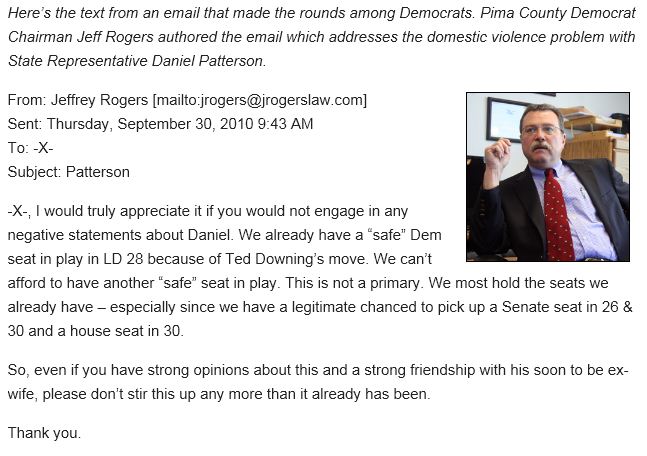
Pima County Democratic Chair Jeff Rogers, who is not known for his tolerance of primary challengers, told the Yellow Sheet that, "It is a known fact that in an election, a Green Party candidate can siphon off enough votes to tip the election toward a GOP candidate."

The matter is scheduled for court on March 12, at 1:30 p.m.

At least Chairman Rogers is out in the open about the fact that he wants to eliminate any choices other than the Democrats. His clear agenda is to polarize the election on the Democrat side.

And, this strategy makes sense. If the Republican candidates should harbor any divisiveness or bitterness after the primary - keeping in mind only one of them can win - then that could have an impact in the special election. If all the Democrats support their candidate, Ron Barber, and if the Republicans are a little divided, this could cause the Democrats to win in a district where the Republicans have an advantage in registration, and in an election where the Republicans, who are generally more inveterate as voters, can be expected to turn out in greater proportion.

But, offer the Democrats an option, which a Green Party candidate would be, and that works against the D's.

I guess when it comes to a democratic election, not all Democrats are pro-choice. :)

Ultimately, this was decided in favor of Manolakis. From Green Party congressional candidate remains on ballot, March 12, 2012:

TUCSON, AZ (Tucson News Now) - A Pima Superior Court judge threw out a challenge Monday to Green Party candidate Charlie Manolakis' position on the ballot for the special election to replace former U.S. Rep. Gabrielle Giffords.

[snip]

Manolakis, a 72-year-old former teacher who has lived in Arizona since 1974, turned in petition signatures to run for the Green Party nomination. His position on ballot was challenged in civil court on grounds he was not a member of the party.

Manolakis said he registered with the Green Party in Pima County on Feb. 23. He said he formerly was registered as a Democrat.

The former Boston resident is the only Green Party candidate who qualified for the race.

The plaintiff in the case was Tucson political blogger Luke Knipe.

The Pima, Santa Cruz, Cochise and Pinal boards of supervisors were also listed as defendants.

Judge Lee F. Jantzen dismissed the action.


But let's not lose sight of the underlying issue: the Pima County Democratic Party sees no advantage in being truly democratic. :)

For more on what's happening on the D side, Tom Danehy at Tucson Weekly had this to say:

The rumors had been swirling for weeks, and that's why I was dismayed that when Gabrielle Giffords announced she was stepping down, her hand-picked successor wasn't standing next to her (and being introduced as such). A big-name local Dem told me, "(That person, whoever it was to be) should have been at Gabby's side, maybe at the Food Bank, handing out food to people. You just can't blow a photo opportunity like that."

And yet they did. Memo to Pima County Democratic Party Chairman Jeff Rogers: What the hell, dude?! I'm still upset at Rogers for taking sides in a Democratic primary election. (He sided with Regina Romero over a Democratic challenger in last year's City Council elections.)

That was a monster no-no, and I've never heard a reasonable explanation from anyone as to why he would do that. That blunder was unforgivable; allowing the Republicans to take Giffords' seat would border on criminally negligent.

Having Giffords' longtime assistant Ron Barber enter the race soothed some people's nerves, especially considering a couple of the possibilities that had been bandied about prior to his announcement. There was the woman who would have had to change parties (!) in order to run in the Democratic primary, and another person absolutely awash in the malodorous essence of Rio Nuevo. By comparison, Barber is a veritable People's Choice.

Still, I wonder about the timing of it all. If he was going to run all along, why not announce it at a more-advantageous time? And if he doesn't want to run in November, then when are we going to find out who is?

I don't know Ron Barber; he seems like a decent guy. Nevertheless, what exactly are his qualifications, other than that he worked for Giffords, and God help me, he got shot? I've always voted for her, and I've been shot, too, but nobody asked me to run. I just hope he's tough enough, because the Republicans, who have always considered Giffords to be a squatter, are going to throw the kitchen sink at him.

Barber's entry in the race did clear things up on the Democratic side. Matt Heinz, who had been in the race, dropped out, leaving the Democratic nomination to Barber. On the other side, the Republican primary should be an absolute bloodbath. I can't wait.

I wonder if it is going to be "an absolute bloodbath" on the Republican side.

In any case, could it be anywhere near as bad as it has long been among the Democrats?

We consider excerpts from Guest Opinion: Is Jeff Rogers Abusing His Office? by Rob Ferrier, January 27, 2012:

While the Pima County Democratic Party might not have a face, it certainly has a voice. I am writing of course of Jeff Rogers, the twice-elected Chair of the Pima County Democratic Party.

The duties of Chair are as follows:

The County Chair shall preside at all meetings; make appointments to committees; make temporary appointments to offices which have been vacated... and generally do all and everything necessary to aid in the election of Democratic candidates, and to promote successful organization and operation of the Pima County Democratic Committee.

In sum, the Chair is to administrate the Party, raise money and groom potential candidates. The Chair is also a member of the Executive Committee. The Executive Committee is allowed and authorized to express policy position on issues of local, state, and national import. Nowhere, however, in the bylaws, is the Chair authorized to decide who is, and who is not, Democrat enough for the Party's taste. Nowhere in the bylaws do the words "Chair" and "duly appointed demagogue" appear within the same sentence.

Yet in 2011, the Pima County Democratic Party, seemingly at Mr. Rogers' direction, but voted on by the Executive Committee, spent almost $9,000.00 to fund a campaign against Joe Flores in the Ward 1 City Council, primary election. In other words, Jeff Rogers, as the head of the Pima County Democratic Party, picked one Democrat over another during a party primary. While, as the Party was quick to point out, this action is not strictly prohibited, it is undeniably unusual.

Apparently, the Pima County Democratic Party boss, Chairman Rogers, has been "administrating" his party by moving against Democrats that he disagrees with, using party money in the primary.

No wonder no Democrats want to challenge Barber in the primary. They would have enough of a fight on their hands battling a Democrat machine trying to sink them.

After more commentary, including more examples of Chairman Rogers undermining Democrat candidates in primaries, Mr. Ferrier concludes:

He does not have the right, however, to tell me, or anyone else, what we are allowed to think or believe as Democrats. And he does not have the right to tell his fellow Democrats that they are not welcome in my Party.

The Democratic Party does not belong to Mr. Rogers. While it is to his credit that he agreed to serve it, neither I, nor the vast majority of the rank and file asked him to define the contours of its policy, nor granted him the right to use it as his bully pulpit. And it is high past time that when he chooses to express his personal views that he identify himself as Jeff Rogers, local gadfly, and not Jeff Rogers, Chair of the Pima County Democratic Party. Because I, for one, am sick and tired of others assuming that Mr. Rogers speaks for me.

I was born and raised Republican. I chose to be a Democrat. Through the years, I participated in Young Democrats, I volunteered for candidates and once, and only once, allowed myself to be dragooned as a Precinct Committeeman. I admired, and still admire, FDR, Truman, JFK and RFK. I voted for Bill Clinton twice despite my personal distaste for his prurient habits. I have long accepted that the blessing of American privilege comes hand in glove with the responsibility of public service. And I embraced the Democratic Party because, fundamentally as a liberal leaning fellow, I believed in a few core ideals.

First, government is and should be, a force for good. Second, all people, regardless of where they came, what they believed, or what the color of their skin, deserved a fair shake from government. And most of all, I joined the Democratic Party because the Party shared those ideals. Within the Party, I am free to think what I want, and to believe what I want. And to know, to coin a phrase, that while my fellow Democrats might not like what I say, they will die for my right to say it. Above all else, we stand and fall together. We are the Great Coalition. The Big Tent. Come one. Come all.

I have friends within the Party that are pro-life. That are gun nuts. That are against gay marriage. That wish to build a wall across the Mexican Border. That dream of the day the death penalty is free from the shackles of due process. I share none of these views. But I would never question their right to belong to my party. And I would never, ever question their right to vote their conscience or to speak their mind. As far as I know, there is no litmus test to be a Democrat.

Except, apparently, in Pima County.

There was a time in this country when the two major parties served the interests of the country as they best saw fit. You might disagree with Truman or Eisenhower, but you could feel comfortable that either one of them was trying to do some good for America.

This has changed.

The "Democratic" Party, as an institution, was infiltrated and has largely been taken over by those who seek power for their own ends.

This infiltration is on the part of "Leftist" radicals. Their strategy has been to promote a plethora of issues, but their goal is their own power.

Lenin promised Russians "peace, land, bread", but in the end, it was about the Bolsheviks gaining and keeping power at the expense of the Russian people.

The same is true today in America.

There are a great many decent people who are Democrats, but increasingly, they are being sold out by their leadership.

To be sure, I disagree with many of these Democrats; with some of them, I disagree on nearly everything.

But, I recognize that they have opinions that they have formed, they have courses of action that they wish to implement, and, they have intentions that are good.

They have been sold out.

In Russia, after the Soviet Union was formed and Lenin died, Stalin had to purge his internal enemies, foremost among them being Trotsky who, after having worked to overthrow capitalism beginning in Russia, found himself fleeing to the capitalist world for safety.

And, we see this today in "Democratic" politics: too often, dissent gets crushed and internal enemies are the first casualties. Many Democrats become disgusted, and switch to the Republican Party. Despite all the desperate rhetoric from the Left, it is the Republican tent that is broad and inclusive, generally civil, where dissent is tolerated and often encouraged, where differences of opinion are respected as being American, and where our disagreements make us stronger by burning away lies in the crucible of freethinking debate.


(Source for last two images.)

Wednesday, March 14, 2012

What is Constant

First, some old news... which often is the best news. :)

Excerpts from Supreme Court declines Pledge of Allegiance case, dated October 5, 2009:

A Florida teenager has lost his bid to have the US Supreme Court decide whether students in public schools have a First Amendment right to refuse to stand and repeat the Pledge of Allegiance.

The underlying lawsuit did not challenge the content of the Pledge. Instead, at issue was a Florida law that requires all public-school students, Grades K-12, to stand and repeat the Pledge, unless excused in writing by a parent.

snip

On Monday, the Supreme Court announced that it would not hear the case. No reason for the decision was offered.

In seeking high-court review of the case, called Frazier v. Smith, Mr. Frazier's lawyers had asked the justices to decide whether he and other students have a constitutional right to refuse to be compelled by the government to repeat the Pledge of Allegiance.

To resolve the case, the justices would have had to clarify a landmark 1943 ruling in which the high court declared schoolchildren in West Virginia may not be required to participate in the Pledge of Allegiance.

The issue in the Frazier case was whether the First Amendment right established in the West Virginia decision belongs to the children alone or instead extends to the children through their parents.

A federal judge in Florida agreed that the right belongs to the students and struck down the Florida law. But a federal appeals-court panel later upheld the law on grounds that the First Amendment right belongs to parents of school-age children – not the children themselves.

The American Civil Liberties Union of Florida took up Frazier's case. In a brief urging the Supreme Court to hear the appeal, ACLU lawyer Randall Marshall quoted from the 1943 West Virginia decision.

"If there is any fixed star in our constitutional constellation, it is that no official, high or petty, can prescribe what shall be orthodox in politics, nationalism, religion, or other matters of opinion or force citizens to confess by word or act their faith therein."

Florida Solicitor General Scott Makar urged the high court to refuse to hear the case. "The state, of course, recognizes that minors have constitutional rights, albeit more limited ones than adults, especially in the area of education," Mr. Makar wrote in his brief to the court. "The state's clear legal position is simply that minors' rights must be balanced against those of their parents and the interests of the government in the education context."

In a friend-of-the court brief, two advocacy groups, the Center for Constitutional Rights and Public Good, said the appeals-court opinion in the Frazier case is a departure from a long and unbroken line of decisions.

"In upholding a Florida statute that limits students' clearly established right to abstain from reciting the pledge of allegiance in school, the court of appeals created a new parental right to control the exercise of their children's conscience," Seth Mermin wrote in the brief.

So, the government position is that children can be required to stand and recite the Pledge unless their parent/guardian requests in writing that they be excused.

This isn't good enough.

The Left - how else should I describe them? - wants it to be an individual student right to exercise their conscience.

What if a student feels that, as a matter of conscience, he shouldn't be compelled to go to school at all? Does he need someone's permission?

What's at issue here is whether children are children, and whether adults can set any rules at all for them.

Because, if you decide that children have individual rights the same as adults, then

1) Pedophilia will no longer be a crime; it will be open season on kids of any age for any purpose.
2) Children will need to vote. Presidential elections will be decided in favor of whoever promises the most toys. (That's kind of what we have now.)
3) Children will need career opportunities. No more child labor laws. Career opportunities will have to include anything that can help them get ahead. That will include the military; specifically, that will include combat.

Well, perhaps I am taking this too far.

We all know it will never get that far. ;)

Let's focus on one key quote:

The American Civil Liberties Union of Florida took up Frazier's case. In a brief urging the Supreme Court to hear the appeal, ACLU lawyer Randall Marshall quoted from the 1943 West Virginia decision.

"If there is any fixed star in our constitutional constellation, it is that no official, high or petty, can prescribe what shall be orthodox in politics, nationalism, religion, or other matters of opinion or force citizens to confess by word or act their faith therein."

I love it when the Left makes a stand on principle. :)

From Sandra Fluke: Slurs won't silence women, dated March 14, 2012:

Editor's note: Sandra Fluke is a third-year law student at Georgetown University Law Center and has served as president of Georgetown Law Students for Reproductive Justice.

snip

Most recently, certain political commentators have started spreading misinformation about the underlying government regulation we are discussing. To be clear, through programs such as Medicaid, the government already does and should fund contraception coverage for the poorest women in our country.

But, despite the misinformation being spread, the regulation under discussion has absolutely nothing to do with government funding: It is all about the insurance policies provided by private employers and universities that are financed by individual workers, students and their families -- not taxpayers.

Georgetown is the oldest Jesuit and Catholic university in the United States.

Established in 1789, Georgetown is the nation's oldest Catholic and Jesuit university. Drawing upon this legacy, we provide students with a world-class learning experience focused on educating the whole person through exposure to different faiths, cultures and beliefs. With our Jesuit values and location in Washington, D.C., Georgetown offers students a distinct opportunity to learn, experience and understand more about the world.


Ms. Fluke clarifies that the topic at hand is the private sector, not the government.

Why does the private sector have to compromise on its core beliefs?

Where is the private sector's right to exercise its conscience without permission from the government? (A principle upon which this country was founded...)

Or, suppose it is a basic economic issue - suppose the insurance company does not cover a certain type of product or service because the company has made the business decision to target a certain part of the market. Suppose the company merely wants to try to keep costs down.

What the Left is trying to do here is force its beliefs on everyone. The Left wants to take the big hammer of government and use it to bludgeon all dissent.

When this goal can be supported by making a plea for freedom, that is what they do - such as when the Left supports a kid's desire to not say the Pledge of Allegiance to the flag of the country that is paying for his education, without having to have a letter from his parent on file.

When this goal can be supported by taking away freedom, that is what they do - such as compelling a business to offer a certain product or service, regardless of economic considerations, and regardless of whether offering that product or service goes against the core beliefs of the founders of that business.

What is constant here is the desire to destroy what is right about this country.

When I say the Pledge, I gladly do so, knowing I am pledging allegiance to a flag and to a nation which is represented by that flag, a nation where Jesuits can be Jesuits and Catholics can be Catholics, and I can agree or disagree with them, as I see fit.

The Left is against this. The Left wants to bludgeon Catholics into being less Catholic, the Left wants to bludgeon the business sector into being less businesslike, and the Left wants to bludgeon anyone who would dare to be American into being less American.

To be sure, there are people on the "Left" who really believe they are working for freedom. But, they need to understand that their movement was long ago hijacked by those who seek to destroy this country... just as those who truly wanted "Peace, Land, Bread" had their movement hijacked nearly a century ago in Russia.

Ms. Fluke, I am not questioning your integrity, I am not questioning your motives, and I am not making slurs about you.

But, I am questioning the wisdom of the position that you have gone out of your way to advocate publicly.

Monday, March 12, 2012

Bogey Dope, Part 2

Prior to reading this, you may wish to be familiar with the contents of my last post, which was Part 1 of this series.

The race for the Congressional seat vacated by Representative Gabrielle Giffords in Arizona's 8th Congressional District is ongoing. For many people in the country, it is not even a blip on their radar scopes, and for a few, it is only that. For a very few, however, it is one of the most important things happening right now.


The current race is to replace Congresswoman Giffords, but there will be a follow-on battle for the seat for the redistricted 2nd Congressional District in the regularly scheduled elections in November. The current CD 8, and the redistricted CD 2, are both located in the southeast corner of Arizona, along the border with Mexico, and including all of Cochise County. The current CD 8 includes the eastern and northern parts of Santa Cruz County, as well as eastern parts of Pima County and a part of Pinal County. The redistricted CD 2 will include only the eastern part of Pima County, in addition to Cochise County. Part of the issue in the CD 8 race to replace Giffords is the question of whether the newly-elected Representative will simply hold the place until the new Congress is seated in January, or whether there will be continuity, with the newly-elected Representative continuing on as the CD 2 Representative in January. This will be decided by whether the same candidate registers for and wins both this special election and the regular election in November.


As the campaign progresses - and early voting in the primary of this special election starts March 22 - we are going to hear from the candidates as they address potential voters and debate each other. I link to some Arizona news sources in the sidebar, which will give you good information as you follow the election. One key link is the Arizona Daily Star's elections page. Regarding upcoming primary debates, we are informed in GOP candidates in CD8 to appear at many events of the currently-scheduled debates:

• On March 14, the SaddleBrooke Republican Club is hosting a candidate panel discussion at 4:15 p.m. at the Mountain View Country Club. Seating is limited.

• The next day, the Sabino High School Republicans are hosting a 90-minute debate at 6:30 p.m. at Sabino High School, 5000 N. Bowes Road.

• On March 26, the Pima County Young Republican Club and Legislative District 26 Republican Party are co-sponsoring a debate that starts at 7 p.m. at Canyon Del Oro High School, 25 W. Calle Concordia, Oro Valley.

• On March 29, the Southern Arizona Chamber Alliance, which includes eight chambers of commerce, will host a candidate mixer from 5:30 to 7 p.m. at El Charro, 6310 E. Broadway.

• On April 12, the candidates meet in Green Valley in what figures to be the final debate. It starts at 6:30 p.m. at Madera Clubhouse, 2055 E. Quail Crossing Blvd., hosted by the Republican Club of Green Valley-Sahuarita and the Quail Creek Republican Club and Tea Party of Green Valley.

The winner of the GOP primary will face Democrat Ron Barber (Giffords' district manager) and Green Party candidate Charlie Manolakis in the special general election on June 12th.

I am interested in the special election in general, but especially in the candidacy of retired Colonel Martha McSally - the reasons for this interest will become apparent.

One aspect of McSally's campaign was an internet chat with the public. (Other GOP Candidates have also had similar chats: Dave Sitton's transcript is from February 24, Frank Antenori's transcript is from February 29, and John Lervold's transcript is from March 2.) In the chat, McSally asked people to call her Martha, rather than refer to her as Col. McSally or call her "ma'am".

A comment: People will call you "Colonel McSally" out of respect and appreciation for your service to our country. They will call you "ma'am" for the same reason, and out of respect for the office you seek, even though many of those who hold elected office in Washington DC (and elsewhere in this country) bring the office into disrepute through their actions. Finally, people will also call you "Martha" out of warmth and a genuine desire to see you do well, even if they support another candidate in this particular race. Expect some people to refer to you in all three manners, depending on the circumstances - as I am about to do. :)

Local concerns will be significant in any Congressional election. However, for a piece of Arizona along the border with Mexico, many local concerns are national issues.

For example, campaigning in Sierra Vista this past weekend, McSally addressed a variety of these issues. From McSally aims for spot vacated by Giffords, dated March 11:

Calling the federal government atmosphere toxic, McSally said the American public want new leadership and ideas.

"The toxicity in the political sphere has a lot of people turned off," she said.

The United States is at a crossroads and there is a need to have people in Washington, D.C., who can pull the country out of the crisis, McSally said.

"The federal government is a little out of control. We need to rein the federal government in," she said.

"The federal government is a little out of control."

Colonel McSally, do you have a knack for understatement, or is there a "buzzer" between the clue bird on your shoulder and your ear? :)

You also mention "toxicity".

Also, in another article entitled CD8 candidate McSally says porous borders are national security threat, dated February 28 and referencing that chat, your views are described thusly (links from the excerpt have been reproduced):

Former Air Force fighter pilot Martha McSally said the country's porous borders are a national security threat that need to be met with an intelligence-driven strategy.

During a 1 1/2 hour online chat Tuesday on the Arizona Daily Star's website, www.azstarnet.com, the Republican candidate in the special election to complete Rep. Gabrielle Giffords' Congressional term also said it's vital to work with Mexico to address the root causes of the trans-national criminal organizations.

"Our porous borders are a national security threat that impacts this community more than any other in the nation," McSally wrote. "We need to have the political will to secure the border with available technology. I have been in leadership positions for critical security operations all over the world and believe we need to execute intelligence driven operations to thwart the transnational criminal organizations."

Some very astute comments, and these issues are interrelated.

If you recall from your history, decades ago, both New York and Chicago were major centers for organized crime. When we elected a President from New York, FDR, pressure was put on federal authorities and on authorities from New York state to clean up New York City; some progress was made.

However, in Illinois, the situation has been very different. In Chicago, organized crime essentially took over the city, and went on to take over the state.

Our current President is far from being an honest man; the guy we have in the White House now is a frontman and a puppet for organized crime, specifically for factions from Chicago.

Of course, organized crime is not constrained by jurisdictional boundaries; increasingly, with global trade and global communications, organized crime has developed global assets and global interests, and much of it is becoming very transnational in nature.

Why is the Obama Administration involved in a dubious plan to let firearms get purchased by straw buyers and move across the border into Mexico into the hands of drug cartels?

In Mexico, the military-grade weapons that the cartels use - fully-automatic weapons, grenades, rocket-launchers - are not being supplied by gun dealers on the US side of the border. Let's get real. On the US side of the border, most of these weapons are illegal for civilians to have, while some of them can only be owned with special licensing. They are not getting sold by respectable gun dealers to relatively unknown clients.

The military-grade weapons in the hands of the cartels are procured the same way the drugs that they traffic are procured: illegally, on the international black market. To be sure, many military and law enforcement personnel work for the cartels, stealing weapons from the Mexican government, or deserting and taking their weapons with them. But, much of this weaponry makes its way in from China, from former Eastern Block countries, from various dealers in Africa, Asia and Europe.

So, why is the Obama Administration helping arm the cartels?

One superficial answer is that by allowing weapons to walk across the border, the Obama Administration creates evidence to support the ridiculous liberal claim that US weapons fuel the violence.

But, scratch the surface a little deeper.

Another answer - less superficial - is that some of the Mexican cartels are so powerful, so well-organized, so well-trained, that we run the risk of them taking over the country. If we support the rivals and maintain a balance of power, we perpetuate the violence, but we also perpetuate a corrupt Mexican government from falling to a cartel in a blatant example of what is known as "state capture". Do an internet search on that expression, and see what you come up with.

But, let's dig down further.

The Obama Administration is backed by organized crime which obviously has ties to certain Mexican organized crime interests, and thus backs them against their rivals.

The real reason for the Fast and Furious scandal is blatant Chicago-style corruption.

Not everyone knows the real reason; different people support, or at least tolerate, the Fast and Furious scandal for different reasons. It just so happens that those different reasons provide different levels of cover stories, and different motivations for people who might otherwise have nothing to do with the operation.

Martha, you need to understand that the transnational organized crime activities, which you decry and which threaten your district and this country, have ties all the way to Washington. For example, should you win the election, you will be in Congress with a colleague named Henry Waxman, a Democrat from California's 30th District.

A few years back, when the Sibel Edmonds scandal was not breaking, Waxman promised that, if the Democrats could regain control of the House, Waxman would make sure that the Sibel Edmonds case got some attention because, after all, it was an example of how Republican President George W. Bush's Administration was abusing "state secrets privelege" for nefarious purposes.

Many people naively trusted a Democrat to break a scandal that would make the Republicans look dirty. After all, Waxman had been behind the 2004 report by the Committee on Government Reform Minority Office catching the Bush Administration with all their misleading information on Iraq. Later, in 2006, about the time Waxman was offering these hearings into the Sibel Edmonds case in the event the Democrats retook Congress, he received the Good Government Award from the Project On Government Oversight for his contributions to transparency and oversight.

Of course, what really happened was that Waxman cut his own deal with the Turkish Deep State, which was a key player in the Sibel Edmonds case. Waxman suddenly became intimate with the Turkish lobby, and the Sibel Edmonds case, which dealt with infiltration by Turkish organized crime into Congress and the FBI, was tabled.

This is not surprising.

The guy listed right above Congressman Waxman at POGO's award page is war hero and Arizona Senator John McCain. McCain also got an award, but his connections to ethnic Albanian organized crime remain relatively unknown and uninvestigated.


You see, these guys will gladly have an investigation that makes them look good, and that makes the other party look bad, but since transnational organized crime corrupts both parties, and corrupts both elected and appointed officials, transnational organized crime is not something that will get seriously investigated.

Besides which, investigating transnational organized crime can be hazardous to one's health. In Mexico, officials are presented with the choice of plata o plomo: "silver or lead" - in other words, take payments and be corrupt, or take a bullet.

This is part of why there is the toxicity that you mention.

To be sure, the left is hypocritical - any means are justified by their ends, which is their own power. The left doesn't care about the environment, or immigrants, or women's rights or reproductive choice or anything else, crap or not. The left wants its own power for its own purposes.

Consequently, when Congresswoman Giffords was shot on that terrible day, and when so many people were killed or hurt, the left saw an opportunity to silence its opposition by blaming "rhetoric". The left does not back down from its calls, whether real or figurative, for violence.

Similarly, when Rush Limbaugh made a comment about Sandra Fluke, and then sincerely apologized, the matter did not end. However, the left says whatever it wants about conservative political leaders and conservative commentators, and that is okay.

So, the toxicity is deliberate - it was designed by those who seek to destroy this country.

But, again, scratch the surface, and it is backed up by professional thugs.

Martha, in the internet chat, you wrote:

I pledged an oath as an officer to support and defend the Constitution and I have shown that I take that oath seriously, even when doing so endangered my career.

I do not doubt your willingness to risk your career, nor do I doubt your willingness to risk your life.

But, understand what you are up against.

To properly address border security and the Fast and Furious scandal, we need real investigations.

These will connect drug cartels to serving and past Presidents, these will connect trafficking in nuclear secrets to foreign intelligence services and to serving and past government officials, these will connect the trafficking of women for forced prostitution to Washington lobby groups and to officials from your own state.

To keep this from happening, these people will pick up a phone and make a call. The result can be anything from an IRS audit of your taxes, to a suddenly-appearing record that you are in collections due to a debt for $100,000 for internet gambling (no one cares if you have ever done that or not - a debt can still magically appear), to people close to you suddenly becoming victims of street crime or getting addicted to drugs.

As a newly-elected Representative in Congress, you will be told what to do and how to get along. If you play ball, then you will be on C-Span, and so on. Asking questions about dirty government officials, including guys sitting across the aisle from you, and including one Senator from your state who is connected to ethnic Albanian organized crime, and another who made Sibel Edmonds' Dirty Dozen list (NSWBC Letter to Senator Kyl)... well, this may not endear you to the establishment. :)

Thankfully, this country has never had a shortage of people willing to give their lives in its defense - especially when those people know they will be remembered as heroes.

The problem is a shortage of people willing to live for this country, even though they will slandered and libeled, and attacked (legally and otherwise), and painted as criminals by the people who themselves are criminals but who happen to have the protection of a facade of respectability.

If you do not understand that this is what you are up against, and then, if you are not ready to face it, then you are just another candidate for political office.

This is part of the reason why I am following your campaign, ma'am. I wonder if perhaps you are the right candidate to bring this whole topic to light...