In Part 1 we began looking at how mosques are actually considered, by leaders in the Muslim world, not just as places of worship, but as centers of political and even military activity. In Part 2 we looked at money, and considered how it snakes its way in to the campaign coffers of political leaders, seeing in particular how Barack Obama and George W. Bush had both received financial support from the Middle East. Towards the end of the post, I wrote:
Once these guys start laundering money to a campaign, there are all kinds of ways to do it. Some foreign billionaire sends a few million to some associates in the US. That money goes to US citizens. Those citizens then have a list of campaigns, PACs and other entities to donate to; these PACs and entities know who they have to pass the money on to, or how it has to get spent. Sometimes, these middlemen keep a small cut for channeling the money.
A little farther on, near the end, we finished with one quote and added a little analysis:
After years of practice, and using methods pioneered by Islamic terrorist groups, they are very, very good at making money vanish.
Notice the last author's comments, about how the left uses the same methods to finance elections that Islamic terrorist groups use to finance holy terror.
We now begin to consider foreign influence coming from another direction, and moving to another destination. Specifically, we look at how foreign powers which, though our allies, have connections that are questionable (to say the least), and how they generate support in Washington.
__________
You may recall the unrest in Egypt in recent years. As part of the "Arab Spring", long-time ruler of Egypt, Hosni Mubarak, resigned, and during elections supervised by the military, Mohamed Morsi was elected to replace him in June, 2012. By November, Morsi, who had been a leading member of the Muslim Brotherhood until his resignation from that organization upon assuming the presidency, established himself as essentially a dictator, granting himself unlimited powers to protect Egypt.
By June 30, 2013, the first anniversary of Morsi's election, Morsi was quite unpopular, and protests erupted demanding his resignation. The military intervened on behalf of the protesters, and in early July Morsi was forced out.
So, for about one year, from the end of June, 2012, until the beginning of July, 2013, Morsi was president of Egypt, and for much of that time ruled basically as a dictator.
It was during this time that an important vote came up in the Senate regarding a legislative amendment that would stop the sale of F-16 fighter aircraft and M1 tanks to Egypt. The amendment was defeated, meaning the sale and delivery could go forward.
In January, 2013, with Morsi - who had been a leading figure in the Muslim Brotherhood until he resigned to become president of Egypt - still firmly ruling Egypt with near-dictatorial powers, Kentucky Senator Rand Paul was speaking in the Senate in favor of the amendment that he had introduced to stop the arms transfer. From US Senate Shoots Down Bid to Halt Sales of F-16s, Tanks to Egypt, January 31, 2013:
(CNSNews.com) – The U.S. Senate Thursday defeated an amendment that aimed to prevent the Obama administration from transferring F-16 fighter aircraft and Abrams tanks to an Egypt in disarray.
A vote to block the measure proposed by Sen. Rand Paul (R-Ky.) – an amendment to the debt limit bill – passed by a 79–19 vote.
In a strongly worded floor statement, Paul questioned the wisdom of providing the sophisticated weaponry at a time when "many see Egypt descending into chaos."
He based his argument on the Egyptian government's conduct, President Mohammed Morsi's expressed radical views, and the possibility that the weapons could be used in a future conflict against Israel.
Every Democrat in the Senate voted in favor of proceeding with the sale.
On the surface, the logic behind allowing the sale to proceed seemed to make some sense. Skipping down in US Senate Shoots Down Bid to Halt Sales of F-16s, Tanks to Egypt:
Rejecting Paul's amendment, Sen. Patrick Leahy (D-Vt.) characterized it as simplistic, short-sighted and potentially harmful to U.S. interests.
"Would that this amendment was as simple as the junior senator from Kentucky described it," he told senators after Paul had spoken. "His amendment would hinder our military assistance program, licenses for commercial sales of all major military equipment, including aircraft, ships, tanks, armor, parts and so on.
"It would mean a loss of thousands of American jobs. We'd incur more than two billion dollars in contract-termination penalties for U.S. taxpayers," Leahy said.
"But we'd also put at risk our access to the Suez Canal, the over flight by the U.S. Air Force over Egyptian territory, cooperation in the Sinai, Gaza, Syria, our emphasis and our ability to keep the Israeli-Egyptian peace agreement going.
"Do I have problems with the way the Morsi government is going? Certainly," he said. "But removing our ability to be involved, with keeping that peace agreement and our ability to influence those – this is not the way to do it."
But, we were still looking at arming the military of a nation that borders Israel, one which the Muslim Brotherhood had just taken over, and one where a new Islamist constitution had just been passed in a referendum.
To be sure, in reviewing reports from that time frame, it is my distinct impression that the Egyptian military was actually a fairly strong ally of the United States. Ultimately, it was the Egyptian military the ousted Morsi, and replaced him with a leader that was far more... I hate to use the term "moderate", but he is a guy who does not support the Muslim Brotherhood.
Presumably, Senators had access to material, both classified offical information, and unclassified information, including that available to the general public, which would allow their staffers to consider this; presumably, Senators looked not just at Morsi, but at the Egyptian military, its leaning, and its ability to influence internal Egyptian politics, before signing off on the sale.
However, I still have concerns about the Democrats in the Senate voting to ship sophisticated arms to the military of a nation that was at the time dictatorially ruled by a de facto leader of the Muslim Brotherhood.
How does a Senator really get influenced to go forward with such an arms sale? Obviously, there are many factors, but not the least of these is money from the country receiving the sophisticated arms.
__________
The Glover Park Group is a registered foreign agent of the Government of Egypt.

Their job includes supporting Egyptian government communications with the US government, the business community, non-governmental audiences and the media.

The Glover Park Group has an affiliated political action committee.

This political action committee gave $1500 to Senator Mark Udall (D - Colorado) in June, 2012, shortly after Morsi came to power in Egypt.

This same PAC also gave another $1000 to Senator Udall in March, 2013, after Udall had supported the sale of these high-tech weapons to Egypt.

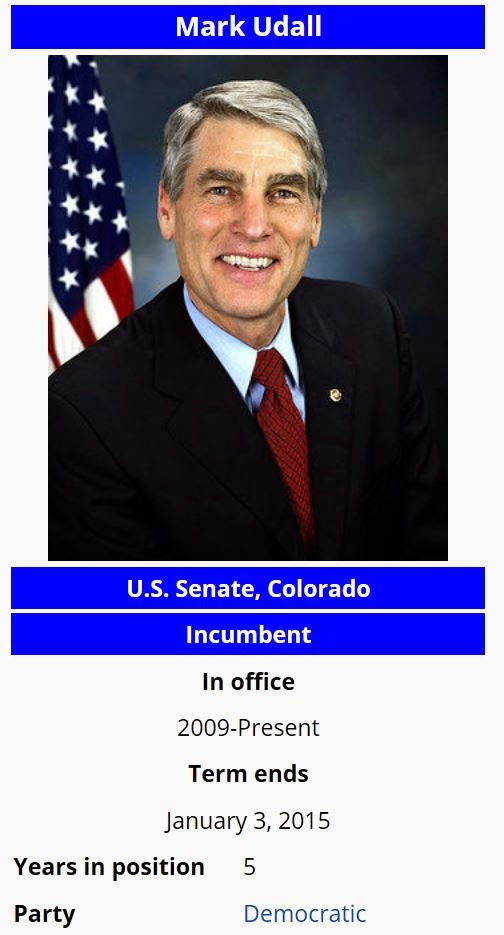
Senator Mark Udall raises big money. Over half of his money is itemized individual contributions, but when one factors in smaller individual contributions, which do not have to be itemized, you realize nearly three-quarters of his money comes not from PACs, but from individuals.

However, in this cycle alone, he has raised over $2 million from PACs. It's not surprising he is listed in a July, 2013, article as among the top ten recipients of lobbyists' money.
Speaking of lobbyist money in Mark Udall's campaign coffers, Senator Udall has also received $2000 from JSTREETPAC, a PAC associated with J Street, an organization which supports dialogue over confrontation and diplomatic solutions over military solutions, especially in regards to Israel and the Middle East.

While I personally agree that diplomacy and dialogue are favorable to war, it is my opinion that if Israel were to unilaterally commit exclusively to diplomacy and dialogue, the Islamic Arab states that surround Israel would overrun and destroy that nation quite quickly, as they have so often tried to do in the past.
I find it interesting that JSTREETPAC, which supports dialogue and diplomacy, gave money to a Senator who voted to send sophisticated weapons to Egypt when Egypt was controlled by the Muslim Brotherhood, and when the Muslim Brotherhood was pushing through a draft of an Islamist constitution.
By order of the Prophet (peace be upon him), stay tuned for more!