Showing posts with label Privacy. Show all posts

Wednesday, October 1, 2014

Trivia, Part 3


In Part 1 we began by reviewing old news about how Rupert Murdoch's media empire used intrusive and illegal means to spy on celebrities in the United Kingdom. We then fast-forwarded to the then-breaking scandal whereby Hollywood celebrities were finding very personal photos appearing in public. We next began reviewing how cell phones work, with an eye towards establishing that basically any use of a cell phone can compromise personal material and information. We saw how cell phone towers can be disguised, and we looked at transportable cell towers, which are used to temporarily restore coverage when towers are out. Finally, we looked at reports about devices called "interceptors" and how they are used to spoof cell phones and access information they should not be able to access.

In Part 2 we looked more in-depth at the definitions of 3G and 4G cell phone technology, and saw just how portable legitimate cell phone "towers" can be - they can fit in the palm of your hand. Then, we looked at portable devices that could be used to spoof cell phones, and saw one that wears kind of like a bullet-proof vest under an overcoat. We finished by seeing that, with these concealable interceptors, it was possible to identify a cell phone belonging to a certain person, locate it, and then jam it or intercept the signals for the purposes of surveillance or spoofing, all without the cell phone operator even knowing.

The security breaches used by means of introduction in Part 1 centered on Apple products. It may therefore be worthwhile to review some relatively recent news about technology that specifically spies on Apple equipment.

At the end of last year, the German news magazine Der Spiegel ran an article entitled Shopping for Spy Gear: Catalog Advertises NSA Toolbox (December 29, 2013), in which the magazine called attention to particulars concerning the United States' National Security Agency spy technology. This was when news of the NSA ANT catalog broke to the general public.


It should be noted that this topic is of particular importance in Germany, especially since the story broke that the United States intelligence community collects intelligence on our ally Germany. Particularly noteworthy in the the scandal is the fact that the United States was caught spying on Chancellor Angela Merkel herself.


According to the highly-classified catalog mentioned above, as of six years ago today the NSA had in development something called DROPOUTJEEP, which was described as (I have included explanatory notes and links in [brackets]):

a software implant for the Apple iPhone that utilizes modular mission applications to provide specific SIGINT [Signals Intelligence] functionality. This functionality includes the ability to remotely push/pull files from the device. SMS retrieval, contact list retrieval, voicemail, geolocation, hot mic. camera capture, cell tower location, etc. Command, control, and data exfiltration can occur over SMS [short message service] messaging or a GPRS [general packet radio service] data connection. All communications with the implant will be covert and encrypted.


The catalog explains that the implant had to be installed via "close access methods", but that a "remote installation capability" would be pursued.

In my opinion, it is a safe bet that this been fielded, including with the "remote installation capability", in the intervening six years.

Another software implant that was underdevelopment six years ago, and is likely fielded and improved today, is the GOPHERSET, which pulls information from the target's SIM (subscriber identity module) card, and texts it out to the person who is doing the spying.


In fact, the Interactive Graphic: The NSA's Spy Catalog gives a nice overview of the NSA-advertised capabilities as of the time the catalog was created:

Cell Phone Networks

When it comes to monitoring and tracking mobile phones, the NSA's ANT division has an entire range of products on offer. These include everything from specially equipped mobile phone models that make it possible to physically track another mobile phone, to fully equipped GSM base stations capable of masquerading as a network operator's official mobile phone antennas, and thus monitor and record conversations or text messages from mobile phones within their range. One only has to think of the alleged tapping of German Chancellor Angela Merkel's mobile phone for examples of their potential uses. Several of these specialized mobile phone base stations also have the capability to determine the exact location of any mobile phone user within their range. Then there is a device called "CANDYGRAM" -- referred to by the ANT technicians as a "telephone tripwire" -- which sends a text message to a command center as soon as certain mobile phone users enter its range.


There is also CROSSBEAM, which records voice data and sends it to the guy doing the spying - a wiretap for the on-the-go cell phone generation:
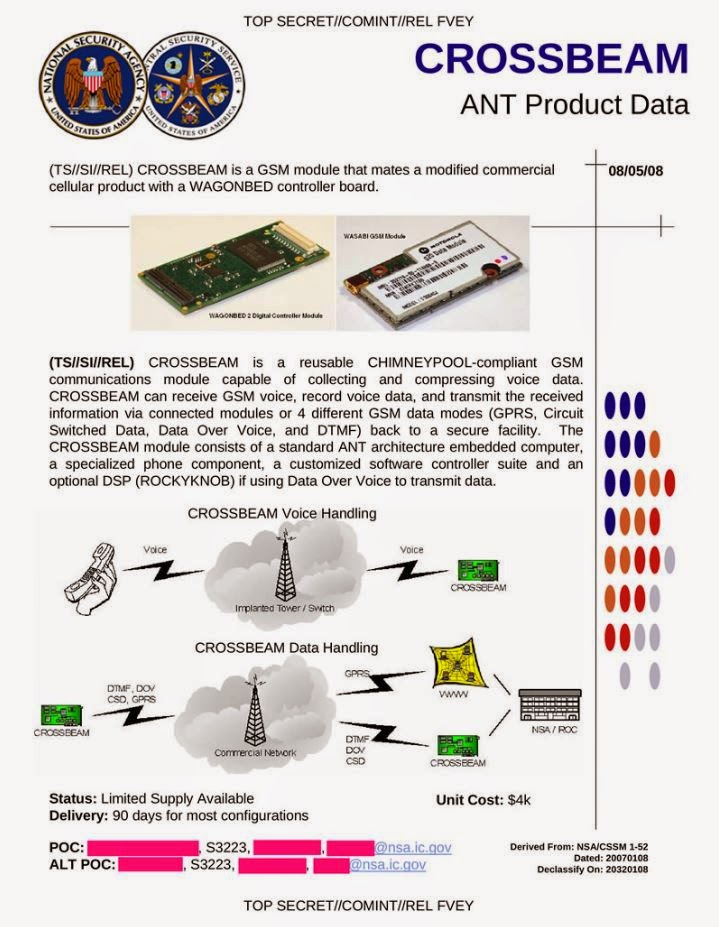


The extensive capabilities that the NSA has fuel the ongoing scandal in Germany, where government officials and ordinary citizens are outraged that the NSA targets Germany with them. An excerpt from NSA, GCHQ have secret access to German telecom networks – report provides background on these capabilities:

US and UK intelligence services have secret access points for German telecom companies' internal networks, Der Spiegel reports, citing slides created in the NSA's 'Treasure Map' program used to get near-real-time visualization of the global internet.

The latest scandal continues to evolve around the US' NSA and the British GCHQ, both of which appear to be able to eavesdrop on German giants such as Deutsche Telekom, Netcologne, Stellar, Cetel and IABG network operators, according to Der Spiegel's report based on material disclosed by Edward Snowden.

The Treasure Map program, dubbed "the Google Earth of the Internet," allows the agencies to expose the data about the network structure and map individual routers as well as subscribers' computers, smartphones and tablets. The German telecoms had "access points" for technical supervision inside their networks, marked as red dots on such a map, shown on one of the leaked undated slides, Spiegel reports, warning it could be used for planning sophisticated cyber-attacks.

Notice that both the US and the UK are involved, with the UK's Government Communications Headquarters (GCHQ) mentioned.

Five powerful countries of the English-speaking industrialized world routinely share signals intelligence data - including communications intelligence - via the Five Eyes program, described in some circles as "the most powerful espionage alliance in world history."

It is worth recalling that we established in Part 1 that Rupert Murdoch's media empire had been intruding into the lives of celebrities in the United Kingdom using a variety of means, including by bribing law enforcement officers in order to gain access to restricted cell phone tracking information.

With that in mind, it is interesting to consider all the capabilities the NSA was advertising it had in its 48-page catalog as of several years ago, when the catalog was leaked. These capabilities are presumably now in the hands of law enforcement throughout the United States, the United Kingdom, Australia, New Zealand and Canada - the Five Eyes program's member countries - and one can similarly assume that the intelligence agenies of the United States at least, if not of other Five Eyes countries as well, have by now even more advanced capabilities.

With all this capability in the hands of all these people - who can be bribed or coerced, and who make mistakes - is there any real expectation of security and privacy as one uses one's cell phone to text a message or take a picture?

More to follow...

Saturday, September 6, 2014

Trivia, Part 2


In Part 1 we touched on how modern communications are reliant on cell phone towers. Then, we ever-so-briefly considered efforts to camouflage these towers, and we saw how mobile cell phone towers can augment cell phone tower coverage in case of damage to a tower or to offer additional capacity when needed. Finally, we introduced the concept of "interceptors", phony cell phone towers that have been surreptitiously placed for some clandestine or illicit purpose.

We will continue by combining the concepts of a cell phone "tower" -- or perhaps "interceptor" is the better term to use here -- with the concepts of camouflage and mobility. However, before we proceed, we need to briefly review some terms used in discussing cell phones.

Most people have heard terms like "3G" and "4G" to describe cell phones and service. What exactly does this mean?

Initially, cell phones were analog devices. The radio frequency spectrum was divided into slices, called channels, and a cell phone would transmit on one channel, while simultaneously receiving on another. This ability to transmit and receive simultaneously is called "full duplexing", and allows for a normal conversation to occur. In contrast, radios tend to be "half duplex" systems, where one party talks while the other listens, and then they switch to where the one listens while the other talks.

Later, digital technology was incorporated, allowing compression and manipulation of the signals which, in turn, increase cell phone call capacity in a system. Even newer technologies in signal processing then allowed for dramatic leaps in data transfer rates, making it possible for cell phones to become handheld computers, and the cell network to work like a Wi-Fi. This was dubbed "3G" for third generation, making analog technology 1G and the first digital technology 2G. Later, anything more advanced than 3G was dubbed "4G", though many people are beginning to realize that most "4G" is, in fact, only an incremental improvement over 3G. Thus, "true" 4G refers to 4G LTE - fourth generation long-term evolution.

Current cell phones use something akin to an operating system. The most common are GSM (Global System for Mobile Communications) used by AT&T and T-Mobile, and IDEN (Integrated Digital Enhanced Network), introduced by Motorola and used by Nextel, which is GSM-based.

For a readable explanation of cell phone technology and how it has evolved, I suggest you begin with How Cell Phones Work.

With this background established, we should begin with the question of just how small and mobile can cell phone "towers" get? To get some idea, we consider excerpts from The tiny cube that could cut your cell phone bill from March 21, 2011:


NEW YORK (CNNMoney) -- As mobile data usage skyrockets, wireless companies are spending billions each year to maximize capacity, and consumers end up footing the cost in the form of higher cell phone bills.

But a cube that fits in the palm of your hand could help solve that problem.

It's called lightRadio, a Rubik's cube-sized device made by Alcatel-Lucent (ALU) that takes all of the components of a cell phone tower and compresses them down into a 2.3-inch block. Unlike today's cell towers and antennas, which are large, inefficient and expensive to maintain, lightRadio is tiny, capacious and power-sipping.

[snip]

When conceiving of lightRadio, Alcatel-Lucent's engineers stripped out all the heavy power equipment that controls modern cell towers, and moved them to centralized stations. That allows the lightRadio cubes to be made small enough to be deployed virtually anywhere and practically inconspicuously: Atop bus station awnings, on the side of buildings or on lamp posts.

Their small size and centralized operation lets wireless companies control the cubes virtually. That makes the antennas up to 30% more efficient than current cell towers. Live data about who is using the cubes can be assessed, and the antennas' directional beams can be shifted to maximize their potential. For instance, radios may be pointed in one direction as people are coming to work in the morning and another direction as they're leaving work at the end of the day.

The lightRadio units also contain multi-generational antennas that can relay 2G, 3G and 4G network signals all from the same cube. That cuts down on interference and doubles the number of bits that can be sent through the air.

Today's cell towers, by contrast, send power in all different directions, most of which is lost, since it doesn't reach anyone's particular devices. They're inefficient in other ways as well: Roughly half of the power from cell towers' base stations is lost before it makes its way up to the antennas at the top of the tower. And they have separate antennas for 2G, 3G and 4G networks, causing interference problems.

[snip]

Each 1.5-Watt lightRadio cube powers about a two-block radius, so in urban areas, they can be deployed throughout the city and stacked like Lego blocks in stadiums or other areas that need extra capacity. In rural areas, they can be deployed atop existing cell towers in arrays.

Since that article was written, these kinds of devices have been deployed to provide cell phone coverage in "dead zones" such as under bridges, inside buildings, and so on.


However, this was intended for the legitimate purpose of providing better cell phone coverage. While this kind of technology could be misused, there are also devices that were intended for surreptitious use. One such device is called an "IMSI Catcher". A brief excerpt from the introduction to IMSI-Catch Me If You Can: IMSI-Catcher-Catchers describes what this is (numbers in [brackets] refer to footnotes in the paper):


IMSI Catchers are MITM (man in the middle) devices for cellular networks [20]. Originally developed to steal IMSI (International Mobile Subscriber Identity) numbers from nearby phones (hence the name), later versions offered call- and message interception. Today, IMSI Catchers can also be used to track handsets, intercept mobile two-factor authentication schemes (mTAN), geo-targeted spam [24], send operator messages that reconfigure the phone (e.g. installing a permanent MITM by setting a new APN, http-proxy, or attack the management interface [32]), or attack SIM cards with encrypted SMS [26] that are filtered by most operators by now.

A company called Gamma Group markets an IMSI Catcher which a person can wear under a coat, kind of like a bullet-proof vest. Here are excerpts from The body-worn "IMSI catcher" for all your covert phone snooping needs, dated September 1, 2013:


"The unit is optimized for short-range covert operation, designed to allow users to get close to Target(s) to maximize the chances of only catching the Target(s') identities and minimal unwanted collateral," one of the marketing pamphlets boasts. "The solution can be used as a standalone device or integrated into wider data-gathering and geo-tracking systems."

At just 41 x 33 x 18 centimeters, the device is small enough to fit under a shirt. It needs from one to 90 seconds to capture the international mobile subscriber identity (IMSI) or international mobile equipment identity (IMEI) of the person being tracked. It works on all GSM-based networks regardless of country and is fully operational even when functioning in a moving vehicle. The same brochure advertises several other varieties of IMSI catchers, including some that work in a totable briefcase and one that receives signals from a covert vehicle roof bar antenna. The James Bond spying tools are sold to government agencies and law enforcement organizations.

[snip]

Other devices available from GammaGroup help snoops physically track and tap a target once his IMSI is known. One device helps spies physically locate a target by locking into his mobile phone signal. It can also intercept the target's SMS messages and "take control of target phones for the purpose of denying GSM service." The devices can even "create a bubble or exclusion zone to deny GSM network coverage without alerting cell phones."

In other words, these devices can identify your cell phone, find where your cell phone is, and then jam it without your cell phone alerting you to the process. Also, your cell phone communications can be monitored, and even spoofed: it is possible your cell phone can receive fake messages, and fake messages can be sent out with your cell phone's signature.

And all it takes to make this happen is to get a small computer-controlled device, which would fit comfortably in a brief case or overcoat, within a reasonably short distance from you - not necessarily close enough for you to notice.

Stick around for Part 3.

Friday, September 5, 2014

Trivia, Part 1

When I have not blogged for nearly a year, and then I resume blogging by beginning with an article that reviews very old news, that should be something of concern.

Three summers ago, there was a big scandal, wherein news outlets of Rupert Murdoch's media empire had used illegal means to obtain information about the highest-ranking members of the British government, as well as information about celebrities and other persons of interest. We begin with excerpts from Murdoch Tabloids' Targets Included Downing Street and the Crown, July 11, 2011:

LONDON — The scandal that has enveloped Rupert Murdoch's media empire in Britain widened substantially on Monday with reports that two of his newspapers may have bribed police officers or used other potentially illegal methods to obtain information about Queen Elizabeth II and former Prime Minister Gordon Brown.

Others on the police payroll have been bribed to use restricted cellphone-tracking technology to pinpoint the location of people sought by the papers in their restless pursuit of scoops, according to two former journalists for the tabloid shut on Sunday, The News of the World.

[snip]

The revelations about the intrusive activities directed at the queen and Mr. Brown have seized the headlines, driving home the realization that nobody, not even the most powerful and protected people in the land, has been beyond the reach of news organizations caught up in a relentless battle for lurid headlines and mass circulations.

A wide segment of British society, from celebrities to ordinary families wrestling with personal tragedies, has been shown to be potentially vulnerable to the newspapers' use of cellphone-hacking, identity theft, tracking technology and police bribery — perhaps even clandestine property break-ins, if some reports circulating in recent days are true.

Recently there has exploded to the surface a scandal in the United States whereby private photos of celebrities were supposedly hacked and published online. At the moment, the issue is still up in the air, with some celebrities denying the authenticity of the photos of them, while other celebrities confirm that the photos of them are authentic; some of these latter are vowing to pursue legal redress.

Many allegations suggest that it was Apple's cloud storage that may have been hacked, but an alternative hypothesis seems like an opportunity to introduce this post.

First, an excerpt from Don't blame iCloud yet for hacked celebrity nudes by Tony Bradley, September 2, 2014:

Boris Gorin, head of security engineering at FireLayers, thinks we shouldn't be throwing stones at iCloud. "The images leaked have been gradually appearing on several boards on the net prior to the post at 4chan—making it reasonable to believe they were not part of a single hack, but of several compromises that occurred over time."

Gorin shared a theory the celebrities may have been hacked while connected to an open public Wi-Fi network at the Emmy Awards. If they accessed their personal iCloud accounts, attackers connected to that network would have been able to intercept and capture the username and password credentials. That's not a security flaw with iCloud and having a strong or complex password wouldn't offer protection against transmitting that password in clear text on a public Wi-Fi network.

Of course, any use of any kind of cell phone could be a security risk, and this is the topic addressed here.

Cell phones communicate via radio frequency (RF) emissions to cell phone towers which, in turn, process the signals and send them into the telephone network. Of course, for years, cell phones have been more than mobile telephones, and so, for years, cell phone towers have also allowed handheld devices to communicate via the Internet.

Consequently, cell phone towers are a key node in modern communications; someone who controls a cell phone tower has access to a significant amount of information.

In an effort to make cell phone towers less conspicuous and more in-tune with the surroundings, efforts have been made to camouflage them. For over two decades, cell phone towers have been disguised as trees, and some of the disguises are not very convincing.


There is also a need for more easily-transportable cell phone towers that can be taken to replace a damaged tower while repairs are being made, or to provide surge capability, for example during a convention or sporting event. These towers can be of a generic nature, useful for not just communications equipment, but emergency lighting and other applications.


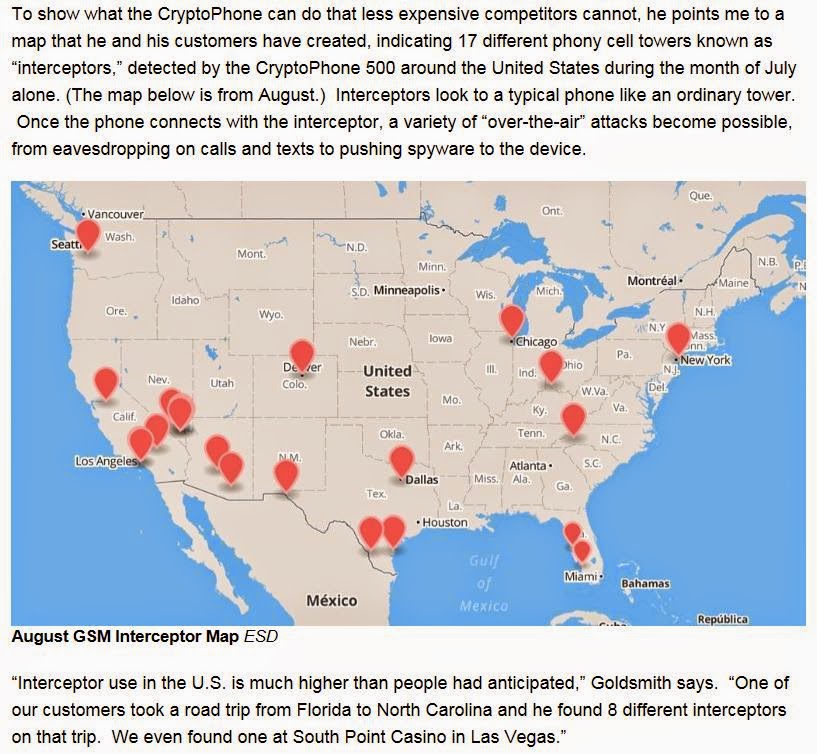
A report by Popular Science entitled Mysterious Phony Cell Towers Could Be Intercepting Your Calls from August 27 is beginning to get some attention in the media. The article begins explaining how certain telephones have security-related enhancements that make them far less vulnerable to spoofing, and how these phones have identified the phony cell phone towers (known as "interceptors) that tried to spoof them, providing information that allowed the company which markets the phones to map where the "interceptors" are.


An excerpt from the middle of the article introduces the problem we are examining:

"Interceptor use in the U.S. is much higher than people had anticipated," [Les] Goldsmith [CEO of ESD America, a maker of "hardened" cell phones] says. "One of our customers took a road trip from Florida to North Carolina and he found 8 different interceptors on that trip. We even found one at South Point Casino in Las Vegas."

Who is running these interceptors and what are they doing with the calls? Goldsmith says we can't be sure, but he has his suspicions.

"What we find suspicious is that a lot of these interceptors are right on top of U.S. military bases. So we begin to wonder – are some of them U.S. government interceptors? Or are some of them Chinese interceptors?" says Goldsmith. "Whose interceptor is it? Who are they, that's listening to calls around military bases? Is it just the U.S. military, or are they foreign governments doing it? The point is: we don't really know whose they are."

As this series continues, we will examine the nature of "interceptors", consider the extent of their use, and discuss the question of to whom they may belong.

Saturday, August 10, 2013

Privacy Notice

This is my privacy notice from Facebook.

Consider it my privacy notice for all my online activity, including here at Blogger. :)


****Privacy Notice****

Attention all agents, employees, contractors, personnel and other persons or entities acting on behalf of or at the behest of any level of government, from whatever country, whether of the United States, or some other nation or non-national entity or of any political subdivision thereof, or of any international organization, whether instituted legally or otherwise, or of any other party:

I am a citizen of the United States of America, exercising my right, endowed by my Creator and codified in the supreme law of this land, to freedom of speech, of the press, and of religion;

And if you, for whatever reason, seek to use information found at this or other websites to infringe upon my rights, whether seeking to abuse your official authority derived directly or indirectly from the government of the United States of America or any political subdivision thereof to unconstitutionally accuse me of crimes of which I am innocent or otherwise persecute me, or whether you wish to pass information to transnational organized crime in an effort to silence me, or whether, working for a foreign power, you wish to commit an act of war against this Republic by attacking me, or for whatever nefarious purpose on behalf of whomever,

Then...

You can blow me!


(It is recommended that other members post a notice similar to this or you may copy and paste this one. Thank you.)

Tuesday, May 4, 2010

No Comment

At a previous post, a commentator made a comment including this rationale:

If they are here legally, then what is the problem showing your green card and moving on. That's like someone being accused for triple homocide and the police telling you, "If you didn't commit these murders, take a polygraph test." Are you seriously going to say no?? If you didn't do anything wrong what would be the reason NOT to take the test?!

and ending with the following:

After 9/11, people should have no problem to heavier security regardless where it is at or how.

Hoping to spark further debate, I responded:

Prove that you are innocent.

Unfortunately, it looks like the debate was not taken.

__________


The founders of this country lived in a time when there were grave threats to security from bandits and highwaymen, pirates, and troubles with Indians living along the frontier.

They also saw how the abuses of their own government could create an oppressive atmosphere.

They preferred to deal with all manner of problems, be they security issues or economic problems, by preserving for themselves the maximum amount of liberty possible.

When you surrender your liberty to anyone, regardless of what is promised you, all you can count on receiving is oppression.

If your concern is economic security, you surrender an increasing amount of your pay to government bureaucrats, who themselves derive their income from the money you give them, with the hopes of getting some of it back should you need, after jumping through the appropriate bureaucratic hoops. You will never get it all back, since some of what you send to the government gets taken out to pay the expenses of administering the program, including the salaries of the bureaucrats deciding whether you get anything at all.

The situation is far worse with physical security.

Do an internet search about whether the police have a requirement to protect an individual, and see what you come up with.

In our country, our police are generally competent, brave and honest. There are, of course, exceptions.

However, there is no specific requirement to protect any one individual. Of course, take that with a grain of salt... President Obama gets great protection from law enforcement, and if you are important in the community, someone will make sure you get taken care of.

But what about the protection that the average member of society can expect from the police? There is a limit to what the police can do, no matter how hard they try and no matter what kind of resources they have available.

However, there is no limit to how police power can be abused, as the founders of this country found out the hard way.

The specific matter in question in the previous post was the surrendering of Constitutional rights for protection from illegal immigration, more specifically, police being required to actively seek out illegal immigrants. Of necessity, this mandates frequent contact with people, some of whom are citizens.

How does law enforcement determine who should be questioned regarding their immigrant status?

Along the Mexican border, do cops arbitrarily question Latinos? US citizens of Latino background will inevitably get caught up in the questioning. Or, to avoid cultural profiling and accusations of "racism", should law enforcement cast its net wider, and get people of European, Asian and African descent?

Either way, US citizens will be caught up in this net, and will be compelled to prove that they are innocent of any accusations made against them, in this case, the accusation that they are here illegally.

Here is the complete comment that was left:

I guess I should state that I am very much liberal. Probably a far right liberal. With that said....this law that was passed in Arizona about the immigrants...If they are here legally, then what is the problem showing your green card and moving on. That's like someone being accused for triple homocide and the police telling you, "If you didn't commit these murders, take a polygraph test." Are you seriously going to say no?? If you didn't do anything wrong what would be the reason NOT to take the test?!

But again, that's just me and I don't live in the state of Arizona where immigrants are over-flowing which, by the way, were the words of Senator McCain and has been a huge problem with no solutions.

After 9/11, people should have no problem to heavier security regardless where it is at or how.

Just to make sure I have beaten this dead horse (though it really is nowhere near dead), here is what I was going to write in response:

What if you're not an immigrant, and don't have a green card? Why do US citizens have to prove their right to be walking down the street in their own country?

This law opens the floodgate for police harassment. And let's not kid ourselves; though our police are probably among the very best in the world, we do have bad cops. There are criminals who get badges, and there are good people with badges who get corrupted. Power corrupts, and that includes police power.

The reason to not take the test is that, though I am innocent, they might find something else to accuse me of as a result of the test. What's to stop the police from accusing me of one crime, then using the investigation to fish for other things? This is a law enforcement interrogation technique. They accuse you of having your boyfriend murdered, so you admit you were angry with him and just meant to have him beat up. You have now confessed to conspiring to commit battery.

Ah, but is this really a problem, as long as the people accused are guilty of something? If you conspire to commit battery, don't you deserve to get caught, even if it is by false accusation of murder?

The problem is that with hundreds of thousands of pages of federal laws on the books - plus state and local laws - everybody is guilty of something. It's just a question of what. Do you really want law enforcement to decide to single you out and go fishing to see what sticks to you? And, why would they do this? Police power is easy to abuse; one person gets targeted because he can pay the cops to leave him along, another because she is pretty, and that too is of value.

No matter how heavy the security is, they cannot prevent terrorism. But, what they can do is make our country so oppressive that it is no longer worth living here. I will gladly take the risk of terrorism to live in a free country; had I lived in Nazi Germany, I would like to think I would have been a "terrorist" - a term which would have been loosely used by the Nazi propaganda machine to refer to anyone who did not support Hitler.

Do you not wonder why the government will not do its job to secure the national border - a legitimate job that it constitutionally has - but then uses the crisis it has allowed to develop as an excuse to attempt things which are not constitutional?

Furthermore, since 9/11 was used as a justification for surrendering our Constitutional rights, I reiterate my question from the previous post: Why has Osama bin Laden not been indicted for 9/11?

The freedoms bought by the founders of this country at such a high price, the freedoms renewed time and again by this nation's citizens - not just our military and those in government service, but by civil rights workers, journalists, and ordinary people - are now being sold, and sold cheaply, for a promise that cannot be kept: the promise of security.

The United States is descending into the organized chaos of an oppressive totalitarian society, and the pretexts used include illegal immigration, terrorism and economic security.

But, let it not be said that, as this was occurring, I had no comment.

Wednesday, April 28, 2010

The Inquisition of the United State, Part 2

In Part 1, we began looking at how executive power was going to grow as a result of Arizona's stupid new law, and then, in a subsequent post, at how Obama could be counted upon to respond to this unconstitutional infringement on the rights of Americans with his own unconstitutional infringement on the rights of Americans - to protect us, of course, from the first unconstitutional infringement on the rights of Americans.

Well, this is quality. From (get this!) the World Socialist Web Site, Obama seizes on Arizona law to push repressive immigration overhaul, dated April 28, 2010:

The anti-immigrant law passed in Arizona last week has caused widespread shock and anger, and a wave of protests in Arizona and across the US.

Senate Bill 1070, passed by Arizona's legislature and signed into law by Republican Governor Jan Brewer on April 23, requires that police stop any person under the mere "reasonable suspicion" that they may be undocumented immigrants. Anyone found without proper photo identification — a driver's license, passport, or Green Card—may be arrested, imprisoned, and deported. The law makes it a crime for any person, group, or community to shelter undocumented workers, and requires local governments to enforce its measures or face lawsuits.

The law's mandate that police act on the suspicion that an individual may be an illegal immigrant will inevitably lead to the racial targeting of Mexicans, Mexican-Americans, and other Hispanic populations. There is nothing in the legislation, moreover, to prevent police from applying its broad powers for warrantless apprehensions to wider layers of the population.

[snip]

The bitter opposition of millions against the Arizona law is not shared by the Obama administration, the Democratic Party, and American liberalism. Far from condemning the bill for its authoritarian and racist elements, Obama has muted his criticism, calling it "misguided," comments echoed by Homeland Security Secretary Janet Napolitano—who was elevated to her position based on her own anti-immigrant credentials.

The criticism of the Arizona bill as misguided, "ill-conceived," or "unhelpful" has been echoed by much of the news media. A vaguely-defined movement to boycott Arizona has been launched by Obama's liberal backers, with the city of San Francisco and political opportunist Al Sharpton leading the way.

In fact, the White House and the media have seized on the extreme right-wing Arizona law to promote their own reactionary and anti-democratic immigration agenda—legislation proposed by Democratic Senator Charles Schumer, of New York, and Republican Senator Lindsey Graham, of South Carolina.

Schumer and Graham spelled out the contours of their initiative in a March 17 column for the Washington Post. The bill's central component would be the creation, in all but name, of an internal passport system.

We call Obama a socialist, but the Obamanistas are so bad, even the socialists (the real ones) don't want anything to do with this guy. (ROFL!)

Of course, as we establish our police state, some planning has to go into this, and we are, of course, lied to about the ramifications. Here is the key information from the proposal by Senators Schumer and Graham:

Our immigration system is badly broken. Although our borders have become far more secure in recent years, too many people seeking illegal entry get through. We have no way to track whether the millions who enter the United States on valid visas each year leave when they are supposed to. And employers are burdened by a complicated system for verifying workers' immigration status.

Last week we met with President Obama to discuss our draft framework for action on immigration. We expressed our belief that America's security and economic well-being depend on enacting sensible immigration policies.

[snip]

We would require all U.S. citizens and legal immigrants who want jobs to obtain a high-tech, fraud-proof Social Security card. Each card's unique biometric identifier would be stored only on the card; no government database would house everyone's information. The cards would not contain any private information, medical information or tracking devices. The card would be a high-tech version of the Social Security card that citizens already have.

An internal passport system, just like the Soviet Union used to have. If you get a good one with a Moscow Washington DC stamp on it, you can get in to the heart of power, like Mr. Barack! :)

Of course, Senators Schumer and Graham insist that there would be no government biometric ID database, but there is no way that could be true. From Schumer and Graham on Immigration Reform: Why Not Do it Without the Biometric National ID? dated March 19, 2010:

But the promise not to create a national identity database is almost certainly false.

Let's review how an identity card is issued at a motor vehicle office today: People take the required documents to a DMV and hand them over. If the DMV accepts their documentation, the DMV creates a file about the person containing at least the material that will be printed on the card—including the person’s photograph. Then the DMV gives the person a card.

What would happen if DMVs didn't keep this file? A couple of things—things that make the senators’ claim not to be creating a national identity database highly doubtful.

If there were no file and a card were lost or stolen, for example, the person would have to return to the card issuer again—with all the documents—and run through the entire process again. Because they have databases, DMVs today can produce a new ID and mail it to the address of record based on a phone call or Internet visit. (They each have their own databases — much better than a single database or databases networked together.)

If no file exists, multiple people could use the very same documents to create ID card after ID card after ID card in the same name but with different biometrics. Workers in the card issuing office could accept bribes with near impunity because there would be no documents proving that they had issued cards wrongly. Criminal use of the system would swamp it.

So that they can provide customer service, and for security reasons, state DMVs keep information about license holders, including a biometric of a sort — a photograph. Senators Schumer and Graham may think that they are designing a database-free biometric identity system — such a thing can exist — but the realities they confront will drive it to become a full-scale biometric national identity database.

Yes, indeed, change we can believe in... from the Grand Inquisitor of the United State.

Stick around for Part 3 - there's no telling where this is going - unless, of course, you are familiar with the excesses of Nazi Germany and the Soviet Union....

Sunday, April 25, 2010

Triplethought, Part 5

In Part 4 we saw how Washington was working on giving the President "emergency" control of the Internet.

But, it is interesting to look at just how much they get and are trying to get even in the absence of such control.

Google maintains a website that tracks government requests directed to Google and YouTube. There you can see how many requests have been made:

Like other technology and communications companies, we regularly receive requests from government agencies around the world to remove content from our services, or provide information about users of our services and products. The map shows the number of requests that we received between July 1, 2009 and December 31, 2009, with certain limitations.

We know these numbers are imperfect and may not provide a complete picture of these government requests. For example, a single request may ask for the removal of more than one URL or for the disclosure of information for multiple users. See the FAQ for more information.


A recent report by the US Department of Justice / Office of the Inspector General addresses how even the meager rules that exist have been bypassed with "exigent letters" that request information from communications companies; the information is deemed necessary, and promises are included in the letter to follow up with another letter or something that actually authorizes (even if unconstitutionally) what is being requested:


And, this is not just a theoretical possibility.

There has been, this month, a quiet court battle in which the government sought emails without a warrant from Yahoo.com. In the legal battle, Google came to Yahoo's assistance. From Google backs Yahoo in privacy fight with DOJ by Declan McCullagh, April 13, 2010:

Google and an alliance of privacy groups have come to Yahoo's aid by helping the Web portal fend off a broad request from the U.S. Department of Justice for e-mail messages, CNET has learned.

In a brief filed Tuesday afternoon, the coalition says a search warrant signed by a judge is necessary before the FBI or other police agencies can read the contents of Yahoo Mail messages--a position that puts those companies directly at odds with the Obama administration.

Yahoo has been quietly fighting prosecutors' requests in front of a federal judge in Colorado, with many documents filed under seal. Tuesday's brief from Google and the other groups aims to buttress Yahoo's position by saying users who store their e-mail in the cloud enjoy a reasonable expectation of privacy that is protected by the U.S. Constitution.

"Society expects and relies on the privacy of e-mail messages just as it relies on the privacy of the telephone system," the friend-of-the-court brief says. "Indeed, the largest e-mail services are popular precisely because they offer users huge amounts of computer disk space in the Internet 'cloud' within which users can warehouse their e-mails for perpetual storage."

The Department of Justice argued that an email that had been opened is not in electronic storage, and does not meet the requirements to be something that is private.

On December 3, 2009, U.S. Magistrate Judge Craig Shaffer ordered Yahoo to hand to prosecutors certain records including the contents of e-mail messages. Yahoo divulged some of the data but refused to turn over e-mail that had been previously viewed, accessed, or downloaded and was less than 181 days old.

A Yahoo representative declined to comment.

"This case is about protecting the privacy rights of all Internet users," a Google representative said in a statement provided to CNET on Tuesday. "E-mail stored in the cloud should have the same level of protection as the same information stored by a person at home."

Since then, the DOJ backed off. From DOJ abandons warrantless attempt to read Yahoo e-mail by Declan McCullagh, April 16, 2010:

The U.S. Justice Department has abruptly abandoned what had become a high-profile court fight to read Yahoo users' e-mail messages without obtaining a search warrant first.

In a two-page brief filed Friday, the Obama administration withdrew its request for warrantless access to the complete contents of the Yahoo Mail accounts under investigation. CNET was the first to report on the Denver case in an article on Tuesday.

Yahoo's efforts to fend off federal prosecutors' broad request attracted allies--in the form of Google, the Electronic Frontier Foundation, the Center for Democracy and Technology, and the Progress and Freedom Foundation--who argued (PDF) that Americans who keep their e-mail in the cloud enjoy a reasonable expectation of privacy that is protected by the U.S. Constitution.

Two years ago, then-presidential candidate Barack Obama had pledged that, as president, he would "strengthen privacy protections for the digital age." This dispute had the potential to test his administration's actual commitment to privacy, which recently became the subject of a legislative push supported by Silicon Valley firms and privacy advocates. The administration has taken a position at odds with that coalition in a second case in Philadelphia involving warrantless tracking of cell phones.

(Please see the original for the rest of the article and important links which I did not reproduce.)

So, change we can believe in? The only thing that has changed in government's intrusion into our privacy is the name of the guy in the White House whose administration is intruding.

Oh, and what he promised he would do back when he was campaigning is not what he is in fact doing now that he is in office... that, too, was change we could believe in.

I guess he had second thoughts about his campaign promises?

Some things never change.

__________

George Orwell said:

Doublethink means the power of holding two contradictory beliefs in one's mind simultaneously, and accepting both of them.

And, of course, there is the adage about reconsidering one's actions, as the government did in the Yahoo case; this is called "giving something a second thought."

But what do we call it when 1) one group of Americans believes that the Republicans are protecting our country, while the Democrats are trying to destroy it, at the same time that 2) another group believes the Democrats are protecting our country, while the Republicans are trying to destroy it?

What do you call it when you realize that both groups are destroying the country, even as you look to each of them to save the country from the other?

Might that constitute "triplethink"?

And, what do you call it when government officials take an oath to uphold, protect, preserve and defend our Constitution, then do everything they can to subvert and destroy it?

What do you call it when, having been stopped from achieving this endeavor, they have second thoughts and back off, even though you know they will try again.

Might such a new attempt not be a triple thought?

Saturday, April 24, 2010

The Inquisition of the United State, Part 1

The federal government has been derelict in its duties to secure our borders. Drugs, terrorists - a plethora of problems - have been entering illegally, along with people who often are generally law-abiding, except for the fact that they are here illegally.

Regardless of the way in which many of the illegals conduct themselves, there are great numbers who are not only here illegally, but who are engaging in further criminal conduct once here. The drugs, movement of terrorists and criminals across the border - this constitutes an invasion of the United States which is damaging our country, especially communities near the border.

The Constitution charges the federal government with the duty to defend against this (emphasis added):

The United States shall guarantee to every State in this Union a Republican Form of Government, and shall protect each of them against Invasion; and on Application of the Legislature, or of the Executive (when the Legislature cannot be convened) against domestic Violence.

In light of the ineffectiveness of the federal government at doing what the Constitution says it is supposed to do (and its effectiveness at doing what the Constitution says it is not supposed to do), the state of Arizona is doing something unconstitional to protect itself against all the illegal crossings of the US border into Arizona.

From Arizona immigration law signed, April 24, 2010:

PHOENIX -- Gov. Jan Brewer of Arizona signed the toughest illegal immigration law in the country, aimed at identifying, prosecuting and deporting illegal immigrants. The governor’s move on Friday unleashed immediate protests and reignited the divisive national battle over federal immigration reform.

Even before Brewer signed the bill, President Barack Obama strongly criticized it.

Speaking at a naturalization ceremony for 24 active-duty service members in the Rose Garden, Obama called for a federal overhaul of immigration laws an overhaul congressional leaders signaled they might take up.

He said the failure of federal officials to act on immigration would open the door to "irresponsibility by others." He said the Arizona bill threatened "to undermine basic notions of fairness that we cherish as Americans, as well as the trust between police and our communities that is so crucial to keeping us safe."

The law, which both opponents and critics called the broadest and strictest immigration measure in the country, makes the failure to carry proof of citizenship or legal immigration status a crime. It also gives police broad powers to detain anyone suspected of being in the country illegally. Opponents have decried it as an open invitation for harassment and discrimination against Hispanics, regardless of their citizenship status.

So, we are now required to carry proof of citizenship? I found nothing in the 17-page law to require this. But, of course, the door is now left open to law enforcement.

In a free country, you can walk down the street, and - provided you are not breaking any laws - you can feel safe that you will not have to prove anything to law enforcement.

This has now changed.

There are now legal requirements for law enforcement to aggressively check that people who are not otherwise breaking any laws are legally present in the country, and law enforcement can be penalized for failing to do so.

A US citizen who speaks Spanish, but not a lot of English (and Latino communities are full of them, just as some communities years ago were full of US citizens who spoke German or Dutch or some other language, but not a lot of English), may now have to prove himself innocent of the charge of being here illegally.

The burden of proof has shifted from the accuser to the accused.

And, government employees of one of these United States are now required to aggressively seek such persons, and seek proof that these persons are not violating any laws at the time they are observed.

The Fourth Amendement (emphasis added):

The right of the people to be secure in their persons, houses, papers, and effects, against unreasonable searches and seizures, shall not be violated, and no Warrants shall issue, but upon probable cause, supported by Oath or affirmation, and particularly describing the place to be searched, and the persons or things to be seized.

Our government entities are radical and out of control.

Because of "anti-terror" legislation rushed through in the wake of suspicious incidents, first in Oklahoma City, then on 9/11, government authorities find their power, which has always been corruptible, to grow at the expense of rights given to us by our Creator and which are supposedly protected by our Constitution.

The government now aggressively seeks to see whether crimes have been committed, and the burden of proof is now shifted to the accused.

I have read the new law; much of it makes sense. It includes provisions against abuses by law enforcement, such as entrapment.

But, ladies and gentlemen, at what point (government bailouts? rendition & torture? national security letters? state secrets privilege?) does the Land of the Free - the United States - become a totalitarian regime of oppression in the name of security from enemies real and perceived - the United State?

How much do we owe to our thin blue line? Too often we forget to say "thank you"; and so many of our blue knights would tell us that we don't have to.

But police power is easy to abuse.

At what point does law enforcement become The Inquisition?

About Face

Found in the Manila Bulletin - Spain claims first full-face transplant by Daniel Woolls, April 24, 2010:

MADRID (AP) – A team of surgeons has carried out the world's first full-face transplant on a young Spanish farmer unable to breathe or eat on his own since accidentally shooting himself in the face five years ago.

It was the most extensive operation yet and the 11th known face transplant worldwide.

During the 24-hour surgery, doctors lifted an entire face, including jaw, nose, cheekbones, muscles, teeth, and eyelids, and placed it masklike onto the man, Dr. Joan Pere Barret told The Associated Press on Friday.

Transplant experts hailed the surgery, carried out late last month at Barcelona's Vall d'Hebron Hospital, as a significant advance.

“It is a breakthrough. They are pushing the envelope and I am very happy for them,” said Dr. Thomas Romo, chief of facial and reconstructive surgery at Lenox Hill Hospital in New York.

The Spanish patient, who was not identified, now has a completely new face from his hairline down and only one visible scar, which looks like a wrinkle running across his neck, said Barret, who headed the 30-member surgical team.

Go to the link and read the rest of the story.

This, of course, has ramifications far beyond accidental dismemberments. From Biometrics for identification, by Jake Edge, April 2, 2008:

Using a fingerprint or other physical characteristic, called biometric data, for identity verification seems, at first glance, like a perfect solution to the problem. Unfortunately, there are some basic problems with using biometric information that way. If the biometric data can be gathered by others, it no longer makes such a good identifier.

As part of a political protest against including fingerprints in passports, the Chaos Computer Club (CCC) published a fingerprint of German Home Secretary Wolfgang Schäuble. Schäuble is a supporter of collecting fingerprint data to combat terrorism. The club not only published the picture, but also a film that can be placed over a finger to deceive fingerprint scanners. A club spokesman has usage recommendations as reported in heise online:

We recommend that you use the film whenever your fingerprint is taken, such as when you enter the US, stop over at Heathrow, or even when you touch bottles at your local super market -- just to be on the safe side.

It seems unlikely that CCC's distributed finger film will actually leave the Secretary's print on a glass surface, but more sophisticated versions of the same basic idea should be able to. Various folks have shown that using an image of someone's fingerprint can fool most scanners. Even sophisticated scanners can be spoofed when that image is placed over a live finger—with body temperature and pulse. The problem is that while a fingerprint is unique, it isn't secret. CCC got theirs from a sympathizer who picked it up from a glass used by the Secretary during a speech.

How easy has it been to get people's account numbers and other private information - especially with all the corporate and government databases that solicit this information?

All this computerized data just drives a determined criminal to try a little harder - but, it certainly creates more opportunities to steal information that we should be allowed to protect instead of being forced to divulge every time we turn around.

More importantly, it is now possible to literally steal a person's identity - face and all - and combine that with fingerprint and other data to make a very convincing imposter.

What might be a motive for this?

Well, money comes to mind. Especially if the face you are getting rid of is one sought internationally by law enforcement for other crimes already committed.

A radical religious-political ideology of armed conquest that promises you virgins in the afterlife comes to mind as well - free virgins can be powerful incentive to someone who feels he has nothing to lose.

They can now transplant entire faces, and have been able to fake someone's fingerprints for a while now....

Think about that.

Tuesday, April 20, 2010

Triplethought, Part 4

In Part 3 we considered the 2006-2007 push by the Bush-43 Administration and certain elements of Congress to gain the legal right to invade our on-line privacy and snoop on our use of the Internet under the pretext of protecting us from child pornography and other cybercrimes.

By 2008, proposals to what records should be kept and of who could snoop what were becoming more aggressive. Here are some excerpts from FBI, politicos renew push for ISP data retention laws by Declan McCullagh, April 23, 2008:

WASHINGTON--The FBI and multiple members of Congress said on Wednesday that Internet service providers must be legally required to keep records of their users' activities for later review by police.

Their suggestions for mandatory data retention revive a push for potentially sweeping federal laws--which civil libertarians oppose--that flagged last year after the resignation of Attorney General Alberto Gonzales, the idea's most prominent proponent.

FBI Director Robert Mueller told a House of Representatives committee that Internet service providers should be required to keep records of users' activities for two years.

"From the perspective of an investigator, having that backlog of records would be tremendously important if someone comes up on your screen now," Mueller said. "If those records are only kept 15 days or 30 days, you may lose the information you may need to bring that person to justice."

[snip]

Based on the statements at Wednesday's hearing and previous calls for new laws in this area, the scope of a mandatory data retention law remains fuzzy. It could mean forcing companies to store data for two years about what Internet addresses are assigned to which customers (Comcast said in 2006 that it would be retaining those records for six months).

Or it could be far more intrusive. It could mean keeping track of e-mail and instant-messaging correspondence and what Web pages users visit. Some Democratic politicians have called for data retention laws to extend to domain name registries and Web hosting companies and even social-networking sites. During private meetings with industry officials, FBI and Justice Department representatives have said it would be desirable to force search engines to keep logs--a proposal that could gain additional law enforcement support, but raise additional privacy concerns and potentially conflict with European laws.

[snip]

Multiple proposals to mandate data retention have surfaced in the U.S. Congress. One, backed by Rep. Diana DeGette, a Colorado Democrat, said that any Internet service that "enables users to access content" must indefinitely retain records that would permit police to identify each user. Another came from Wisconsin Rep. F. James Sensenbrenner, a close ally of President Bush, and a third was written by Rep. Smith, who endorsed the idea again on Wednesday.

[snip]

At the moment, Internet service providers typically discard any log file that's no longer required for business reasons such as network monitoring, fraud prevention or billing disputes. Companies do, however, alter that general rule when contacted by police performing an investigation--a practice called data preservation.

Did you catch all that?

Currently, ISPs cooperate and maintain records as needed, and particularly if requested to do so by the police.

This isn't good enough.

That crowd in Washington wants to be able to find out who accessed what, and when. And they want these records kept available for them - forever!

By 2009, a bill was under consideration that would just give the President control of the Internet - ostensibly during emergencies. From Bill would give president emergency control of Internet by Declan McCullagh, August 28, 2009:

Internet companies and civil liberties groups were alarmed this spring when a U.S. Senate bill proposed handing the White House the power to disconnect private-sector computers from the Internet.

[snip]

The new version would allow the president to "declare a cybersecurity emergency" relating to "non-governmental" computer networks and do what's necessary to respond to the threat. Other sections of the proposal include a federal certification program for "cybersecurity professionals," and a requirement that certain computer systems and networks in the private sector be managed by people who have been awarded that license.

The government wants to be able to decide who, in the private sector, may manage "certain computer systems".

But, it gets better! Skipping down:

When Rockefeller, the chairman of the Senate Commerce committee, and Olympia Snowe (R-Maine) introduced the original bill in April, they claimed it was vital to protect national cybersecurity. "We must protect our critical infrastructure at all costs--from our water to our electricity, to banking, traffic lights and electronic health records," Rockefeller said.

[snip]

The privacy implications of sweeping changes implemented before the legal review is finished worry Lee Tien, a senior staff attorney with the Electronic Frontier Foundation in San Francisco. "As soon as you're saying that the federal government is going to be exercising this kind of power over private networks, it's going to be a really big issue," he says.

Probably the most controversial language begins in Section 201, which permits the president to "direct the national response to the cyber threat" if necessary for "the national defense and security." The White House is supposed to engage in "periodic mapping" of private networks deemed to be critical, and those companies "shall share" requested information with the federal government. ("Cyber" is defined as anything having to do with the Internet, telecommunications, computers, or computer networks.)

"The language has changed but it doesn't contain any real additional limits," EFF's Tien says. "It simply switches the more direct and obvious language they had originally to the more ambiguous (version)...The designation of what is a critical infrastructure system or network as far as I can tell has no specific process. There's no provision for any administrative process or review. That's where the problems seem to start. And then you have the amorphous powers that go along with it."

Translation: If your company is deemed "critical," a new set of regulations kick in involving who you can hire, what information you must disclose, and when the government would exercise control over your computers or network.

To be sure, the Senate seems to think this is excessive concern:

Update at 3:14 p.m. PDT: I just talked to Jena Longo, deputy communications director for the Senate Commerce committee, on the phone. She sent me e-mail with this statement:

The president of the United States has always had the constitutional authority, and duty, to protect the American people and direct the national response to any emergency that threatens the security and safety of the United States. The Rockefeller-Snowe Cybersecurity bill makes it clear that the president's authority includes securing our national cyber infrastructure from attack. The section of the bill that addresses this issue, applies specifically to the national response to a severe attack or natural disaster. This particular legislative language is based on longstanding statutory authorities for wartime use of communications networks. To be very clear, the Rockefeller-Snowe bill will not empower a "government shutdown or takeover of the Internet" and any suggestion otherwise is misleading and false. The purpose of this language is to clarify how the president directs the public-private response to a crisis, secure our economy and safeguard our financial networks, protect the American people, their privacy and civil liberties, and coordinate the government's response.

Since the Constitution gives the President the authority and duty to protect the American people and direct the national response to any emergency that threatens our security and safety, why don't we let the President go a little further? Food and clothing are necessary - why shouldn't the President secure these things from attack by establishing regulations deciding who can be hired to work at your supermarket or department store? We need to get around, and we are dependent upon cars and trucks. Why shouldn't the President decide what information must be disclosed about your car, and when it last had its brakes checked or oil changed?

And, if these things are important, shouldn't hospitals answer to the President? Oh, I forgot - Obama is way ahead of me on that one.

The government is interested in knowing who is saying what to whom, and they want to make sure that they have the power the hire or fire - or even render destitute - anyone in a position to stand in their way.

The First Amendment:

Congress shall make no law respecting an establishment of religion, or prohibiting the free exercise thereof; or abridging the freedom of speech, or of the press; or the right of the people peaceably to assemble, and to petition the Government for a redress of grievances.

Congress, together with the Presidency, is working very hard on making a law abridging our freedom of speech and of the press, and abridging our right to peaceably assemble - via the Internet.

As George Orwell explained:

If you want a vision of the future, imagine a boot stamping on a human face - forever.

The means to bring about this future is by controlling communications now; as Orwell explained:

Who controls the past controls the future. Who controls the present controls the past.

Stay tuned for Part 5!

Triplethought, Part 3

In Part 2, we saw how the Washington was reversing course from an Administration position that was concerned about protecting privacy to a position of pushing through laws that would allow the government to snoop on Americans protect us from child pornographers and other lawbreakers.

Specifically, we consider excerpts from Congress may make ISPs snoop on you by Declan McCullagh, May 16, 2006:

A prominent Republican on Capitol Hill has prepared legislation that would rewrite Internet privacy rules by requiring that logs of Americans' online activities be stored, CNET News.com has learned.

The proposal comes just weeks after Attorney General Alberto Gonzales said Internet service providers should retain records of user activities for a "reasonable amount of time," a move that represented a dramatic shift in the Bush administration's views on privacy.

[snip]

Until Gonzales' speech, the Bush administration had explicitly opposed laws requiring data retention, saying it had "serious reservations" (click here for PDF) about them. But after the European Parliament last December approved such a requirement for Internet, telephone and voice over Internet Protocol (VoIP) providers, top administration officials began talking about it more favorably.

Attorney General Gonzales' speech was just the beginning, though. Behind closed doors, he was armtwisting the telecommunications industry.

Gonzales pressures ISPs on data retention by Declan McCullagh May 26, 2006:

U.S. Attorney General Alberto Gonzales and FBI Director Robert Mueller on Friday urged telecommunications officials to record their customers' Internet activities, CNET News.com has learned.

In a private meeting with industry representatives, Gonzales, Mueller and other senior members of the Justice Department said Internet service providers should retain subscriber information and network data for two years, according to two sources familiar with the discussion who spoke on condition of anonymity.

The closed-door meeting at the Justice Department, which Gonzales had requested, according to the sources, comes as the idea of legally mandated data retention has become popular on Capitol Hill and inside the Bush administration. Supporters of the idea say it will help prosecutions of child pornography because in many cases, logs are deleted during the routine course of business.

Attorney General Alberto Gonzales In a speech last month at the National Center for Missing and Exploited Children, Gonzales said that Internet providers must retain records for a "reasonable amount of time."

"I will reach out personally to the CEOs of the leading service providers and to other industry leaders," Gonzales said. "Record retention by Internet service providers consistent with the legitimate privacy rights of Americans is an issue that must be addressed."

Notice how lip-service is still paid to "the legitimate privacy rights of Americans"; notice also the direction this goes in. A bill was introduced early the next year. From GOP revives ISP-tracking legislation by Declan McCullagh, February 6, 2007:

All Internet service providers would need to track their customers' online activities to aid police in future investigations under legislation introduced Tuesday as part of a Republican "law and order agenda."

Employees of any Internet provider who fail to store that information face fines and prison terms of up to one year, the bill says. The U.S. Justice Department could order the companies to store those records forever.

Rep. Lamar Smith of Texas, the top Republican on the House Judiciary Committee, called it a necessary anti-cybercrime measure. "The legislation introduced today will give law enforcement the tools it needs to find and prosecute criminals," he said in a statement.

[snip]

Details about data retention requirements would be left to Gonzales. At a minimum, the bill says, the regulations must require storing records "such as the name and address of the subscriber or registered user to whom an Internet Protocol address, user identification or telephone number was assigned, in order to permit compliance with court orders."

Because there is no limit on how broad the rules can be, Gonzales would be permitted to force Internet providers to keep logs of Web browsing, instant message exchanges, or e-mail conversations indefinitely. (The bill does not, however, explicitly cover search engines or Web hosting companies, which officials have talked about before as targets of regulation.)

That broad wording also would permit the records to be obtained by private litigants in noncriminal cases, such as divorces and employment disputes. That raises additional privacy concerns, civil libertarians say.

Are you following this? They pay lip-service to protecting privacy, but then leave themselves a loop-hole to keep track of web browsing, instant messages and emails - forever - and go so far as to leave open the possibility of allowing this information to be brought out in non-criminal court proceedings.

So, hypothetically, under such a law, if you witness illegal activities at your place of employment (as did Sibel Edmonds when working as a contract translator for the FBI) and you come forward to report this (as she did), and your case gets shut down (as hers did), your employer can now go after you for breach of confidentiality rules, or just for calling the boss a crook and a moron (defamation of character) - and the records are there forever.

They're not protecting our privacy - they're protecting themselves.

But wait! There's more! In Part 5 we will zoom ahead to 2010 and see how this is actually being applied in courtrooms today - but first, Part 4.

Monday, April 19, 2010

Triplethought, Part 2

In Part 1, we began looking at how the US government was seeking to require ISPs to keep records of Internet activity, and was seeking access to such records.

We now jump across "the pond" to see the progress of a similar endeavor in Europe. From Europe passes tough new data retention laws, by Jo Best, December 14, 2005:

The European Parliament on Wednesday passed new, far-reaching data retention legislation for the telecommunications industry.

[snip]

Telecommunications providers will now have to keep data such as the time of each fixed and cell phone call made in Europe; whether a call is answered or not; the duration of the call; and other details that can help trace the caller. On the Internet side, they will be required to retain information on the times people connect to the Internet, people's IP addresses, and details pertaining to e-mail messages and VoIP calls. The content of the communications will not be recorded.

"The content of the communications will not be recorded" - and we trust them to not record the content, and we trust them that this will not change.

The legislation is being championed by the U.K. and other governments. They say it will help trace terrorists through communications records. The change in the law was proposed during the U.K.'s presidency of the European Union in the wake of the July 7 bombings in London.

If the UK government were serious about ending terrorism, why do their politicians persist with their program of population replacement, driving the native population off the British Isles, even as those loyal to a foreign ideology of armed conquest - Islam - are being brought in by droves?

It is politically easier to get some technical means to maintain surveillance over the entire population that it is to have the balls to single out the militant groups that are causing the problems and deal with them.

But, back to Amerika... (Oops, did I spell that wrong?) From ISP snooping gaining support by Declan McCullagh, April 14, 2006:

The explosive idea of forcing Internet providers to record their customers' online activities for future police access is gaining ground in state capitols and in Washington, D.C.

Top Bush administration officials have endorsed the concept, and some members of the U.S. Congress have said federal legislation is needed to aid law enforcement investigations into child pornography. A bill is already pending in the Colorado State Senate.

Mandatory data retention requirements worry privacy advocates because they permit police to obtain records of e-mail chatter, Web browsing or chat-room activity that normally would have been discarded after a few months. And some proposals would require providers to retain data that ordinarily never would have been kept at all.

[snip]

At a hearing last week, Rep. Ed Whitfield, a Kentucky Republican who heads a House oversight and investigations subcommittee, suggested that data retention laws would be useful to police investigating crimes against children.

Yeah, do it for our children. (Since I question this, I must be an extremist siding with child pornographers, right? Maybe it's worse - maybe I'm Osama bin Laden...)

"What we haven't seen is any evidence where the data would have been helpful, where the problem was not caused by law enforcement taking too long when they knew a problem existed," said Dave McClure, president of the U.S. Internet Industry Association, which represents small to midsize companies.

McClure said that while data retention aficionados cite child pornography, the stored data would be open to any type of investigation--including, for instance, those focused on drug crimes, tax fraud, or terrorism prosecutions. "The agenda behind this doesn't appear to be legitimate," he said.

Mr. McClure's comment is right on the money!

I leave you to read a position paper on the topic from the USIIA. (See also this link, dated February 17, 2005.)


I will come back to this in Part 5.

Meanwhile, the story continues as a few days later, the US Attorney General called for "'reasonable' data retention", then Congress quickly picked up on this way to infringe into the privacy of the people protect children from pornographers. From Congress may consider mandatory ISP snooping by Declan McCullagh, April 28, 2006:

It didn't take long for the idea of forcing Internet providers to retain records of their users' activities to gain traction in the U.S. Congress.

Last week, Attorney General Alberto Gonzales, a Republican, gave a speech saying that data retention by Internet service providers is an "issue that must be addressed." Child pornography investigations have been "hampered" because data may be routinely deleted, Gonzales warned.

Now, in a demonstration of bipartisan unity, a Democratic member of the Congressional Internet Caucus is preparing to introduce an amendment--perhaps during a U.S. House of Representatives floor vote next week--that would make such data deletion illegal.

Colorado Rep. Diana DeGette's proposal (click for PDF) says that any Internet service that "enables users to access content" must permanently retain records that would permit police to identify each user. The records could not be discarded until at least one year after the user's account was closed.

It's not clear whether that requirement would be limited only to e-mail providers and Internet providers such as DSL (digital subscriber line) or cable modem services. An expansive reading of DeGette's measure would require every Web site to retain those records. (Details would be left to the Federal Communications Commission.)

So a bunch of bureaucrats and appointed officials, who worked for Bush-43 at the time, would be in charge of invading our privacy.

Interestingly, concerns about protecting our privacy were in the minds of our Department of Justice only five years previously, in response to the then-growing movement in Europe for ISP record retention. From Comments of the United States Government on the European Commission Communication on Combating Computer Crime, March, 2001:

Any regulation of conduct involving the use of the Internet requires a careful consideration of different societal interests. Triumph over network crime cannot and must not come at the price of lost privacy and individual freedom. Our domestic investigative tools are subject to strict constitutional, statutory, courtordered, and internal policy limitations, and we are committed to ensuring that such tools continue to be developed and used consistent with our laws and our much-cherished notions of individual liberty.

An interesting comment follows the above paragraph, only a little farther down in the paper:

Because cyber criminals are not confined by national borders or geography, numerous US agencies participate in an initiative coordinated by the State Department to conduct international outreach on critical infrastructure protection. This initiative recognizes that exploitation of information technology is an increasing feature of transnational crime, and that governments around the world must work together to harmonize their substantive and procedural computer crime laws and establish new mechanisms that allow for prompt assistance in investigating and prosecuting computer-related crimes.

Cyber criminals are not confined by national borders or geography; neither are they confined to extra-governmental service! And, by 2006, the US government had reversed course concerning the privacy of American citizens.

Stay tuned for Part 3!