(This post is in response to comments left at Hitpiece Interview Targets Newton Co, IN, Sheriff Hartman; for additional background, see also Sheriff Hartman Controversy Update.)


The reason I did not want to debate the Constitutionality of probable cause and hot pursuit was not to end the discussion. Indeed, I expected that, if the discussion continued, I would learn something, and sure enough, I have. My point is this: probable cause and hot pursuit are not random.
I reiterate that there are law enforcement personnel who abuse their power; police power is easy to abuse.
However, random searches are not an abuse of lawfully-derived police power; they are unconstitutional from the start, a police power that is not lawfully-derived, but which is rather the very thing our Constitution is intended to defend us from.
Sheriff Hartman has stated he will not do random searches. I believe him. As any other law enforcement officer, he has the opportunity to abuse his power, to say he saw or suspected something, and to do a search which from a Godseye view would be random, but which he could deceitfully defend in court. This is not the issue here. The issue here is blatantly going down a street where no criminal activity is believed to be occurring, and searching houses anyway, to see if something can be dug up - a random search; goin' fishin' - under the authority of a state supreme court ruling which some claim can be interpreted to mean that such blatantly unconstitutional conduct is in fact Constitutional. I have seen no evidence to suggest that such blatantly unlawful conduct would be anything but repugnant to Sheriff Hartman, or that he would do anything other than arrest the law enforcement officers who attempted it.
Your basic premise, however, seems to be not whether probable cause authority was exceeded, but rather that probable cause itself is unconstitutional, and is itself the problem. For example, you stated:
This is erroneous.
The Fourth Amendment reads as follows:
The Fourth Amendment offers us protection against unreasonable searches and seizures, and then states that warrants shall be issued upon probable cause.
However, certain searches and seizures, limited in scope and under exigent circumstances, have been allowed as being reasonable even despite the absence of a warrant which was deemed unobtainable due to the exigency.
For example, in Terry v. Ohio, 392 U.S. 1 (1968), the Supreme Court opinion stated that "the rule excluding evidence seized in violation of the Fourth Amendment has been recognized as a principal mode of discouraging lawless police conduct"; thus, "its major thrust is a deterrent one ... and experience has taught that it is the only effective deterrent to police misconduct in the criminal context, and that, without it, the constitutional guarantee against unreasonable searches and seizures would be a mere 'form of words.'"
This, to me, seems to argue in favor of what I hope would be obvious: random searches of homes are a gross violation of civil rights, and evidence seized thereby is not admissible in court. Furthermore, I feel this is an argument against the "scope-and-grope" and "pornoscanning" that now routinely accompany efforts to travel by air in the US. However, if the intent of such a search is not to secure admissible evidence for a criminal prosecution, but merely to intimidate the people, then such unconstitutional conduct does indeed serve the interests of those in power; this situation would have to be addressed in a different and more comprehensive manner other than using the exclusionary rule in a criminal case.
The court went on to say:
The court upheld that even something portrayed as outside the bounds of the Fourth Amendment, such as a "stop-and-frisk", is indeed a Fourth Amendment seizure and an act that subjects the person to more than a "petty indignity" and went on to say:
After pointing out the necessity to use a balance of the need to search against the invasion it would entail as the only ready test for reasonableness of a search or seizure, the court held that
The court also cautioned that "[a]nything less would invite intrusions upon constitutionally guaranteed rights based on nothing more substantial than inarticulate hunches, a result this Court has consistently refused to sanction."
(Please see the Terry v. Ohio, 392 U.S. 1 (1968) for links and footnotes which I omitted in my quotes.)
The difference is probable cause versus random searches and seizures.
The Supreme Court has upheld, and I agree in principle, that probable cause is not unreasonable, provided it meets certain criteria.
The incendiary allegation against Sheriff Hartman is that he is ready to use random house-to-house searches with essentially no legitimate reason. He has denied this, and I believe him.
In the wake of that Indiana Supreme Court ruling, someone did indeed go fishing in Newton County, Indiana - and it was not the county sheriff!


The reason I did not want to debate the Constitutionality of probable cause and hot pursuit was not to end the discussion. Indeed, I expected that, if the discussion continued, I would learn something, and sure enough, I have. My point is this: probable cause and hot pursuit are not random.
I reiterate that there are law enforcement personnel who abuse their power; police power is easy to abuse.
However, random searches are not an abuse of lawfully-derived police power; they are unconstitutional from the start, a police power that is not lawfully-derived, but which is rather the very thing our Constitution is intended to defend us from.
Sheriff Hartman has stated he will not do random searches. I believe him. As any other law enforcement officer, he has the opportunity to abuse his power, to say he saw or suspected something, and to do a search which from a Godseye view would be random, but which he could deceitfully defend in court. This is not the issue here. The issue here is blatantly going down a street where no criminal activity is believed to be occurring, and searching houses anyway, to see if something can be dug up - a random search; goin' fishin' - under the authority of a state supreme court ruling which some claim can be interpreted to mean that such blatantly unconstitutional conduct is in fact Constitutional. I have seen no evidence to suggest that such blatantly unlawful conduct would be anything but repugnant to Sheriff Hartman, or that he would do anything other than arrest the law enforcement officers who attempted it.
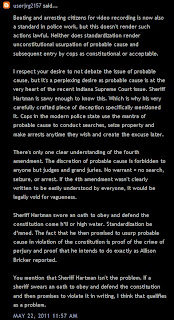
Your basic premise, however, seems to be not whether probable cause authority was exceeded, but rather that probable cause itself is unconstitutional, and is itself the problem. For example, you stated:
There's only one clear understanding of the fourth amendment. The discretion of probable cause is forbidden to anyone but judges and grand juries. No warrant = no search, seizure, or arrest.
This is erroneous.
The Fourth Amendment reads as follows:
The right of the people to be secure in their persons, houses, papers, and effects, against unreasonable searches and seizures, shall not be violated, and no Warrants shall issue, but upon probable cause, supported by Oath or affirmation, and particularly describing the place to be searched, and the persons or things to be seized.
The Fourth Amendment offers us protection against unreasonable searches and seizures, and then states that warrants shall be issued upon probable cause.
However, certain searches and seizures, limited in scope and under exigent circumstances, have been allowed as being reasonable even despite the absence of a warrant which was deemed unobtainable due to the exigency.
For example, in Terry v. Ohio, 392 U.S. 1 (1968), the Supreme Court opinion stated that "the rule excluding evidence seized in violation of the Fourth Amendment has been recognized as a principal mode of discouraging lawless police conduct"; thus, "its major thrust is a deterrent one ... and experience has taught that it is the only effective deterrent to police misconduct in the criminal context, and that, without it, the constitutional guarantee against unreasonable searches and seizures would be a mere 'form of words.'"
This, to me, seems to argue in favor of what I hope would be obvious: random searches of homes are a gross violation of civil rights, and evidence seized thereby is not admissible in court. Furthermore, I feel this is an argument against the "scope-and-grope" and "pornoscanning" that now routinely accompany efforts to travel by air in the US. However, if the intent of such a search is not to secure admissible evidence for a criminal prosecution, but merely to intimidate the people, then such unconstitutional conduct does indeed serve the interests of those in power; this situation would have to be addressed in a different and more comprehensive manner other than using the exclusionary rule in a criminal case.
The court went on to say:
Yet a rigid and unthinking application of the exclusionary rule, in futile protest against practices which it can never be used effectively to control, may exact a high toll in human injury and frustration of efforts to prevent crime. No judicial opinion can comprehend the protean variety of the street encounter, and we can only judge the facts of the case before us. Nothing we say today is to be taken as indicating approval of police conduct outside the legitimate investigative sphere. Under our decision, courts still retain their traditional responsibility to guard against police conduct which is overbearing or harassing, or which trenches upon personal security without the objective evidentiary justification which the Constitution requires. When such conduct is identified, it must be condemned by the judiciary, and its fruits must be excluded from evidence in criminal trials. And, of course, our approval of legitimate and restrained investigative conduct undertaken on the basis of ample factual justification should in no way discourage the employment of other remedies than the exclusionary rule to curtail abuses for which that sanction may prove inappropriate.
The court upheld that even something portrayed as outside the bounds of the Fourth Amendment, such as a "stop-and-frisk", is indeed a Fourth Amendment seizure and an act that subjects the person to more than a "petty indignity" and went on to say:
We do not retreat from our holdings that the police must, whenever practicable, obtain advance judicial approval of searches and seizures through the warrant procedure ... But we deal here with an entire rubric of police conduct -- necessarily swift action predicated upon the on-the-spot observations of the officer on the beat -- which historically has not been, and, as a practical matter, could not be, subjected to the warrant procedure. Instead, the conduct involved in this case must be tested by the Fourth Amendment's general proscription against unreasonable searches and seizures.
After pointing out the necessity to use a balance of the need to search against the invasion it would entail as the only ready test for reasonableness of a search or seizure, the court held that
in justifying the particular intrusion, the police officer must be able to point to specific and articulable facts which, taken together with rational inferences from those facts, reasonably warrant that intrusion. The scheme of the Fourth Amendment becomes meaningful only when it is assured that, at some point, the conduct of those charged with enforcing the laws can be subjected to the more detached, neutral scrutiny of a judge who must evaluate the reasonableness of a particular search or seizure in light of the particular circumstances. And, in making that assessment, it is imperative that the facts be judged against an objective standard: would the facts available to the officer at the moment of the seizure or the search "warrant a man of reasonable caution in the belief" that the action taken was appropriate?"
The court also cautioned that "[a]nything less would invite intrusions upon constitutionally guaranteed rights based on nothing more substantial than inarticulate hunches, a result this Court has consistently refused to sanction."
(Please see the Terry v. Ohio, 392 U.S. 1 (1968) for links and footnotes which I omitted in my quotes.)
The difference is probable cause versus random searches and seizures.
The Supreme Court has upheld, and I agree in principle, that probable cause is not unreasonable, provided it meets certain criteria.
The incendiary allegation against Sheriff Hartman is that he is ready to use random house-to-house searches with essentially no legitimate reason. He has denied this, and I believe him.
In the wake of that Indiana Supreme Court ruling, someone did indeed go fishing in Newton County, Indiana - and it was not the county sheriff!