Saturday, September 7, 2013

Funding for Terrorism, Senator McCain, and Punishment for Treason

I have been rather actively involved in the social media. Lately, I have not done so many blog posts here as I have created images and made comments for posting on social media.

There, I notice a trend of patriotic Americans who are complaining about Senator McCain. McCain's viewpoints and proposals on many issues have people outraged. They call it treason. The more polite commentary blame it on senility. They want him imprisoned.

I have done tremendous research on the crowd in Washington. What got me started was hearing about Sibel Edmonds case. Honestly, I think I have forgotten more about her case than most of my readers will ever know, unless someone actually bothers to read her book - and that person may have to read it more than once to know more than I have forgotten.

However, I did not stop there. I began my own research. I dug. I mean I really dug. I mean, I really, really dug, looking in places other people do not look, for things other people do not seek, and cross-referencing a wide variety of data. A quick glance at the sidebar here at the blog should convince anyone of the possibility that, when I do research, I do way more than most bloggers, and way more than nearly anyone in our mainstream media.

I present this as factual, but make no effort to prove my statements. In many of my posts, I give links, I show images from documents... here, I merely tell you what I know, and hope you will independently verify the information and conclusions provided.

Based on the material I have seen, some of it posted on the internet by other bloggers and by competent journalists from outside the mainstream, there is no doubt in my mind that the problem of corruption in Washington, DC, goes far beyond the extensive situation described by Sibel Edmonds.

In particular, I am convinced that Senator John McCain of Arizona has been connected to foreign organized crime for nearly two decades. The cartel in question is of primarily ethnic Albanian origin, and is based in the Balkans. This cartel was closely linked to ethnic Albanian and Islamic terrorists who have also operated in the Balkans, but who operate elsewhere as well.

If you go back to the Cold War, terrorism was easy to understand: the Soviet Union was behind much of it, and it was aimed at the West. Whenever a terrorist organization tried to bite the hand that fed it, the KGB, whose job was protections of Soviet assets worldwide, would spare no expense to teach that organization a lesson and redirect its activities.

In the 1980's terrorist organizations began to diversify their sources of funding. In particular, they teamed up with drug trafficking organizations (DTO's). The alliance was natural: they both had the same enemy - the government - though one fought for an ideological reason, and the other for monetary profit.

The DTO's discovered that terrorists were ready-made anti-government militarized forces, trained and equipped, which could provide considerable balance in the fight to protect drug trafficking operations against government counternarcotics forces which themselves were becoming heavily militarized in much of the drug-producing and drug-transiting regions of the world.

For their part, the terrorist organizations saw the profit in the production and trafficking of drugs. Cocaine, in particular, is so profitable that even if a small percentage of the total amount produced gets sold rather than interdicted, the DTO is still making good money. DTO's have always been able to get several times more product through to buyers than the bare minimum needed for solvency. Terrorists saw that production and trafficking of drugs exacerbated problems for their enemies in the government, a situation which could then be leveraged politically and militarily. Furthermore, the immense profits available in drug trafficking could finance terrorist activities in a way that state sponsors never could: virtually unlimited money was available, with practically no strings attached.

Narcoterrorism was born, and the monster had the "DNA" of both its parents.

It was in Latin America, in places like Colombia and Peru, where some of the earliest innovations in this area took place. But, it happened elsewhere. The Palestine Liberation Organization - the well-known PLO - was trouble for its Arab and Soviet sponsors - so much so that Jordanian security forces drove it from Jordanian territory across from the West Bank. The PLO landed in Lebanon, where it found the Bekaa Valley a perfect place to produce narcotics. This was when the PLO began to become less ideologically-centered, and more centered on profit. Its nickname was the "Poppy Lovers' Organization"; suffice it to say that its leader, Nobel Peace Prize Winning Yassir Arafat, died a very rich man indeed - and its award to a drug-trafficking terrorist should tell you something about the Nobel Peace Prize.

The US government was not immune to the lures of easy money.

In Latin America, the US was dealing with the threat of communist subversion. Maoist rebels were fighting to take over Peru, and other communist groups were battling the government in Colombia; both nations had an extensive problem with DTO's as well.

But, Nicaragua was special. There, taking its name from a legendary bandit of the late 1920's whose forces were defeated with the help of the US Marines, a group called the Sandinistas deposed President Somoza and established a communist regime. This regime was a threat to the security of the whole region.

In particular, Costa Rica, Nicaragua's neighbor to the south, did not even have an army, rightly concerned that standing armies and the constant coups they produce were a scourge to Latin American countries. Costa Rica's neighbor farther south, Panama, considered contingency plans to move Panamanian troops north into Costa Rica, should this become necessary to answer communist aggression from Nicaragua.

To Nicaragua's north, communist infiltration through a stretch of Honduran jungle supported an attempt by communist-backed forces to seize power in El Salvador, resulting in a long, brutal civil war there.

All this trouble could easily be traced back to Managua, and from there to Havana and Moscow.

The US had to do something to keep the cancer of communism from spreading, so the US began supporting the "contras", people who were against the Sandinista revolution and the resulting communist regime.

However, the Reagan Administration had to deal with a deeply-entrenched Democrat Congress - one which too often sympathized with the communists.

The "solution" discovered by certain relatively low-ranking players was to traffic cocaine to America. The money could be used to fund the contras, and since the money was illegal, it was "black" money for black ops, out of reach of Congress. It was far from an ideal solution, but the reality was that Americans were getting their cocaine - they were going to buy from someone - and if the intelligence community provided some of it, then at least the profits could be channeled to a productive purpose, the defeat of communist subversion in the Americas. The laudable ends "justified" the criminal means.

Predictably, the drug money soon corrupted the laudable ends. Drug trafficking became an end itself, with support for the contras becoming merely a cover story for corruption. According to some accounts, the operation worked so well that corrupt US intelligence operatives had to start supplying arms to the Sandinistas, lest they be defeated, the war would end, and there would be no need for the profitable drug trafficking black op to continue. According to some accounts, the DTO's were caught in the middle between heavily-armed communist forces and heavily armed anti-communist forces, so corrupt US intelligence operatives had to supply arms to the DTO's so the drugs could continue to be produced and shipped. If all of this is true, US intelligence operatives were supplying all sides and making real money doing so, all under a cover story of stopping communist subversion.

The same recipe was used in response to the Soviet invasion of Afghanistan, to greater effect, and with greater official sanction. Poppies grown along the Durand Line (the border between Afghanistan and Pakistan) could be refined into heroin, and much of this heroin could be shipped into the Soviet Union and "sold" there. The Soviet ruble was not considered hard currency, but barter to rogue Soviet officials for arms and supplies could always be arranged. The heroin destroyed the infidel godless communist regime from the inside, while the arms helped support the jihad in Afghanistan. Once again, it was black money for black ops, well out of reach of Congress, but this time with fatwas avowing Allah's approval. The war in Afghanistan, fought right outside the Soviet border, became Moscow's "Vietnam", and kept Moscow from dealing more harshly with Poland and from causing problems elsewhere; in fact, the war in Afghanistan and the resulting stress in the Soviet Union proved to be the straw that broke the communist camel's back in Russia.

By the 1990's, the guys who came up with this recipe had moved up in rank in government service. Add to that the intrinsic corruption of the Clintons and their Administration, and the Clinton Administration became the most corrupt Administration in US history: no one else was even close. The cold war was over, but government officials were dealing with DTO's which, in turn, were connected to terrorist groups, including Islamic terrorist groups connected to the Arab-Afghan Mujahideen - "Al Qaeda" - and to the Poppy Lovers' Organization.

Bush-43 took was inaugurated in January, 2001. As a dedicated Republican, I was happy to vote for him after the outrages of the Clinton era, and I was confident America was on the right track again. Little did I realize...

Information that these Arab-Afghan Mujahideen were planning terrorist strikes against the US was not lacking. They had planned many attacks involving aircraft, including the Bojinka plot. They had attempted to crash planes into buildings, kamikaze style.


And, information was coming in that something was afoot for later in 2001. Blueprints to US skyscrapers had been sent to the Middle East - and, if you are going to crash a plane into a building, why do you need blueprints of the building? Guys affiliated with Islamic terrorist organizations were learning how to fly big commercial jets, and the way they were doing it looked suspicious.


So, there was background to this - Condoleezza Rice lied when she said she didn't "think anyone could have predicted" this - and there was hard intelligence coming in that it may have been about to happen.

The trouble is, an attack this big had never happened before. It was considered very unlikely.

Much more importantly, though, the intelligence coming that it could be about to happen was not coming in through counterterrorism channels; it was coming in through counternarcotics channels: the intelligence apparatus targeting DTO's was picking up information about possible ops being planned by terrorist organizations affiliated with the DTO's.

This was a major problem. An investigation into this could conceivably lead to highly-placed US officials, both elected and appointed, who were on the payroll of these DTO's. By this time - mid-2001 - this included Republican Dennis Hastert, who at the time was the 59th Speaker of the House, and who was on the payroll of Turkish organized crime.


It should be noted that by this time, Senator John McCain was already doing favors for the Albanian cartel described above. McCain was steering US policy in a direction favorable to the cartel and its terrorist allies; in return, a PAC affiliated with that foreign cartel was laundering illicit money from foreign organized crime activities into McCain's campaign coffers.

This illicit money wasn't just from moving Afghan heroin into Western Europe and America; it included the profits of operations for trafficking arms, for trafficking women for forced prostitution, and for trafficking in human body parts from living non-volunteers - Serbian prisoners of war and even civilians captured in the fighting in the former Yugoslavia. This money was mixed in with legitimate, legal campaign contributions from decent, honest, hard-working Americans of ethnic Albanian descent, and given to McCain. In return, McCain, who as a Republican in the Senate was aware of the reports about these terrorists and criminals that the Clinton Administration had been supporting (and that the Bush-43 Administration was now supporting - oh, yes, Bush-43 and even Joe Biden took money from the same guys), was helping Clinton to support them.

McCain went into this with his eyes open, he knew what he was doing, he knew where the money was coming from, and he knew that he was hurting innocent people in the Balkans and betraying US security interests.


An investigation into the intelligence about upcoming terrorist attacks - intelligence that was mainly coming in through counternarcotics channels - would inevitably lead to highly-placed, powerful people in the US government, and would be very embarrassing for them, implicating them in extensive, treasonous corruption.

So, they buried it, instead.

Then, when 9/11 hit, the cover-up began, and from the very beginning, Bush-43 was deeply involved in steering the investigation away from the corruption.

Meanwhile, these guys who came up with the idea to fund anti-communist groups with drug money in the 1980's... they had moved up in rank, and now found themselves under another Republican administration. They were calling the shots now.

This, coupled with the Bush-43 Administration's cronyism, made the Bush-43 Administration more corrupt than the Clinton Administration. And, when one considers how Clinton was giving critical military technology to Communist China in exchange for Chinese money laundered into Democrat campaign coffers, that's saying something.

I mentioned Condoleezza Rice above... she was involved in the Chinese espionage. While working at Stanford, she discretely failed to investigate a Chinese spy ring that was stealing critical technology there. But, that's another story.

Fast forward to the Obama Administration: we now have a "President" who openly, obviously hates America. He was raised by communists and nursed with communist propaganda. He received a strong dose of Islamic indoctrination - and Islam, like communism, is antithetical to everything America stands for.

On top of that, he has no integrity, no honor, no moral compass... in short, he's a perfect example of the worst the far left has to offer.


The treasonous corruption is now so bad, even the Clinton years look good by comparison.

Back to McCain.

As far as I'm concerned, McCain served his time in prison in the Hanoi Hilton. Provided he will cooperate fully with the investigation, I believe his time should be served restricted to the grounds of senior officer's quarters on a military base, where his family can stay with him and visit him, and where he will be safe from the criminals he will need to betray to recuperate some degree of honor.

The others... well, I want them in a federal prison. And, I think we need to build a new one, one big enough to house them all. We need honest investigators, answerable to an honest President, a real American, and we need those investigators to go through Washington, DC, with a fine-toothed comb.

Saturday, August 10, 2013

Obama Images

Miscellaneous images I made for and uploaded on Facebook:


Privacy Notice

This is my privacy notice from Facebook.

Consider it my privacy notice for all my online activity, including here at Blogger. :)


****Privacy Notice****

Attention all agents, employees, contractors, personnel and other persons or entities acting on behalf of or at the behest of any level of government, from whatever country, whether of the United States, or some other nation or non-national entity or of any political subdivision thereof, or of any international organization, whether instituted legally or otherwise, or of any other party:

I am a citizen of the United States of America, exercising my right, endowed by my Creator and codified in the supreme law of this land, to freedom of speech, of the press, and of religion;

And if you, for whatever reason, seek to use information found at this or other websites to infringe upon my rights, whether seeking to abuse your official authority derived directly or indirectly from the government of the United States of America or any political subdivision thereof to unconstitutionally accuse me of crimes of which I am innocent or otherwise persecute me, or whether you wish to pass information to transnational organized crime in an effort to silence me, or whether, working for a foreign power, you wish to commit an act of war against this Republic by attacking me, or for whatever nefarious purpose on behalf of whomever,

Then...

You can blow me!


(It is recommended that other members post a notice similar to this or you may copy and paste this one. Thank you.)

Saturday, July 27, 2013

Warrior King, Part 2

In Part 1, we examined how corruption in Ghana permitted the trafficking of narcotics from Latin America, through Ghana, and on to Europe, in particular to the UK. Then-President
John Atta Mills was quoted in Wikileaked cables to be concerned about corruption even among his personal entourage.


Since that post in December, 2010, a great deal has happened.

First, President Mills passed away in office on July 24, 2012. His Vice President, John Dramani Mahama, then ascended to the Presidency, and was retained as President as a result of the regularly-scheduled general elections on December 7, 2012. The elections went off fairly smoothly, as they generally have in Ghana since 1992, when a new constitution was written restoring multi-party politics. The next year, as the new constitution took effect, the Fourth Republic was proclaimed, and President Mahama is the fourth President of the Fourth Republic.

However, this has not altered the close relationship between Ghana and the United States - neither has a change in Presidential administrations in Washington. From Ghana: Background and U.S. Relations by Nicolas Cook of the Library of Congress Congressional Research Service (link in sidebar), July 8, 2009:

U.S. Relations

U.S.-Ghanaian relations are close ― as discussed in the Overview and Current Developments of this report ― and a small population of Americans, many of African-American descent, has settled permanently in Ghana. The Obama Administration regards Ghana as "a stable and democratic country" and as among the "most trusted partners" of the United States in Africa, a sentiment that reflects broad continuity with the Bush Administration's view of Ghana.30 In part, this strong partnership is due to the Obama Administration's view of Ghana’s status as "a leader in promoting peaceful conflict resolution in Africa" and as a major troop contributor to international peacekeeping missions.31


Considering the unrest across North Africa and into the Middle East in the past couple of years, U.S. Africa Command commissioned a project to assess the stability of some of the countries in Africe. In response, the Center for Strategic and International Studies in Washington, D.C., wrote a series of reports on the projected stability of several key African nations over the next several years. Ghana was one of the countries analyzed.

According to Ghana: Assessing Risks to Stability, by David W. Throup, June, 2011, the foundation of Ghana's economy has been production of cocoa. Mining, in particular gold, has provided additional income to Ghana. In recent years, oil was discovered, and Ghana has been transitioning to become more of an oil exporting country. In general, Ghana's economy has been productive and stable, due in part to good management of the economy by both of the major political parties, regardless of which one has been in power.

However, there are problems. Soil fertility is declining, there have been few innovations in the production of cocoa, and the country has failed to develop its agricultural sector beyond cocoa; though much of Ghana is fertile and could produce a wide variety of lucrative crops, including for export, Ghana remains a net importer of food. Additionally, exports of oil are expected to peak in 2014, but are then anticipated to fall off sharply beyond 2016; this in the face of unrealistic expectations about what the development of oil production would mean to the country. Finally, the manufacturing industry is not growing, with a major weakness being power supplies.

Overall, after reading Throup's analysis, my impression is that in the next 5-10 years, Ghana could begin to experience significant economic difficulties.

It is in this overall context that we return to the consideration of the trafficking of illegal drugs through Ghana, usually on its way from Latin America to Europe, but sometimes to the United States, as well.

Drug money corrupts government officials, even in stable countries. Ghana, is described by USAID as "a stable, democratic country with a free press, independent judiciary, apolitical military, and active civil society." That notwithstanding, corruption is generally acknowledged as a significant problem; in Ghana, a key node in the corruption is with the judiciary.


First, we have some excerpts from Ghana sits on drug time bomb, May 7, 2008:

THE HEAD of Conflict Prevention, Management and Resolution Department (CPMRD) at the Kofi Annan International Peacekeeping Training Centre, Dr. Kwesi Aning, says Ghana is sitting on a time bomb. He said this in regard to the increasing spate of drug menace in the country.

He wondered why government officials are not prepared to face the fact and adopt methods to reverse the situation. "We need to call a spade a spade. The nation is actually in a deep crisis and people are afraid to speak about it," he said.

[snip]

Dr. Aning contended among others that the fear factor that has gripped many officials who are fighting against some of these vices must be condemned. He cited the case of the late Chief Justice, Justice Kingsley Acquah, who reportedly told him that his life was in danger because he was fighting against corruption in the judiciary.

Despite the shortcomings of the security agencies in curbing the menace, he noted that the judiciary has in no small way thwarted the zeal and ability of the security agencies to combat this particular type of crime.

Dr. Aning said "it became apparent that particular judges give particular judgements in drug cases that are beginning to show a pattern. While previously, this was explained as due to the technicalities of the law, it is now clear that judgements by some members of the judiciary are more than suspicious, especially in cases where judges grant bail to drug traffickers with sureties which are far less than the value of the drugs seized."

It is interesting that allegations of corruption seem to focus on the judiciary.

In one instance, in April, 2006, the MV Benjamin was trafficking 77 parcels of cocaine - each parcel with 30 kilos in it. There were arrests, with one suspect eluding police until February, 2012. Ultimately, each of five suspects who were convicted received 25 years in prison.

However, a major scandal broke when the cocaine went missing.

Mrs. Justice Georgina Wood, was named to head a commission to look into the disappearance of the cocaine.


The key finding fthe commission's report was that one detective sergeant took a bribe to allow one of the perpetrators to escape:

4.7. The Committee finds that DETECTIVE SERGEANT NO27294 who from his own account had the opportunity of meeting ASEM DARKEI SHERIFF at KPONE almost immediately after the discharge, and who then confided in him that the COCAINE had already been discharged, acted corruptly by accompanying ASEM DARKEI SHERIFF to his house, receiving $3,000 from him, and allowing him to make good his escape without reporting him to his superiors.

It seems no one could figure out what happened to 76 of the sacks of cocaine.

Fast forward to 2008: a woman is discovered with a white substance in her possession. The substance tests positive as cocaine; over a kilo is confiscated as evidence, and the woman is held for trial. In 2011, at trial, the defense asks that the evidence be tested again; this time, though, it tests negative for cocaine. It seems the police have over a kilo of baking soda. The defense submitted that the prosecution had no case.

So, Mrs. Justice Wood, now Chief Justice of Ghana, was named to head another commission to investigate this scandal.


From Ghana's corrupt Chief Justice in cocaine scandal again, January 12, 2012:

In effect the Chief Justice is arguing that that the police who arrested the suspect, brought her before a court of competence, followed up on her bail, and brought her back to court to face charges for her crimes swap their most important evidence in the case in order to free her. The question is, for what purpose would the police do that? It does not make sense. If the police wanted the suspect to be free they would not have forced the person or persons who signed off her bail before it was the granted to produce her for further action. The report as released by Chief Justice simply will not pass the litmus test. And the police are already disputing the report.

This is the kind of stuff we have come to expect from the Obama regime.

So, corruption is endemic in Ghana, and it prevents effective prosecution of drug trafficking. Who exactly is responsible depends on the party being asked, as fingers are pointed in different directions: officials and journalists point their fingers at the judiciary, while the judiciary blame corrupt police.

Returning now to Ghana sits on drug time bomb, May 7, 2008, Dr. Aning expressed further concerns during his keynote address, including the following:

He also mentioned the activities of land guards, chieftaincy disputes, land litigations, the concentration of youth unemployment, ethnic tension as being contributory factors to the heightening tension in the country.

[snip]

"Corruption has become a way of life, abuse of authority and position is now a menace, robbery with violence resulting in the loss of precious lives continue to plague our society more seriously than ever before", he noted.

In Ghana: Assessing Risks to Stability, Throup in 2011 indicated that ethnic tensions were not a significant problem in Ghana, and that militant Islamic extremism was not getting much traction among the 15 percent of the population that are Muslim, mostly in the north of the country, though he did point out that Iran is spreading Shi'ite teachings among the Sunni Muslims there. One thing Throup mentions about ethnicity is that the patronage-style politics does tend to politicize ethnicity.

I wonder to what extent economic difficulties, should they develop significantly, would generate ethnic issues. Also, I wonder about the possibilities of militant Islam spreading down into Ghana. A combination of factors, insignificant individually, could generate instability.

Also, as Ghana's banking industry develops, I wonder about the potential for money laundering. And, of course, with money laundering and drug trafficking, one has to wonder about terrorism: it seems Ghana would make a useful base to support terrorist operations in Latin America, targeting U.S. interests.

We will look at these topics as the series continues.

Tuesday, July 23, 2013

Liberty, Equality, Fraternity, Part 1

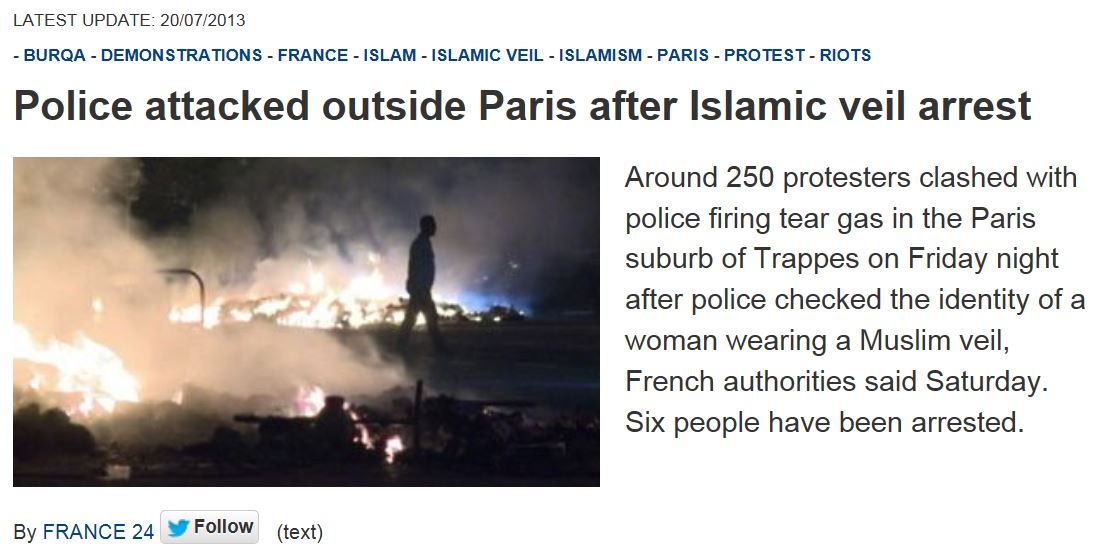
News of the unrest in Trappes, in the western suburbs of Paris, is all over the web and in the blogosphere.


Before we look at the background, we will briefly review the initial incident and the unrest it sparked. We begin with an excerpt from Police attacked outside Paris after Islamic veil arrest, July 20, 2013:

Husband of veiled woman 'tried to strangle police officer'

The clashes were apparently sparked by the arrest on Thursday of a man accused of assaulting a police officer after his wife was stopped for wearing a full-face veil – illegal under French law.

"Her husband reacted in a hostile fashion, insulting and hitting the policeman," Jean-Marc Galland, a senior official for Yvelines département (region), where Trappes is located, told Reuters. "The man was placed in custody for that reason."

"On Friday, there were demands for clarification from people in the town who did not understand the arrest," he added.

Mr Lesclous later told reporters that the man had in fact attempted to strangle one of the police officers during the altercation.

However, The Collective Against Islamophobia in France (CCIF) published a statement on its website on Saturday, claiming to be from the wife of the arrested man, in which she accused the police of being abusive and using unnecessary force.

For its part, the CCIF has an introduction to this woman's version of the events under the title The islamophobic wave is increasing, dated July 20. I have reproduced the commentary as is; there are a few minor formatting and spelling errors.

CCIF has been refered a case by Hajar, a young lady victim of a strong-arm identity checking by national police in Trappes (Yvelines). During this identity checking, her husband has been abused and put into custody because he dared to protest against the violent and provocative behaviour of the police agents.

Here is her story:

"I am refering to you because I suffered from a police abuse. They wanted to control me because I wear the full-veil. As usual, I complied to this identity checking. I was about to lift my veil when I saw police agents violently pushing my mother.

I told the other agents to take a look of what their colleagues were doing, that it was unacceptable, that they shouldn't touch my mother who had nothing to do with this control. One of the agents got suddently very angry against my husband just because he said (concerning my mum): " Don't touch her! Why do you touch her knowing she has nothing to do with this control?"

The policeman then replied to my husband, in a very aggressiv and scornful way:"What are you gonna do?" I intervened between them in order to prevent things from becoming ugly.

Once the policeman was done with my mother, he came to me and made big gestures in front of my face while speeking very rudely. Threatened, I asked him to be quiet.

Then he grabbed me by the head of my veil and dragged me with a dreadful strengh to press me on the hood of the car, while yelling: "You're talking to me?? You're talking to me??"

Needless to say, the woman's husband was taken into custody. Allegedly, the police taunted these people, and continued to do so, even after the husband was handcuffed and in the car.

What is interesting is the allegation by this woman that the police had initially pushed her mother, and that the woman's husband moved to the defense of his mother-in-law. I do not recall seeing these allegations in other coverage of the initial incident, though, admittedly, I have not looked through all of the vast amount of coverage the situation has received.

If the Muslim woman's allegations are true, it is understandable how her husband might have reacted in a less-than-compliant way. It is also worth noting that this is likely a rather conservative Muslim family, since not all Muslim women wear the full facial veil. It is provocative in fundamentalist Muslim culture for males who are not related to a woman to see her - that is why she wears a full facial veil - and it is even more provocative for these males to then actually touch her and other women in her group.

CCIF has another statement, placing the matter into context. From Serial islamophobic aggressions: the involvement of Police forces in Trappes (Yvelines), July 20, 2013; again, I have not cleaned up the passage, but the formatting is as it is in the original:

For several weeks now, violence toward french Muslim women is increasing in a very serious way. On Friday 19th of July, CCIF (Collective against islamophobia in France) has been refered a case by Hajar, a young lady victim of a strong-arm identity checking.

During this identity check by the police, her husband has been abused and put into custody because he dared to protest against the violent and provocative behaviour of the police agents.
He will be heard by a judge today, Saturday 20th.

Like in other cases, the role of the police is questionned but Police Unions have rushed to make statements to exempt their colleagues of any responsability. And yet, there has been so far no investigation.

CCIF once again deplores the mass media covering of this case that, as in other cases, put the words of Police Unions above all suspicion, without even checking the facts. Once again, the Muslim protagonists are immediately suspected.
Mulims are systematically assumed guilty.

As in other recent cases, victims undergo a double injury: the physical and verbal violence and the systematic change status, from victim to culprit.
In France, racism and islamophobia are now cleary institutionalized and legitimized.
On this identity checking that turned ugly, several witnesses are reporting the use of physical abuse from the police toward someone who was actually cooperating. (Hajar indeed complied to the control)

Even if things did not happen exactly the way the woman and CCIF allege, something even remotely close to the alleged behavior would be considered highly provocative by a conservative Muslim family.

And this brings us to the key issue: increasingly, the Muslim community in France (and elsewhere) does not see itself as a part of the local culture, but rather, seeks to keep its own culture. This is far from the "melting pot" that we were taught was American culture during the heyday of European immigration roughly a century ago. Skipping down in Police attacked outside Paris after Islamic veil arrest, we get one public figure's perspective on the violence::

'Mass immigration' to blame, says Le Pen

Meanwhile, Marine Le Pen, leader of France's far-right National Front party, was quick to blame Friday's violence on what she called "the rise of a harmful communitarianism exacerbated by mass immigration" in France.

She claimed that those involved in the riots were attempting to "demonstrate through violence that they have taken control over large parts of the Republic".

"It is high time to ... organise the reconquest by law and order of each square metre of the national territory," she commented in a statement.

"Governments must stop trembling before thugs and finally stand up to them with total inflexibility and extreme firmness."

Le Pen's reference to a lack of control and a lack of law and order in certain parts of France is very interesting.

France has places called Sensitive Urban Zones (ZUS) - over 700 within mainland France. Ostensibly, these are areas that have some kind of social problems such as high unemployment, a low rate of high school graduation, or lack of home ownership, but the reality is that these are basically police no-go areas. The existence and location of these ZUS is not a secret; France maintains a website identifying them, including maps: Atlas des Zones urbaines sensibles (Zus).

The unrest addressed above occured in Trappes, just southwest of downtown Paris; it is the pink area next to the A in lower-left corner of the image from Google Maps below:


Here is a close-up of that area:


It just so happens that the area just to the left of the A in the map above is ZUS546:


Another term one hears is the reference to an area as a banlieue, which could be translated as "suburb", and, indeed, if one were to glance at the map and compare it to the map of an American city, it looks like Trappes is a suburb of Paris.

However, the word "banlieue" has a slightly different connotation. It tends to refer to areas of low-income housing, or perhaps government housing; it may be more appropriately translated as "slum" or "housing project", depending on the specific situation.

Regardless of the word one uses to describe the area, it is one of the over 700 areas in mainland France where French authorities are unable to effectively enforce French law without a violent reaction from the locals - a reaction which can easily spread to the other hundreds of such areas, as has happened in the past. For example, in 2005, an incident in which Muslim youths were hiding from the police in a power substation and there electrocuted themselves sparked unrest which, within ten days, had spread to well over 200 locations in France. Banlieues, sensitive urban zones, no-go areas... others refer to these areas simply as Muslim Ghettos.


But, what do you think this story may have in common with the other story I began with my previous post?

More to follow.

Sunday, July 21, 2013

So Close to the United States, Part 1

Actually, I have not felt terribly motivated to blog in recent months, as you may perceive from how few posts have been written. However, as I was surfing through Facebook this weekend, I noticed people posting links about the Texas Highway Patrol, a division of the Department of Public Safety, and its new armored patrol boats operating in the Rio Grande.


I find it interesting how people complain nothing is being done to stem the tide of illegal immigration and general lawlessness along our southern border, yet, people then complain when some government agency actually tries do to something about it, misconstruing what is being done.

Perhaps it is time to do another post here at the blog.

First, I would like to review some previous material, with a focus on a series dealing with issues just south of the border.

In So Far from God, Part 1 we saw how President Calderón's escalation in the war on drugs helped fuel a dramatic increase in violence and instability in Mexico, so much so that surrender of Ciudad Juarez to the cartels was beginning to become somewhat politically palatable. If it went that route, I wondered where things would end.

In So Far from God, Part 2, we considered what actually gets smuggled - narcotics, weapons, and other merchandise, including people - and saw how Ciudad Juarez connects to El Paso which, in turn, connects to the major trafficking routes in Texas. We also saw how the cartels are using military grade weapons, and this caused us to question common reports that 90 percent of the weapons used in Mexico come from gun sales in the United States: how can this be so, when the weapons being used - automatic weapons, crew-served weapons, grenades, grenade launchers, and other military-grade weapons - are not being sold in gun shops and guns shows north of the border? Also, we saw how, with the cartels now armed almost as heavily as the Mexican military, President Calderón had begun to explain the unrest in Mexico as a battle for the government of Mexico to exert control over sovereign Mexican territory - which, by the way, is one way to describe a civil war. In the comments, we clarified the origin of the "90%" figure.

In So Far from God, Part 3, we saw how foreign sources account for the military-grade weapons, as well as outright theft from the Mexican government of weapons sold by the US government. We also saw how these foreign suppliers are even providing radars and submarines to the cartels; there's no way the Obama Administration can blame these items on gun shops along the border! More significantly, though, is that Islamic terrorist groups have helped supervise the training of cartel gunmen in special camps near the US border.

With So Far from God, Part 4 we began to see how Africa is increasingly becoming a transit area for South American cocaine destined for Europe and beyond, and we also saw how there was a westward flow of precursor chemicals for methamphetamines, as well as other suspicious cargo. This is significant, considering how we developed in other posts the concept of the Saharan and Sahelian regions of North Africa as a crossroads for smuggling all kinds of goods as well as for the interactions of various Islamic terrorist groups going as far east as the Arabian Peninsula and the Horn of Africa.

We pause in our review of past posts to introduce some new information not previously covered at this blog and to examine information that has been presented from a new perspective.

One key aspect to what we learned in Part 4 - though not developed as a concept in the post, but rather seen in a new light now - is that the Mexican cartels have come to have significant influence in Africa, with ties going all the way to the Red Sea and Persian Gulf. Whether this grew out of a desire to grow their business, or out of necessity due to increased pressure by government forces in Mexico, is not important; the fact is, Mexican cartels are tied in with the trafficking of arms, drugs and Islamic terrorism that occurs across the Saharan/Sahelian region of Africa.

This is interesting.

If cocaine is going one way, and arms and expertise to fight against government forces are coming the other way, that means Islamic terrorist organizations have bases and allies, not just in this hemisphere, but immediately along our southern border.

This is not a theoretical threat. We have extensive evidence that we are actually being infiltrated by Islamic terrorists across our southern border. Here are excerpts from A Line in the Sand: Confronting the Threat at the Southwest Border, a House committee report not specifically dated but apparently finalized in late 2006:

Items have been found by law enforcement officials along the banks of the Rio Grande River and inland that indicate possible ties to a terrorist organization or member of military units of Mexico.106 A jacket with patches from countries where al Qa'ida is known to operate was found in Jim Hogg County, Texas by the Border Patrol. The patches on the jacket show an Arabic military badge with one depicting an airplane flying over a building and heading towards a tower, and another showing an image of a lion's head with wings and a parachute emanating from the animal. The bottom of one patch read "martyr," "way to eternal life" or "way to immortality."107


[snip]

Members of Hezbollah, the Lebanon-based terrorist organization, have already entered to the United States across our Southwest border. On March 1, 2005, Mahmoud Youssef Kourani pleaded guilty to providing material support to Hezbollah.111 Kourani is an illegal alien who had been smuggled across the U.S.-Mexico border after bribing a Mexican consular official in Beirut for a visa to travel to Mexico. Kourani and a Middle Eastern traveling partner then paid coyotes in Mexico to guide them into the United States. Kourani established residence among the Lebanese expatriate community in Dearborn, Michigan and began soliciting funds for Hezbollah terrorists back home in Lebanon. He is the brother of the Hezbollah chief of military operations in southern Lebanon.

In December 2002, Salim Boughader Mucharrafille, a café owner in Tijuana, Mexico, was arrested for illegally smuggling more than two hundred Lebanese illegally into the United States, including several believed to have terrorist ties to Hezbollah.112 Just last month Robert L. Boatwright, Assistant Chief Patrol Agent of the El Paso Texas Sector, reported, "We have apprehended people from countries that support terrorism... they were thoroughly debriefed and there was a tremendous amount of information collected from them."113

Statements made by high-ranking Mexican officials prior to and following the September 11, 2001 terrorist attacks indicate that one or more Islamic terrorist organizations has sought to establish a presence in Mexico. In May 2001, former Mexican National security adviser and ambassador to the United Nations, Adolfo Aguilar Zinser, reported, that "Spanish and Islamic terrorist groups are using Mexico as a refuge."114

Federal Bureau of Investigation Director Robert Mueller has confirmed in testimony "that there are individuals from countries with known al-Qa'ida connections who are changing their Islamic surnames to Hispanic-sounding names and obtaining false Hispanic identities, learning to speak Spanish and pretending to be Hispanic immigrants."115

These examples highlight the dangerous intersection between traditional transnational criminal activities, such as human and drug smuggling, and more ominous threats to national security. Sheriff Sigifredo Gonzalez summed it up this way: "I dare to say that at any given time, daytime or nighttime, one can get on a boat and traverse back and forth between Texas and Mexico and not get caught. If smugglers can bring in tons of marijuana and cocaine at one time and can smuggle 20 to 30 persons at one time, one can just imagine how easy it would be to bring in 2 to 3 terrorists or their weapons of mass destruction across the river and not be detected. Chances of apprehension are very slim."116

So, before this series continues - even before we finish our review of the previous series - I would like to address the matter that sparked my desire to start writing again at the blog: the advent of heavily armed patrol boats in the Rio Grande River, manned by Texas State Police. Actually, this is old news - from a little more than a year ago - but it is now really making the rounds on Facebook.

From Heavily-armed Texas gunboats now patrol Rio Grande, June 28, 2012:

"Typically, the boats operating in the Rio Grande River are operating with six M-240, 30-caliber automatic machine guns," explains Lt. Charley Goble, the DPS officer in command of the newly deployed force of gunboats on the Rio Grande.

Texas now has a small navy of gunboats patrolling the Rio Grande and the Intercoastal Waterway.  Right now, the DPS has four of the 34-foot shallow water vessels, but the fleet will soon grow to six.  Each of the boats, equipped with armor-plating, night vision equipment and a small arsenal of weaponry, costs about $580,000 in state and federal funds.

Troopers patrolling the border say the expense is justified, considering the ruthless nature of their adversaries in the Mexican drug cartels. What they fear, more than anything else, is the prospect of an ambush.

An ambush may seem particularly threatening, considering what we know, not covered in the article, about the presence of terrorists infiltrating the border and training cartel gunmen along the border. These terrorists have developed their skills ambushing US forces in Iraq and Afghanistan. They downed our Blackhawk helicopter in Somalia - "Blackhawk Down" - using techniques they had developed fighting the Soviets in Afghanistan in the 1980s. These guys have decades of corporate experience successfully ambushing superior forces.

And now they're here.

:)

From "Texas Navy" fights drug traffickers' escapes on the Rio Grande, June 25, 2012:

Video from Texas State Police shows officers chasing a pick-up truck, its bed loaded down with drugs destined for sale in the United States.

The drug runners, once cornered, race back to the border to escape capture.

"They do not care who they run over," said Lt. Charlie Goble, who patrols the Rio Grande Valley. "They do not care how many felonies they commit while they're doing so, their goal is to get away from law enforcement."

The cartels' latest escape technique is something called a "splashdown."

"They just splash their vehicle right into the river," Goble said. "We have seen them jump off 30-foot cliffs into the river."

After the drug runners abandon their vehicles in the river, other cartel members in boats rush in to save their bales of drugs, and whisk them back to the Mexican side of the river, determined to get the drugs back to Mexico.

"The cartels that are controlling these situations -- they're very ruthless," Goble said. "Their life literally depends on them either getting the load to where it's going, or safely getting it back."

Police say the drug traffickers have made these splashdown getaways at least 65 times in the past three years. Texas police don't have the boats they need to stop them -- and the drug runners know it.

"They know once they get back into the water, they're safe," Goble. Said. "All they gotta do is swim home."

The Texas-style solution? Launching its own mini-navy. Six boats, each equipped with multiple machine guns, will soon be patrolling a 54-mile stretch of the Rio Grande.

From Have You Seen the Bulletproof Texas Gunboats Equipped With Automatic Machine Guns That Will Battle Drug Cartels on the Water?, July 4, 2012:

Maj. Bob Bailey of the Texas Highway Patrol’s Special Ops Division told Fox News the boats would be another tool for law enforcement on top of ground units, helicopters and various weapons being used to battle the ruthless cartels who seem to always find a way to get their product into the United States. He says the cartels have access to “unlimited” funds and firepower.

Trafficking cocaine is extremely lucrative, and we have already seen how the cartels are getting firepower far beyond what is available in a local gun show on this side of the border - contrary to the lies the Obama Administration spread regarding this situation.


All in all, I think Texas authorities would be irresponsible, foolish and derelict in their duties if they were not doing something like this; I applaud the Texas government for deploying its heavily-armed patrol boats, I hope they will be safe and effective, and I would further add that if Obama were on the right side of this issue, federal vessels would also be patroling this international waterway.

More to follow as this series continues.

Saturday, March 16, 2013

License to Intrude, Part 4

There have been no updates to the blog in a few months, and this series in particular has not been updated in almost a year. But, what I haven't written about is actually quite interesting.

First, a review. In Part 1 we saw how the FBI - government agents whose job is to protect our Constitutional form of government - were taking shortcuts around the Constitution to collect and retain information on law-abiding American citizens who were engaged in lawful activities. (!) We also saw how connected Facebook's senior leadership was to the Obama regime, and this certainly raised the question about potential for abuse. Then, in Part 2, we saw how Facebook collected extensive information on its users, and considered Facebook's policy of sharing information collected with government agencies based on the presumed good faith of those agencies.

Well, in Part 3 we looked at issues being addressed with recent proposed legislation regarding privacy and security and cyberspace. We then went on to see how Facebook was making the location of its users public, and we saw how this trend might likely evolve, with apps that could tell you about the people around you. Of course, if the app can tell you about the people around you, it could also tell someone else about the people around you, and thus about whom you hang around with. ;)

Of course, what has happened since that last post is hardly surprising, but it is important to consider.


First, we examine excerpts from a December 27, 2012, article entitled Prevent Facebook from automatically importing photos by CNET's Dennis O'Reilly (I have reproduced links found in the original):

A few weeks ago, Facebook introduced the ability to sync photos taken on your iPhones, iPads, and Android phones to your Facebook account automatically. Jason Cipriani describes how to enable the feature in "Getting started with Facebook photo sync on Android, iPhone."

[snip]

As you can imagine, having all the photos taken by your phone or tablet uploaded to Facebook imperils your privacy and security. As MercuryNews.com's Brandon Bailey reported earlier this month, Facebook claims it will not use the data associated with the photos until they are posted.

The referenced article, Facebook says it won't use data from private photos, by Brandon Bailey, December 4, 2012, has this to say:

Some analysts raised the possibility this week that Facebook might analyze private photos for digital clues about where they were taken or even the identities of people in the photos, perhaps applying that information in the same way it relies on other user data to determine which ads and other messages are shown to different users.

A Facebook representative appeared to dispute that on Tuesday, saying in a statement: "We only utilize photo data after users decide to share them to Facebook." In response to a follow-up question, the representative said that means the company won't use data from uploaded photos in the user's private album, although the company would apply its normal policies if the user opts to share the photos on Facebook.

[snip]

Bloggers and security experts have praised some aspects of the Photo Sync feature, while cautioning that it could still give Facebook access to more data if it leads to users sharing more photos, and that it might also increase the chances for sharing photos inadvertently.

Of course, let us trust both the ability and the intentions of Facebook. The next logical question is: Who really cares what Facebook does or what Facebook says it will do? Haven't we established in this series that Facebook is a de facto feeder of raw data to the government? And, again, we are assuming government employees are acting competently and in good faith. Considering all the scandals governments are known for, can we trust the people who brought us Fast and Furious with this information?

As pointed out in Prevent Facebook from automatically importing photos:

However, all the data associated with the photos, including where and when they were taken, is still accessible to Facebook and can be used to determine the ads you see. Privacy advocates have pointed out that Facebook users are much more likely to post photos that are already uploaded, often inadvertently.

And, if it is accessible to Facebook, then it is accessible to whom else? Government agents? Hackers? Obamanista operatives?

A situation that is not dissimilar has hit close to home for Facebook. In an article from December 26, enttiled Randi Zuckerberg loses control on Facebook (and Twitter), author Chris Matyszczyk points out how the sister of Facebook's CEO inadvertently posted publicly a photo that she had intended to be seen only by her friends. The article addresses issues such as human decency.

My point, however, is that Facebook's senior leadership is well-connected with an administration that traffics weapons to at least one Mexican drug cartel. Believing that such a government acts in good faith and therefore releasing information to that government's agents trumps any hopes for human decency regarding the possibilities for what might happen with all this information that Facebook has by tracking us online even when we are not logged in to Facebook, and by tracking our location in the physical world, and by automatically uploading photos of the places we are and the people with whom we interact into Facebook's database.

But, of course, it doesn't end there, does it?

What happens once the FBI gets all this information on you, including photos uploaded automatically from your smartphone of where you are and of whom you are with?

Well, FBI security has not always been the best, and another recent scandal specifically illustrates the danger of FBI databases.

Back on September 3, activists involved in AntiSec, an operation run in part by members of the hacker group Anonymous, posted online one million Apple Unique Device Identifiers (UDIDs) from a database of 12 million it claimed to have hacked.


Several articles (AntiSec claims to have snatched 12M Apple device IDs from FBI, September 3, 2012; FBI finds no evidence that AntiSec hacked its laptop, September 4, 2012; How the FBI might've been owned (12M Apple records), September 4, 2012) tell the story of how AntiSec claims to have exploited a bug in Java to access a laptop being used by FBI Special Agent Christopher K. Stangl.


Some key details emerge in this excerpt from FBI finds no evidence that AntiSec hacked its laptop which, in turn, links to another of the articles listed above:

Stangl was among a group of four dozen or so U.S. and UK law enforcement agents who were recipients of an e-mail that AntiSec members got ahold of related to investigating AntiSec, Anonymous and their affiliates. The e-mail was sent last January to organize a conference call among the agents which the hackers then listened in on. Robert David Graham speculates on his Errata Security blog that the hackers got Stangl's e-mail address off that list and targeted him for compromise with a phishing e-mail.

The @AnonyOps Twitter account responded to the FBI statement, saying "FBI says there was no hack. That means either they're lying or they *gave* the information up to someone in #antisec. It's happened before."

Security Space Rogue, the former editor of Hacker News Network, tweeted: "FBI statement is ambiguously short. States not from an 'FBI' laptop. How about a personal laptop of an FBI agent?" An FBI spokesperson did not immediately respond when asked that question late this afternoon.

So, the question hangs as to whether SA Stangl was using this database on a personal laptop. If so, was he doing his official work on his personal computer? Many people do, though one would expect government agencies dealing with issues requiring security and confidentiality would not permit this.

Or, was non-official work being done with this database?

Apparently, access to SA Stangl's laptop (and possibly to other devices?) was gained by exploiting this Java bug after Anonymous intercepted an email with SA Stangl's email address on it. The email had the addresses of many other law enforcement officials, and was scheduling a conference call for French, British, Europol and FBI personnel to discuss these hacktivists and their activities.


It all makes for a nice package, really.

Facebook gets your information (location, photos) automatically, shares it based on presumed good faith with the government run by an administration of a President for whom Facebook officers have campaigned and fundraised. The FBI is then targeted by hackers whom the FBI is investigating and who have successfully stolen other personal information from computers used by FBI agents.

If the FBI can't protect itself and its investigation from the group it is investigating, how well will it protect your information? Will it even admit it has your information, and that your information has been compromised?

Why does the Clinton/FBI Filegate scandal come to mind here?

Of course, there is more to this, isn't there?

An alleged Anonymous hacker was arrested because his presumed girlfriend posted a picture of her breasts online, and US authorities supposedly traced this back to the hacker they were looking for by tying in GPS data of where the photo was taken with a statement the hacker had made online about the location of his female friend.


The article, Breasts lead to arrest of Anonymous hacker, dated April 14, 2012, by Chris Matyszczyk (another of whose articles was mentioned above), concludes thusly:

However, the photograph of the breasts apparently linked authorities to Ochoa -- because, taken with an iPhone, it contained GPS information. The information allegedly suggested she lived in Melbourne, Australia.

Further burrowing led the police to discover a posting on Ochoa's Facebook page that allegedly revealed his girlfriend was Australian.

The claim is that police have managed to match pictures of her that Ochoa allegedly posted on Facebook to the breast image.

To the untrained eye, this might seem curious, as the Facebook pictures allegedly show her face, while the taunting picture does not.

Perhaps the authorities have gone beyond mere facial-recognition technology and are in possession of software that can match other bodily parts with astonishing accuracy.

So, photos get uploaded to Facebook automatically - who knows where they go from there? - and now an expert with a highly reputable computer news magazine speculates that the authorities may have software that can do recognition of other body parts besides faces.

Why do I feel it is not just Hooters girls who need be concerned about this?