Showing posts with label Afghanistan. Show all posts

Saturday, September 7, 2013

Funding for Terrorism, Senator McCain, and Punishment for Treason

I have been rather actively involved in the social media. Lately, I have not done so many blog posts here as I have created images and made comments for posting on social media.

There, I notice a trend of patriotic Americans who are complaining about Senator McCain. McCain's viewpoints and proposals on many issues have people outraged. They call it treason. The more polite commentary blame it on senility. They want him imprisoned.

I have done tremendous research on the crowd in Washington. What got me started was hearing about Sibel Edmonds case. Honestly, I think I have forgotten more about her case than most of my readers will ever know, unless someone actually bothers to read her book - and that person may have to read it more than once to know more than I have forgotten.

However, I did not stop there. I began my own research. I dug. I mean I really dug. I mean, I really, really dug, looking in places other people do not look, for things other people do not seek, and cross-referencing a wide variety of data. A quick glance at the sidebar here at the blog should convince anyone of the possibility that, when I do research, I do way more than most bloggers, and way more than nearly anyone in our mainstream media.

I present this as factual, but make no effort to prove my statements. In many of my posts, I give links, I show images from documents... here, I merely tell you what I know, and hope you will independently verify the information and conclusions provided.

Based on the material I have seen, some of it posted on the internet by other bloggers and by competent journalists from outside the mainstream, there is no doubt in my mind that the problem of corruption in Washington, DC, goes far beyond the extensive situation described by Sibel Edmonds.

In particular, I am convinced that Senator John McCain of Arizona has been connected to foreign organized crime for nearly two decades. The cartel in question is of primarily ethnic Albanian origin, and is based in the Balkans. This cartel was closely linked to ethnic Albanian and Islamic terrorists who have also operated in the Balkans, but who operate elsewhere as well.

If you go back to the Cold War, terrorism was easy to understand: the Soviet Union was behind much of it, and it was aimed at the West. Whenever a terrorist organization tried to bite the hand that fed it, the KGB, whose job was protections of Soviet assets worldwide, would spare no expense to teach that organization a lesson and redirect its activities.

In the 1980's terrorist organizations began to diversify their sources of funding. In particular, they teamed up with drug trafficking organizations (DTO's). The alliance was natural: they both had the same enemy - the government - though one fought for an ideological reason, and the other for monetary profit.

The DTO's discovered that terrorists were ready-made anti-government militarized forces, trained and equipped, which could provide considerable balance in the fight to protect drug trafficking operations against government counternarcotics forces which themselves were becoming heavily militarized in much of the drug-producing and drug-transiting regions of the world.

For their part, the terrorist organizations saw the profit in the production and trafficking of drugs. Cocaine, in particular, is so profitable that even if a small percentage of the total amount produced gets sold rather than interdicted, the DTO is still making good money. DTO's have always been able to get several times more product through to buyers than the bare minimum needed for solvency. Terrorists saw that production and trafficking of drugs exacerbated problems for their enemies in the government, a situation which could then be leveraged politically and militarily. Furthermore, the immense profits available in drug trafficking could finance terrorist activities in a way that state sponsors never could: virtually unlimited money was available, with practically no strings attached.

Narcoterrorism was born, and the monster had the "DNA" of both its parents.

It was in Latin America, in places like Colombia and Peru, where some of the earliest innovations in this area took place. But, it happened elsewhere. The Palestine Liberation Organization - the well-known PLO - was trouble for its Arab and Soviet sponsors - so much so that Jordanian security forces drove it from Jordanian territory across from the West Bank. The PLO landed in Lebanon, where it found the Bekaa Valley a perfect place to produce narcotics. This was when the PLO began to become less ideologically-centered, and more centered on profit. Its nickname was the "Poppy Lovers' Organization"; suffice it to say that its leader, Nobel Peace Prize Winning Yassir Arafat, died a very rich man indeed - and its award to a drug-trafficking terrorist should tell you something about the Nobel Peace Prize.

The US government was not immune to the lures of easy money.

In Latin America, the US was dealing with the threat of communist subversion. Maoist rebels were fighting to take over Peru, and other communist groups were battling the government in Colombia; both nations had an extensive problem with DTO's as well.

But, Nicaragua was special. There, taking its name from a legendary bandit of the late 1920's whose forces were defeated with the help of the US Marines, a group called the Sandinistas deposed President Somoza and established a communist regime. This regime was a threat to the security of the whole region.

In particular, Costa Rica, Nicaragua's neighbor to the south, did not even have an army, rightly concerned that standing armies and the constant coups they produce were a scourge to Latin American countries. Costa Rica's neighbor farther south, Panama, considered contingency plans to move Panamanian troops north into Costa Rica, should this become necessary to answer communist aggression from Nicaragua.

To Nicaragua's north, communist infiltration through a stretch of Honduran jungle supported an attempt by communist-backed forces to seize power in El Salvador, resulting in a long, brutal civil war there.

All this trouble could easily be traced back to Managua, and from there to Havana and Moscow.

The US had to do something to keep the cancer of communism from spreading, so the US began supporting the "contras", people who were against the Sandinista revolution and the resulting communist regime.

However, the Reagan Administration had to deal with a deeply-entrenched Democrat Congress - one which too often sympathized with the communists.

The "solution" discovered by certain relatively low-ranking players was to traffic cocaine to America. The money could be used to fund the contras, and since the money was illegal, it was "black" money for black ops, out of reach of Congress. It was far from an ideal solution, but the reality was that Americans were getting their cocaine - they were going to buy from someone - and if the intelligence community provided some of it, then at least the profits could be channeled to a productive purpose, the defeat of communist subversion in the Americas. The laudable ends "justified" the criminal means.

Predictably, the drug money soon corrupted the laudable ends. Drug trafficking became an end itself, with support for the contras becoming merely a cover story for corruption. According to some accounts, the operation worked so well that corrupt US intelligence operatives had to start supplying arms to the Sandinistas, lest they be defeated, the war would end, and there would be no need for the profitable drug trafficking black op to continue. According to some accounts, the DTO's were caught in the middle between heavily-armed communist forces and heavily armed anti-communist forces, so corrupt US intelligence operatives had to supply arms to the DTO's so the drugs could continue to be produced and shipped. If all of this is true, US intelligence operatives were supplying all sides and making real money doing so, all under a cover story of stopping communist subversion.

The same recipe was used in response to the Soviet invasion of Afghanistan, to greater effect, and with greater official sanction. Poppies grown along the Durand Line (the border between Afghanistan and Pakistan) could be refined into heroin, and much of this heroin could be shipped into the Soviet Union and "sold" there. The Soviet ruble was not considered hard currency, but barter to rogue Soviet officials for arms and supplies could always be arranged. The heroin destroyed the infidel godless communist regime from the inside, while the arms helped support the jihad in Afghanistan. Once again, it was black money for black ops, well out of reach of Congress, but this time with fatwas avowing Allah's approval. The war in Afghanistan, fought right outside the Soviet border, became Moscow's "Vietnam", and kept Moscow from dealing more harshly with Poland and from causing problems elsewhere; in fact, the war in Afghanistan and the resulting stress in the Soviet Union proved to be the straw that broke the communist camel's back in Russia.

By the 1990's, the guys who came up with this recipe had moved up in rank in government service. Add to that the intrinsic corruption of the Clintons and their Administration, and the Clinton Administration became the most corrupt Administration in US history: no one else was even close. The cold war was over, but government officials were dealing with DTO's which, in turn, were connected to terrorist groups, including Islamic terrorist groups connected to the Arab-Afghan Mujahideen - "Al Qaeda" - and to the Poppy Lovers' Organization.

Bush-43 took was inaugurated in January, 2001. As a dedicated Republican, I was happy to vote for him after the outrages of the Clinton era, and I was confident America was on the right track again. Little did I realize...

Information that these Arab-Afghan Mujahideen were planning terrorist strikes against the US was not lacking. They had planned many attacks involving aircraft, including the Bojinka plot. They had attempted to crash planes into buildings, kamikaze style.


And, information was coming in that something was afoot for later in 2001. Blueprints to US skyscrapers had been sent to the Middle East - and, if you are going to crash a plane into a building, why do you need blueprints of the building? Guys affiliated with Islamic terrorist organizations were learning how to fly big commercial jets, and the way they were doing it looked suspicious.


So, there was background to this - Condoleezza Rice lied when she said she didn't "think anyone could have predicted" this - and there was hard intelligence coming in that it may have been about to happen.

The trouble is, an attack this big had never happened before. It was considered very unlikely.

Much more importantly, though, the intelligence coming that it could be about to happen was not coming in through counterterrorism channels; it was coming in through counternarcotics channels: the intelligence apparatus targeting DTO's was picking up information about possible ops being planned by terrorist organizations affiliated with the DTO's.

This was a major problem. An investigation into this could conceivably lead to highly-placed US officials, both elected and appointed, who were on the payroll of these DTO's. By this time - mid-2001 - this included Republican Dennis Hastert, who at the time was the 59th Speaker of the House, and who was on the payroll of Turkish organized crime.


It should be noted that by this time, Senator John McCain was already doing favors for the Albanian cartel described above. McCain was steering US policy in a direction favorable to the cartel and its terrorist allies; in return, a PAC affiliated with that foreign cartel was laundering illicit money from foreign organized crime activities into McCain's campaign coffers.

This illicit money wasn't just from moving Afghan heroin into Western Europe and America; it included the profits of operations for trafficking arms, for trafficking women for forced prostitution, and for trafficking in human body parts from living non-volunteers - Serbian prisoners of war and even civilians captured in the fighting in the former Yugoslavia. This money was mixed in with legitimate, legal campaign contributions from decent, honest, hard-working Americans of ethnic Albanian descent, and given to McCain. In return, McCain, who as a Republican in the Senate was aware of the reports about these terrorists and criminals that the Clinton Administration had been supporting (and that the Bush-43 Administration was now supporting - oh, yes, Bush-43 and even Joe Biden took money from the same guys), was helping Clinton to support them.

McCain went into this with his eyes open, he knew what he was doing, he knew where the money was coming from, and he knew that he was hurting innocent people in the Balkans and betraying US security interests.


An investigation into the intelligence about upcoming terrorist attacks - intelligence that was mainly coming in through counternarcotics channels - would inevitably lead to highly-placed, powerful people in the US government, and would be very embarrassing for them, implicating them in extensive, treasonous corruption.

So, they buried it, instead.

Then, when 9/11 hit, the cover-up began, and from the very beginning, Bush-43 was deeply involved in steering the investigation away from the corruption.

Meanwhile, these guys who came up with the idea to fund anti-communist groups with drug money in the 1980's... they had moved up in rank, and now found themselves under another Republican administration. They were calling the shots now.

This, coupled with the Bush-43 Administration's cronyism, made the Bush-43 Administration more corrupt than the Clinton Administration. And, when one considers how Clinton was giving critical military technology to Communist China in exchange for Chinese money laundered into Democrat campaign coffers, that's saying something.

I mentioned Condoleezza Rice above... she was involved in the Chinese espionage. While working at Stanford, she discretely failed to investigate a Chinese spy ring that was stealing critical technology there. But, that's another story.

Fast forward to the Obama Administration: we now have a "President" who openly, obviously hates America. He was raised by communists and nursed with communist propaganda. He received a strong dose of Islamic indoctrination - and Islam, like communism, is antithetical to everything America stands for.

On top of that, he has no integrity, no honor, no moral compass... in short, he's a perfect example of the worst the far left has to offer.


The treasonous corruption is now so bad, even the Clinton years look good by comparison.

Back to McCain.

As far as I'm concerned, McCain served his time in prison in the Hanoi Hilton. Provided he will cooperate fully with the investigation, I believe his time should be served restricted to the grounds of senior officer's quarters on a military base, where his family can stay with him and visit him, and where he will be safe from the criminals he will need to betray to recuperate some degree of honor.

The others... well, I want them in a federal prison. And, I think we need to build a new one, one big enough to house them all. We need honest investigators, answerable to an honest President, a real American, and we need those investigators to go through Washington, DC, with a fine-toothed comb.

Sunday, September 23, 2012

Issues, Part 6: The War in Afghanistan

After we have left Afghanistan, the Taliban will grow stronger, and, sooner or later, either 1) the government in Afghanistan will reach an accomodation with them, until ultimately the Taliban, in some form, simply take over, or 2) the Taliban will win outright.

Thus, to win the war in Afghanistan, all the Taliban have to do is survive until America pulls out.

This, they are accomplishing.

The reason for this is that the Taliban's powerbase is not being effectively attacked.

The Taliban powerbase is in Pakistan.

Pakistan has long defined itself by its Muslimness, as opposed to Pakistan's main potential enemy, India. India is, of course, larger, and would presumably prevail in a conventional war, if that war were allowed to play out until one side or another achieved absolute victory.

Pakistan has tried to offset India's advantages in various ways. For example, Pakistan long sought, and finally developed, its own nuclear weapons (though there is a story behind this, which winds its way into China and all the way back to espionage at key US facilities).

But, a main way in which Pakistan has sought some leverage against a presumed Indian victory is by means of militarized Islamic schools, called madrassas. Madrassas have been prevalent in the Islamic world for centuries, but in Pakistan they took on a peculiar twist, serving as military training centers for jihadists who would fight the infidel world. Of immediate concern has, of course, always been India; graduates of the madrassas could be expected to fight a guerilla war should India ever overrun Pakistan in a conventional war, ensuring that a conventional Indian victory would not be the last word in the conflict. However, once trained and indoctrinated into the ways of Islamic holy war, such militants are hard to keep on a leash.

For years, Pakistani-trained militants have crossed into Jammu and Kashmir, conducting terrorist attacks against Indian forces there. Pakistan has for years been a state sponsor of Islamic terrorism.

When Afghanistan fell into chaos in the wake of the Soviet withdrawal, these Pakistani-backed militias went into Afghanistan and stabilized it under Taliban rule.

Once established in Afghanistan, these jihadists slipped off their leash, seeking war against all infidels and against all Muslims who oppose the jihadists (whom the jihadists refer to as takfir); their jihad took on a life of its own.

First of all, under the Taliban, fellow jihadists found they could use Afghanistan as a base of operations against any infidel enemies, without so much as the minimal restraints placed upon them by Pakistani sponsors. This is why we invaded Afghanistan in the wake of 9/11 - to oust the terrorists that were based there under Taliban rule, and who had attacked the United States.

Additionally, Pakistani-trained and -based jihadists have continued attacks against India, as well.

However, most significantly for Pakistanis, these jihadists are not going to settle for less than victory against all infidels and takfir, worldwide, and that starts with takfir closest to home - Pakistani Muslims who do not support the violence.

Pakistan has been pulled in two directions. There is of course the Islamic militants. But, there is also a modern society in Pakistan, a Muslim society that fits peacefully into the world around it. This segment of Pakistani society is, of necessity, targeted by the militants and those who support them. For the militants to win their global jihad, the "Land of the Pure" must be cleansed of these corrupted takfir elements.

Pakistanis have at least tolerated (and significant elements of Pakistani officialdom have actively helped) the growth of militant Islamic extremists in Pakistan as a counterweight to India. This counterweight was powerful when the Taliban ran Afghanistan. However, it is now out of control, and now less extreme elements in Pakistani society may find that they get roasted in the fire they have allowed to be kindled.

The invulnerability of the Taliban's base in Pakistan is why the Taliban have not been extinguished in Afghanistan; it is why American troops have not yet come home victorious.

The base's invulnerability lies in the fact that it is on the other side of the Durand Line (the border between Afghanistan and Pakistan).

Understandably, Pakistan does not want US troops crossing the Durand Line into Pakistani territory to attack the militants; Pakistan is a sovereign nation, and the views of its people and government should be respected regarding Pakistan's territorial integrity.

However, assuming the political will exists in Islamabad to clean out the Taliban strongholds, these bases can be difficult to get to from Pakistani territory.

That political will needs to exist in Islamabad, because the Taliban will not compromise; their version of Islam means they will fight to the death against all takfir, and takfir is anyone who disagrees with them, and that most emphatically includes moderate or Westernized elements of Pakistani society.

If that will does not exist in Pakistan, then Pakistan is with the terrorists, and needs to be treated as an enemy of all civilized nations.

However, any society has its criminal element, and Pakistan should not be condemned because of its criminal element, even though that criminal element has strong support in Rawalpindi.

There is an answer that will allow for the civilized world to prevail over the terrorists, and for civilized Pakistanis to retain control of their great nation, while maintaining Pakistani territorial integrity against infringement from foreign troops.

In conjunction with Afghanistan and the US and international forces in Afghanistan, Pakistani troops need to be brought into Afghanistan. From there, Pakistani troops attack across the Durand Line into Pakistan, while simultaneously more Pakistani troops attack from deep inside Pakistan into the border areas. Across the border in Afghanistan, Afghan, US and international forces will conduct their own offensives toward the Durand Line, but not crossing it. Military operations against the Taliban on Pakistani soil will be conducted exclusively by Pakistani troops; any exceptions to this will be at the behest of Islamabad. Taliban militants will be caught in the middle, their bases will be sandwiched out of existence, and the militants will be exterminated or scattered.

On top of this, Pakistan needs to shut down all terrorist training bases in Pakistani territory, not just the ones in proximity to Afghanistan, and Pakistan needs to work to end terrorism from Pakistani territory. Pakistan needs to do this to keep from being overrun by the militants Pakistan once saw as insurance against India.

Once Pakistan has accomplished this, the international community needs to help promote peace between Pakistan and India, including offering guarantees of Pakistan's existence and territorial integrity.

Saturday, October 22, 2011

Pearls of the Sun God, Part 2

We continue from Part 1 examining the events in Somalia, which have taken an interesting turn.

Anyone following the news from the Horn of Africa knows that the TFG, together with AMISOM, launched an offensive to clear Al Shabaab terrorists from Mogadishu and its environs.


From AMISOM PRESS RELEASE: TFG/AMISOM Commence Operations to Secure Final Sector of Mogadishu, October 10, 2011:

10 civilian deaths from continued Al Shabaab mortaring in Heliwa and Karaan Districts last week have prompted the Somali National Army, supported by AMISOM, to undertake operations in the North of the Mogadishu.

Operations are aimed at securing the former Arafat Hospital and the Pasta Factory on the Industrial Road, and driving the Al Qaeda linked extremists out of the city.

And, more recently, from AMISOM PRESS RELEASE: Control of Deynile Critical to Security of Mogadishu, October 21, 2011:

Mogadishu, 21 October, 2011; AMISOM Force Commander, Maj. Gen. Fred Mugisha, today undertook a tour of the frontline following the commencement yesterday of operations in support of the Somali National Army, aimed at pushing al-Qa'ida linked extremists from the strategic Deynile district on the outskirts of Mogadishu.

"Deynile is of vital strategic importance as it controls access to the Afgoye Corridor which links the capital to the terrorist-controlled areas of southern Somalia, allowing them to reinforce and resupply their fighters in Masla and Balaad in the far northeastern edges of the city," he said following his tour.

"The Afgoye Corridor is also home to hundreds of thousands of internally displaced persons and securing it will allow humanitarian aid, which the extremists have so far been restricting, to finally reach them," he said. "The extremists have also been using the suburbs of Deynile as a base to assemble improvised explosive devices, including car and truck bombs such as those recently employed to target civilians in the capital."

He said that the success of this operation was critical for the security of Mogadishu. "As was to be expected, given Deynile's significance, the operation has encountered heavy resistance but steady progress is being made. In the face of this resistance, AMISOM has suffered casualties," he added.

The offensive has had some success - which generates new problems. As we previously pointed out, control of key economic areas in Mogadishu served as a source of income for Al Shabaab, as the organization "taxed" merchants and businesses.

Of course, we have also been told a big part of the problem in Somalia now is a famine.

But, then, the famine is starting to look a little suspicious.

We now consider an article entitled Somalia: Manufacturing a famine by Rasna Warah, October 19, 2011:

On July 18 this year, the United Nations Monitoring Group on Somalia and Eritrea tabled a report to the UN Security Council.

The report stated that United Nations agencies, international humanitarian aid organisations and local Somali non-governmental organisations had been forced to move their operations or cease them entirely in many parts of Somalia, mainly due to "an alarming void in international humanitarian aid and development assistance," and also because of "threats from elements of Al Shabaab," who control much of southern Somalia.

Two days later, the UN's World Food Programme — the largest distributor of food aid to Somalia — declared that Bakool and Lower Shebelle, two regions in southern Somalia, had been hit by the worst famine in 20 years.

The UN agency further claimed that 3.7 million people across the country — almost half the total Somali population – were in danger of starving, of which 2.8 million were in the south.

This declaration led to a massive multimillion-dollar fund-raising campaign by UN and international humanitarian agencies. Meanwhile, journalists began referring to the famine as a "biblical event." By September, Time magazine was reporting that the famine had expanded and that a full 12.4 million people in Djibouti, Ethiopia, Eritrea, Kenya, Somalia and Uganda were at risk from hunger.

The magazine also stated that in southern Somalia, 63 per cent of the population was either starving or at risk of it.

These figures did not convince many Somali analysts, including Ahmed Jama, a Nairobi-based agricultural economist and former consultant with the UN's Food and Agricultural Organisation.

"I was disturbed by the WFP announcement because Lower Shebelle is Somalia's breadbasket and had even experienced a bumper harvest last year," he told this writer.

Skipping down:

But was there really widespread famine, or were the famine figures exaggerated or misinterpreted? FSNAU's estimates for Somali populations "in crisis" in the period August-September 2011 were highest in the most fertile southern parts of Somalia, and were highest in those areas controlled by Al Shabaab.

Significantly, there were only 490,000 people (less than one-eighth of Nairobi's population) in Somalia who were experiencing what the IPC classifies as "famine" or a "humanitarian catastrophe."

In fact, about half of the nearly four million people that the WFP claims are starving are actually experiencing what is known as a "humanitarian emergency"; the rest are in an "acute food and livelihood crisis."

Therefore, I think the widely reported "famine" in Somalia is highly exaggerated. What Somalia is experiencing is generalised food insecurity, not widespread famine. Unfortunately, most media organisations have failed to mention or comprehend this fact.

Is it possible that the "famine" in Somalia was "manufactured" to raise funds? The sequence of events leading to the famine appeal certainly raises suspicions. According to Jama, the timing of the famine declaration in July was probably a response to the shortfall of funds that WFP has recently been experiencing and also to divert attention from the criticism that the UN agency was subjected to after the UN Monitoring Group on Somalia released its 2010 report in March last year.

Then, WFP was castigated by the UN Monitoring Group for colluding with corrupt Somali contractors who are known to sell or divert food aid. Sources interviewed by the Monitoring Group — an entity mandated by the UN Security Council to monitor arms embargo violations in Somalia — estimated that up to half of the food aid reaching Somalia was regularly diverted, not just by Somali transport contractors, but by WFP personnel and NGOs operating in Somalia. That 2010 report led some donors, notably the US, to withdraw funding to WFP’s operations in Somalia.

Rasna then goes on to explain how the European Union has invested a considerable amount of money - 175 million Euros over the past 15 years - to develop the agricultural infrastructure of the Shabelle region of Somalia - "Somalia's breadbasket" - and the question presents itself as to how a famine could occur in a "breadbasket" whose infrastructure has been built up with so much investment over more than a decade. Later on, Rasna points out that the EU funds this through the UN, and relies on UN reports to assess the effectiveness of the program - without any independent or EU audits.

An opportunity for someone? To divert and profit from control of international aid? And, perhaps more... after all, there is international traffic of ships, aircraft, and trucks moving that international aid, from developed countries to Somalia, and then the ships, aircraft and trucks go back... I wonder if they are empty when they go back.

The interesting turn, though, is a Kenyan armed invervention, prompted - supposedly - by lawlessness that spilled over from Somalia into Kenya.


From Kibaki gambles on regional war with Al Shabaab, October 21, 2011 (also available here):

Panic in Lamu

Some witnesses say the kidnappings along Kenya's coast were carried out by groups linked to the Somali pirates whose operations have come under pressure from heavier international maritime policing in the region. The kidnappings generated panic. The resort town of Lamu, favoured by (relatively) wealthy European tourists, emptied within days and this at the start of the tourist high season, which this year was forecast to generate a record US$1 billion in revenue.

Those abductions were further aggravated by the kidnapping of two Spanish aid workers in the sprawling Dadaab refugee camp. This was the shot that sent Kenya's armed forces into south-central Somalia. Invoking Article 61 of the United Nations charter on territorial integrity, some 1,600 Kenyan troops launched their first cross-border military offensive, Operation Linda Nchi (Protect the Nation), since the end of the Shifta War in 1967. Derided in the region for their lack of fighting experience, the Kenyan armed forces have deployed mechanised infantry with aerial cover from fighter aircraft and helicopter gunships. We hear that Somali TFG troops will be joining them in the battle for Afmadow.

The real prize, though, is the port city of Kismayo. Both Kenya's military and its Amisom counterparts believe that the capture of Kismayo, from which Al Shabaab now derives much of its revenue, will choke off the militants.

Kismayo... in Part 1 we discussed how Al Shabaab taxes, among other things, the charcoal industry, which exports charcoal to the Arabian Peninsula. But, a port town is important for moving other commodities, as well.

By the way: the Kenyan attack seems to be supported by US drone activity which has resulted in losses of some of our drones.

Either way, Kismayo is important to Al Shabaab, and Al Shabaab is preparing to defend it. From Kenya-Somalia: A risky intervention, October 20, 2011:

On the move

"Many people have been leaving in the last three days. No-one wants to get caught up in the fighting, I have sent my family to the villages," said a resident of Afmadow, a town 140km north of Kenya's border.

Describing the intervention as a "joint Kenya-Somali operation", the commander of Somalia's Transitional Federal Government (TFG) forces in the border area, Gen. Yusuf Hussein Dhumal, told IRIN from his base in Tabta, 65km north of the Kenyan border, that his forces were in control of Qoqani, 50km south of Afmadow town.

"We are being delayed by heavy rains. Our aim was to be in Afmadow by now but the rains have made that impossible. We will push until we chase them [Al-Shabab] from Kismayo."

Mohamed Ahmed Ilkase, a reporter for Somali national TV travelling with the Somali forces, told IRIN Al-Shabab was reportedly regrouping in Afmadow.

A resident of the port city of Kismayo, 500km south of the Somali capital, Mogadishu, said Al-Shabab had been reinforcing its positions in the city and conscripting people "to fight the enemy. They have been bringing many militias since Monday [17 October] and have been calling on residents to register to fight."

He said families had started leaving the city. "Some are going south [towards Kenya], while many others are going north to Mogadishu."

Al Shabaab has time to dig in to defend Kismayo, conscripting local people to fight. The time is available because heavy rains are slowing the movement of the military forces trying to seize the town... heavy rains in a region that has a famine caused by drought.

Of course, it is not uncommon for an area devastated by drought to have heavy rain, which still does not make up for an extended time of below-average rainfall. And, it is not uncommon in arid regions of the world for sudden heavy rain to bring vehicular movement to a standstill.

We consider an excerpt from an article entitled Taliban Heroin Flooding Kenya on its Way To Europe and The Americas from December 14, 2009 (the post appears to be a copy of an article from The Standard (Kenya), to which I link in the sidebar, but I have (curiously) not been able to find the article there; italics, boldface and other formatting are in the original):

Kenya is fast becoming a key hub for trafficking of drugs from Afghanistan to the rest of the world.

According to reports by the United Nations, "30 to 35 metric tonnes" of Afghan heroin pass through East Africa each year.

This is two-thirds the volume going through West Africa. The largest ever drug haul in Kenya, in December 2004, was 1.1 metric tonnes with a street value of over Sh13 billion.

The proceeds from the drugs are used to finance terrorism activities in Northern Africa and some other sub-Saharan states. It is also suspected that the illicit drug trade supports the unending conflict in neighbouring Somalia.

The Taliban, among whom the world's most notorious terrorist Osama bin Laden hides, are reported to earn $100 million (Sh8 billion) a year from protecting the drug trade. Drug barons are rumoured to sit in Afghan government positions raking in billions more. The UN puts the potential export value of Afghan narcotics at about $3.4 billion (Sh270 billion) a year. So much is grown that destroying it all is impossible: With stockpiles of 10,000 metric tonnes awaiting export, the UN this year proposed creating a "flood of drugs" in the country to destroy the value of opium.

This last comment is interesting; if the Afghan opium fields were suddendly destroyed, for example, by spraying herbicide on or by burning the opium plants, there is still enough Afghan heroin in the "pipeline" to supply the world until another harvest - and, perhaps, for longer. This stuff has been getting stockpiled under the watch of US-led international forces in Afghanistan.

Skipping down:

On November 24, a ministerial declaration supporting UN efforts against drugs and organised crime was signed in Kenya. Dated December 8, the report quotes Antonio Maria Costa, the Executive Director on the UN Office on Drug and Crime (UNODC) as saying: "Drugs are enriching not only organized crime but also terrorists and other anti-Government forces,"

He describes the situation as a worrisome development.

"In East Africa... 30 to 35 tonnes of Afghan heroin [are] trafficked each year causing a dramatic increase in heroin addiction and spreading of HIV and Aids in the slums of Nairobi and Mombasa."

The official said the rise is also connected to state failure in Somalia.

"Mainly because of the drastic situation in Somalia, he said, East Africa was becoming a free economic zone for all sorts of trafficking — drugs, migrants, guns, hazardous wastes and natural resources."

West Africa has traditionally been associated with the international drug trade but Kenya now leads states in East Africa that have emerged as favourites for drug traffickers.

Obviously, this development of Kenya becoming a hub for drug-trafficking is not something that happened over night. For example, drug-trafficking through Kenya was addressed in an article entitled Traffickers' drugs haven in Kenya by Karen Allen, May 9, 2006

Mules

It is something that worries Titus Naikuni, chief executive of Kenya Airways.

His airline crews have been amongst those used as drug mules.

Five of his staff have been arrested over the past year, trying to bring narcotics into Europe.

With extra security measures now in place, he says his employees are aware that international drug cartels are now targeting them.

The travel industry is used to move drugs from Kenya to Europe.


It is interesting that the previously-described "panic in Lamu" is resulting in a dramatically-decreased number of tourists coming in from Europe to Kenya. Decreased business might have an impact on the travel industry... at a minimum, fewer tourists means that honest customs and immigration officials (assuming some can be found) have more time to examine aircraft, passengers and cargo, and thus to detect drug shipments.

We now consider an excerpt from a recent report, Termites at Work: Transnational Organized Crime and State Erosion in Kenya by Peter Gastrow, September, 2011:

While to the onlooker Kenya appears to be in a relatively healthy state, it is in fact weakening due to a process of internal decay. Endemic corruption and powerful transnational criminal networks are “white-anting” state institutions and public confidence in them. Termites are at work, hollowing out state institutions from the inside. As a result, development is being hampered, governance undermined, public trust in institutions destroyed, and international confidence in Kenya’s future constantly tested.

The country is perceived as one of the most corrupt in the world, ranked far down at 154th on a list of 178 countries that feature in the 2010 Transparency International Corruption Perceptions Index.5 Close to 90 percent of Kenyans surveyed rated their country as being between corrupt and extremely corrupt, while only 8.5 percent regarded it as slightly corrupt.6 Bribery has become a normal part of life. In 2010, 58.6 percent of persons who sought the services of the Nairobi City Council paid bribes, 54.4 percent of those who sought the services of the police did the same, and 47.8 percent who sought the services of the judiciary also resorted to bribes.7 It is this corruption- ridden environment that enables criminal networks to thrive. They can buy protection, information, and power.

I wonder if the corruption includes collaborating with transnational cartels that traffic in Afghan heroin (and Latin American cocaine)?


Kenya's intervention in Somalia is not about stabilizing Somalia, a neighbor which has been in chaos for decades. The intervention is about control of a route for moving heroin from Afghanistan where it is produced, via Iran and Pakistan, to the Somali port of Kismayo, from which heroin is trafficked through the lawless areas of southern Somalia and across the border into Kenya, and from there smuggled to lucrative markets in Europe and elsewhere.

And, the US is actively supporting this intervention, just like the US occupies Afghanistan, where the heroin is now comfortably produced and even stockpiled.

Sunday, September 26, 2010

Afghanistan Off the Beaten Path

A very interesting vid from Al Jazeera, which I found in a post at The Long War Journal:


The problem posed by the Pakistan frontier is implicit in the video: it is a line behind which the Taliban can hide whenever they want to. This matter must be addressed, and until it is, it may be impossible for the US to win, but not impossible for the Taliban to win.

Think about that last statement and its ramifications.

Meanwhile, from elsewhere off the beaten path:

An article from last year points out how a problem that has plagued US and NATO "peacekeeping" operations in Europe appears to be having a negative impact in Afghanistan, as well. While many of our troops are being deprived of the comforts of home (to put it mildly), there are US government employees and contractors who are finding ways to enjoy their assignment in Afghanistan - trafficked women are providing (willingly? or not?) certain services in Kabul. For details, see Illicit sex and boozing by civilian U.S. contractors and officials in Afghanistan undermining mission, November 15, 2009.

Also from Kabul Press (September 12, 2010), concerns that the US and NATO logistic network for less-than-critical supplies is very vulnerable to Taliban interdiction - supposedly so much so that the Taliban could force us out within a month. (The concern is noted, but I wonder if it is really that critical.)

A more recent (September 26, 2010) article entitled Afghan Girl Killed by Reckless U.S. Mortar Fire draws some big conclusions from a recent incident:

A gunman fired a few cents worth of AK-47 rounds at the U.S. Marines and in response the Marines probably fired $10,000.00 in mortar rounds that all missed their target, yet killed an innocent. This incident could sum up the entire Afghan war and helps explain why American efforts have largely failed.

Finally, Kabul Press has an article entitled Why you are silent about war crimes, massacres and crimes against humanity committed by the Taliban in Afghanistan?, dated September 12, 2010, calling on the world to complain about Taliban atrocities.

Indeed, every stray mortar round shot by US forces is fair game, every stray bullet fired by an IDF soldier is fair game - why indeed the silence about systematic atrocities on the other side?

Sunday, August 8, 2010

The District Next Door

Anyone following the news is aware of the Taliban's killing of some international aid workers in Karan Wa Munjan district of Badakhshan Province in Afghanistan.

First, we consider excerpts from International Assistance Mission slayings: part of Taliban war strategy by Patrik Jonsson, August 7, 2010:

The execution-style killings of 10 people working for a Christian medical team in a remote region of northern Afghanistan fit into Taliban insurgents' stated shift in tactics: Target Western civilians, especially Christians, as "foreign invaders."

The Taliban took credit for one of the deadliest attacks yet on aid workers in Afghanistan, saying the Christian charity workers were proselytizing to poor villagers – a charge that the International Assistance Mission, which dispatched the team, denies.

[snip]

Taliban spokesman Zabihullah Mujahid claimed responsibility for the attack in conversations with Western reporters. "One of our patrols confronted a group of foreigners," Mr. Mujahid was quoted as saying. "They were Christian missionaries and we killed them all." In the past, the Taliban has claimed responsibility for attacks carried out in actuality by bandits and independent warlords.

But the Los Angeles Times quoted Gen. Agha Nur Kamtuz, police chief in Badakhshan, saying the area had become dangerous in the past month, with intense fighting taking place between Taliban and Western-backed Afghan security forces.

Notice the name of the Taliban spokesman: Mr. Mujahid - in English, Mr. Holy Warrior. That's another story altogether... or perhaps it is the same story?

The article points out that the Taliban claim credit for any kind of attack on Westerners, which makes sense: any street gang wants to claim credit for any drive-by done on its rivals within the boundaries of its turf.

However, notice also that they are stating Badakhshan Province has become dangerous lately. Badakhshan is along the extreme easternmost frontier of Afghanistan bordering both Pakistan and China.

From Afghanistan war: Deadly ambush of medical mission roils one of safest provinces, by Ben Arnoldy, August 7, 2010:

In one of Afghanistan's safest provinces, 10 members of a medical mission - including six Americans - were killed by militants. The attack highlights the trouble coalition forces have had containing the reach of insurgent activity in the Afghanistan war.

[snip]

Some reports suggested the attack might stem from criminal activity, but a Taliban spokesman claimed the killings, telling the Associated Press that the group was "spying for the Americans" and "preaching Christianity." The group, International Assistance Mission (IAM), is a Christian organization, but on its website the group says it does not use aid to further a religious view.

[snip]

Badakhshan is located in the far northeast of Afghanistan and is home to few ethnic Pashtuns, the group from which the Taliban draws its membership.

However, "dry tinder" for militancy remains: The province lies on a major opium smuggling route and some former commanders are searching for work. Meanwhile, the Taliban have recently overrun several bordering districts in Pakistan and Afghanistan, imperiling the stability of one of the country's calmest provinces.

"I believe we have this risk of losing some areas of Badakhshan, either through the criminal groups, former commanders who are allied with insurgents, and some who are part of the insurgency," says Waliullah Rahmani, head of the Kabul Center for Strategic Studies.

In the second quarter of this year, Badakhshan ranked 5th safest out of 34 provinces in terms of attacks initiated by armed opposition groups, according to the Afghanistan NGO Safety Office.

[snip]

The attack on the international medical team took place in Badakhshan's southernmost district, Kuran wa Munjan. The group had been performing medical work in neighboring Nuristan Province. The head of the IAM told the Associated Press that the group decided to drive back to Kabul via Badakhshan because they thought that was the safest route.

[snip]

An aid worker based in Badakhshan says that Kuran wa Munjan borders two districts in Pakistan that had been taken by the Taliban two months back.

And another bordering district, Nuristan's Barg-e-Matal, has switched hands four times this year between insurgents and coalition forces. Last month, several hundred Taliban seized control of the district before being pushed back by NATO and Afghan troops.

So actually, much of the trouble is from the Barg-e-Matal District (also Bargi Matal) from neighboring Nuristan Province:


(To download your own copy of this map, which will allow you to see it much better, click here.)

But, the trouble really begins in Pakistan. The Taliban have a safe haven there. Among my many related posts, may I suggest The Colonel Imam Situation?

Meanwhile, we review excerpts from Paths of terrorism lead but to Pakistan by Ardeshir Cowasjee May 9, 2010:

Many of our neo-terrorists are schooled and brainwashed beings, with a grudge, or several grudges, imbued with bravado, intent on disrupting what is left of civilised life, with nary a care as to how many complete strangers they either blow to smithereens or maim, or how much they destroy.

[snip]

What is it about Pakistan that it manages to produce so many young men who are violence prone, caring neither for their own or other people's lives? We seriously need to ask ourselves this question.

It was asked and partially answered in the Wall Street Journal of May 3 by Sadanand Dhume under the heading 'Why Pakistan Produces Jihadists'. He firstly asks: "Why do Pakistan and the Pakistani diaspora churn out such a high proportion of the world's terrorists?" He cites Mir Aimal Kasi, the CIA shooter, Ramzi Yousef, the 1993 World Trade Centre bomber, Khalid Sheikh Mohammed of 9/11 fame, Omar Saeed Sheikh, the Daniel Pearl kidnapper, and three of the four July 2005 London train bombers as being 'made in Pakistan'.

He goes on to list a few "whose passage to jihadism passes through" Pakistan — Osama bin Laden himself, Ayman al-Zawahiri, Mohamed Atta, Richard Reid and his shoe, and John Walker Lindh of the so-called American Taliban. These are not lists to be proud of. Something is radically wrong and heaven alone knows how long it will take to even start to put it right. With the governments and leadership we have suffered and still suffer it is not likely that in the foreseeable future our production line will decrease, let alone cease.

[snip]

No one, not even the most nationalistic Pakistani, can deny that the country is used as a training ground for terrorists or jihadists or whatever.

It is open knowledge that both the ignorant poor and deprived and the university-educated youth, and even adult men, can come to Pakistan and learn how to make bombs to blow up themselves, if they so wish, and as many others that they can either take with them or leave dead and maimed while they flee.

Karan Wa Munjan district of Badakhshan is now unstable because of a nearby district, Barg-e-Matal in Nuristan. But the real trouble lies across the international boundary in Pakistan.

Islam's borders are bloody, but Islam's interior is bloodier still, and Pakistan was founded in an environment promoting Islam as a reason to divide the subcontinent upon independence from Britain. Now, however, that promotion of militant and political Islam has joined Wahabbism from Saudi Arabia, developing into a powerful jihadist conflagration that threatens the whole world.

But, the most threatened are those who live in among the burning fuel, and those who live nearby - in this case, in the district next door.

Tuesday, June 15, 2010

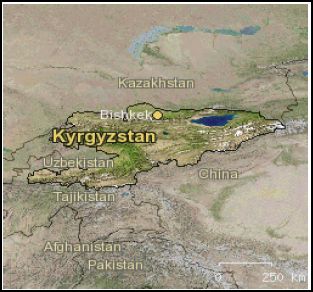
The South Country, Part 5

See? I told you so!

From UN says violence in Kyrgyzstan was orchestrated, By Yuras Karmanau and Sergei Grits, June 15, 2010:

From self-imposed exile in Belarus, Bakiyev has denied any ties to the violence, but Otunbayeva insisted Tuesday his supporters had stoked the conflict.

"Many instigators have been detained and they are giving evidence on Bakiyev's involvement in the events. No one has doubts that he is involved," she said.

The region around Osh, a city of 250,000, is a top conduit for heroin flowing out of Afghanistan, and thus a hotbed for gangs and guns. Some observers said the violence could have been rooted in the fight for control over drug trafficking.

Mars Sariyev, a Bishkek-based analyst, said figures from Bakiyev's entourage might have encouraged the ethnic violence in order to regain control over the drug flow.


Afghanistan is now the major world producer of heroin.  Afghan heroin is very high quality, and the price has come down dramatically in recent years; in short, Afghan heroin is literally driving other producers out of the world market.


One major route to market for Afghan heroin is through Central Asia to Russia and Europe; destination countries and countries along the route are suffering increased rates of heroin usage, along with all the problems that accompany heroin use.


Heroin production supports our enemies in the War on Terror - or whatever we're calling it today under Obama.

Our enemies just call it a jihad against the Great Satan. Perhaps Obama should adopt that term as well.

But, heroin production doesn't just support our enemies.

Terrorist organizations such as Al Qaeda, like organized crime, are involved in criminal activities; terrorists want to kill and destroy, organized crime wants to make money. But, illegal is illegal, and they have common enemies: governments and nations seeking to protect themselves and their citizens.

So, as you go high enough up the chain in either terrorist or criminal organzations, you get to a point where their support networks converge; arms-trafficking, narcotics-trafficking and other criminal activities converge with terrorist activities, and the money-laundering that supports it all.

These criminal activities need to be protected from law enforcement, so money is diverted to paying off law enforcement and government officials.

Consequently, if you investigate government corruption deeply enough, it is easy to trace much of it to drug trafficking, and then to terrorism; similarly, if you investigate terrorism and terrorism financing deeply enough, it is easy to trace it to drug trafficking, and then to corrupt government officials.

That is why there was no serious investigation of the Oklahoma City Bombing; they prosecuted McVeigh and Nichols, who were guilty, and they ended it there, even though the trail also led to Al Qaeda via the Philippines, and to Saddam Hussein's regime in Iraq.

That is why the Crime of the Century - the 9/11 attacks - were not investigated by the FBI, and to this day, Osama bin Laden is not wanted for 9/11. Look at the FBI's wanted poster for Osama: no mention of 9/11.

That is why they didn't prevent 9/11, even though they had plenty of fairly specific, actionable intelligence about it: had they acted, the investigation would have turned up corrupt US government officials on the payroll of foreign organized crime, so these officials derailed the warnings before 9/11, and the investigation afterwards, to protect themselves.

From Cracking the Case: An Interview With Sibel Edmonds by Scott Horton, August 22, 2005:

SH: And as you pointed [out], some of this information has been confirmed in the public. I know when you speak about the Iranian informant...

SE: Correct.

SH: ...who warned in April of 2001 -- that was even confirmed by Mueller, the director of the FBI.

SE: Absolutely there was actually an article in the Chicago Tribune in July 2004 saying that even Mueller expressed surprise that during the hearings, the commissioners didn't ask about this. And guess what, nobody reported all these omissions. What would happen if you hit them with 20 cases? And I'm talking about 20 affidavits from experts and veteran agents.

SH: This is all about the question of prior knowledge and who knew what, when before the attack.

SE: And also what happened afterward. I started working three days after Sept. 11 with a lot of documents and wiretaps that I was translating. Some of them dated back to 1997, 1998. Even after Sept. 11, covering up these investigations and not pursuing some of these investigations because the Department of State says, "You know what, you can't pursue this because that may deal with this particular country. If this country that the investigation deals with are not one of the Axis of Evil, we don't want to pursue them." The American people have the right to know this. They are giving this grand illusion that there are some investigations, but there are none. You know, they are coming down on these charities as the finance of al-Qaeda. Well, if you were to talk about the financing of al-Qaeda, a very small percentage comes from these charity foundations. The vast majority of their financing comes from narcotics. Look, we had 4 to 6 percent of the narcotics coming from the East, coming from Pakistan, coming from Afghanistan via the Balkans to the United States. Today, three or four years after Sept. 11, that has reached over 15 percent. How is it getting here? Who are getting the proceedings from those big narcotics?

One of those countries which if mentioned cannot be investigated is Kyrgyzstan, because, if you investigated it, and really dug down deep... from 'The Stakes Are Too High for Us to Stop Fighting Now' An interview with FBI whistleblower Sibel Edmonds by Christopher Deliso, August 15, 2005:

SE: The fact that there are no investigations -- I will give you an analogy, okay? Say if we decided to have a "war on drugs," but said in the beginning, "right, we're only going to go after the young black guys on the street level." Hey, we already have tens of thousands of them in our jails anyway, why not a few more? But we decided never to go after the middle levels, let alone the top levels...

It's like this with the so-called war on terror. We go for the Attas and Hamdis -- but never touch the guys on the top.

CD: You think they [the government] know who they are, the top guys, and where?

SE: Oh yeah, they know.

CD: So why don't they get them?

SE: It's like I told you before -- this would upset "certain foreign relations." But it would also expose certain of our elected officials, who have significant connections with high-level drugs- and weapons-smuggling -- and thus with the criminal underground, even with the terrorists themselves.

Sunday, May 2, 2010

War of Civilizations?

First of all, for those of you who missed it last Sunday night, please watch the following vid from 60 Minutes:


CBS is part of the mainstream media. Having said that, they do excellent work, within the bounds of what they find it comfortable to do.

In the video, Lesley Stahl missed an important opportunity.

Several Muslims - dare I call this particular group extremists? I'm not sure if it is a fair characterization - in Pakistan were debating with a former jihadist, Maajid Nawaz, about jihadist ideology, and Ms. Stahl then entered the conversation. One of the men alleged that the US was behind the attacks on 9/11 - in what we would call a "false flag" operation - to have a pretext to attack the Muslim world.

Ms. Stahl seemed to find the allegation that 9/11 was a false flag operation incredible.

Since the idea is incredible - and growing in popularity - why does no one in the mainstream media delve into it and thoroughly investigate it? If it is so incredible, it should be easy to disprove.

Let's get our history straight.

Lee Harvey Oswald killed President Kennedy - and, he acted alone.

Before that, Polish troops crossed the frontier into Nazi Germany in late August of 1939, and Germany was forced to defend itself.

Our government is trustworthy and, even if it should be shown that the incident along the Polish-German border in August, 1939, was a false-flag operation, that does not trump the fact that all of our American government officials are absolutely honest and brave, and can not be bought off or intimidated.

:|

It was not to wage war on Islam.

Most of the attackers were Saudis, and Saudi Arabia is the home of Islam's two holiest sites.

If we wanted to wage war on Islam, Mecca and Medina would be pig farms now.

(Pigs are particularly repugnant to Islam, so would be a natural choice to defile Islam's holiest cities.)

There was the incentive of tremendous profits to be made supporting the war, not to mention the illegal profits enabled by the hostilities.

This is on top of the natural resources to which we would have unfettered access by invading Iraq and Afghanistan.

Mr. Nawaz correctly points to oil and other possible reasons behind the US presence in Iraq and Afghanistan - not to an American hatred of Islam.

:|

The terrorist attack on 9/11 was the crime of the century.

Why was the Federal Bureau of Investigation not allowed to investigate this terrorist incident? The FBI was sent in to investigate other Al Qaeda attacks elsewhere. Why was the WTC not cordoned off as a crime scene?

Why does the FBI's "Wanted" poster for Usama Bin Laden not refer to 9/11?


It was revised in November of 2001.


Where is the mention of 9/11 in the FBI's UBL wanted poster?

Enquiring minds want to know.

I want to know. :)

__________

The war of civilizations is as follows.

The United States was born - imperfect - in a quest to establish a government based on the principle that all people are equal: not equally tall or short, smart or dumb, rich or poor, but equally human; especially that no royalty was more human, having the authority to take away fundamental rights bestowed up us by our Creator.

To be sure, this new country was imperfect, and its implementation of this principle of equality was very imperfect. In many parts of the new nation, people could be bought and sold as property; slavery still existed. Even half a century after slavery was outlawed, people were still treated as second-class citizens (and worse) based on their skin color and gender.

Problems exist to this day.

The fact that this nation is not perfect does in no way negate the validity of the founding principle: we are all created equal, and endowed by our Creator with certain inalienable rights, and that among these are life, liberty and the pursuit of happiness.

In sharp contrast, Islam is a medieval ideology, wherein women are treated little better than cattle, according to laws codified centuries ago, and acccording to the example of the ideology's founder, who is considered to be a perfect example of humanity.

As long as some glimmer of hope for a better, more equitable life exists anywhere in creation, those who have been enslaved by Islam, like those who were enslaved by communism, will dream of throwing off their own chains in search of the freedom intended for them by their Creator, and for which an eternal fire burns in their hearts.

As long as this is the case, Islam, like communism, is in danger.

To prevail, all America has to do is survive.

But, to prevail, Islam must conquer and destroy; that is why it was spawned in battle with holy warriors challenging all they encountered with the infamous triple choice: conversion to Islam, submission to the caliphate in dhimmi status, or war of annihilation.

There is indeed a war between what America stands for and the Islamic world, but it is not America that seeks to conquer.

__________

Having said that, though, there are things in Muslim lands of great value, and there are corrupt and criminal people in our "government of the people, by the people and for the people" who seek to hijack our nation's might for personal enrichment.

Of course, the reverse is true, as well: there are things of value in America, and the Islamic world has corrupt and criminal leaders whose authority is "divinely" unquestionable, and for whom Islam is a vehicle....

Sunday, March 28, 2010

I Want You

I couldn't have made this one up.

An article in Islam Times entitled NATO turning its Back on Opium Sales:


(Islam Times) - NATO has refused to close down the Afghan poppy fields in fear of what would happen after Afghan's sole source of income is eradicated.

Islam Times reports from Press TV: NATO has rejected an appeal made by Russia for eradication of opium fields in Afghanistan, arguing that the sole source of income in the region cannot be removed.

Addressing a meeting of the NATO-Russia Council on Wednesday, head of Russia's Federal Drug Control Agency (FSKN) Victor Ivanov said "Afghan opiates led to the death of 1 million people by overdose in the last 10 years, and that is United Nations data. Is that not a threat to world peace and security?"

The Russian official tasked NATO forces with "normalizing the situation in Afghanistan" which includes "the elimination of drug production."

Meanwhile, NATO spokesman James Appathurai voiced understanding for Russian concerns, given the country's estimated 200,000 heroin and morphine addicts and the tens of thousands dying each year as a result of their addiction.

However, he went on to say that the Afghan drug problem had to be handled carefully in an effort to avoid alienating local residents.

"We share the view that it has to be tackled," the spokesman said. "But there is a slight difference of views," Appathurai added.

"We cannot be in a situation where we remove the only source of income for people who live in the second poorest country in the world without being able to provide them an alternative. That is simply not possible," the NATO official explained.

According to statistics provided by Ivanov, Russia was the single largest consumer of heroin in 2008. Moscow blames NATO for the surge in heroin trafficking from Afghanistan to Russia.

The production of opium in Afghanistan has [been] skyrocketing since the US-led invasion of the country in 2001.

But, the story goes far beyond that; this is a question of "Deep Politics".


As I pointed out in a recent post:

According to information in the Sibel Edmonds case, some of which has now come out through depositions, heroin money was being channeled through Turkish contacts to bribe US government officials, both elected and appointed, from both parties, in the years prior to 9/11. (The Sibel Edmonds case tells us a great deal about this; you can start learning about it here.) Word of the coming terrorist attacks was coming through counternarcotics and counterespionage channels - and, had word gotten out, a lot of US politicians would have been caught with their fingers in a poppy pie!

However, on the other fingers on the other hand, there was no poppy pie, but plenty of fossil fuels: a major terrorist attack on the US would galvanize public opinion to attack Al Qaeda's sponsors, the Taliban. This would pave the way for the pipeline deal to go through. And, for those in the US government receiving bribes from foreign organized crime, it would also allow US troops to protect opiate production from Taliban interference as part of a strategy to win the hearts and minds of Afghan farmers, while blaming resurgent opiate production on Al Qaeda (who, incidentally, does in fact play a role in opiate production and shipment).

Here's what this looks like:

1) We know that heroin sales financed the jihad in Afghanistan during the Soviet occupation, and the Soviet Union's troubles in Afghanistan helped cause the Evil Empire to implode -- no big loss.

2) We understand from alternative media and "the Left" that much of the de facto interest of our government in the Middle East has nothing to do with Islamic terrorism and the efforts of the faithful to force the world to submit. Indeed, if this were the main concern, why are we so friendly with Saudi Arabia, the source of the ideology and money to fund it? Why are we not more forceful with Pakistan, who sponsors and gives safe haven to the Taliban?

It looks like we are still playing big power politics in Central and South Asia, viewing Russia as the enemy.

Now, I am not advocating we suddenly trust Medvedev and Putin with our lives.

Of course, I don't trust Obama/Bush/Clinton or the other unindicted criminals in Washington, either.

But if we accept that we are playing big power politics, then the jockeying for oil under cover of a "War on Terror" (or what ever the Obamanistas call it now -- the only change the Obamanator has delivered is a new name) is the real game, and it makes sense.

And, many people are duped into not interfering in the heroin trade, because it is killing off our "real enemy", the Russians.

But, what is really going on once you dig down another level and explore the Sibel Edmonds case is that heroin money finds its way to Washington as bribes, so officials find ways to not interfere in somebody's very profitable business.

The Russians, the Afghans, the Americans -- WE THE PEOPLE of all these nations, and of other nations -- are getting screwed by the same dirty machine.

Having said all that, look what I found:


And it's true! The "real" Uncle Sam -- i.e., Real America -- needs us all (Americans, Russians, Afghans, etc.) to do just this: wake up, wake others up, know we are free, think for ourselves, and resist tyranny.

So, where did I find this??

At a website for the Religion of Peace, an ideology that seeks to deprive us of our rights to think freely, and which seeks to impose upon us a barbaric sixth-century tyrrany!


I could have sat here all day, and not have made this one up!

I WANT YOU to think for yourself.

Saturday, March 27, 2010

Flies In The Ointment

In a previous post entitled Back-Channel Peace Talks Shut Down - Why?, I finished with this:

By the way, don't think that it is only corrupt elements of Pakistan's government and Islamic extremists who profit by drug trafficking. That money travels from the street, where the drugs are bought, to the fields of Afghanistan, where poppies are grown -- and most of it stops somewhere in between, or gets diverted elsewhere.

And those damned peacetalks with the Taliban were going to ruin all this.

Funny how, after decades supporting militant Islamic extremists and supporting the Taliban, Pakistan's security forces all of a sudden got on-board, coming up with the Taliban's No. 2 guy.

There is an interesting article at Asia Times Online, entitled War and peace: A Taliban view, by Syed Saleem Shahzad, dated March 26, 2010. In it, a spokesman for the Taliban denied the back-channel peace talks:

Mullah Baradar was part of the Taliban and there was no trust deficit between him and Mullah Omar. However, it is entirely false that he was part of any reconciliation process or that he held any talks with anybody.

Hmmm... no back-channel peacetalks?

Part 2 has some interesting information:

I switch topics. "Do you think the conflict in Afghanistan will just go on, and that there is no point in talks?"

The Taliban leader looks into my eyes for a while before answering.

"This all comes from real intentions. They want our defeat, not reconciliation. This talks issue is not a new one. The Taliban talked to the Americans, the Saudis and to the Pakistanis even before 9/11. The Taliban wanted to avoid the war [on Afghanistan in 2001] but we felt that the Americans were bent on a war and wanted to dislodge the Taliban government, and they were looking for some excuse.

"They made an issue of Osama bin Laden's presence in Afghanistan and tightened the noose around the Taliban government. We said that Osama bin Laden was just an individual. For argument's sake, say that tomorrow he died. Would the Taliban government then be acceptable to you? The Americans responded with other issues, women's rights and human rights in Afghanistan, as well as education.

"We replied, 'OK, we will work on mechanisms under which we will take steps for women's education and the improvement of human rights.' What then? The Americans raised another issue, about holding elections. At this point we realized the Americans were only concerned about waging war on Afghanistan for whatever reason. Had 9/11 not happened, they would have found any old excuse to wage war," says Abdullah.

Hmmm... "'any old excuse to wage war,' says Abdullah."

A series entitled "Genesis" was done at another blog based on official US government documents, and the series, with some analysis, led to the conclusion that Pakistan, likely with US support, established the Taliban to stabilize Afghanistan, with an eye towards building a pipeline through the country from Central Asian gas fields to the Pakistani port of Gwadar.

Looking back decades before, to another war and another part of the world, there's a debate about whether the United States had really been caught off-guard at Pearl Harbor, or whether some people high in government had information about an attack, but allowed it to occur so there would be reason for the United States to enter the war, and provide badly needed help in defeating the Axis.

Of course, that could never have happened, and it SURE could never have happened again!

:)

One of the problems with conspiracy theories (there are usually many problems) is that they tend to overestimate the competence of governments.

:|

From 'I Saw Papers That Show US Knew al-Qa'ida Would Attack Cities With Airplanes', dated April 2, 2004:

A former translator for the FBI with top-secret security clearance says she has provided information to the panel investigating the 11 September attacks which proves senior officials knew of al-Qa'ida's plans to attack the US with aircraft months before the strikes happened.

She said the claim by the National Security Adviser, Condoleezza Rice, that there was no such information was "an outrageous lie".

Sibel Edmonds said she spent more than three hours in a closed session with the commission's investigators providing information that was circulating within the FBI in the spring and summer of 2001 suggesting that an attack using aircraft was just months away and the terrorists were in place. The Bush administration, meanwhile, has sought to silence her and has obtained a gagging order from a court by citing the rarely used "state secrets privilege".

She told The Independent yesterday: "I gave [the commission] details of specific investigation files, the specific dates, specific target information, specific managers in charge of the investigation. I gave them everything so that they could go back and follow up. This is not hearsay. These are things that are documented. These things can be established very easily."

She added: "There was general information about the time-frame, about methods to be used ­ but not specifically about how they would be used ­ and about people being in place and who was ordering these sorts of terror attacks. There were other cities that were mentioned. Major cities with skyscrapers."

FBI and other government documents, officially released in the course of the Moussaoui trial, specifically and strongly support the assertion that the US government was aware of the danger prior to the attack.

You know, the Taliban were getting in the way of our petroleum deals.

And, in 2001, they had just cracked down on opiate production.

According to information in the Sibel Edmonds case, some of which has now come out through depositions, heroin money was being channeled through Turkish contacts to bribe US government officials, both elected and appointed, from both parties, in the years prior to 9/11. (The Sibel Edmonds case tells us a great deal about this; you can start learning about it here.) Word of the coming terrorist attacks was coming through counternarcotics and counterespionage channels - and, had word gotten out, a lot of US politicians would have been caught with their fingers in a poppy pie!

However, on the other fingers on the other hand, there was no poppy pie, but plenty of fossil fuels: a major terrorist attack on the US would galvanize public opinion to attack Al Qaeda's sponsors, the Taliban. This would pave the way for the pipeline deal to go through. And, for those in the US government receiving bribes from foreign organized crime, it would also allow US troops to protect opiate production from Taliban interference as part of a strategy to win the hearts and minds of Afghan farmers, while blaming resurgent opiate production on Al Qaeda (who, incidentally, does in fact play a role in opiate production and shipment).

From War and peace: A Taliban view, Part 2:

"Once [Mullah Omar] asked Mullah Baradar to meet him, but Baradar replied that he operated in the field and might one day be arrested, and that would compromise Mullah Omar's position. Remember, nobody can isolate Mullah Omar. Everything in the Taliban starts and ends with Mullah Omar's orders," Abdullah says.

Mullah Omar, "commander of the faithful" - the weak link in the Taliban?

Or, The Taliban - fly in the ointment?

Okay, as long as I'm off in the direction of the loony bin, let's go all the way - in for a penny, in for a pound! For conspiracy kooks, there is a series of posts that has to be the Grand Unified Theory of conspiracies. From The Twilight Zone, Part 1, dated February 22, 2008:

The War on Terror is a charade: scratch it once, it comes up Big Oil; scratch it twice, it comes up Big Heroin.

Speaking of conspiracies, the first commentator at the end of The Twilight Zone, Part 1 wrote to the post author:

This is high explosive, YD! Take very good care of yourself.

And now that blogger, the author of that "high explosive" post, has stopped blogging, leaving behind a mysterious comment on how his (or her) email had been subpoenaed:


Another fly in somebody's ointment?