America should already have a space station in Earth orbit, America should already have a base on the moon, America should already have a space station in lunar orbit, America should have already sent a manned mission to Mars.
America needs a new fleet of space shuttles - a fleet, not just a handful like we had with our previous program.
This fleet should be used to establish space stations in Earth orbit and in lunar orbit. We should also have at least one base on the moon.
Manned exploration should already be occurring in the farthest reaches of our Solar System. This exploration should be launched from lunar bases and orbiting space stations.
The exploration should consist not just of one spacecraft with a handful of astronauts, but rather, it should consist of an entire group of spacecraft. If we designed one spacecraft to be able to accomodate a crew of thirty for round trip flight time to the destination, plus one year, that would allow adequate time at the destination for scientific exploration and experimentation. Then, instead of placing thirty people on that vessel, we place perhaps twelve, and launch a group of five spacecraft towards the destination. The expedition could suffer the catastrophic loss of over half the force of spacecraft - three ships - and still have enough room and supplies on the remaining two spacecraft to return every member of the expedition to Earth.
This could be designated as one scientific task group. For example, we could send one group to each of Jupiter's major moons, Io, Europa, Ganymede and Callisto, leaving one group doing general studies of the area and coordinating and monitoring the work of the other groups. This would be a scientific task force of twenty-five spacecraft; among those spacecraft would be 300 crewmembers, but there would be room on board those spacecraft for 750 people, so that if multiple emergencies occurred, adequate rescue resources would be immediately available on the scene, rather than months or years away on Earth.
Another advantage to having an expedition of this size is it could include scientists of every field to make observations regarding the atmosphere, the geology, and so on, of the destinations. Astrophysicists who specialize in planetary science would of course play a key role, but astrophysicists and astronomers specializing in stellar, galactic and cosmologic astronomy would have a tremendous opportunity to make observations from what we might hope would turn out to be a significantly different vantage point than has heretofore been achieved.
Why should we limit ourselves to one such task force in space at a time? Another could be sent to Saturn and its moon Titan, and yet another to Mars. Depending on the scientific objectives and the objects of interest, some task forces could be larger or smaller than others.
Needless to say, we are speaking of having an entire fleet of spacecraft, and literally hundreds of people on exploration missions on board dozens of craft heading to several different destinations at any given moment. We would also need the personnel to man the space stations in Earth and lunar orbit, and the bases on the moon. And, would we not want to establish a base on Mars and a space station in Martian orbit?
Such programs would be logical but dramatic extensions of NASA's ongoing programs. Currently, there is a polemic regarding use of the SLS, and questions regarding whether the SLS is non-competitive, using current shuttle suppliers. Frankly, with the requirements that would be generated by the programs described above, the entire polemic would be blown out of the sky; the entire American aerospace industry would be working as hard as possible for years to build the space shuttles, heavy lift launch systems, and modular components for orbiting space stations and lunar and martian bases. Beyond that, the deep space exploration craft, a large number of which would need to be deployed for the missions described above, would have to be built; they may have to be prefabricated on Earth for assembly in orbit.
Implicit in this idea is the notion of having literally thousands of people trained for duties in space. This means we would need a dramatically expanded training program for those serving in space.
The United States currently has six service academies: in alphabetical order, these are 1) the Air Force Academy in Colorado Springs, Colorado; 2) the Coast Guard Academy in New London, Connecticut; 3) the Merchant Marine Academy in Kings Point, New York; 4) the Military Academy in West Point, New York; 5) the Naval Academy in Annapolis, Maryland; and 6) the Uniformed Services University of the Health Sciences in Bethesda, Maryland. The first five are undergraduate academies, and the last one is a postgraduate academy.
We need a seventh service academy, specifically for space service; I will refer to it as the Space Service Academy.
Physically, I would envision the Space Service Academy having a main location in a western state, with a large airbase essentially co-located with it. These facilities should be purpose-built. The Space Service Academy should also have ancillary facilities located at geographically separate locations for purposes, some of which will be described below.
Academically, I would envision the Space Service Academy having an extended program, perhaps six years of academics. Upon graduation, officers would have bachelors' degrees with at least a dual major in technical fields - for example, astrophysics and aerospace engineering, or computer engineering and mathematics, or meteorology and planetary science. The program should be tailorable, so officers can graduate with a master's degree, and there should be options for additional studies to yield a doctorate.
During their time at the Space Service Academy, the personnel studying there should be able to coordinate their graduation requirements with those of the other service academies so that, upon graduation, they receive a commission valid for one of the branches of service. For example, by choosing one set of options, a graduate will receive a commission in the Air Force, by choosing another set of options, the Coast Guard, and so on. Consequently, I will now refer to the personnel studying at the Space Service Academy as cadets or midshipmen.
Since cadets and midshipmen of the Space Service Academy are being trained for space exploration, their training needs to be very rigorous. It should include aircrew training, so graduating officers are qualified pilots or navigators. It should also include advanced survival training; during six years, a cadet or midshipman should attend basic survival school, taught at the Space Service Academy's main facility, and should be rotated through ancillary facilities to learn Arctic survival in Alaska, water survival (perhaps in Florida), as well as desert and jungle survival. Martial arts training should be required; judo or taekwondo could be offered, as well as the Marine Corps Martial Arts Program.
The rationale behind this kind of survival and martial arts training is that the Space Service Academy trains officers for space exploration, during the course of which an emergency could result in the officer landing literally anywhere on Earth and being at least temporarily in a survival situation; furthermore, given the fact that there has been war ongoing somewhere on the Earth's surface continually for the past several decades, the officer could find her- or himself thrust into a combat survival situation under extremely harsh conditions.
Other military training should be coordinated with the military services, and should include airborne, ranger, advanced firearms and firearms instructor training.
Additionally, language training should be included. Cadets and midshipmen should be required to learn one foreign language in which a great deal of technical, scientific literature is written, such as Mandarin Chinese, German, Russian, or Japanese, as well as the language of a culture that produces less or no technology-oriented literature, such as Hausa or Dari. The Space Service Academy commandant should be able to write waivers for exceptionally gifted cadets and midshipmen who have a difficult time with languages that are too exotic, modifying but not eliminating the foreign language requirement. This language training requirement needs to be understood in the context that, just as Americans went to the moon in peace on behalf of all humankind, so is our space exploration program a peaceful one on behalf of all humanity, and our Space Service qualified officers, though highly capable military officers ready to defend the ideals upon which America is built, are first and foremost explorers and ambassadors of peace. Language training will serve our Space Service qualified officers on exchange duty with foreign nations, it will serve them as foreign nations send, at our invitation, their own astronauts to participate in our space exploration programs, and it will serve them should they find themselves in survival situations as described above.
Applications to the Space Service Academy should implicitly include applying to the other service academies and to the military ROTC programs. If a qualified candidate is not selected for the Space Service Academy, he or she should be offered a slot in one of the other academies or programs. It follows, then, that the other academies and the ROTC programs would be fertile recruiting ground for the Space Service Academy. Upon graduation, cadets and midshipman are commissioned into one of the branches of service, but with a special designation that they are Space Service qualified. In the absence of specific Space Service missions, these officers could pursue their careers with their respective services, but knowing that they are on call for Space Service.
For people who wish to be Space Service qualified, but who do not wish to serve in a military capacity, alternative training programs could lead to service in the Public Health Service Commissioned Corps and the National Oceanic and Atmospheric Administration Commissioned Corps. Similarly, a comparable program could be established leading to service as Foreign Service Officers. Other federal agencies that would have a need for personnel with scientific and administrative training include the US Forest Service (USFS) and the US Geological Survey (USGS); the USGS, it should be noted, maintains an astrogeology research program. To support these aspects of Space Service training, the Space Service Academy would need to coordinate with the Foreign Service Institute for training of personnel who would serve as Foreign Service Officers while awaiting their opportunities to serve in space, and a Public Service Institute or Public Service Academy could be established to provide training for Public Service Officers, who could work with USFS, USGS, National Weather Service, and other federal agencies while awaiting their opportunities.
With a projected need for dozens of spacecraft, either on exploration missions or held in Earth or lunar orbits, plus space stations in Earth and lunar orbits, plus bases on the moon, plus bases on and stations in orbit above Mars, it should be a reasonable guarantee that a Space Service Academy graduate will, during the course of twenty years of government service, get into space at least once, even if only in Earth orbit. Realistically, Space Service qualified officers could expect to serve at least one tour of duty on a space station or extraterrestrial planetary/lunar base, and one tour of duty on a deep space exploration mission, according to aptitude and desire.
Because of the extreme likelihood of serving in space, the program will likely be highly competitive, because young people will want to go to space.
The Space Service Academy should be a center of excellence, having facilities for scientific research, including its own nuclear reactor and nuclear collider.
Once accepted to attend the Space Service Academy, cadets and midshipmen should be issued all necessary uniform items and necessities, as well as receiving pay and full benefits such as Department of Defense healthcare, in a manner similar to that in which cadets and midshipmen are treated in the other service academies.
The program should be merit-based. There should be tolerated absolutely no political agenda requiring quotas based on skin color, ethnicity, or any other irrelevant criteria. Admission to the Space Service Academy should boil down to academic performance, scores on standardized tests, physical fitness and health, interview results, letters of recommendation and nomination, and assessments of future aptitude. Every effort should be made to ensure the success of any accepted cadet or midshipman; cadets and midshipmen whose performance does not meet expectations should be removed from the Space Service Academy and sent to other programs, or for enlisted service in an appropriate branch of the armed forces.
As this program is described, once the Space Service Academy is established by law, it can begin operations immediately, recruiting from the other service academies and officer training programs, working in temporary facilities, and coordinating with NASA, the armed forces and their service academies, and various elements of the aerospace industry for specific aspects of the training program.
The goal of attending a service academy and getting an excellent scientific education, paid for by the United States of America and at no cost to the attendee, with the added benefit of offering experience and an expectation of participating in space exploration - credentials that will open doors to the very best opportunites that business, government and academia have to offer - should be widely advertised to young Americans beginning in elementary school, so they will focus on academics beginning at an early age.
These Americans who travel into space will, as their predecessors have done, discover new solutions to problems that we have here on Earth, and bring those solutions back, making life here better; they will inspire us and offer us hope for a better future.
Let's rejuvenate the promise of America as a beacon of hope for all humanity for all time. The sky's the limit!
Sunday, August 5, 2012


Friday, August 3, 2012
Standing There on Freedom's Shore, Part 3
This series addresses a variety of issues that are impacting the northern two-thirds of Africa, especially the Saharan and Sahelian regions. You may wish to review Part 1 and Part 2, though it is not necessary; critical information from previous posts will be specifically linked in later parts of this series.
First, we will consider Libya. There was so much coverage of the overthrow of Gaddafi (or however you spell his name; his revenge on the world will be in the history books with all the confusion over how to render his name in English) in Libya, that it really wasn't much of a temptation to add to it. Of course, now I have a reason... :)
On March 22, 2011, the Treasury Department published a press release entitled Treasury Identifies 14 Companies Owned by Libya’s National Oil Corporation as Subject to Sanctions, listing Libyan companies whose assets were frozen in order to help force Gaddafi from power. The press release included this comment:
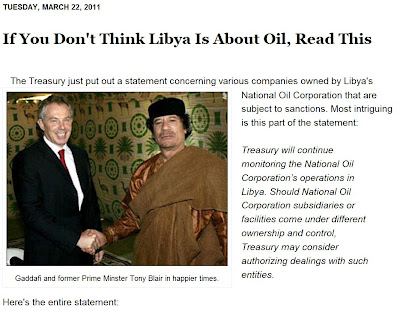
Economic analyst Robert Wenzel immediately picked up on this, and called attention to it in a post entitled If You Don't Think Libya Is About Oil, Read This.
Interestingly, the contingency foreseen in the Treasury Department press release happened almost simultaneously with the press release. From Libyan Rebel Council Forms Oil Company to Replace Qaddafi's (please see the original for further information and for links which I did not reproduce):
Linking to this article, Wenzel explained its significance on March 28. From Libyan Rebels Form Central Bank:
Wenzel finishes his article calling the rebels "puppets and cover".
The topic was picked up by CNBC in an article entitled Libyan Rebels Form Their Own Central Bank, dated March 28, 2011, which echoed and referenced Wenzel's analysis:
Further analysis comes from Patrick Henningsen. From Globalists Target 100% State Owned Central Bank of Libya, March 28, 2011:

More analysis is provided by Ellen Brown. From Libya all about oil, or central banking? April 14, 2011:

Skiping down:
Well, guess what?
Bank for International Settlements' link to the Central Bank of Libya:

Freedom and human rights comprise the cover story for oil. Oil, though, is the cover story for water - without which humans cannot live - and money - which, if properly manipulated, enslaves humanity.
But, what else lurks beneath the surface?
First, we will consider Libya. There was so much coverage of the overthrow of Gaddafi (or however you spell his name; his revenge on the world will be in the history books with all the confusion over how to render his name in English) in Libya, that it really wasn't much of a temptation to add to it. Of course, now I have a reason... :)
On March 22, 2011, the Treasury Department published a press release entitled Treasury Identifies 14 Companies Owned by Libya’s National Oil Corporation as Subject to Sanctions, listing Libyan companies whose assets were frozen in order to help force Gaddafi from power. The press release included this comment:
Treasury will continue monitoring the National Oil Corporation’s operations in Libya. Should National Oil Corporation subsidiaries or facilities come under different ownership and control, Treasury may consider authorizing dealings with such entities.
Economic analyst Robert Wenzel immediately picked up on this, and called attention to it in a post entitled If You Don't Think Libya Is About Oil, Read This.

Interestingly, the contingency foreseen in the Treasury Department press release happened almost simultaneously with the press release. From Libyan Rebel Council Forms Oil Company to Replace Qaddafi's (please see the original for further information and for links which I did not reproduce):
Libyan rebels in Benghazi said they have created a new national oil company to replace the corporation controlled by leader Muammar Qaddafi whose assets were frozen by the United Nations Security Council.
The Transitional National Council released a statement announcing the decision made at a March 19 meeting to establish the "Libyan Oil Company as supervisory authority on oil production and policies in the country, based temporarily in Benghazi, and the appointment of an interim director general" of the company.
The Council also said it "designated the Central Bank of Benghazi as a monetary authority competent in monetary policies in Libya and the appointment of a governor to the Central Bank of Libya, with a temporary headquarters in Benghazi."
The Security Council adopted a resolution on March 17 that froze the foreign assets of the Libyan National Oil Corp. and the Central Bank of Libya, both described in the text as "a potential source of funding" for Qaddafi's regime.
Linking to this article, Wenzel explained its significance on March 28. From Libyan Rebels Form Central Bank:
Here's one for the Guinness Book of Records. The Libyan rebels in Benghazi said they have created a new national oil company to replace the corporation controlled by leader Muammar Qaddafi whose assets were frozen by the United Nations Security Council and have formed a central bank!
The Transitional National Council released a statement announcing the decision made at a March 19 meeting to establish the "Libyan Oil Company as supervisory authority on oil production and policies in the country, based temporarily in Benghazi, and the appointment of an interim director general" of the company.
The Council also said it "designated the Central Bank of Benghazi as a monetary authority competent in monetary policies in Libya and the appointment of a governor to the Central Bank of Libya, with a temporary headquarters in Benghazi."
This suggests we have a bit more than a rag tag bunch of rebels running around and that there are some pretty sophisticated influences.
I have never before heard of a central bank being created in just a matter of weeks out of a popular uprising.
Wenzel finishes his article calling the rebels "puppets and cover".
The topic was picked up by CNBC in an article entitled Libyan Rebels Form Their Own Central Bank, dated March 28, 2011, which echoed and referenced Wenzel's analysis:
Libyan rebels in Benghazi say they have formed their own central bank.
[snip]
Is this the first time a revolutionary group has created a central bank while it is still in the midst of fighting the entrenched political power? It certainly seems to indicate how extraordinarily powerful central bankers have become in our era.
Robert Wenzel of Economic Policy Journal thinks the central banking initiative reveals that foreign powers may have a strong influence over the rebels.
This suggests we have a bit more than a ragtag bunch of rebels running around and that there are some pretty sophisticated influences. "I have never before heard of a central bank being created in just a matter of weeks out of a popular uprising," Wenzel writes.
Further analysis comes from Patrick Henningsen. From Globalists Target 100% State Owned Central Bank of Libya, March 28, 2011:
Eric V. Encina writes: One seldom mentioned fact by western politicians and media pundits: the Central Bank of Libya is 100% State Owned. The world’s globalist financiers and market manipulators do not like it and would continue to their on-going effort to dethrone Muammar Muhammad al-Gaddafi, bringing an end to Libya as independent nation.
Currently, the Libyan government creates its own money, the Libyan Dinar, through the facilities of its own central bank. Few can argue that Libya is a sovereign nation with its own great resources, able to sustain its own economic destiny. One major problem for globalist banking cartels is that in order to do business with Libya, they must go through the Libyan Central Bank and its national currency, a place where they have absolutely zero dominion or power-broking ability. Hence, taking down the Central Bank of Libya (CBL) may not appear in the speeches of Obama, Cameron and Sarkozy but this is certainly at the top of the globalist agenda for absorbing Libya into its hive of compliant nations.
When the smoke eventually clears from all the cruise missiles and cluster bombs, you will see the Allied reformers move in to reform Libya's monetary system, pumping it full of worthless dollars, priming it for a series of chaotic inflationary cycles.
[snip]
Libya also holds more bullion as a proportion of gross domestic product than any country except Lebanon, according to the London-based World Gold Council using January data from the International Monetary Fund. The value of gold is based on the March 25 close of $1,429.74 an ounce.
Will this gold remain in Libya once Allied forces have taken control of Tripoli, or will it lost, or exchanged for pallets upon pallets of paper aka US dollars?
FOLDING LIBYA INTO THE NEW WORLD ORDER
In the Libyan banking charter, one of the primary mandates will be that it is regulating the quantity, quality and cost of credit to meet the requirements of economic growth and monetary stability. This of course, is the very opposite role which privately owned central banks play elsewhere in the world. Private central banks elsewhere create inflation, periodically inflating bubbles by design and then popping them in order to transfer large sums of wealth out of lower and middle class hands and into the hands of the financial elites.

More analysis is provided by Ellen Brown. From Libya all about oil, or central banking? April 14, 2011:
Whatever might be said of Gaddafi's personal crimes, the Libyan people seem to be thriving. A delegation of medical professionals from Russia, Ukraine and Belarus wrote in an appeal to Russian President Dmitry Medvedev and Prime Minister Vladimir Putin that after becoming acquainted with Libyan life, it was their view that in few nations did people live in such comfort:
[Libyans] are entitled to free treatment, and their hospitals provide the best in the world of medical equipment. Education in Libya is free, capable young people have the opportunity to study abroad at government expense. When marrying, young couples receive 60,000 Libyan dinars (about 50,000 US dollars) of financial assistance. Non-interest state loans, and as practice shows, undated. Due to government subsidies the price of cars is much lower than in Europe, and they are affordable for every family. Gasoline and bread cost a penny, no taxes for those who are engaged in agriculture. The Libyan people are quiet and peaceful, are not inclined to drink, and are very religious.
They maintained that the international community had been misinformed about the struggle against the regime. "Tell us," they said, "who would not like such a regime?"
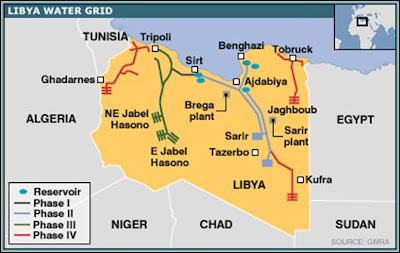
Even if that is just propaganda, there is no denying at least one very popular achievement of the Libyan government: it brought water to the desert by building the largest and most expensive irrigation project in history, the US$33 billion GMMR (Great Man-Made River) project. Even more than oil, water is crucial to life in Libya.
The GMMR provides 70% of the population with water for drinking and irrigation, pumping it from Libya's vast underground Nubian Sandstone Aquifer System in the south to populated coastal areas 4,000 kilometers to the north. The Libyan government has done at least some things right.
Another explanation for the assault on Libya is that it is "all about oil", but that theory too is problematic. As noted in the National Journal, the country produces only about 2% of the world's oil. Saudi Arabia alone has enough spare capacity to make up for any lost production if Libyan oil were to disappear from the market. And if it's all about oil, why the rush to set up a new central bank?
Another provocative bit of data circulating on the Net is a 2007 "Democracy Now" interview of US General Wesley Clark (Ret). In it he says that about 10 days after September 11, 2001, he was told by a general that the decision had been made to go to war with Iraq. Clark was surprised and asked why. "I don't know!" was the response. "I guess they don't know what else to do!" Later, the same general said they planned to take out seven countries in five years: Iraq, Syria, Lebanon, Libya, Somalia, Sudan, and Iran.
What do these seven countries have in common? In the context of banking, one that sticks out is that none of them is listed among the 56 member banks of the Bank for International Settlements (BIS). That evidently puts them outside the long regulatory arm of the central bankers' central bank in Switzerland.
[snip]
Libya not only has oil. According to the International Monetary Fund (IMF), its central bank has nearly 144 tonnes of gold in its vaults. With that sort of asset base, who needs the BIS, the IMF and their rules?
[snip]
So is this new war all about oil or all about banking? Maybe both - and water as well. With energy, water, and ample credit to develop the infrastructure to access them, a nation can be free of the grip of foreign creditors. And that may be the real threat of Libya: it could show the world what is possible.


Skiping down:
If the Gaddafi government goes down, it will be interesting to watch whether the new central bank joins the BIS, whether the nationalized oil industry gets sold off to investors, and whether education and healthcare continue to be free.
Well, guess what?
Bank for International Settlements' link to the Central Bank of Libya:

Freedom and human rights comprise the cover story for oil. Oil, though, is the cover story for water - without which humans cannot live - and money - which, if properly manipulated, enslaves humanity.
But, what else lurks beneath the surface?
Thursday, August 2, 2012
Blue Men on Abandoned Ground, Part 1
I have many series of posts in progress (see lower sidebar). They converge and diverge...
Prior to reading this, you may wish to familiarize yourself with Standing There on Freedom's Shore, Part 1, where we took an early look at the situation in Libya, back when the international coalition was just beginning to get serious about deposing Gaddafi, and where we also considered atrocities by Cote d'Ivoire's new strongman, Alassane Ouattara, who was installed by the French in violation of international law and with the backing of the international community. In fact, the interventions in Cote d'Ivoire and in Libya were similar except for the military power that the defender could muster; France essentially did it alone in Cote d'Ivoire, but Libya was too strong, and even with NATO's help, the international coalition needed to be bailed out by US forces. We ended by considering how the Sahara/Sahel region was a crossroads for Africa, carrying trade going back for centuries.

Then, in Standing There on Freedom's Shore, Part 2, we revisited the concept of the Sahara/Sahel as a crossroads for illicit trade, with a focus on the trade in illegal arms, but touching on the rest of the underground economy, including illegal drugs, counterfeit credit cards, intellectual property, mineral wealth such as diamonds, and a variety of other contraband. We also mentioned how such criminal activities are now the main source of financing terrorism. We specifically touched on heroin, which is mainly produced in Afghanistan these days. Its trafficking finances Islamic terrorism, even as the heroin consumption itself destroys infidel societies from within in nations to which it is trafficked - a dangerous mix made far more dangerous since heroin is now laced with anthrax, as I addressed in my previous post People as Playthings, Part 2. We also mentioned the link between heroin money and corruption in Washington; since key politicians are connected to heroin money, the war on terrorism is a charade, because there is no political will to attack the financial source of Islamic terrorism, of which heroin trafficking is a very significant part. We then touched on the Tuareg (spelled Touareg in Standing There on Freedom's Shore, Part 2) grievances in Niger, amidst accusations by each side - Tuaregs and government authorities - that the other was involved in trafficking contraband. Finally, we looked at how the Tuaregs were also carrying out an insurgency in Mali, and that this had resulted in people being displaced to Burkina Faso, which was implicated in supporting Ouattara's seizure of power in Cote d'Ivoire with the facade of free elections and with French military support, and we noticed that Gaddafi - whom we deposed in Libya - had actually been trying to broker peace between the Tuareg groups and the governments in Niger and Mali.
Also, in Men of Integrity, Part 1, we introduced Burkina Faso as a country with a socialist history and which now serves as a transit point for contraband, especially illegal arms and Latin American cocaine on its way to Europe. However, we also saw how Thomas Sankara, the guy who established the socialist regime in Burkina Faso, was right about debt being a modern form of enslavement of Africa. But, we also saw how Sankara's childhood friend, Blaise Compaoré, murdered Sankara and seized power there in 1987. We also introduced Guillaume Soro, one of Ouattara's key people in Côte d'Ivoire, as a corrupt guy from Burkina Faso with mansions there and in France. ;)
As I pointed out repeatedly in my posts on Côte d'Ivoire, Ouattara himself is a former IMF man, a puppet for the international bankers, so Compaoré's betrayal of Sankara and the subsequent involvement from Burkina Faso in the taking over of Côte d'Ivoire really appears to be a case of Sankara having been right about Africa's debt slavery.

In Men of Integrity, Part 2, we considered the situation with food insecurity that surrounded Burkina Faso last year, and considered how the situation might spark unrest on the part of the nomads in Burkina Faso.
Since that time, there has been a coup in Mali, and Tuareg rebels are now reportedly associated with Al Qaeda in the Islamic Maghreb (AQIM). So, with this important development, we diverge into a new series looking at Mali.

We begin by introducing some history of the Tuaregs and their relations with the government there.
An early Tuareg revolt, the Kaocen Revolt, mainly during World War I, began when a Tuareg leader named Ag Mohammed Wau Teguidda Kaocen, who had been indecisively fighting the French for years, took advantage of a local jihad against the French. Rallying his troops, and armed with newer weapons including one cannon taken from the Italians in Libya, he began to have some success defeating French forces. The rebellion was suppressed when a large French force counterattacked, seized rebel towns, and took reprisals even against those who had not supported the rebels.
The Tuareg Rebellion of 1962–1964 followed Mali's independence. The regional peoples expected their own nation, but instead found themselves relatively left out by the new government. A rapid military response by Mali's armed forces ended the revolt amid brutal repression.

The Tuareg Rebellion of 1990-1995 saw Tuaregs rebelling against both Mali and Niger, seeking either autonomy or independence. In Niger, it began in 1985, in the aftermath of a famine that occurred in 1984-5. Significantly, Libya was providing support to the Tuareg opposition. After a massacre of Tuareg civilians in May, 1990 - the Tchin-Tabaradene Massacre in Niger - there was relative peace in Niger, but fighting erupted in Mali. For the next six years in Mali, the fighting first died down, then intensified with the advent of fighters who supposedly had been trained in Libya, then died down again as a peace was negotiated. By 1996, the rebellions were generally over in both countries; in Niger, most of the rebels were successfully reintegrated into society, though there was a degree of unease, whereas in Mali, some groups continued to maintain an armed hostility to the government, turning to smuggling and criminal activities along the border in areas farthest from the capital.
Generally speaking, the peace achieved in Mali was held up as an example of how an impoverished nation with significant ethnic troubles could end an internal conflict in a constructive manner. For the most part, government troops were withdrawn from the Tuareg areas, rebel forces were integrated into the security forces, and the rebels got significant input into how their areas were governed. The peace was far from perfect, and not without incident, but was very laudable, and lasted for a decade.
The Tuareg Rebellion of 2007-2009 was another round of fighting that occurred in both Mali and Niger. Significantly, in Niger, a center of the fighting was Arlit, home to one fifth of the world's uranium deposits and source of most of Niger's foreign exchange income; this mining operation is run by a French state-owned enterprise, and all of France's nuclear energy and nuclear weapons programs are dependent on it. The mines were assessed to be nearing the end of their usefulness; Niger had already worked a deal with a Chinese company to begin another mining operation, and was talking to other international companies. Also significantly, in Mali, many of the Malian Tuareg groups did not participate in the rebellion; in fact, with their help, a semblance of peace was quickly restored before fighting intensified amid desertions of ethnic Tuaregs from the Malian military. By 2008-2009, some Tuareg groups had scored some successes against Malian forces, provoking a government response and denunciation of peace talks; President Amadou Toumani Touré called attention to the proximity of Tuareg operations to Saharan/Sahelian smuggling routes, and the Malian Armed Forces got to the point where they stated they would not engage in peace talks with "bandits". Throughout this time, there were sporadic kidnappings of foreigners both in Mali and in Niger, with AQIM being implicated, though allegations were floated of both rebel and government involvement.

Common themes to Tuareg rebellions include: 1) arms and training from Libya, whether incidentally, or as a matter of Libyan policy; 2) a movement of Tuaregs across international borders, which are literally lines in the sand; 3) trouble not remaining confined to one nation, but usually encompassing both Mali and Niger.

Gaddafi's involvement can be better evaluated with an excerpt from Qaddafi’s Tangled Legacy in Africa by Richard Downie, March 2, 2011:
Specifically, regarding Libya, Gaddafi's government seemed to be involved in helping the rebels and providing safe haven. Often, though, Tuareg fighters went to Libya, served there, and came back with increased skills, not necessarily having been deliberately trained by Libya as insurgents. Also, Gaddafi's involvement was not solely as an instigator; he helped broker peace deals, although one wonders if he didn't help stir up the rebellions in order to gain influence by brokering peace.
Further insights into the Tuareg, and the rebellion of the 1990's, can be gained from Conflict and Conflict Resolution in the Sahel: The Tuareg Insurgency in Mali by Lieutenant Colonel Kalifa Keita of the Army of the Republic of Mali, May 1, 1998, pages 7-8 (11-12 of 48 as you download the pdf), from which the two black-and-white maps above were taken (numbers in superscripts are footnotes in the original):
So, allegations of Tuaregs being bandits and being involved in smuggling cannot be summarily dismissed.
Continuing on page 9 (13 of 48):
This is significant, because any calls by Tuaregs for an internationally-recognized Tuareg nation-state would likely not be universally echoed by all Tuaregs; also, it explains how some factions of Tuaregs are involved in rebellions, while others are not.
Skipping to pages 13-14 (17-18 of 48):
This explains the Libyan connections, both incidental and deliberate.
Skipping to page 24 (28 of 48):
What is interesting is that, theoretically and on the surface, Muslims are brothers and sisters, and only infidels are characterized by nationality, ethnicity, etc. The reality, though, is that the Islamic world's racism and discrimination are rampant. In fact, the Tuareg were traditionally animists, though Christianity spread into the region. When the Arabs arrived, they brought Islam, but Tuareg Islam was mixed with animist beliefs. In fact, many Arabs connect the name "Tuareg" with the Arabic word tawariq, meaning "abandoned" - by God. Most recent reports suggest AQIM may be bringing a purer form of Islam to the Tuaregs and to Mali.
With this background established, this series will continue by exploring the current situation in Mali. Meanwhile, I suggest checking the links in my sidebar, especially Alex Thurston's Sahel Blog.
Prior to reading this, you may wish to familiarize yourself with Standing There on Freedom's Shore, Part 1, where we took an early look at the situation in Libya, back when the international coalition was just beginning to get serious about deposing Gaddafi, and where we also considered atrocities by Cote d'Ivoire's new strongman, Alassane Ouattara, who was installed by the French in violation of international law and with the backing of the international community. In fact, the interventions in Cote d'Ivoire and in Libya were similar except for the military power that the defender could muster; France essentially did it alone in Cote d'Ivoire, but Libya was too strong, and even with NATO's help, the international coalition needed to be bailed out by US forces. We ended by considering how the Sahara/Sahel region was a crossroads for Africa, carrying trade going back for centuries.

Then, in Standing There on Freedom's Shore, Part 2, we revisited the concept of the Sahara/Sahel as a crossroads for illicit trade, with a focus on the trade in illegal arms, but touching on the rest of the underground economy, including illegal drugs, counterfeit credit cards, intellectual property, mineral wealth such as diamonds, and a variety of other contraband. We also mentioned how such criminal activities are now the main source of financing terrorism. We specifically touched on heroin, which is mainly produced in Afghanistan these days. Its trafficking finances Islamic terrorism, even as the heroin consumption itself destroys infidel societies from within in nations to which it is trafficked - a dangerous mix made far more dangerous since heroin is now laced with anthrax, as I addressed in my previous post People as Playthings, Part 2. We also mentioned the link between heroin money and corruption in Washington; since key politicians are connected to heroin money, the war on terrorism is a charade, because there is no political will to attack the financial source of Islamic terrorism, of which heroin trafficking is a very significant part. We then touched on the Tuareg (spelled Touareg in Standing There on Freedom's Shore, Part 2) grievances in Niger, amidst accusations by each side - Tuaregs and government authorities - that the other was involved in trafficking contraband. Finally, we looked at how the Tuaregs were also carrying out an insurgency in Mali, and that this had resulted in people being displaced to Burkina Faso, which was implicated in supporting Ouattara's seizure of power in Cote d'Ivoire with the facade of free elections and with French military support, and we noticed that Gaddafi - whom we deposed in Libya - had actually been trying to broker peace between the Tuareg groups and the governments in Niger and Mali.
Also, in Men of Integrity, Part 1, we introduced Burkina Faso as a country with a socialist history and which now serves as a transit point for contraband, especially illegal arms and Latin American cocaine on its way to Europe. However, we also saw how Thomas Sankara, the guy who established the socialist regime in Burkina Faso, was right about debt being a modern form of enslavement of Africa. But, we also saw how Sankara's childhood friend, Blaise Compaoré, murdered Sankara and seized power there in 1987. We also introduced Guillaume Soro, one of Ouattara's key people in Côte d'Ivoire, as a corrupt guy from Burkina Faso with mansions there and in France. ;)
As I pointed out repeatedly in my posts on Côte d'Ivoire, Ouattara himself is a former IMF man, a puppet for the international bankers, so Compaoré's betrayal of Sankara and the subsequent involvement from Burkina Faso in the taking over of Côte d'Ivoire really appears to be a case of Sankara having been right about Africa's debt slavery.

In Men of Integrity, Part 2, we considered the situation with food insecurity that surrounded Burkina Faso last year, and considered how the situation might spark unrest on the part of the nomads in Burkina Faso.
Since that time, there has been a coup in Mali, and Tuareg rebels are now reportedly associated with Al Qaeda in the Islamic Maghreb (AQIM). So, with this important development, we diverge into a new series looking at Mali.

We begin by introducing some history of the Tuaregs and their relations with the government there.
An early Tuareg revolt, the Kaocen Revolt, mainly during World War I, began when a Tuareg leader named Ag Mohammed Wau Teguidda Kaocen, who had been indecisively fighting the French for years, took advantage of a local jihad against the French. Rallying his troops, and armed with newer weapons including one cannon taken from the Italians in Libya, he began to have some success defeating French forces. The rebellion was suppressed when a large French force counterattacked, seized rebel towns, and took reprisals even against those who had not supported the rebels.
The Tuareg Rebellion of 1962–1964 followed Mali's independence. The regional peoples expected their own nation, but instead found themselves relatively left out by the new government. A rapid military response by Mali's armed forces ended the revolt amid brutal repression.

The Tuareg Rebellion of 1990-1995 saw Tuaregs rebelling against both Mali and Niger, seeking either autonomy or independence. In Niger, it began in 1985, in the aftermath of a famine that occurred in 1984-5. Significantly, Libya was providing support to the Tuareg opposition. After a massacre of Tuareg civilians in May, 1990 - the Tchin-Tabaradene Massacre in Niger - there was relative peace in Niger, but fighting erupted in Mali. For the next six years in Mali, the fighting first died down, then intensified with the advent of fighters who supposedly had been trained in Libya, then died down again as a peace was negotiated. By 1996, the rebellions were generally over in both countries; in Niger, most of the rebels were successfully reintegrated into society, though there was a degree of unease, whereas in Mali, some groups continued to maintain an armed hostility to the government, turning to smuggling and criminal activities along the border in areas farthest from the capital.
Generally speaking, the peace achieved in Mali was held up as an example of how an impoverished nation with significant ethnic troubles could end an internal conflict in a constructive manner. For the most part, government troops were withdrawn from the Tuareg areas, rebel forces were integrated into the security forces, and the rebels got significant input into how their areas were governed. The peace was far from perfect, and not without incident, but was very laudable, and lasted for a decade.
The Tuareg Rebellion of 2007-2009 was another round of fighting that occurred in both Mali and Niger. Significantly, in Niger, a center of the fighting was Arlit, home to one fifth of the world's uranium deposits and source of most of Niger's foreign exchange income; this mining operation is run by a French state-owned enterprise, and all of France's nuclear energy and nuclear weapons programs are dependent on it. The mines were assessed to be nearing the end of their usefulness; Niger had already worked a deal with a Chinese company to begin another mining operation, and was talking to other international companies. Also significantly, in Mali, many of the Malian Tuareg groups did not participate in the rebellion; in fact, with their help, a semblance of peace was quickly restored before fighting intensified amid desertions of ethnic Tuaregs from the Malian military. By 2008-2009, some Tuareg groups had scored some successes against Malian forces, provoking a government response and denunciation of peace talks; President Amadou Toumani Touré called attention to the proximity of Tuareg operations to Saharan/Sahelian smuggling routes, and the Malian Armed Forces got to the point where they stated they would not engage in peace talks with "bandits". Throughout this time, there were sporadic kidnappings of foreigners both in Mali and in Niger, with AQIM being implicated, though allegations were floated of both rebel and government involvement.

Common themes to Tuareg rebellions include: 1) arms and training from Libya, whether incidentally, or as a matter of Libyan policy; 2) a movement of Tuaregs across international borders, which are literally lines in the sand; 3) trouble not remaining confined to one nation, but usually encompassing both Mali and Niger.

Gaddafi's involvement can be better evaluated with an excerpt from Qaddafi’s Tangled Legacy in Africa by Richard Downie, March 2, 2011:
Aside from his support of the ANC [South Africa's governing party, the African National Congress], Qaddafi has shown little discrimination in his funding of rebel movements, and many African governments will not readily forgive his role in bankrolling and arming some of the continent's most brutal insurgencies. In particular, his bloody fingerprints can be found all over the civil wars of West Africa during the 1990s and early 2000s. A rogues' gallery of African rebel leaders and would-be tyrants passed through Qaddafi's training camps in the 1970s and 1980s. They included the Liberian warlord turned president turned indicted war criminal, Charles Taylor; the head of Sierra Leone's most bloodthirsty rebel group, Foday Sankoh; and the assorted Tuareg rebel forces from Mali and Niger who returned home to wage war against their governments.
In recent years, as he found himself ostracized in the Middle East, Qaddafi increasingly viewed Africa as the stage on which to act out his grandiose schemes. Pan-Arabism was ditched in favor of pan-Africanism. During his time as president of the African Union in 2009, a largely ceremonial role that rotates annually, Qaddafi unveiled his latest vision du jour: a United States of Africa, led by him. Few paid any attention. The limits of his influence were starkly revealed at the end of 2009 when his attempt to extend his tenure as AU president was unanimously rejected. Africa's leaders increasingly took his money with one hand and used the other to stifle their laughter.
Specifically, regarding Libya, Gaddafi's government seemed to be involved in helping the rebels and providing safe haven. Often, though, Tuareg fighters went to Libya, served there, and came back with increased skills, not necessarily having been deliberately trained by Libya as insurgents. Also, Gaddafi's involvement was not solely as an instigator; he helped broker peace deals, although one wonders if he didn't help stir up the rebellions in order to gain influence by brokering peace.
Further insights into the Tuareg, and the rebellion of the 1990's, can be gained from Conflict and Conflict Resolution in the Sahel: The Tuareg Insurgency in Mali by Lieutenant Colonel Kalifa Keita of the Army of the Republic of Mali, May 1, 1998, pages 7-8 (11-12 of 48 as you download the pdf), from which the two black-and-white maps above were taken (numbers in superscripts are footnotes in the original):
Tuaregs, sometimes called the "Blue Men of the Desert" because of the indigo dye which colors their traditional flowing garments, are one of a number of pastoral desert peoples of North Africa. The Tuareg language (Tamasheq) and other cultural features indicate that Tuaregs are ethnically related to the Berbers of the Mediterranean littoral. But unlike the settled, agricultural Berbers, Tuaregs have a nomadic pastoral culture well-adapted to the harsh climate of the Sahara desert. Estimates of the total number of Tuareg vary, but most suggest several million. Mali alone contains about 621,000. Tuareg are most numerous in the West African countries of Niger, Mali, and Burkina Faso. (See Figure 2.) Smaller numbers live in Algeria, Libya, Mauritania, and other countries of North Africa. Like their neighbors, the Tuaregs are Islamic in religion. However, their practice of Islam contains many unorthodox features probably inherited from a pre-Islamic past.18
[snip]
Tuaregs were once renowned as desert raiders, traders, and warriors. While they only occasionally have coalesced into sedentary state structures (as in the Sultanate of Air [Aïr Mountains - EL] around Agadez in Niger), their proclivity (in autonomous groups) for slave raiding, banditry, and smuggling did not endear them to the authorities of other Sahelian societies. Typical Tuaregs were wide-ranging nomads whose wealth in livestock provided material security in a difficult environment. They generally have considered themselves superior to their darker-skinned agricultural neighbors on the desert's southern edge. Tuareg tradition still winks at smuggling and banditry, a fact that does little to recommend Tuaregs to modern state authorities.
So, allegations of Tuaregs being bandits and being involved in smuggling cannot be summarily dismissed.
Continuing on page 9 (13 of 48):
Western media and literature show an occasional fascination for the Tuaregs and have tended to portray them in quaint and romantic terms.25 This particularly is true of the French media. However, contemporary West Africans hold a distinctly different stereotype. They find distasteful the rigid caste system of the traditonal Tuareg, with its reliance on dark-skinned slaves (the Bellah or so-called "black Tuareg") for manual labor. West Africans tend to view the Tuaregs as lazy, prone to violence and criminality, opportunistic, ethnically chauvinistic, and unpatriotic. These views have been reinforced by Tuareg insurgencies in Mali and Niger.26
THE FIRST TUAREG REBELLION IN MALI
Like other African peoples, Tuaregs were affected by "the winds of change" blowing through Africa in the 1950s, and were motivated to imagine a post-colonial dispensation. Many Tuaregs in Mali (and neighboring countries) had begun to dream of an independent state - "Azawad" - comprised of Tuareg-populated territory in northern Mali, northern Niger, and southern Algeria.27 However, Tuaregs' primary loyalties were directed to their local communities. Tuaregs as a group have never demonstrated a unified political (or military) agenda.
This is significant, because any calls by Tuaregs for an internationally-recognized Tuareg nation-state would likely not be universally echoed by all Tuaregs; also, it explains how some factions of Tuaregs are involved in rebellions, while others are not.
Skipping to pages 13-14 (17-18 of 48):
Since the 1960s, many of the Tuareg young men from the entire subregion had been attracted to the richer North African states, particularly Libya. Some were enticed by the wage labor in the oil industry, others (later) by Libyan leader Muammar Qadhafi's military forces. Qadhafi incorporated some Tuareg volunteers into his regular military forces. Others, he inducted into a Libyan-sponsored "Islamic Legion" from which he subsequently dispatched Islamic militants to Lebanon, Palestine, and Afghanistan. By the mid 1980s, some of Qadhafi's Tuareg volunteers had acquired considerable combat experience in the various conflicts of the Near East and South Asia.38
Libya itself suffered a series of reverses in the mid 1980s. In 1985, world oil prices collapsed. Libya's oil industry laid off a large proportion of its workforce, including hundreds of Tuaregs. Many returned to their home communities, unemployed and resentful. In 1986, Libya's mercurial leader Qadhafi tried to annex neighboring Chad by an outright military invasion. The Chadians, with French assistance, crushed Libyan forces in northern Chad, resulting in another exodus of Tuaregs - this time from Qadhafi's military forces.
The dissolution of the Libyan-financed Islamic Legion in the late 1980s and the Soviet evacuation of Afghanistan in 1989 resulted in the return of additional young male Tuaregs to their home areas. Thus, by the end of the 1980s, Tuareg communities throughout the Sahel had numbers of unemployed and restless young men with considerable military experience. Violence and banditry in northern Mali began to increase.
Circumstantial evidence suggests that in the 1980s, Libya endeavored to destabilize the governments of Mali and Niger by providing arms, training, and advice to Tuareg dissidents.39 By this time, the conflicts in Western Sahara and Chad had flooded the region with small arms.40
This explains the Libyan connections, both incidental and deliberate.
Skipping to page 24 (28 of 48):
Populations of African countries had begun to see the conflict as a struggle between the "white" Arab/Berber/Maur and black African peoples, leading to growing resentments that threatened to polarize the subregion along racial lines.58 The government of Mali devoted considerable effort to consultations with other regional actors to resolve these issues.59
What is interesting is that, theoretically and on the surface, Muslims are brothers and sisters, and only infidels are characterized by nationality, ethnicity, etc. The reality, though, is that the Islamic world's racism and discrimination are rampant. In fact, the Tuareg were traditionally animists, though Christianity spread into the region. When the Arabs arrived, they brought Islam, but Tuareg Islam was mixed with animist beliefs. In fact, many Arabs connect the name "Tuareg" with the Arabic word tawariq, meaning "abandoned" - by God. Most recent reports suggest AQIM may be bringing a purer form of Islam to the Tuaregs and to Mali.
With this background established, this series will continue by exploring the current situation in Mali. Meanwhile, I suggest checking the links in my sidebar, especially Alex Thurston's Sahel Blog.
Wednesday, July 25, 2012
People as Playthings, Part 2
In Dan's Brother Angel, Part 1, we looked at organized crime in Denmark, specifically the connection to "biker gangs" that were fighting over control of the distribution of illegal drugs. In Denmark the fight has an ethnic flavor to it, as ethnic Danes are battling "Asian" gangs. The Asian gangs are Muslims who, the Danish bikers say, do not want to assimilate. We also considered how Denmark was increasingly a destination for cocaine. From other series in this blog, we know that Latin American cocaine is increasingly being trafficked via Africa.
In Dan's Brother Angel, Part 2, we saw how heroin was specifically a drug, the trafficking of which was being fought over, and how its use was on the rise in Denmark. Furthermore, following up on an aspect of the situation in Part 1, we saw how police were allegedly taking sides in the fight, often, but not always, siding with ethnic Danish biker gangs against "immigrant" groups. We also considered how "immigrant" is a politically correct code word for Muslim groups.
Significantly, the narcotics in question focus on heroin brought in from Afghanistan and Pakistan. Trafficking of the Afghan heroin is especially done by ethnic Turkish and ethnic Albanian cartels, though I mentioned that in passing in these posts, and did not provide support for that statement.
In Dan's Brother Angel, Part 3, we skipped over to Scotland, and saw how heroin use was on the rise. We also saw how government programs were about continuing the addiction, not curing it, and how the number of heroin-related deaths was increasing. We noticed the concidence between how the treatment program continues addiction, and how the UK government is part of the military operation in Afghanistan that seems unable or unwilling to eliminate the heroin production there. I asked the question: Who benefits?
Dan's Brother Angel, Part 4 painted a picture of a Muslim leader of the UK's Muslim community named Anjem Choudary. Though disavowed by many of the UK's more mainstream Muslims, Choudary is very much of an Islamic supremacist, and seeks to destroy infidel society and replace it with Islamic law - undoubtedly, Islamic law interpreted by him. We also saw how Choudary has a past of serious drug abuse. Dan's Brother Angel, Part 5 went more in-depth, showing how Choudary was receiving money from the UK government, even as he was calling for the destruction of the UK's society and its replacement by an Islamic caliphate. Part 5 also showed us how Choudary associates with drug-traffickers, who deal in heroin and cocaine, among other drugs, and we saw how certain members of the Muslim subculture in the UK are happy to traffic heroin: it's a chemical jihad. The heroin kills infidels, and the money from selling the heroin furthers the jihad in other ways, although an article referenced explains that some of the Muslim drug dealers will sell to anybody, infidel or Muslim:
The ruthless racket is a two-pronged attack which peddles death and misery with heroin while netting massive sums to pay for future terror attacks.
A senior security source told the Daily Star Sunday: "The Afghan poppy fields are probably the biggest financial contributor to al-Qaida and the Taliban.
"The UK's heroin trade is increasing at an alarming rate and most of the cash helps arm terrorists with bombs and guns."
The US has already been targeted in the evil campaign which mirrors a terror plot in the new James Bond novel Devil May Care.
Between 1990 and 2005 Taliban-linked drug peddler Haji Baz Mohammed raked in a staggering £17billion by pouring heroin into North America.
He told a US court that "selling heroin was a jihad because they were taking Americans' money and the heroin was killing them".
[snip]
Our investigators went on the hunt for heroin in Luton and did a deal in the back of a taxi.
Pulling out a handful of wraps, the driver said: "I'll sort you a fix for £10 but a gram's £50. It’s knockout gear." Asked where the drugs came from he said: "Poppy fields between Pakistan and Afghanistan.
"The big bosses have Taliban and al-Qaida connections and we're often told only to deal it to non-Muslims. They call it chemical jihad and hope to ruin lives while getting massive payouts at the same time.
"I'm more interested in the money. I knock it out to anyone, whatever their beliefs.
"But there are lots of big-hitters who only sell to non-Muslims – to poison them."
So, ethnic Muslim groups are big players in the trafficking and distribution of heroin, and now of cocaine as well, in Western Europe.
In People as Playthings, Part 1 we considered the "Amerithrax" case (the anthrax attacks of late 2001). In particular, we looked at investigative reporting that raised serious questions regarding the plausibility of the FBI's claim that the attacks were perpretated by Army scientist Dr. Bruce E. Ivins. It should be noted that the attacks came in the wake of the 9/11 terrorist attacks, and were accompanied with letters calling for death to America and to Israel.

We now consider excerpts of a report entitled An Outbreak of Anthrax Among Drug Users in Scotland, December 2009 to December 2010, dated December, 2011 (excerpts from pages viii and then pgs 21-23 (10 and then pgs 37-39 of 134 as you download the pdf)):
Summary
Outbreak Characteristics
• An outbreak of anthrax was identified starting in Glasgow in December 2009, when cases of serious soft tissue infection (SSTI) among drug users were confirmed as being due to infection with Bacillus anthracis, the first such outbreak formally recorded. A local outbreak investigation began, which became a national investigation in January 2010, coordinated by Health Protection Scotland (HPS), when cases were identified in multiple NHS board areas.
[snip]
• The outbreak was declared as ended in December 2010, by which time 208 initially suspected cases had been formally investigated; 119 patients were ultimately classed as anthrax cases, classified further as: 47 confirmed cases; 35 probable cases; and 37 possible cases based on the strength of microbiological evidence, provided by the Health Protection Agency, Novel and Dangerous Pathogens Laboratory (HPA-NDPL) at Porton Down; the remaining 89 initially suspected cases were finally classed as not having anthrax (anthrax negative). Fourteen anthrax cases died (13 confirmed, 1 probable).
• Most of the cases occurred between December 2009 and March 2010. The last case to be confirmed in Scotland had symptoms in July 2010; however, the last suspected case was investigated in October 2010, indicating that the risk of infection to drug users in Scotland persisted for almost a year.
[snip]
4.4.2. Genotyping of the B. anthracis Outbreak Strain
To characterize the particular strain (or strains) isolated from the outbreak cases, genotyping of B. anthracis isolates was carried out at the HPA-NDPL and by Professor Paul S. Keim of the Northern Arizona University (NAU), Translational Genomics Research Institute (TGen), USA.
B. anthracis is considered to be a relatively new organism in that its low genetic diversity implies that all strains existing now can be traced back to a common ancestor, evolving some thousands of years ago from its close relative Bacillus cereus. For that reason B. anthracis is considered to be a recently emerged pathogen. The nature of the B. anthracis organism allows genotyping analysis (known colloquially as DNA fingerprinting) to be used to compare and categorize an unknown or new strain into previously known genetic groups.
[snip]
Genotyping therefore enabled conclusive exclusion of the possibility that the Scottish strain was related to the former Soviet Union bio-weapons (Sverdlovsk) strain; Vollum (the former British bio-weapons strain); and the Ames strain, which was associated with the USA anthrax bioterrorism attacks of 2001, causing an outbreak of respiratory and cutaneous anthrax.
In other words, this was not the kind of anthrax involved in the 1979 Soviet bioweapons accident, nor was it the kind the British used to work with for their bioweapons program, nor was it the kind used in the 2001 terrorist attack in the US.
Continuing:
The elimination of the outbreak isolates from the Vollum branches was particularly important because these strains are found commonly in Afghanistan and Pakistan. This particular exclusion was significant in that intelligence on the sources for heroin trafficking into the UK and Scotland indicated that Afghanistan and Pakistan were the most likely countries of origin. Had the heroin used by the outbreak cases been contaminated in one of these source countries (e.g. during raw heroin production), it would more likely have been of a Vollum strain type.
Exclusionary conclusions are very strong and there is therefore great confidence that the outbreak strain is not a common laboratory strain or a previously known United Kingdom variant.
Progressive sequential genotype comparisons excluded more strains, until there were only two previously identified anthrax strains that showed a closely related phylogenetic SNP profile to the outbreak variant. Both of these strains originated from animals (goats) dying of anthrax in central Turkey. Further testing using additional techniques supported this conclusion. The approximate location of these two earlier animal cases is shown on Figure 2.
In order to determine if all the heroin-associated outbreak cases were infected with heroin from a common source, an additional highly specific genotyping procedure was developed for the outbreak strain. This was accomplished by the complete sequencing of the genome (DNA sequence) of one outbreak isolate at TGen. This genome sequence was compared to other previously completed anthrax genomes to identify SNPs that could be strain specific. Screening a set of three SNPs revealed that they differentiated the outbreak strain from the two Turkish strains and all other known B. anthracis strains (~2,000). In addition, the SNPs grouped all the outbreak isolates together. This strongly suggests that all the heroin-associated outbreak isolates are of a single strain, emanating from a single infective source, perhaps even a single infected animal.
The overall conclusion from this work is therefore that the isolates of B. anthracis grown from the heroin associated anthrax outbreak cases in Scotland were most closely related to strains previously found in infected animals in Turkey. This finding provides additional support for the favoured outbreak hypothesis; that the heroin implicated as the vehicle for transmitting the anthrax identified in Scottish drug users, was probably contaminated in transit between the source country (probably Afghanistan or Pakistan) and final destination (Europe/UK/Scotland) and that a likely locus of this contamination was in Turkey, possibly via contact with a contaminated animal, carcass or hide.
Police intelligence also supports the plausibility of such a link in that Turkey is a known staging post in the distribution of illegal heroin, between Afghanistan and Pakistan and the UK.
Although evidence from the genotyping data linking the outbreak strain to the Turkish strains is not conclusive, it is highly significant and supportive of the favoured outbreak hypothesis. It is also consistent with anecdotal evidence obtained from several sources; that animal skins (particularly goat skins) are used in the transport of illegal heroin. Contamination with anthrax spores from a goat skin is therefore a plausible explanation for the origin of the anthrax spores, imported via heroin to Scotland.
To date all the isolates from the Scottish cases have been characterised as an indistinguishable novel strain, not isolated from human anthrax cases previously. The fact that all the strains identified to date are indistinguishable suggests that they are a very closely related clonal population and that they had a single common origin from one infected animal. The strains identified from cases in England and Germany similarly show that these are indistinguishable from the Scottish strains and therefore are highly likely to have shared a common single source.

Okay, so: this was a new strain of the pathogen that causes anthrax; it came from Turkey, contamination was accidental as the drugs were being moved through Turkey, the incident is over. Unlikely such a thing would happen again, right?
From Anthrax cases among injecting drug users Germany, June-July 2012 Update 6 July 2012:
Updated event background information
As of 4 July, 2012, three cases of infection with B. anthracis have been reported among IDUs in Germany. The first two cases were reported from the city of Regensburg, Bavaria. Both had symptom onset during June and anthrax infection was confirmed by blood culture and PCR [1]. The first case has died. Molecular typing on isolates of B. anthracis infecting these first two cases showed that the strains were genetically similar to each other and to the strains isolated during the 2009/2010 outbreak [1].

And, from Anthrax cases among injecting drug users Germany, June-July 2012 Update 13 July 2012:
Updated event background information
As of 10 July, 2012, five cases of infection with B. anthracis among injecting drug users have been reported in Germany, Denmark and France.
[snip]
The fourth case has been reported from the city of Copenhagen, Denmark [3]. The person had no recent travel history and reported having purchased heroin in Copenhagen.
The fifth case has been reported from Rhône-Alpes region, France [4]
[snip]
This patient acquired heroin in the Rhône-Alpes region and did not travel outside of France prior to symptom onset.
Next, we consider excerpts from Case of anthrax confirmed in Lanarkshire heroin user, from July 25, 2012:
A case of anthrax has been confirmed in an injecting drug user in Lanarkshire.
The area's health authority said the patient was being treated at one of its hospitals and was in a critical but stable condition.
NHS Lanarkshire believes the patient could have contracted the anthrax bacteria from a contaminated batch of heroin circulating in the area.
[snip]
Dr David Cromie, consultant in public health medicine at NHS Lanarkshire, said: "It is possible that heroin contaminated with anthrax may be circulating in Lanarkshire and potentially other parts of Scotland."
[snip]
"Muscle-popping, skin-popping, and injecting when a vein has been missed are particularly dangerous.
"Smoking heroin carries much less risk than injecting it. If there is any pain or swelling around an injection site drug users should seek urgent medical attention."
Heroin can be smoked. Did you know that? Smoking it carries less risk of anthrax infection than injecting it.
We now return to An Outbreak of Anthrax Among Drug Users in Scotland, December 2009 to December 2010, page 57 (73 of 134):
5.3.5. Methods of Heroin Taking (Exposure Routes)
[snip]
In the anthrax outbreak muscle-popping [intramuscular injection] did not feature prominently. Most cases (who provided data) reported injection use of some sort, either exclusively or as often in combination with other methods. Some reported exclusively noninjection methods of taking heroin (e.g. smoking).
The retrospective case-control study which compared cases to non-case heroin users (historically) showed that cases had a longer history of injection use of heroin; cases were relatively less likely to have smoked heroin exclusively.
In 2009-2010, most of the victims injected somehow.
My questions are these:
If the 2009-2010 incident resulted from one batch of heroin that got accidentally contaminated, why is it continuing now?
On the other hand, if the same guys in Turkey are moving heroin with the same anthrax-contaminated materials, why haven't they come down with anthrax? Why aren't we hearing about an outbreak in Turkey among the people who are moving the drugs?
You know, Bacillus anthracis, like most pathogenic bacteria, needs iron from its host to grow and proliferate. Interestingly, it has two siderophore proteins that help get iron from the host's hemoglobin.
In other words, if you want to contaminate people with this stuff, getting them to inject it somehow might just be a great way to do it, because access to the host's blood helps the pathogen.
In 2001, terrorists hit the US with anthrax. Though the FBI tried to blame an Army scientist - in fact, one who was instrumental in helping them identify which strain of anthrax had been used - their case was hollow and contrived. The real culprits were Islamic terrorists with connections to corrupt employees of the US bioweapons military-industrial complex, and with connections to officialdom so they could subtly steer the investigation away from themselves.
Now, Islamic terrorists are deliberately targeting Western Europe with heroin laced with anthrax, and they are leveraging their connections in Western Europe's drug distribution underworld to do it: they are mixing bioweapons in with their "chemical jihad".
To be sure, the contamination with Bacillus anthracis is at a low level, and for good reasons.
In 2001, the goal was, as I pointed out in Part 1, to maximize publicity.
But, if casualties had been the goal, three essential mistakes were made: 1) they hit high-publicity targets, thus alerting us to the attack and to the need to respond; 2) they used a form of anthrax that was obviously deliberately chosen as a weapon, again making it clear that we were under attack; and 3) they delivered it in a conspicuous manner, so we could see it was a deliberate attack. These aspects spread terror, but they allow us to respond in a timely manner and thus to minimize casualties.
This time, the terrorists are: 1) hitting heroin addicts, which fewer people care about; 2) using a form of anthrax that looks more natural and less weaponized; and 3) delivering it in such a way as to make it look like it is not deliberate.
Consequently, the goal this time is to spread the pathogen and the disease in such a way that we don't realize what is going on until it is too late; the goal is to inflict casualties.
From An Outbreak of Anthrax Among Drug Users in Scotland, December 2009 to December 2010, page 53 (69 of 134):
5.2.1. Deliberate Contamination of Heroin
The possibility of deliberate or malicious contamination of heroin was considered. Some evidence might support such an explanation, especially the clonal nature of the organisms isolated from anthrax cases in Scotland and elsewhere (suggesting a single common source). Had deliberate contamination occurred due to the use of an artificially cultured organism, then it is likely that all the cases would have had the same anthrax strain. Police intelligence supported the conclusion that the heroin was from Afghanistan or Pakistan. However, there was no specific intelligence to suggest that deliberate contamination had occurred. Although this possibility cannot be completely eliminated, it seems unlikely; drug users would seem an unlikely target for a deliberate attack.
Unlikely? That depends on your objective, and on the tactics you have chosen to achieve it.
Meanwhile, the terrorists from 2001 are still at large.
Monday, July 23, 2012
Truth and Reconciliation, Part 6
We continue with our series entitled "Truth and Reconciliation". In the sidebar to the right, below the images, are the indices to my multipart series. Côte d'Ivoire has its own section, of which "Truth and Reconciliation" is the second series. I will assume a certain degree of familiarity with those posts, however this post will refer with links back to key themes in previous posts. Ideally, the reader should go through those other posts, in order, then rely on the references in this post to help put everything together.
I will examine recent reports in a roughly chronological order.
First, we look at excerpts from COTE D'IVOIRE: Former pro-Ouattara rebels still need reining in, December 30, 2011:
In L'Abidjanaise, Part 8, we took a close look at how the forces suppporting Ouattara were becoming splintered and indisciplined. To be sure, one report quoted blamed that on strict implementation of previous peace accords by Gbagbo, as a calculated strategy to frustrate and divide the opposition. However, I pointed at reasons to suspect this warlordism was being provoked as part of someone's strategy to destabilize certain governments in the region.
It was obvious at the time the Ouattara's supporters included many local strongmen and thugs. Looking back now, I wonder if Gbagbo wasn't just using the best strategy he could against what he knew to be an internationally-manipulated coalition of criminal gangs allied against him.
In any case, it is clear now that Ouattara does not command the forces that backed him. Throughout my posts on the situation in Côte d'Ivoire, I have pointed out Ouattara's connections to the IMF, to former French President Sarkozy (see Truth and Reconciliation, Part 5), the appearance that Côte d'Ivoire is being set up to be raped by France, and the indiscipline and brutality of Ouattara's troops (see Truth and Reconciliation, Part 1).
I have also pointed out (for example, see L'Abidjanaise, Part 4) similarities to the situations elsewhere. In Serbia's Kosovo and in Libya, we have seen armed militants seek to overthrow the internationally-recognized government. The situations in Serbia, Libya and Côte d'Ivoire are different, but they have common themes, namely that the international community supported the militants, including militarily, to bring about a new government. In the Balkans, Serbia was partitioned, and its historic province of Kosovo was declared by the international community to be independent, under control of a government known for connections to transnational terrorism and organized crime. In Libya, a Pan-Africanist leader who resisted European economic domination of Africa was ousted by force. In Côte d'Ivoire, under the auspices of the UN, the French government placed a close friend of the then-President of France in power by force, and with a great deal of indiscriminate killing of Ivoirians (see Côte d'Ivoire and 2012).
Given the insecurity described above, and the fact that Ouattara's forces are involved in brutalizing civilians rather than protecting them, the UN felt it had to respond to security concerns. So, we now consider excerpts from UN expert urges continued support for Côte d'Ivoire following deadly attack, June 13, 2012:

How convenient! UN troops are deployed to respond to security concerns, they are attacked, and the attack is used as justification to "speed up the adjustment of the country's arms embargo" - in other words, to arm Ouattara's forces, who themselves are guilty of many of the atrocities, hoping they will provide security.
But, one thing doesn't make any sense.
From UN destroys hundreds of small arms and light weapons in Côte d'Ivoire, July 13, 2012:

On the one hand, the authorities want to "speed up the adjustment of the country's arms embargo", but on the other hand, they are destroying arms.
Why?
My bet is that the people who are being disarmed are the supporters of ousted President Gbagbo, and ordinary people who just want to protect themselves.
We already established that Ouattara has little control over his own supporters, so we know they are not surrendering their weapons. But, they would probably collaborate in disarming anyone other than themselves, because that would make it easier for them to "pay themselves by abusing the public."
And, keep in mind that Ivoirians had already said back in December that the public would defend itself... this is unacceptable to foreign powers who have conspired with local warlords to steal an election and install a "president" who is ineligible under local law for the presidency.
Meanwhile, let's look at the economic situation. We examine excerpts from Ivory Coast Resumes Payments on Its Defaulted Eurobonds, June 15, 2012 (see original for links which I did not reproduce):
As I predicted in L'Abidjanaise, Part 6, the value of holding Côte d'Ivoire's debt is zooming up relative to where it was during the crisis: an excellent financial opportunity for those who engineered this situation and thus knew how it was going to play out.
But, let's put this in some kind of context.
A confidential report (normally I provide links; this time, you'll have to get it yourself) entitled "Côte d’Ivoire: Stability Restored, Difficult Road Ahead", dated May 15, 2012, had this to say on page 4:


In addition to a big slice of the world cocoa market, and significant coffee production, there is a great deal of gold and other mineral wealth at stake; in L'Abidjanaise, Part 4 we also mentioned diamonds.
But, what about oil? Côte d’Ivoire Oil Industry by Carolyn Avery, IAS Group, dated April, 2010, starts off:
A "substantial reevaluation of West African, including Ivorian, reserve estimates"...
Skipping down to page 5 in "Côte d’Ivoire: Stability Restored, Difficult Road Ahead":
In other words, Ouattara's forces in the north, who were supposed to have disarmed but didn't, would not cooperate with Gbagbo's government in the south. Despite this, Gbagbo was able to keep things from spiraling out of control.
When you consider the data, though, it becomes more interesting.


What jumps out at me from these charts is that, under Gbagbo, the value of the 2032 Eurobond was going up, and external Ivoirian debt as a percent of Ivoirian GDP was going down.
Somebody just couldn't have that, could he?
I highly encourage you to read this entire article: France And The Ivory Coast-The Empire Strikes Back by Dr. Gary K. Busch, December 16, 2010. Here is an excerpt:
Gbagbo's history, going back decades, is one of a man looking out for the best interests of his country, seeking to help the little people, without demonizing those who were successful. His history as a statesman is that of a man who was willing to make every compromise possible in the interests of peace, without selling out the nation he represents.
The accusations of war crimes, for which Gbagbo is now detained and on trial, revolve around events during the unrest provoked by Ouattara and Ouattara's international puppetmasters as they sought to illegally seize a presidency for a man who was ineligible, so that that man, Alassane Ouattara, could open the nation up to further neocolonial exploitation by France which was, at the time, being run by Ouattara's close friend Nicolas Sarkozy.

That is the truth.
As this series continues, we will look at reconciliation.
I will examine recent reports in a roughly chronological order.
First, we look at excerpts from COTE D'IVOIRE: Former pro-Ouattara rebels still need reining in, December 30, 2011:
ABIDJAN, 30 December 2011 (IRIN) - Eight months after President Allassane Ouattara assumed office at the end of a prolonged civil conflict, peace remains fragile amid abuses and killings by former rebel fighters who once provided him support.
Ten civilians were killed and about 15 wounded this month in fighting between the former rebels, which now form part of the national army, and civilians in Vavoua, west-central Cote d'Ivoire, and in Sikensi in the south.
In a statement on 29 December, the UN Operation in Côte d'Ivoire (UNOCI) called on the government to stop the violence. "UNOCI encourages the Ivorian authorities to implement the tough measures they announced and to strengthen discipline" within the Republican Forces of Côte d'Ivoire (FRCI), UNOCI spokesman Hamadoun Touré said.
He said UNOCI remained concerned about the "numerous violations of human rights attributed to FRCI in several parts of the country which have led to the reactions by residents of the affected communities." He cited cases of arbitrary arrest and illegal detention in Abidjan, the commercial capital.
Adding to this, Ivoirian Human Rights League President René Legré said: "We note that despite the promises to ensure security, there has been no progress. People are still armed."
He said the unrestrained behaviour by FRCI soldiers was beginning to anger the public, which would defend itself.
"We fear that the day will come when people will no longer respect the army," he added.
Following the Vavoua incident, Ouattara ordered the soldiers to return to barracks but they refused.
[snip]
Describing the government's response to the insecurity as "state impotence", Legré said many soldiers in villages and towns which his team had inspected appeared to be taking orders from outside the official military structure. Moreover, he quoted solders as saying that since the government was not paying them salaries, they would pay themselves by abusing the public.
In L'Abidjanaise, Part 8, we took a close look at how the forces suppporting Ouattara were becoming splintered and indisciplined. To be sure, one report quoted blamed that on strict implementation of previous peace accords by Gbagbo, as a calculated strategy to frustrate and divide the opposition. However, I pointed at reasons to suspect this warlordism was being provoked as part of someone's strategy to destabilize certain governments in the region.
It was obvious at the time the Ouattara's supporters included many local strongmen and thugs. Looking back now, I wonder if Gbagbo wasn't just using the best strategy he could against what he knew to be an internationally-manipulated coalition of criminal gangs allied against him.
In any case, it is clear now that Ouattara does not command the forces that backed him. Throughout my posts on the situation in Côte d'Ivoire, I have pointed out Ouattara's connections to the IMF, to former French President Sarkozy (see Truth and Reconciliation, Part 5), the appearance that Côte d'Ivoire is being set up to be raped by France, and the indiscipline and brutality of Ouattara's troops (see Truth and Reconciliation, Part 1).
I have also pointed out (for example, see L'Abidjanaise, Part 4) similarities to the situations elsewhere. In Serbia's Kosovo and in Libya, we have seen armed militants seek to overthrow the internationally-recognized government. The situations in Serbia, Libya and Côte d'Ivoire are different, but they have common themes, namely that the international community supported the militants, including militarily, to bring about a new government. In the Balkans, Serbia was partitioned, and its historic province of Kosovo was declared by the international community to be independent, under control of a government known for connections to transnational terrorism and organized crime. In Libya, a Pan-Africanist leader who resisted European economic domination of Africa was ousted by force. In Côte d'Ivoire, under the auspices of the UN, the French government placed a close friend of the then-President of France in power by force, and with a great deal of indiscriminate killing of Ivoirians (see Côte d'Ivoire and 2012).
Given the insecurity described above, and the fact that Ouattara's forces are involved in brutalizing civilians rather than protecting them, the UN felt it had to respond to security concerns. So, we now consider excerpts from UN expert urges continued support for Côte d'Ivoire following deadly attack, June 13, 2012:

13 June 2012 –
A United Nations independent human rights expert today urged all Ivorians and the international community to maintain their support for Côte d'Ivoire's national reconciliation in the aftermath of an attack last week which killed seven UN peacekeepers, eight civilians and one Ivorian soldier.
"This attack, through its magnitude, constitutes a major challenge for the Ivorian people and the international community," the UN Independent Expert on the human rights situation in Côte d'Ivoire, Doudou Diène, said in a news release.
[snip]
According to preliminary reports, on Friday, 8 June, peacekeepers serving with the UN Operation in Côte d'Ivoire (UNOCI) were on patrol in the proximity of Para village, near the town of Tai, located in the country's south-west near the Liberian border, when they were attacked by a group of unidentified armed elements.
The peacekeepers were deployed in the area in response to concerns about the safety of local residents.
[snip]
[Mr. Diène] also called on the international community to speed up the adjustment of the country's arms embargo in order to enable the Ivorian Government to respond proportionately to threats to the security of its population, and to ensure that its security forces remain committed to upholding human rights.
How convenient! UN troops are deployed to respond to security concerns, they are attacked, and the attack is used as justification to "speed up the adjustment of the country's arms embargo" - in other words, to arm Ouattara's forces, who themselves are guilty of many of the atrocities, hoping they will provide security.
But, one thing doesn't make any sense.
From UN destroys hundreds of small arms and light weapons in Côte d'Ivoire, July 13, 2012:
13 July 2012 –
Some 600 small arms and light weapons have been wiped out in Côte d'Ivoire over the last two days by the United Nations Mine Action Service (UNMAS) as part of the country's first weapon destruction exercise since the 2011 post-election crisis.
[snip]
The arms were collected by UNOCI staff working in disarmament, demobilization and reintegration (DDR) of ex-combatants during ad hoc weapon collection operations across the country.
[snip]
According to UNMAS, since July 2011, COMNAT-CI [National Commission of Small Arms and Light Weapons of Côte d'Ivoire] has conducted 36 ad hoc weapon collection operations across the country, with UNOCI's support, recovering 1,811 weapons and 316,600 munitions. This weaponry is collected and stocked in different military bases of UNOCI.
On the one hand, the authorities want to "speed up the adjustment of the country's arms embargo", but on the other hand, they are destroying arms.
Why?
My bet is that the people who are being disarmed are the supporters of ousted President Gbagbo, and ordinary people who just want to protect themselves.
We already established that Ouattara has little control over his own supporters, so we know they are not surrendering their weapons. But, they would probably collaborate in disarming anyone other than themselves, because that would make it easier for them to "pay themselves by abusing the public."
And, keep in mind that Ivoirians had already said back in December that the public would defend itself... this is unacceptable to foreign powers who have conspired with local warlords to steal an election and install a "president" who is ineligible under local law for the presidency.
Meanwhile, let's look at the economic situation. We examine excerpts from Ivory Coast Resumes Payments on Its Defaulted Eurobonds, June 15, 2012 (see original for links which I did not reproduce):
Ivory Coast, the world's largest cocoa producer, said it has resumed coupon payments on $2.3 billion of defaulted Eurobonds for the first time since January last year.
The country told the Central Bank of West African States, which represents Ivory Coast and a number of other former French colonies, to transfer $45 million to meet scheduled June coupon payments on June 12, Adama Kone, head of the nation's public treasury said by phone yesterday. The dollar bonds gained for a second day, jumping 1.6 percent to 72.375 cents on the dollar as of 11:23 a.m. in London, according to data compiled by Bloomberg.
The Eurobonds due 2032 have surged 50 percent this year after the government of President Alassane Ouattara pledged to bondholders in January that the June payment would be made. The government of ousted President Laurent Gbagbo halted payments following a post-election crisis in November 2010.
[snip]
Ivory Coast dollar bonds have returned 44 percent so far this year, the best performer and beating an average return of 6.5 percent, according to the JPMorgan Chase & Co. EMBI Global Index. Venezuela had the second-highest gain with a 15 percent.
As I predicted in L'Abidjanaise, Part 6, the value of holding Côte d'Ivoire's debt is zooming up relative to where it was during the crisis: an excellent financial opportunity for those who engineered this situation and thus knew how it was going to play out.
But, let's put this in some kind of context.
A confidential report (normally I provide links; this time, you'll have to get it yourself) entitled "Côte d’Ivoire: Stability Restored, Difficult Road Ahead", dated May 15, 2012, had this to say on page 4:

Medium terms prospects for the Ivorian economy should improve as political stability is established and the business environment improves. As it is the case in many other African countries, Cote d'Ivoire has a large natural resources endowment which has not been fully tapped. The country still accounts for more than 40% of the world cocoa production. Gold production has also been expanding over the past few years and reached 870 metric tons in 2011 (up from 94 MT in 2007). Oil prospects also look good, and a turnaround in production, which fell from a peak of 62,000 barrels per day (b/d) in 2006 to 40,000 b/d last year, is possible. To encourage oil companies to invest in new exploration, the authorities announced their intention to introduce significant amendments and reforms to the current hydrocarbon legislation during 2012 H1.

In addition to a big slice of the world cocoa market, and significant coffee production, there is a great deal of gold and other mineral wealth at stake; in L'Abidjanaise, Part 4 we also mentioned diamonds.
But, what about oil? Côte d’Ivoire Oil Industry by Carolyn Avery, IAS Group, dated April, 2010, starts off:
Côte d'Ivoire is a modest oil producer and an important regional refiner with ambitious plans to play a more central role in West Africa's petroleum product market. The Gbabgo administration’s goal is to more than double production to 200,000 barrels per day within the next few years, and to bring a second refinery on line. Recent oil discoveries along the Gulf of Guinea may lead to a substantial reevaluation of West African, including Ivorian, reserve estimates. The discovery in 2007 of up to 1.8 billion barrels of recoverable oil in the Jubilee field off the coast of Ghana has prompted Jubilee operator Tullow Oil to intensify its exploration of neighboring Côte d'Ivoire's coast, which has yet to be thoroughly surveyed1.
A "substantial reevaluation of West African, including Ivorian, reserve estimates"...
Skipping down to page 5 in "Côte d’Ivoire: Stability Restored, Difficult Road Ahead":
FISCAL POSITION WORSENED
Political divisions during the past decade hampered tax collection in the northern region and undermined fiscal performances. Nonetheless, the authorities have been able to limit fiscal deterioration, and from 2002 to 2010 the deficit averaged 1.2% of GDP.
In other words, Ouattara's forces in the north, who were supposed to have disarmed but didn't, would not cooperate with Gbagbo's government in the south. Despite this, Gbagbo was able to keep things from spiraling out of control.
When you consider the data, though, it becomes more interesting.


What jumps out at me from these charts is that, under Gbagbo, the value of the 2032 Eurobond was going up, and external Ivoirian debt as a percent of Ivoirian GDP was going down.
Somebody just couldn't have that, could he?
I highly encourage you to read this entire article: France And The Ivory Coast-The Empire Strikes Back by Dr. Gary K. Busch, December 16, 2010. Here is an excerpt:
In summary, the colonial pact maintained the French control over the economies of the African states; it took possession of their foreign currency reserves; it controlled the strategic raw materials of the country; it stationed troops in the country with the right of free passage; it demanded that all military equipment be acquired from France; it took over the training of the police and army; it required that French businesses be allowed to maintain monopoly enterprises in key areas (water, electricity, ports, transport, energy, etc.). It is difficult to imagine what the changes were from colonial rule to today that aren’t merely cosmetic.
The civil war which broke out between the North and the South in the Ivory Coast was largely about the efforts of the Gbagbo government seeking to achieve real independence; a breakaway from the colonial dominance of the French which controlled almost every aspect of national life.
Gbagbo's history, going back decades, is one of a man looking out for the best interests of his country, seeking to help the little people, without demonizing those who were successful. His history as a statesman is that of a man who was willing to make every compromise possible in the interests of peace, without selling out the nation he represents.
The accusations of war crimes, for which Gbagbo is now detained and on trial, revolve around events during the unrest provoked by Ouattara and Ouattara's international puppetmasters as they sought to illegally seize a presidency for a man who was ineligible, so that that man, Alassane Ouattara, could open the nation up to further neocolonial exploitation by France which was, at the time, being run by Ouattara's close friend Nicolas Sarkozy.

That is the truth.
As this series continues, we will look at reconciliation.
Subscribe to:
Posts (Atom)