Showing posts with label France. Show all posts

Tuesday, July 23, 2013

Liberty, Equality, Fraternity, Part 1

News of the unrest in Trappes, in the western suburbs of Paris, is all over the web and in the blogosphere.


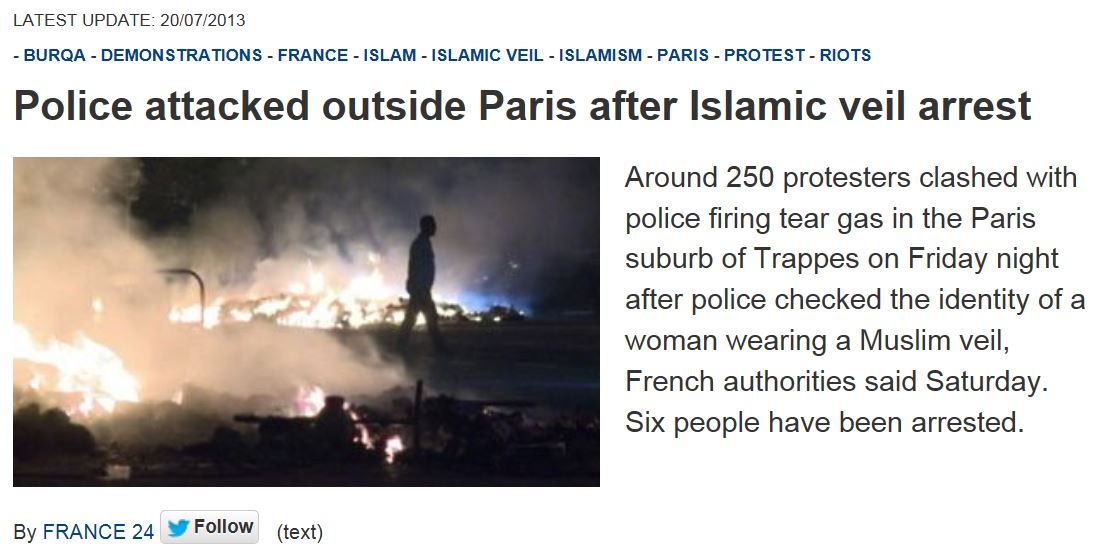
Before we look at the background, we will briefly review the initial incident and the unrest it sparked. We begin with an excerpt from Police attacked outside Paris after Islamic veil arrest, July 20, 2013:

Husband of veiled woman 'tried to strangle police officer'

The clashes were apparently sparked by the arrest on Thursday of a man accused of assaulting a police officer after his wife was stopped for wearing a full-face veil – illegal under French law.

"Her husband reacted in a hostile fashion, insulting and hitting the policeman," Jean-Marc Galland, a senior official for Yvelines département (region), where Trappes is located, told Reuters. "The man was placed in custody for that reason."

"On Friday, there were demands for clarification from people in the town who did not understand the arrest," he added.

Mr Lesclous later told reporters that the man had in fact attempted to strangle one of the police officers during the altercation.

However, The Collective Against Islamophobia in France (CCIF) published a statement on its website on Saturday, claiming to be from the wife of the arrested man, in which she accused the police of being abusive and using unnecessary force.

For its part, the CCIF has an introduction to this woman's version of the events under the title The islamophobic wave is increasing, dated July 20. I have reproduced the commentary as is; there are a few minor formatting and spelling errors.

CCIF has been refered a case by Hajar, a young lady victim of a strong-arm identity checking by national police in Trappes (Yvelines). During this identity checking, her husband has been abused and put into custody because he dared to protest against the violent and provocative behaviour of the police agents.

Here is her story:

"I am refering to you because I suffered from a police abuse. They wanted to control me because I wear the full-veil. As usual, I complied to this identity checking. I was about to lift my veil when I saw police agents violently pushing my mother.

I told the other agents to take a look of what their colleagues were doing, that it was unacceptable, that they shouldn't touch my mother who had nothing to do with this control. One of the agents got suddently very angry against my husband just because he said (concerning my mum): " Don't touch her! Why do you touch her knowing she has nothing to do with this control?"

The policeman then replied to my husband, in a very aggressiv and scornful way:"What are you gonna do?" I intervened between them in order to prevent things from becoming ugly.

Once the policeman was done with my mother, he came to me and made big gestures in front of my face while speeking very rudely. Threatened, I asked him to be quiet.

Then he grabbed me by the head of my veil and dragged me with a dreadful strengh to press me on the hood of the car, while yelling: "You're talking to me?? You're talking to me??"

Needless to say, the woman's husband was taken into custody. Allegedly, the police taunted these people, and continued to do so, even after the husband was handcuffed and in the car.

What is interesting is the allegation by this woman that the police had initially pushed her mother, and that the woman's husband moved to the defense of his mother-in-law. I do not recall seeing these allegations in other coverage of the initial incident, though, admittedly, I have not looked through all of the vast amount of coverage the situation has received.

If the Muslim woman's allegations are true, it is understandable how her husband might have reacted in a less-than-compliant way. It is also worth noting that this is likely a rather conservative Muslim family, since not all Muslim women wear the full facial veil. It is provocative in fundamentalist Muslim culture for males who are not related to a woman to see her - that is why she wears a full facial veil - and it is even more provocative for these males to then actually touch her and other women in her group.

CCIF has another statement, placing the matter into context. From Serial islamophobic aggressions: the involvement of Police forces in Trappes (Yvelines), July 20, 2013; again, I have not cleaned up the passage, but the formatting is as it is in the original:

For several weeks now, violence toward french Muslim women is increasing in a very serious way. On Friday 19th of July, CCIF (Collective against islamophobia in France) has been refered a case by Hajar, a young lady victim of a strong-arm identity checking.

During this identity check by the police, her husband has been abused and put into custody because he dared to protest against the violent and provocative behaviour of the police agents.
He will be heard by a judge today, Saturday 20th.

Like in other cases, the role of the police is questionned but Police Unions have rushed to make statements to exempt their colleagues of any responsability. And yet, there has been so far no investigation.

CCIF once again deplores the mass media covering of this case that, as in other cases, put the words of Police Unions above all suspicion, without even checking the facts. Once again, the Muslim protagonists are immediately suspected.
Mulims are systematically assumed guilty.

As in other recent cases, victims undergo a double injury: the physical and verbal violence and the systematic change status, from victim to culprit.
In France, racism and islamophobia are now cleary institutionalized and legitimized.
On this identity checking that turned ugly, several witnesses are reporting the use of physical abuse from the police toward someone who was actually cooperating. (Hajar indeed complied to the control)

Even if things did not happen exactly the way the woman and CCIF allege, something even remotely close to the alleged behavior would be considered highly provocative by a conservative Muslim family.

And this brings us to the key issue: increasingly, the Muslim community in France (and elsewhere) does not see itself as a part of the local culture, but rather, seeks to keep its own culture. This is far from the "melting pot" that we were taught was American culture during the heyday of European immigration roughly a century ago. Skipping down in Police attacked outside Paris after Islamic veil arrest, we get one public figure's perspective on the violence::

'Mass immigration' to blame, says Le Pen

Meanwhile, Marine Le Pen, leader of France's far-right National Front party, was quick to blame Friday's violence on what she called "the rise of a harmful communitarianism exacerbated by mass immigration" in France.

She claimed that those involved in the riots were attempting to "demonstrate through violence that they have taken control over large parts of the Republic".

"It is high time to ... organise the reconquest by law and order of each square metre of the national territory," she commented in a statement.

"Governments must stop trembling before thugs and finally stand up to them with total inflexibility and extreme firmness."

Le Pen's reference to a lack of control and a lack of law and order in certain parts of France is very interesting.

France has places called Sensitive Urban Zones (ZUS) - over 700 within mainland France. Ostensibly, these are areas that have some kind of social problems such as high unemployment, a low rate of high school graduation, or lack of home ownership, but the reality is that these are basically police no-go areas. The existence and location of these ZUS is not a secret; France maintains a website identifying them, including maps: Atlas des Zones urbaines sensibles (Zus).

The unrest addressed above occured in Trappes, just southwest of downtown Paris; it is the pink area next to the A in lower-left corner of the image from Google Maps below:


Here is a close-up of that area:


It just so happens that the area just to the left of the A in the map above is ZUS546:


Another term one hears is the reference to an area as a banlieue, which could be translated as "suburb", and, indeed, if one were to glance at the map and compare it to the map of an American city, it looks like Trappes is a suburb of Paris.

However, the word "banlieue" has a slightly different connotation. It tends to refer to areas of low-income housing, or perhaps government housing; it may be more appropriately translated as "slum" or "housing project", depending on the specific situation.

Regardless of the word one uses to describe the area, it is one of the over 700 areas in mainland France where French authorities are unable to effectively enforce French law without a violent reaction from the locals - a reaction which can easily spread to the other hundreds of such areas, as has happened in the past. For example, in 2005, an incident in which Muslim youths were hiding from the police in a power substation and there electrocuted themselves sparked unrest which, within ten days, had spread to well over 200 locations in France. Banlieues, sensitive urban zones, no-go areas... others refer to these areas simply as Muslim Ghettos.


But, what do you think this story may have in common with the other story I began with my previous post?

More to follow.

Sunday, June 12, 2011

Truth and Reconciliation, Part 5

First, you may wish to review Part 1, Part 2, Part 3, and Part 4, all of which are the latest posts under the label Ivory Coast.

In particular, in Part 3, I stated the following:

Ouattara's policies, acting as IMF frontman and Prime Minister in Côte d'Ivoire many years ago, helped generate the very crisis that led to the civil war which, in turn, led to a de facto partition of Côte d'Ivoire in the wake of the civil war there a few years back. This partition only ended when a disputed election was settled by international force in favor of a man who would do the bidding of the foreign powers that backed him militarily and diplomatically.

The international puppetmasters sent in their man, he did their dirty work, and they rewarded him by giving him a presidency 1) which he was not eligible for, 2) which he won in a dirty election, and 3) which was enforced only by military power of neo-colonial forces operating under the auspices of the UN.


Furthermore, the conduct alleged of Ouattara's backers then is the same kind of thing we are seeing today.

And, at the end of Part 4, I made this statement:

US government sources show Gbagbo and his closest people were basically free of narcotics-related corruption, while Ouattara has a reputation for looting Côte d'Ivoire to enrich himself and his associates.

Who controls the mainstream media? Who manipulates the international community? Because these people are telling us a very slanted story about what is going on in Côte d'Ivoire today, and they're not telling us certain aspects of Côte d'Ivoire's history.

And, by controlling what we learn today about what happened yesterday, they set the stage for colonialistic/imperialistic exploitation of Côte d'Ivoire in the future, under their puppet Ouattara.

Indeed, Ouattara is selling Ivoirians into slavery.

Now, we review an excerpt from a UN report entitled Transnational Organized Crime in the West African Region, dated 2005; the excerpt is from page 8 (17 of 48 when you download the pdf):

In countries where a full-scale war develops, such as Sierra Leone and Liberia, it becomes difficult to distinguish between organized crime and political violence. There are now disturbing signs that a similar evolution may be taking place in Côte d'Ivoire. The robbery of a bank in Bouake, a town under control of the rebel Forces nouvelles movement [Guillaume Soro was secretary general of this group at the time; these guys put Ouattara in power this year - EL], reportedly organized by one of the leaders of the rebellion, and a major bank hold-up in Abidjan in 2002 that is also believed to have been organized by a future leader of the insurrection, make clear not only the close connection between political violence and crime, but also suggest the formation of a nexus of political disorder that provides a suitable environment for organized crime, creating a triangular logic of disorder, violence and crime in which each becomes a corollary of the other.

A similar phenomenon, we have mentioned, has been noted in Senegal, where the gendarmerie reports the export of marijuana from the Casamance region, favoured by conditions of low-intensity conflict, towards other parts of the region.26 Not only does the organization of armed struggle require financing, which increasingly may come from criminal activity,27 but in extreme cases the State itself may come under the control of professional criminals. Some observers would consider this to have been the case of Liberia under the presidency of Charles Taylor, from 1997 to 2003. The rebellion of the Revolutionary United Front (RUF) in Sierra Leone has often been presented in such a manner. A Sierra Leonean police officer notes the significance in this regard of the RUF's having obliged the legitimate government of the country to share power, allowing the RUF's leader, Foday Sankoh, to occupy a position equivalent to that of a vice president and gaining control of the precious minerals department of the government.28 The Sierra Leonean president, Ahmed Tejan Kabbah, has represented the war in his country as a criminal enterprise on a national scale.29 Indeed, the Sierra Leone police reports that members of the Armed Forces Ruling Council, the junta that had power in 1997-1998, themselves pioneered the use of Sierra Leone as a transit point in the international drug trade.30 In such cases, distinctions between crime and legitimate activity become difficult, since the authorities responsible for enforcing the law of the land may themselves be organizers of criminal activity.

What is described above is something known as "State Capture" - where organized crime takes over an entire state.

Next, we condiser an article entitled Côte d'Ivoire: is cocoa money propping up Gbagbo regime?, from January 26, 2011:

Companies exporting from Côte d’Ivoire must publish information on taxes paid into the country's cocoa sector, and respect the temporary ban on exports announced this week by president-elect Alassane Ouattara, said Global Witness today. The embargo comes amid fears that the incumbent Laurent Gbagbo – who refuses to recognise Ouattara's November election victory – is using cocoa money to preserve his grip on power.

Global Witness's 2007 report, Hot Chocolate, exposed how money from the international cocoa trade had financed both rebels and government loyalists in the country's civil war from 2002-03. The rebels continue to control the north of the country, with Gbagbo loyalists – who rejected Ouattara's November electoral victory – ruling over the south. Concerns about the cocoa sector have not gone away, and there are now concerns that Gbagbo may now be using the industry to finance his activities, as fears grow that the country could see a return to war.

The EU has imposed sanctions on Mr Gbagbo and his allies following reports of systematic killings of groups considered loyal to Mr Ouattara. However, he was until recently able to access Ivorian state funds held at the Central Bank of West African States (BCEAO). The governor of the BCEAO was forced to quit last week after reportedly allowing Gbagbo's government to withdraw at least $140m from state coffers(1).

Mr Ouattara's ban on exports is an attempt to restrict the cash flow to Mr Gbagbo and his supporters.

"The army's loyalty allows Gbagbo to maintain his stranglehold on the Ivorian state, and it needs to be paid," said Daniel Balint-Kurti, Campaigner at Global Witness. "Cocoa taxes have long been a major source of funds for his regime, and there's a danger money stolen from the sector is being used to fund the militias now terrorising parts of the population."

In December 2010, Global Witness wrote to several cocoa companies to make them aware of our concerns that their payments could be diverted and ask what policies they have in place to prevent this. We are awaiting their reply.

"Companies should now respect the ban and immediately publish the taxes and levies they have paid on cocoa, so that this money can be properly traced," added Balint-Kurti.

Of course, publishing information about what taxes and levies paid would allow the authorities to track down whoever received that money.

The "authorities" right now are Ouattara's gang of thugs.

As the excerpt above points out, "money from the international cocoa trade had financed both rebels and government loyalists" - how determined are Ouattara's "authorities" going to be to trace the money that leads back to themselves? There will only be investigations to determine who supported Gbagbo, so revenge can be served.

We now look at an excerpt from Cocoa speculators cash in on Côte d'Ivoire conflict by Khadija Sharife, dated May 12, 2011:

Some weeks ago, a Pambazuka article written by Pierre Sané, former secretary general of Amnesty International, disclosed the relations between Côte d'Ivoire’s new president, Alassane Ouattara, and Loïc Folloroux, stepson of the head of cocoa and coffee-trading Armajaro's Africa division. Outtara's banning of cocoa exports was seen as serendipitous to the company's fortunes, particularly Armajaro's leading cocoa speculator, Anthony Ward.

It is Ouattara, not Gbagbo, who was closely tied to those who make money off the ups and downs of cocoa exports from Côte d'Ivoire.


We now consider excerpts of French Commentary Examines Sarkozy's Personal Ties with Cote d'Ivoire's Ouattara, April 13, 2011

"A friend of Sarkozy:" Laurent Gbagbo attaches this label to Alassane Ouattara to stigmatize him, as supposed evidence of a "conspiracy" by the former colonial government against the former president, arrested Monday 11 April. However, far from concealing it, the incoming Ivorian head of state boasts of it: "Nicolas Sarkozy is an old friend," he has kept saying in recent months. "If I have five or six real friends in the world, he's one of them," he told L'Express in January, and Mr Ouattara, a former IMF official, said on Canal Plus that he is also friends with Dominique Strauss-Kahn and Laurent Fabius. "Ever since 28 November (the date of the election result -- Le Monde editor's note,) he has spoken with Nicolas Sarkozy by telephone every day," a source close to the Ivorian president told Le Monde.

Sarkozy, the President of France, manipulated the UN to get the green light for French troops to lead the charge to install his "old friend" Ouattara - an IMF front man and friend of Strauss-Kahn (the former IMF boss and accused rapist with a reputation of womanizing) as President of Côte d'Ivoire. So, abuse of power is rampant in these circles.

The story of this "friendship" begins in 1990. Mr Ouattara, then prime minister under Houphouet-Boigny, the authoritarian "father of the nation" approaching the end of his rule, negotiated the privatization of water and electricity management in Cote d'Ivoire. He chose to grant the 15-year concession to Martin Bouygues, a close friend of Nicolas Sarkozy, a business lawyer. Mr Bouygues became close friends with Mr Ouattara.

The use of political power for personal profit is also not unknown among these guys.


Skipping past the details of Ouattara's wife and her connections to people in power, including to Sarkozy, we get to the part where Ouattara helps Sarkozy rape Côte d'Ivoire nearly two decades ago:

Via Martin Bouygues, Nicolas and Cecilia Sarkozy became close friends of Alassane and Dominique Ouattara. Politics and business only strengthened the couples' friendship: in 1993, Mr Ouattara, then Ivorian prime minister, helped his French counterpart, Edouard Balladur, whose budget minister Mr Sarkozy was, to proceed with the painful devaluation of the CFA franc.

Read all of French Commentary Examines Sarkozy's Personal Ties with Cote d'Ivoire's Ouattara - it's a real soap-opera of corruption connecting Sarkozy to Ouattara.

We now consider an excerpt from HRW urges Ivory Coast to investigate human rights violations, war crimes, dated April 10, 2011, by Carrie Schimizzi, reproduced with links found in the original:

[JURIST] Democratically elected Ivory Coast President Alassane Ouattara should investigate "atrocities," including murder and rape, committed by opposing political forces during recent conflicts, a Human Rights Watch (HRW) [advocacy website] report [press release] requested Saturday. According to the report, forces loyal to Ouattara, known as the Republican Forces of Cote d'Ivoire, killed more than 100 civilians, raped at least 20 supporters of rival Laurent Gbagbo [BBC profile] and burned at least 10 villages over the past month.

The article also points to accusations against Gbagbo's forces - but, that is really irrelevant, isn't it? I mean, the media tells us daily that Gbagbo was the "strongman" who refused to yield power to democratically-elected Ouattara, etc. But these allegations shown above are of atrocities committed by Ouattara's forces.

So, the darling of the international media, friend of Sarkozy, our knight in shining armor come to slay the dragon of despotism and restore democracy to Côte d'Ivoire - it's his forces implicated in war crimes?

From UN Reports on Murder and Rape in Ivory Coast dated June 10, 2011:

United Nations investigators have found evidence that crimes against humanity may have been committed in Ivory Coast both by forces loyal to the West African country's ex-president Laurent Gbagbo and by forces loyal to his opponent and successor, Alassane Ouattara.

Three investigators were sent to Ivory Coast by the United Nations Human Rights Council in May. Their job was to probe alleged attacks against the population since the country's presidential election last November.

What they found, the panel said Friday, was evidence of possible crimes against humanity having been committed on both sides of the political divide.

They said rape and murder were carried out through generalized and systematic attacks, targeting people based on their assumed political sympathies.

The investigator's report is set to be discussed at the Human Rights Council next Wednesday and until then they have declined to speak with VOA about its findings.

But they're not the first to say that forces loyal to Ivory Coast's current leader, Alassane Ouattara, may have committed major crimes in recent months.

The international rights groups Human Rights Watch and Amnesty International have both accused Ouattara's followers of targeting suspected supporters of former leader Laurent Gbagbo.

Deputy Director for Africa at Amnesty, Véronique Aubert, says that Ouattara must bring the situation under control. "He's the president and that's why we expect him to issue clear public instructions to security forces to comply with Ivorian law and international human rights law," she said.

Crimes against humanity - committed by Ouattara's forces.


We now go back in time one day to review an article entitled Ivory Coast crisis: Alassane Ouattara forces accused, dated June 9, 2011:

The United Nations has accused forces loyal to Ivory Coast's President Alassane Ouattara of unleashing violence against supporters of former President Laurent Gbagbo.

The troops killed two people and wounded dozens of others during attacks in the south and west, the UN said.

It said many residents fled to forests, leaving villages empty.

Mr Ouattara was sworn in last month, promising to end months of conflict.

The UN human rights officer in Ivory Coast, Guillaume Ngefa, demanded an immediate and impartial investigation into the attacks.

He said Mr Ouattara's forces targeted the village of Becouesin, 50 km (30 miles) north of the main city, Abidjan.

"Along the way, they beat a person who later died from his wounds," said Mr Ngefa.

After accusations that Ouattara's forces hacked at people with machetes, the article concludes:

The violence in Ivory Coast was triggered by the refusal of Mr Gbagbo to cede power and accept Mr Ouattara's victory in presidential elections last year.

At least 3,000 people were killed in the conflict.

The international community and the international media are still sticking up for their frontman, Ouattara.

The violence was not triggered by the refusal of Gbagbo to cede power; it was triggered by the decision to install Ouattara by force of arms, rather than handle the disputed election in accordance with Ivoirian law.

This decision was made by a transnational criminal cartel that includes French President Sarkozy.


Ouattara, not Gbagbo, is the criminal here - and he has been for decades.