Showing posts with label Ivory Coast. Show all posts

Monday, July 23, 2012

Truth and Reconciliation, Part 6

We continue with our series entitled "Truth and Reconciliation". In the sidebar to the right, below the images, are the indices to my multipart series. Côte d'Ivoire has its own section, of which "Truth and Reconciliation" is the second series. I will assume a certain degree of familiarity with those posts, however this post will refer with links back to key themes in previous posts. Ideally, the reader should go through those other posts, in order, then rely on the references in this post to help put everything together.

I will examine recent reports in a roughly chronological order.

First, we look at excerpts from COTE D'IVOIRE: Former pro-Ouattara rebels still need reining in, December 30, 2011:

ABIDJAN, 30 December 2011 (IRIN) - Eight months after President Allassane Ouattara assumed office at the end of a prolonged civil conflict, peace remains fragile amid abuses and killings by former rebel fighters who once provided him support.

Ten civilians were killed and about 15 wounded this month in fighting between the former rebels, which now form part of the national army, and civilians in Vavoua, west-central Cote d'Ivoire, and in Sikensi in the south.

In a statement on 29 December, the UN Operation in Côte d'Ivoire (UNOCI) called on the government to stop the violence. "UNOCI encourages the Ivorian authorities to implement the tough measures they announced and to strengthen discipline" within the Republican Forces of Côte d'Ivoire (FRCI), UNOCI spokesman Hamadoun Touré said.

He said UNOCI remained concerned about the "numerous violations of human rights attributed to FRCI in several parts of the country which have led to the reactions by residents of the affected communities." He cited cases of arbitrary arrest and illegal detention in Abidjan, the commercial capital.

Adding to this, Ivoirian Human Rights League President René Legré said: "We note that despite the promises to ensure security, there has been no progress. People are still armed."

He said the unrestrained behaviour by FRCI soldiers was beginning to anger the public, which would defend itself.

"We fear that the day will come when people will no longer respect the army," he added.

Following the Vavoua incident, Ouattara ordered the soldiers to return to barracks but they refused.

[snip]

Describing the government's response to the insecurity as "state impotence", Legré said many soldiers in villages and towns which his team had inspected appeared to be taking orders from outside the official military structure. Moreover, he quoted solders as saying that since the government was not paying them salaries, they would pay themselves by abusing the public.

In L'Abidjanaise, Part 8, we took a close look at how the forces suppporting Ouattara were becoming splintered and indisciplined. To be sure, one report quoted blamed that on strict implementation of previous peace accords by Gbagbo, as a calculated strategy to frustrate and divide the opposition. However, I pointed at reasons to suspect this warlordism was being provoked as part of someone's strategy to destabilize certain governments in the region.

It was obvious at the time the Ouattara's supporters included many local strongmen and thugs. Looking back now, I wonder if Gbagbo wasn't just using the best strategy he could against what he knew to be an internationally-manipulated coalition of criminal gangs allied against him.

In any case, it is clear now that Ouattara does not command the forces that backed him. Throughout my posts on the situation in Côte d'Ivoire, I have pointed out Ouattara's connections to the IMF, to former French President Sarkozy (see Truth and Reconciliation, Part 5), the appearance that Côte d'Ivoire is being set up to be raped by France, and the indiscipline and brutality of Ouattara's troops (see Truth and Reconciliation, Part 1).

I have also pointed out (for example, see L'Abidjanaise, Part 4) similarities to the situations elsewhere. In Serbia's Kosovo and in Libya, we have seen armed militants seek to overthrow the internationally-recognized government. The situations in Serbia, Libya and Côte d'Ivoire are different, but they have common themes, namely that the international community supported the militants, including militarily, to bring about a new government. In the Balkans, Serbia was partitioned, and its historic province of Kosovo was declared by the international community to be independent, under control of a government known for connections to transnational terrorism and organized crime. In Libya, a Pan-Africanist leader who resisted European economic domination of Africa was ousted by force. In Côte d'Ivoire, under the auspices of the UN, the French government placed a close friend of the then-President of France in power by force, and with a great deal of indiscriminate killing of Ivoirians (see Côte d'Ivoire and 2012).

Given the insecurity described above, and the fact that Ouattara's forces are involved in brutalizing civilians rather than protecting them, the UN felt it had to respond to security concerns. So, we now consider excerpts from UN expert urges continued support for Côte d'Ivoire following deadly attack, June 13, 2012:


13 June 2012 –

A United Nations independent human rights expert today urged all Ivorians and the international community to maintain their support for Côte d'Ivoire's national reconciliation in the aftermath of an attack last week which killed seven UN peacekeepers, eight civilians and one Ivorian soldier.

"This attack, through its magnitude, constitutes a major challenge for the Ivorian people and the international community," the UN Independent Expert on the human rights situation in Côte d'Ivoire, Doudou Diène, said in a news release.

[snip]

According to preliminary reports, on Friday, 8 June, peacekeepers serving with the UN Operation in Côte d'Ivoire (UNOCI) were on patrol in the proximity of Para village, near the town of Tai, located in the country's south-west near the Liberian border, when they were attacked by a group of unidentified armed elements.

The peacekeepers were deployed in the area in response to concerns about the safety of local residents.

[snip]

[Mr. Diène] also called on the international community to speed up the adjustment of the country's arms embargo in order to enable the Ivorian Government to respond proportionately to threats to the security of its population, and to ensure that its security forces remain committed to upholding human rights.

How convenient! UN troops are deployed to respond to security concerns, they are attacked, and the attack is used as justification to "speed up the adjustment of the country's arms embargo" - in other words, to arm Ouattara's forces, who themselves are guilty of many of the atrocities, hoping they will provide security.

But, one thing doesn't make any sense.

From UN destroys hundreds of small arms and light weapons in Côte d'Ivoire, July 13, 2012:
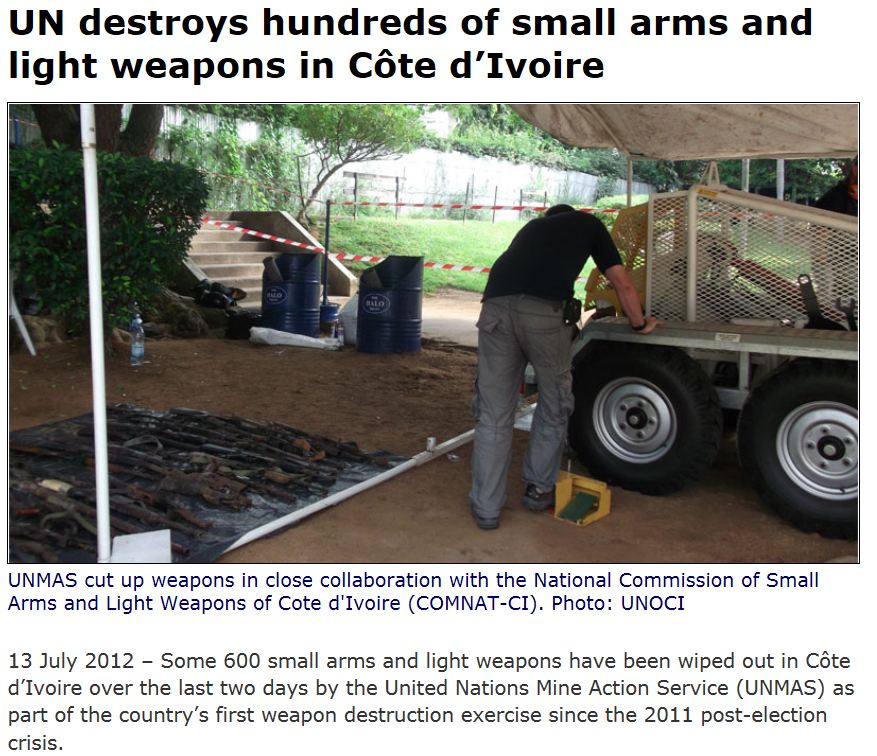

13 July 2012 –

Some 600 small arms and light weapons have been wiped out in Côte d'Ivoire over the last two days by the United Nations Mine Action Service (UNMAS) as part of the country's first weapon destruction exercise since the 2011 post-election crisis.

[snip]

The arms were collected by UNOCI staff working in disarmament, demobilization and reintegration (DDR) of ex-combatants during ad hoc weapon collection operations across the country.

[snip]

According to UNMAS, since July 2011, COMNAT-CI [National Commission of Small Arms and Light Weapons of Côte d'Ivoire] has conducted 36 ad hoc weapon collection operations across the country, with UNOCI's support, recovering 1,811 weapons and 316,600 munitions. This weaponry is collected and stocked in different military bases of UNOCI.

On the one hand, the authorities want to "speed up the adjustment of the country's arms embargo", but on the other hand, they are destroying arms.

Why?

My bet is that the people who are being disarmed are the supporters of ousted President Gbagbo, and ordinary people who just want to protect themselves.

We already established that Ouattara has little control over his own supporters, so we know they are not surrendering their weapons. But, they would probably collaborate in disarming anyone other than themselves, because that would make it easier for them to "pay themselves by abusing the public."

And, keep in mind that Ivoirians had already said back in December that the public would defend itself... this is unacceptable to foreign powers who have conspired with local warlords to steal an election and install a "president" who is ineligible under local law for the presidency.

Meanwhile, let's look at the economic situation. We examine excerpts from Ivory Coast Resumes Payments on Its Defaulted Eurobonds, June 15, 2012 (see original for links which I did not reproduce):

Ivory Coast, the world's largest cocoa producer, said it has resumed coupon payments on $2.3 billion of defaulted Eurobonds for the first time since January last year.

The country told the Central Bank of West African States, which represents Ivory Coast and a number of other former French colonies, to transfer $45 million to meet scheduled June coupon payments on June 12, Adama Kone, head of the nation's public treasury said by phone yesterday. The dollar bonds gained for a second day, jumping 1.6 percent to 72.375 cents on the dollar as of 11:23 a.m. in London, according to data compiled by Bloomberg.

The Eurobonds due 2032 have surged 50 percent this year after the government of President Alassane Ouattara pledged to bondholders in January that the June payment would be made. The government of ousted President Laurent Gbagbo halted payments following a post-election crisis in November 2010.

[snip]

Ivory Coast dollar bonds have returned 44 percent so far this year, the best performer and beating an average return of 6.5 percent, according to the JPMorgan Chase & Co. EMBI Global Index. Venezuela had the second-highest gain with a 15 percent.

As I predicted in L'Abidjanaise, Part 6, the value of holding Côte d'Ivoire's debt is zooming up relative to where it was during the crisis: an excellent financial opportunity for those who engineered this situation and thus knew how it was going to play out.

But, let's put this in some kind of context.

A confidential report (normally I provide links; this time, you'll have to get it yourself) entitled "Côte d’Ivoire: Stability Restored, Difficult Road Ahead", dated May 15, 2012, had this to say on page 4:


Medium terms prospects for the Ivorian economy should improve as political stability is established and the business environment improves. As it is the case in many other African countries, Cote d'Ivoire has a large natural resources endowment which has not been fully tapped. The country still accounts for more than 40% of the world cocoa production. Gold production has also been expanding over the past few years and reached 870 metric tons in 2011 (up from 94 MT in 2007). Oil prospects also look good, and a turnaround in production, which fell from a peak of 62,000 barrels per day (b/d) in 2006 to 40,000 b/d last year, is possible. To encourage oil companies to invest in new exploration, the authorities announced their intention to introduce significant amendments and reforms to the current hydrocarbon legislation during 2012 H1.


In addition to a big slice of the world cocoa market, and significant coffee production, there is a great deal of gold and other mineral wealth at stake; in L'Abidjanaise, Part 4 we also mentioned diamonds.

But, what about oil? Côte d’Ivoire Oil Industry by Carolyn Avery, IAS Group, dated April, 2010, starts off:

Côte d'Ivoire is a modest oil producer and an important regional refiner with ambitious plans to play a more central role in West Africa's petroleum product market. The Gbabgo administration’s goal is to more than double production to 200,000 barrels per day within the next few years, and to bring a second refinery on line. Recent oil discoveries along the Gulf of Guinea may lead to a substantial reevaluation of West African, including Ivorian, reserve estimates. The discovery in 2007 of up to 1.8 billion barrels of recoverable oil in the Jubilee field off the coast of Ghana has prompted Jubilee operator Tullow Oil to intensify its exploration of neighboring Côte d'Ivoire's coast, which has yet to be thoroughly surveyed1.

A "substantial reevaluation of West African, including Ivorian, reserve estimates"...

Skipping down to page 5 in "Côte d’Ivoire: Stability Restored, Difficult Road Ahead":

FISCAL POSITION WORSENED

Political divisions during the past decade hampered tax collection in the northern region and undermined fiscal performances. Nonetheless, the authorities have been able to limit fiscal deterioration, and from 2002 to 2010 the deficit averaged 1.2% of GDP.

In other words, Ouattara's forces in the north, who were supposed to have disarmed but didn't, would not cooperate with Gbagbo's government in the south. Despite this, Gbagbo was able to keep things from spiraling out of control.

When you consider the data, though, it becomes more interesting.


What jumps out at me from these charts is that, under Gbagbo, the value of the 2032 Eurobond was going up, and external Ivoirian debt as a percent of Ivoirian GDP was going down.

Somebody just couldn't have that, could he?

I highly encourage you to read this entire article: France And The Ivory Coast-The Empire Strikes Back by Dr. Gary K. Busch, December 16, 2010. Here is an excerpt:

In summary, the colonial pact maintained the French control over the economies of the African states; it took possession of their foreign currency reserves; it controlled the strategic raw materials of the country; it stationed troops in the country with the right of free passage; it demanded that all military equipment be acquired from France; it took over the training of the police and army; it required that French businesses be allowed to maintain monopoly enterprises in key areas (water, electricity, ports, transport, energy, etc.). It is difficult to imagine what the changes were from colonial rule to today that aren’t merely cosmetic.

The civil war which broke out between the North and the South in the Ivory Coast was largely about the efforts of the Gbagbo government seeking to achieve real independence; a breakaway from the colonial dominance of the French which controlled almost every aspect of national life.

Gbagbo's history, going back decades, is one of a man looking out for the best interests of his country, seeking to help the little people, without demonizing those who were successful. His history as a statesman is that of a man who was willing to make every compromise possible in the interests of peace, without selling out the nation he represents.

The accusations of war crimes, for which Gbagbo is now detained and on trial, revolve around events during the unrest provoked by Ouattara and Ouattara's international puppetmasters as they sought to illegally seize a presidency for a man who was ineligible, so that that man, Alassane Ouattara, could open the nation up to further neocolonial exploitation by France which was, at the time, being run by Ouattara's close friend Nicolas Sarkozy.


That is the truth.

As this series continues, we will look at reconciliation.

Friday, November 25, 2011

Men of Integrity, Part 2

In Part 1, we considered a brief recent history of Burkina Faso. Highlights included how Thomas Sankara led a military coup in 1983 (one of a series the country had seen), seizing power with the help of his friend Blaise Compaoré. Sankara established a Castro-style revolutionary government, complete with revolutionary committees and torture, defying the powers of international bankers and French neo-colonialists. Sankara was trying to establish Upper Volta, as the country was then known, as a truly independent nation - independent of the manipulating foreign powers that seek to keep so many African nations subdued.


Compaoré murdered his childhood friend, seizing power in 1987 in a country that Sankara had renamed "Burkina Faso", and began to align his country's policies more closely with the goals and desires of these international puppet masters. As a result of Compaoré's new policies, Burkina Faso supported bands of armed thugs who stirred up trouble in Sierra Leone and Liberia, as well as in neighboring Côte d'Ivoire, where strongman Alassane Ouattara, a fellow Burkinabé countryman, was this year installed as "president" with assistance from French military power operating under UN auspices, and in violation of Ivoirian law.


Guillaume Soro, another Burkinabé who owns very nice houses ;) in Burkina Faso and France, is one of Ouattara's chief lieutenants in what I might call an occupation of Côte d'Ivoire.


So, what we have is an obvious attempt by foreign powers, including neo-colonial France and international bankers, to use the power they have consolidated in Burkina Faso to spread their influene throughout western Africa, with their most recent conquest being Côte d'Ivoire.

Needless to say, relations between Compaoré and Ouattara are cordial. The text of Burkina Faso: President, Ouattara Aim to Boost Ties, November 18, 2011:

Burkina Faso's President Blaise Compaore, who backed Alassane Ouattara during Ivory Coast's political crisis, hosted a joint cabinet meeting with the Ivorian leader Friday to boost bilateral cooperation.

Compaore said the joint meetings were designed to foster stronger integration between the neighbouring west African states.

Speaking at the opening ceremony, Compoare added that he was "happy about the return of peace and institutional stability in our sister republic, Ivory Coast".

Compaore was firmly behind Ouattara in the impasse that arose from the November 2010 elections, when Laurent Gbagbo refused to accept he had lost, although Compaore's mediation efforts appeared to achieve little.

The crisis ended with the arrest in April of Gbagbo, whose resistance gave rise to clashes that left thousands dead.

At the joint meeting, Ouattara thanked Burkina's leader for his "personal involvement ... in the denouement of the Ivorian crisis".

Some three million Burkinabe work in Ivory Coast, mostly on cocoa plantations.

An estimated 80,000 Burkinabe fled Ivory Coast during the country's political unrest. - ANP/AFP

But, the main thing they are working on bilaterally is the consolidation of power.

For some background, we consider an excerpt from COTE D'IVOIRE: Barakissa Ouédraogo, "We must talk, otherwise we’ll keep killing one another", from earlier this year:

OUAGADOUGOU, 4 July 2011 (IRIN) - As Ivoirian and international officials discuss truth, reconciliation and trying those suspected of war crimes, Barakissa Ouédraogo, one of more than 100,000 Burkinabé who fled Côte d'Ivoire for Burkina Faso during the post-election violence, says helping families rebuild destroyed homes would do more to foster stability.

Ouédraogo said she regularly received death threats and that Burkinabé friends in Côte d’Ivoire were killed and maimed. "The violence just got to be too much - so many killed, so many injured. We had to flee." She said presidents come and go, and that it is the people who must decide not to let politics lead to killing. Ouédraogo was born in Côte d’Ivoire, where Burkinabé have lived for generations. Having fled to Burkina in January, she recently returned to Abidjan's Abobo District to assess the damage at her shelled home.

"I think these truth and reconciliation processes are just theatre, decoration. If you ask me, the money that would go into organizing such things could be used to fix holes in roofs, to help families who are really destitute. If you see your home repaired, you get some relief. Whatever your ethnicity, whatever your politics, that would ease your pain. There are still people living outdoors.

"You're going to go to talk to a commission, tell them how your family was killed and you want to forgive, then what? You return to the street because your home is flattened."

One of the main causes of "flattened" homes was the use of French firepower - helicopter gunships, for example - to support Ouattara's thugs as they ousted President Gbagbo. The "truth and reconciliation processes" mentioned, for which another of my series on events in the region is named (see sidebar), is an attempt to whitewash the crimes of Ouattara's thugs and their French allies, and blame everything on Gbagbo's supporters.

So, Burkina Faso under Blaise Compaoré played a key role in destabilizing the region and in particular in overthrowing the legitimate government of Ivoirian President Laurent Gbagbo.

But, as we saw in Part 1, what goes around comes around.

First, we consider the backdrop to the drama that is about to play out in the region. From WEST AFRICA: Sahel the danger zone for food insecurity:

DAKAR, 27 October 2011 (IRIN) - Erratic rains and high imported rice and wheat prices against a backdrop of chronic food insecurity and malnutrition in parts of the Sahel, will leave millions of people at risk of food insecurity, according to the latest crop assessments.

"We are definitely going to have a difficult year," said Patricia Hoorelbeke, West Africa head of NGO Action Against Hunger (ACF), adding that the NGO is considering expanding its food and nutrition programmes in the region.

Food production

Food production is expected to be lower than usual in parts of western Niger, Chad's Sahelian zone, southern Mauritania, western Mali, eastern Burkina Faso, northern Senegal and Nigeria, according to a report by the World Food Programme (WFP) and the Food and Agriculture Organization (FAO), and a separate assessment by USAID's food security monitor FEWS NET.

The link at the end of the passage has some interesting infographics. In the short term (i.e., for the rest of this year) there will be food supply "stress" in Mauritania - fairly distant from Burkina Faso:


But, as 2012 opens, the situation will worsen, engulfing the entire country of Mali (where there are other troubles) and spreading to the other side of Burkina Faso.


As the passage itself indicates, eastern parts of Burkina Faso will become directly affected.

A stressed food supply, caused by drought, has been known to help generate fairly chaotic conditions; Somalia is a classic example of this.

For some additional background on the developing food insecurity situation throughout the Sahelian region of Africa, which includes the area we are considering, I suggest an article by Alex Thurston, published in The Christian Science Monitor, entitled Sahel Grapples with Food Insecurity, November 21, 2011, and cross-posted at Thurston's blog: Focus on Sahelian Food Shortages.

The food insecurity situation is noteworthy in Chad, where there are chronic problems with malnutrition and food shortages, and is of real concern in Niger, already shaded in the graphic above to have a stressed area near its capital, which is near the border with Burkina Faso. Skipping down in WEST AFRICA: Sahel the danger zone for food insecurity:

Returnees from Libya

The return to Niger and Chad of migrants from Libya who previously sent money home to help mitigate crop deficit is already pushing some families into further food insecurity, according to the International Organization for Migration (IOM). "These returns have aggravated extreme poverty and hunger which is affecting more than half of Niger's 2.5 million people threatened with food insecurity this year," said IOM.

While international attention and government involvement has been relatively high in Niger compared to the devastating drought of 2005, Oumarou Lalo Keita, principal adviser to the prime minister, said international agencies have been slow to respond to government appeals for increased aid over recent months as a result of the return of some 90,000 migrants from Libya. "There is clearly cause for concern," he said. Following the 2009-2010 drought, the country does not have sufficient emergency food stocks, he said. "We experience difficulties year-on-year, and there is still a gap between needs and the support we receive."

While governments and aid agencies in West Africa are for the most part well-versed in responding to food insecurity, readiness and capacity is still low in some areas.

Part of the Chadian Sahel and eastern Burkina Faso are not receiving as much international attention, said ACF's Hoorelbeke. "Chadian Sahel is hardly covered - there are not enough agencies there... If there is a situation that we hear very little about, it is eastern Burkina Faso, where we are likely to see a real problem this year," she told IRIN.

The same guys who pull strings in western Africa have been busy in Libya. And now, people returning from Libya are going to be a problem, and not just because they are refugee mouths to feed instead of wage-earners as they were under Gaddafi. From Burkina Faso, Niger - Libya weapons fear, November 14, 2011:

Ouagadougou - Burkina Faso and Niger are concerned about regional insecurity following the conflict in Libya which they fear has led to new arms trafficking, Niger's prime minister said Monday.

"It is a major concern, the trafficking of arms is a real threat to the region," Rafini Briji said on a visit to Ouagadougou.

"The conflict in Libya has created very complicated situations since the arms depots were opened and people from all quarters helped themselves and took them [arms] in all directions," he said.

Briji said Niger and Burkina Faso were worried about armed groups and the concentration of weapons all around their two countries.

In response they have decided to reinforce their co-operation to ensure security in the Sahel-Saharan zone, Briji added.

During a visit to South Africa on Friday, Niger's President Mahamadou Issoufou asked for military aid to help fight armed groups and traffickers, saying the Libyan conflict had aggravated terrorist threats.

Since the overthrow and killing of Libyan strongman Muammar Gaddafi, experts have expressed concern that part of Gaddafi's considerable stock of weapons could end up in the hands of al-Qaeda's branch in North Africa which has bases in the Sahel and is currently holding several foreign hostages.

To be sure, the Sahara/Sahel region was already a crossroads for smugglers moving South American cocaine to Europe, moving Asian heroin to the Americas, and moving arms to anyone with a means to pay for them. But, Libya was well-stocked with arms, and the area is now going to be flooded with weapons - and not just with military-grade automatic rifles.

Perhaps the potential for trouble is why Compaoré's government in Burkina Faso is taking a page from the playbook of Compaoré's childhood friend Thomas Sankara, whom Compaoré murdered to seize power, and trying a new plan to alleviate food insecurity problems. From BURKINA FASO: “Blue revolution” needed to boost dry-season harvest:

OUAGADOUGOU, 17 November 2011 (IRIN) - The Burkina Faso government is attempting for the first time to implement a nationwide dry-season agricultural campaign to counteract possible food insecurity in areas that received poor or erratic rainfall this year. But the government, alongside others in the region, also needs to invest in a "blue revolution" - small-scale irrigation systems to help farmers grow crops in drought-prone zones - says the International Food Policy Research Institute (IFPRI)

Some 146 out of 351 communes across 10 of Burkina Faso's 13 regions were affected by low grain outputs, according to the government's provisional estimates. The regions most affected by poor rains were the northern millet-producing zone, the Sahel, the Centre north, the Centre west, the East and the Centre east.

"At the moment the food security situation is not alarmist, but there are pockets spread out across the country that could be in a critical situation, and that need to be closely monitored," the Deputy-director of the World Food Programme (WFP) in Burkina Faso, Ariane Waldvogel, told IRIN.

One thing is for sure: If food insecurity in and around Burkina Faso develops into a real crisis, this could be the spark that allows all these nomadic mercenaries with all their new Libyan toys to ignite a real flame in Burkina Faso - a country that has in recent months experienced unrest - bringing the troubles that Compaoré helped cause elsewhere home to roost.

Thursday, June 30, 2011

Unity and Faith, Part 4

In Part 1 we had an overview of Nigeria and introduced the various angles of the north/south split in the country. Then in Part 2 we considered some of the various factors in the unrest in Nigeria. Next, in Part 3 we examined the jihad and counterjihad aspects of this unrest a little more closely, encountering reason to suspect Nigeria's security forces of committing excesses, including extrajudicial killings, in dealing with the trouble.


We now review excerpts from 'Nigeria's Taliban': How Big a Threat?, dated July 30, 2009. With the ongoing violence in Nigeria today, it is important to keep in mind this article is from two years ago.

The immediate crisis may be over in Nigeria, but the threat of violence remains. Government security forces today attacked a mosque filled with Islamist militants, killing scores of fighters and forcing more to flee. The militants, blamed for days of violence across the country's north, belong to a group known as Boko Haram, which aims to overthrow the federal government in Abuja and impose a strict version of Islamic law. The sect's leader Mohammed Yusuf escaped the raid along with some 300 of his men, but was later arrested and then died in custody according to police. Four days of clashes, sparked by attacks on police stations and government buildings, have killed at least 300 people.

The Boko Haram leader died in police custody; interesting in light of the allegations against Nigeria's security forces that we considered in Part 3.

Continuing:

Also known as Nigeria's Taliban, Boko Haram formed about eight years ago. A huge government operation against the group in 2004 ended with the police claiming victory. But five years on and the militants are back, stronger and more vicious. In the latest outbreak of violence, in Maiduguri, the capital of northeastern Borno state, militant gunmen assaulted police stations and engaged armored-personnel backed troops.

Africa's most populous country sits on a religious fault line. Its 150 million people are split almost evenly between Muslims in the north and Christians in the south. For many years, the northern Muslim élite have dominated Nigerian politics, using their positions to enrich themselves and their families.

The allegations are that it was a "northern Muslim élite" responsible for much of the corruption.

Skipping down a little:

Over the past few years a new breed of young Muslim activists, most of them educated and from the middle class, have aggressively embraced a stricter version of Islam, rejecting anything Western and Christian.

It seems this sect may have been founded by younger Muslims who were angry at corruption among their parents. Regardless, as if often the case, the terrorist organization has its foundation among educated, middle class Muslims.

The article concludes pointing out the concern that al Qaeda might gain a foothold here, and calling attention to a special place Osama bin Laden had assigned Nigeria in the world's jihad.

A month later, Nigeria's Vanguard reported that Boko Haram ressurects, declares total Jihad:

The Islamic sect Boko Haram has declared total Jihad in Nigeria, threatening to Islamise the entire nation by force of war.

[snip]

WE SPEAK AS BOKO HARAM
For the first time since the Killing of Mallam Mohammed Yusuf, our leader, we hereby make the following statements.

1) First of all that Boko Haram does not in any way mean "Western Education is A sin" as the infidel media continue to portray us. Boko Haram actually means "Western Civilisation" is forbidden. The difference is that while the first gives the impression that we are opposed to formal education coming from the West, that is Europe, which is not true, the second affirms our believe in the supremacy of Islamic culture (not Education), for culture is broader, it includes education but not determined by Western Education.

[snip]

2) That the Boko Haram is an Islamic Revolution which impact is not limited to Northern Nigeria, in fact, we are spread across all the 36 states in Nigeria, and Boko Haram is just a version of the Al Qaeda which we align with and respect. We support Osama bin Laden, we shall carry out his command in Nigeria until the country is totally Islamised which is according to the wish of Allah.

[snip]

Having made the following statement we hereby reinstate our demands:

1) That we have started a Jihad in Nigeria which no force on earth can stop. The aim is to Islamise Nigeria and ensure the rule of the majority Muslims in the country. We will teach Nigeria a lesson, a very bitter one.

[snip]

3) That we shall make the country ungovernable, kill and eliminate irresponsible political leaders of all leanings, hunt and gun down those who oppose the rule of Sharia in Nigeria and ensure that the infidel does not go unpunished.


It is not uncommon that analysts point to economic disparities as a source of the violence in Nigeria. But, the terrorists themselves point to Islamic ideology. Furthermore, at least some of the economic disparity is the fault of a corrupt "northern Muslim élite". Consequently, any analysis that does not factor in jihadist Islamic ideology is inadequate.

Fast forward to June 15, 2011, when an article in the Nigeria Daily News entitled Nigerian Islamist sect, Boko Haram vows fiercer, wider attacks quoted Boko Haram as declaring:

"Very soon, we will wage jihad...We want to make it known that our jihadists have arrived in Nigeria from Somalia where they received real training on warfare from our brethren who made that country ungovernable...," said the group in a handwritten statement.

"This time round, our attacks will be fiercer and wider than they have been," it said, adding it would target all northern states and the country's capital Abuja. The statement in Hausa, a widely spoken language in the North, was anonymously delivered to journalists in the North-eastern city of Maiduguri, capital of Borno State, where the attacks were concentrated.

The sect admitted links with a foreign Islamist group connected to Al-Qaeda, although security experts had already speculated that it had established ties with Islamists in North Africa.

Maiduguri featured in an attack only days later.


From Nigerian Boko Haram Islamists 'kill nurse' in Maiduguri, June 20, 2011:

Gunmen from Nigeria's radical Islamist sect Boko Haram have killed a nurse who was playing cards in the north-eastern city of Maiduguri, according to police.

Police said four people were also wounded in the shooting at a bus stop in the city.

Of interest is the connection to foreign terrorist groups; this is an international Islamic extremist ideology that is manifesting itself locally in Nigeria. Boko Haram's statement specifically mentioned Somalia, and there are reasons to suspect other connections.

First, we look at excerpts from Boko Haram Declares War, dated June 27, 2011:

Few seem convinced by President Goodluck Jonathan's assurances that the security situation is under control following the bombing on 16 June of Louis Edet House, the national police headquarters in Abuja. It killed at least two people and wounded seven. Agents of the United States Federal Bureau of Investigation arrived to help investigate claims of international terrorist links.

[snip]

Some immediate questions emerge from the latest round of attacks: Who is behind Boko Haram? How much foreign support has it got and how can it best be confronted? After downplaying its importance and regional ties for some years, Nigerian security officials now point to cross-border links.

[snip]

It seems their tactics are working: security sources speak of training camps of Hausa-speaking Nigerians in Burkina Faso and Niger as well as a wave of new recruits to Boko Haram across northern Nigeria. It's harder to trace the international links, but some officials are taking seriously claims from Boko Haram that their militants, including bomb-makers, have been training in Somalia alongside Al Shabaab and Al Qaida operatives. There are also small, highly mobile affiliates of Al Qaida in the Islamic Maghreb across the Sahel, which could provide the training and the materiel to launch the type of bombings and guerrilla attacks that Boko Haram favours.

Also, in Part 2 we began reviewing a paper entitled Key Issues in Nigeria's 2011 Elections, dated March 29, 2011, by Sola Tayo. We now pick up with an excerpt from page 7:

Concerns about internal security are common during electoral periods, but the possible action of outsiders is also causing concern within the government. In November 2010 a shipment of arms was intercepted in Lagos. The intended destination of the shipment was unclear, although it is claimed it was to be re-exported to The Gambia. However the trafficked rockets and explosives, which came from Iran, were the responsibility of a Nigerian and two Iranians who have been charged with the importation of prohibited firearms. The incident caused a diplomatic storm which resulted in Nigeria reporting Iran to the UN Security Council for a possible arms violation. Although Nigeria has not severed diplomatic ties with Iran, the relationship (on the Nigerian side at least) is tense.

Whatever the intended destination of that shipment, the Nigerian government is understandably wary of arms shipments entering the country and ending up in the possession of militant groups. It is equally suspicious of direct interference by outsiders. In March 2010 the Libyan leader, Muammar Gaddafi, suggested that Nigeria be split in two to end the violence between Muslims and Christians. His comments provoked a strong reaction from the Nigerian government, with Abuja recalling the Ambassador in Tripoli and accusing Libya of trying to destabilize the country. The issue of partitioning the country into a Muslim north and Christian south is a deeply sensitive subject in Nigeria.

Gaddafi is not the only one to suggest this division of Nigeria; there are calls among Nigerians for a north/south (= Muslim/infidel) "divorce" and I am sure recent events in Sudan will fuel these calls. Also, the situation in Côte d'Ivoire, where a "northerner" of questionable Ivoirian credentials was installed by force by the international community, in violation of Ivoirian law, may set a precedent that worries the southerners in Nigeria.


The arms shipment addressed in the quoted passage above was quite substantial, too.


In fact, it was so substantial that some analysts suggested it was a new way to supply anti-Israeli terrorists forces. From Nigerian arms seizure may indicate new Iran-Hamas route, October 29, 2010.

Weapons discovered in 13 shipping containers in the Port of Lagos earlier this week could signify that Iran is trying to develop a new route to smuggle arms and explosives to Hamas in the Gaza Strip, defense officials said on Thursday.

The ship, apparently from Iran, reportedly docked in the Lagos Port on Tuesday and, according to the bill of lading, was supposed to be carrying construction supplies. On inspecting the 13 containers, customs officials discovered rockets, mortars, bombs, rifles and heavy machine guns hidden among crates of building tiles.

Nigerian officials were quoted in the media claiming that the cargo had been under surveillance for some time. It was possible that the intelligence on the cargo was supplied by Western sources.

"On opening the first container, the service operatives discovered rocket launchers, grenades and other explosives; the weapons were concealed among crates of floor tiles," Nigerian State Security Service spokeswoman Marilyn Ogar was quoted as saying.

The largest rocket appeared to be a 107-mm. Katyusha, which Iran is known to manufacture and which makes up the backbone of Hizbullah's and Hamas's arsenals.

Even if most of the weapons, including the rockets, are intended for Palestinian terrorists, it is not unreasonable to expect that local Nigerian jihadists might take a cut for helping move them.

So, we have Iranian arms smuggled into Nigeria, resulting in an international incident reported to the UN.

But, the report previously quoted above, Key Issues in Nigeria's 2011 Elections, only mentions the smuggled arms; why don't we hear about the heroin?

From From Iran: Customs intercept container of heroin at Tin-Can port, November 19, 2010 (I fixed misspellings of "heroin"):

LAGOS—Nigerian Customs Service has intercepted a large quantity of heroin concealed in a 40-foot container, which was believed to have originated from Iran. The container which was brought into the Tin-can Island Port [Nigeria's Tin Can Port - EL] was concealed among machine parts.

[snip]

Also confirming the interception of the large quantity of hard drugs at the Tin-Can Island Port, Customs spokesman, Mr. Wale Adeniyi, said that about ten wraps of heroin each weighing 112kg had been off-loaded from the container.

It was also gathered that CMA-CGM, the shipping company that brought in the 13 containers of arms and ammunition intercepted recently at the Apapa Port, also brought the heroin-laden container.

The heroin and the arms were being moved via the same smuggling route, it appears.


Nigeria is a major oil-producing country. We now see arms- and heroin smuggling from Iran, and connections to international Islamic terrorist groups. Where have we seen this combination before: oil, heroin, and Islamic terrorists?

A November, 2009, NATO research paper entitled An assessment of crime related risks in the Sahel touches on the role played by Nigerian organized crime cartels, and points to increasing movement of marijuana and cocaine across the Sahel region. Of course, I have been pointing to the movement of arms, terrorism and heroin through this region, and alluding to (though not yet establishing) connections between events in Côte d'Ivoire and cocaine trafficking from South America to Europe.

Boko Haram is connected to international Islamic terrorists who, in turn, are connected to international arms- and narcotics traffickers. These connections run to Iran, to Somalia, and across the Sahara/Sahel region to Al Qaeda in the Islamic Maghreb. They of course run through nearby countries; Burkina Faso was specifically mentioned. Burkina Faso is a significant player in the world of transnational smuggling, and is implicated in the situation in Côte d'Ivoire; in fact, Côte d'Ivoire's new strongman, Ouattara, is from Burkina Faso. Nigerian groups are also connected to movement of South American cocaine.

Boko Haram's ideology is shared with terrorists all over the world; the "Religion of Peace" is in fact an ideology of terrorism. But, it would be cut off at the knees without all the transnational organized crime activities that fund it, via smuggling of cocaine, heroin, arms and other commodities, and that supply it with potent weapons.

Unfortunately, though, our "War on Terror", or whatever they call it these days, will only deal the most superficial aspects of terrorism. Political correctness will not allow us to connect terrorism to Islam, and corruption and illicit money which finds its way to important officials in Washington from transnational organized crime will not allow us to effectively address terrorism in any case.

Sunday, June 12, 2011

Truth and Reconciliation, Part 5

First, you may wish to review Part 1, Part 2, Part 3, and Part 4, all of which are the latest posts under the label Ivory Coast.

In particular, in Part 3, I stated the following:

Ouattara's policies, acting as IMF frontman and Prime Minister in Côte d'Ivoire many years ago, helped generate the very crisis that led to the civil war which, in turn, led to a de facto partition of Côte d'Ivoire in the wake of the civil war there a few years back. This partition only ended when a disputed election was settled by international force in favor of a man who would do the bidding of the foreign powers that backed him militarily and diplomatically.

The international puppetmasters sent in their man, he did their dirty work, and they rewarded him by giving him a presidency 1) which he was not eligible for, 2) which he won in a dirty election, and 3) which was enforced only by military power of neo-colonial forces operating under the auspices of the UN.


Furthermore, the conduct alleged of Ouattara's backers then is the same kind of thing we are seeing today.

And, at the end of Part 4, I made this statement:

US government sources show Gbagbo and his closest people were basically free of narcotics-related corruption, while Ouattara has a reputation for looting Côte d'Ivoire to enrich himself and his associates.

Who controls the mainstream media? Who manipulates the international community? Because these people are telling us a very slanted story about what is going on in Côte d'Ivoire today, and they're not telling us certain aspects of Côte d'Ivoire's history.

And, by controlling what we learn today about what happened yesterday, they set the stage for colonialistic/imperialistic exploitation of Côte d'Ivoire in the future, under their puppet Ouattara.

Indeed, Ouattara is selling Ivoirians into slavery.

Now, we review an excerpt from a UN report entitled Transnational Organized Crime in the West African Region, dated 2005; the excerpt is from page 8 (17 of 48 when you download the pdf):

In countries where a full-scale war develops, such as Sierra Leone and Liberia, it becomes difficult to distinguish between organized crime and political violence. There are now disturbing signs that a similar evolution may be taking place in Côte d'Ivoire. The robbery of a bank in Bouake, a town under control of the rebel Forces nouvelles movement [Guillaume Soro was secretary general of this group at the time; these guys put Ouattara in power this year - EL], reportedly organized by one of the leaders of the rebellion, and a major bank hold-up in Abidjan in 2002 that is also believed to have been organized by a future leader of the insurrection, make clear not only the close connection between political violence and crime, but also suggest the formation of a nexus of political disorder that provides a suitable environment for organized crime, creating a triangular logic of disorder, violence and crime in which each becomes a corollary of the other.

A similar phenomenon, we have mentioned, has been noted in Senegal, where the gendarmerie reports the export of marijuana from the Casamance region, favoured by conditions of low-intensity conflict, towards other parts of the region.26 Not only does the organization of armed struggle require financing, which increasingly may come from criminal activity,27 but in extreme cases the State itself may come under the control of professional criminals. Some observers would consider this to have been the case of Liberia under the presidency of Charles Taylor, from 1997 to 2003. The rebellion of the Revolutionary United Front (RUF) in Sierra Leone has often been presented in such a manner. A Sierra Leonean police officer notes the significance in this regard of the RUF's having obliged the legitimate government of the country to share power, allowing the RUF's leader, Foday Sankoh, to occupy a position equivalent to that of a vice president and gaining control of the precious minerals department of the government.28 The Sierra Leonean president, Ahmed Tejan Kabbah, has represented the war in his country as a criminal enterprise on a national scale.29 Indeed, the Sierra Leone police reports that members of the Armed Forces Ruling Council, the junta that had power in 1997-1998, themselves pioneered the use of Sierra Leone as a transit point in the international drug trade.30 In such cases, distinctions between crime and legitimate activity become difficult, since the authorities responsible for enforcing the law of the land may themselves be organizers of criminal activity.

What is described above is something known as "State Capture" - where organized crime takes over an entire state.

Next, we condiser an article entitled Côte d'Ivoire: is cocoa money propping up Gbagbo regime?, from January 26, 2011:

Companies exporting from Côte d’Ivoire must publish information on taxes paid into the country's cocoa sector, and respect the temporary ban on exports announced this week by president-elect Alassane Ouattara, said Global Witness today. The embargo comes amid fears that the incumbent Laurent Gbagbo – who refuses to recognise Ouattara's November election victory – is using cocoa money to preserve his grip on power.

Global Witness's 2007 report, Hot Chocolate, exposed how money from the international cocoa trade had financed both rebels and government loyalists in the country's civil war from 2002-03. The rebels continue to control the north of the country, with Gbagbo loyalists – who rejected Ouattara's November electoral victory – ruling over the south. Concerns about the cocoa sector have not gone away, and there are now concerns that Gbagbo may now be using the industry to finance his activities, as fears grow that the country could see a return to war.

The EU has imposed sanctions on Mr Gbagbo and his allies following reports of systematic killings of groups considered loyal to Mr Ouattara. However, he was until recently able to access Ivorian state funds held at the Central Bank of West African States (BCEAO). The governor of the BCEAO was forced to quit last week after reportedly allowing Gbagbo's government to withdraw at least $140m from state coffers(1).

Mr Ouattara's ban on exports is an attempt to restrict the cash flow to Mr Gbagbo and his supporters.

"The army's loyalty allows Gbagbo to maintain his stranglehold on the Ivorian state, and it needs to be paid," said Daniel Balint-Kurti, Campaigner at Global Witness. "Cocoa taxes have long been a major source of funds for his regime, and there's a danger money stolen from the sector is being used to fund the militias now terrorising parts of the population."

In December 2010, Global Witness wrote to several cocoa companies to make them aware of our concerns that their payments could be diverted and ask what policies they have in place to prevent this. We are awaiting their reply.

"Companies should now respect the ban and immediately publish the taxes and levies they have paid on cocoa, so that this money can be properly traced," added Balint-Kurti.

Of course, publishing information about what taxes and levies paid would allow the authorities to track down whoever received that money.

The "authorities" right now are Ouattara's gang of thugs.

As the excerpt above points out, "money from the international cocoa trade had financed both rebels and government loyalists" - how determined are Ouattara's "authorities" going to be to trace the money that leads back to themselves? There will only be investigations to determine who supported Gbagbo, so revenge can be served.

We now look at an excerpt from Cocoa speculators cash in on Côte d'Ivoire conflict by Khadija Sharife, dated May 12, 2011:

Some weeks ago, a Pambazuka article written by Pierre Sané, former secretary general of Amnesty International, disclosed the relations between Côte d'Ivoire’s new president, Alassane Ouattara, and Loïc Folloroux, stepson of the head of cocoa and coffee-trading Armajaro's Africa division. Outtara's banning of cocoa exports was seen as serendipitous to the company's fortunes, particularly Armajaro's leading cocoa speculator, Anthony Ward.

It is Ouattara, not Gbagbo, who was closely tied to those who make money off the ups and downs of cocoa exports from Côte d'Ivoire.


We now consider excerpts of French Commentary Examines Sarkozy's Personal Ties with Cote d'Ivoire's Ouattara, April 13, 2011

"A friend of Sarkozy:" Laurent Gbagbo attaches this label to Alassane Ouattara to stigmatize him, as supposed evidence of a "conspiracy" by the former colonial government against the former president, arrested Monday 11 April. However, far from concealing it, the incoming Ivorian head of state boasts of it: "Nicolas Sarkozy is an old friend," he has kept saying in recent months. "If I have five or six real friends in the world, he's one of them," he told L'Express in January, and Mr Ouattara, a former IMF official, said on Canal Plus that he is also friends with Dominique Strauss-Kahn and Laurent Fabius. "Ever since 28 November (the date of the election result -- Le Monde editor's note,) he has spoken with Nicolas Sarkozy by telephone every day," a source close to the Ivorian president told Le Monde.

Sarkozy, the President of France, manipulated the UN to get the green light for French troops to lead the charge to install his "old friend" Ouattara - an IMF front man and friend of Strauss-Kahn (the former IMF boss and accused rapist with a reputation of womanizing) as President of Côte d'Ivoire. So, abuse of power is rampant in these circles.

The story of this "friendship" begins in 1990. Mr Ouattara, then prime minister under Houphouet-Boigny, the authoritarian "father of the nation" approaching the end of his rule, negotiated the privatization of water and electricity management in Cote d'Ivoire. He chose to grant the 15-year concession to Martin Bouygues, a close friend of Nicolas Sarkozy, a business lawyer. Mr Bouygues became close friends with Mr Ouattara.

The use of political power for personal profit is also not unknown among these guys.


Skipping past the details of Ouattara's wife and her connections to people in power, including to Sarkozy, we get to the part where Ouattara helps Sarkozy rape Côte d'Ivoire nearly two decades ago:

Via Martin Bouygues, Nicolas and Cecilia Sarkozy became close friends of Alassane and Dominique Ouattara. Politics and business only strengthened the couples' friendship: in 1993, Mr Ouattara, then Ivorian prime minister, helped his French counterpart, Edouard Balladur, whose budget minister Mr Sarkozy was, to proceed with the painful devaluation of the CFA franc.

Read all of French Commentary Examines Sarkozy's Personal Ties with Cote d'Ivoire's Ouattara - it's a real soap-opera of corruption connecting Sarkozy to Ouattara.

We now consider an excerpt from HRW urges Ivory Coast to investigate human rights violations, war crimes, dated April 10, 2011, by Carrie Schimizzi, reproduced with links found in the original:

[JURIST] Democratically elected Ivory Coast President Alassane Ouattara should investigate "atrocities," including murder and rape, committed by opposing political forces during recent conflicts, a Human Rights Watch (HRW) [advocacy website] report [press release] requested Saturday. According to the report, forces loyal to Ouattara, known as the Republican Forces of Cote d'Ivoire, killed more than 100 civilians, raped at least 20 supporters of rival Laurent Gbagbo [BBC profile] and burned at least 10 villages over the past month.

The article also points to accusations against Gbagbo's forces - but, that is really irrelevant, isn't it? I mean, the media tells us daily that Gbagbo was the "strongman" who refused to yield power to democratically-elected Ouattara, etc. But these allegations shown above are of atrocities committed by Ouattara's forces.

So, the darling of the international media, friend of Sarkozy, our knight in shining armor come to slay the dragon of despotism and restore democracy to Côte d'Ivoire - it's his forces implicated in war crimes?

From UN Reports on Murder and Rape in Ivory Coast dated June 10, 2011:

United Nations investigators have found evidence that crimes against humanity may have been committed in Ivory Coast both by forces loyal to the West African country's ex-president Laurent Gbagbo and by forces loyal to his opponent and successor, Alassane Ouattara.

Three investigators were sent to Ivory Coast by the United Nations Human Rights Council in May. Their job was to probe alleged attacks against the population since the country's presidential election last November.

What they found, the panel said Friday, was evidence of possible crimes against humanity having been committed on both sides of the political divide.

They said rape and murder were carried out through generalized and systematic attacks, targeting people based on their assumed political sympathies.

The investigator's report is set to be discussed at the Human Rights Council next Wednesday and until then they have declined to speak with VOA about its findings.

But they're not the first to say that forces loyal to Ivory Coast's current leader, Alassane Ouattara, may have committed major crimes in recent months.

The international rights groups Human Rights Watch and Amnesty International have both accused Ouattara's followers of targeting suspected supporters of former leader Laurent Gbagbo.

Deputy Director for Africa at Amnesty, Véronique Aubert, says that Ouattara must bring the situation under control. "He's the president and that's why we expect him to issue clear public instructions to security forces to comply with Ivorian law and international human rights law," she said.

Crimes against humanity - committed by Ouattara's forces.


We now go back in time one day to review an article entitled Ivory Coast crisis: Alassane Ouattara forces accused, dated June 9, 2011:

The United Nations has accused forces loyal to Ivory Coast's President Alassane Ouattara of unleashing violence against supporters of former President Laurent Gbagbo.

The troops killed two people and wounded dozens of others during attacks in the south and west, the UN said.

It said many residents fled to forests, leaving villages empty.

Mr Ouattara was sworn in last month, promising to end months of conflict.

The UN human rights officer in Ivory Coast, Guillaume Ngefa, demanded an immediate and impartial investigation into the attacks.

He said Mr Ouattara's forces targeted the village of Becouesin, 50 km (30 miles) north of the main city, Abidjan.

"Along the way, they beat a person who later died from his wounds," said Mr Ngefa.

After accusations that Ouattara's forces hacked at people with machetes, the article concludes:

The violence in Ivory Coast was triggered by the refusal of Mr Gbagbo to cede power and accept Mr Ouattara's victory in presidential elections last year.

At least 3,000 people were killed in the conflict.

The international community and the international media are still sticking up for their frontman, Ouattara.

The violence was not triggered by the refusal of Gbagbo to cede power; it was triggered by the decision to install Ouattara by force of arms, rather than handle the disputed election in accordance with Ivoirian law.

This decision was made by a transnational criminal cartel that includes French President Sarkozy.


Ouattara, not Gbagbo, is the criminal here - and he has been for decades.

Tuesday, May 10, 2011

Truth and Reconciliation, Part 4

"He who controls the present, controls the past.
He who controls the past, controls the future."


George Orwell

We consider current events in Côte d'Ivoire. From Ivory Coast: Mass graves unearthed in Yopougon, dated May 9, 2011:

The UN's human rights chief in Ivory Coast has told the BBC new mass graves have been found there containing the remains of more than 50 male victims.

Guillaume Ngefa said two burial sites had been found in a suburb of Abidjan.

He said local people allege that many of the victims were killed by former President Laurent Gbagbo's supporters.

They said the massacre in the Yopougon district happened the day after Mr Gbagbo was seized by supporters of his opponent, President Alassane Ouattara.

Football field

Mr Ngefa said the UN was examining all mass graves, including those alleged to contain the bodies of Mr Gbagbo's supporters.

He said that so far 10 graves had been found in Abidjan with a total of 63 bodies.

"We suspect there could be more," he told the BBC's World Today programme.

One of the suspected mass grave sites is at a football pitch in Yopougon, which was controlled by pro-Gbagbo groups until last week.


We now review excerpts from As bodies pile up, Ivorians fear reprisals, by Tim Cocks and Ange Aboa, May 10, 2011:

ABIDJAN (Reuters) - In a muddy slum at the edge of Ivory Coast's main city, palm leaves stuck in reddish mounds of earth mark the mass graves of locals killed by rampaging gunmen.

Buried there are 68 bodies of President Alassane Ouattara's Dioula tribespeople, killed by militiamen loyal to his rival, Laurent Gbagbo, just hours after his overthrow on April 11, residents of the Yopougon district of Abidjan say.

"There are 29 people buried just in that one," said Ibrahim Bakayoko, 62, a local leader, walking over to a conspicuously large grave -- 3-4 metres (yards) square -- with a small bunch of flowers at its centre.

"The day after Gbagbo fell, the militiamen came here and went door to door, dragging the Dioula out and executing them."

Formerly a soccer pitch, the graves, flanked by rows of ramshackle houses peppered with bullet holes in the part of Yopougon known as Doukoure, attest to the recent violence.

Faced with the sheer number of bodies, and unable to venture too far for fear of falling victim themselves, Yopougon locals had no choice but to create impromptu cemeteries.


The Dyula (or "Dioula" in the excerpt) are mainly Muslim people, originally from the northern part of Côte d'Ivoire and the border areas of neighboring countries. Presumably, they might be supporters of Ouattara, which suggests Gbagbo's forces killed them.

But, I wonder...

Skipping down:

Deputy U.N. mission human rights officer Guillaume Ngefa confirmed the body count of 68 to Reuters but did not specify their ethnicity. However he supported the assertion that they were killed by Kalashnikov-wielding gunmen at a time when pro-Gbagbo militia still held the upper hand in the suburb.

"EVERYONE IS AFRAID"

Sprawling around the western tenticle of Abidjan's filthy lagoon, the poor, densely populated district of Yopougon bore the brunt of the worst urban warfare between Gbagbo's and Ouattara's forces. It continued for weeks after Gbagbo fell.

In many parts of the suburb there is barely a building unscathed by bullet holes. Many are completely bombed out.


An interesting choice of words - "bombed out". If I recall correctly from a video in a previous post, US Senator James Inhofe pointed out that it was French aircraft doing the bombing, inflicting tremendous numbers of civilian casualties.

I wonder if these mass graves, the ethnicity of whose occupants the UN mission human rights officer refuses to confirm, might not be from the slaughter inflicted by French bombs?

Continuing:

Fighting has died down since Ivorian troops captured a naval base in Abidjan from remnants of Gbabgo's militiamen last week.

But while much of the rest of Abidjan sees traffic jams growing, bank queues lengthening and boutique shops re-opening, Yopougon is traumatised. Very few are out on the bomb-cratered streets in this neighbourhood housing two million.

"Everyone is afraid," said Madou Bakari, a traditional healer. "We are trying to forget, but many have left here and will never come back. Life is hard here because we lost everything."

The U.N. peacekeeping mission is investigating reports of violations by both sides in Yopougon, and some local charities fear Ouattara's forces may be carrying out reprisal killings.

If true, it wouldn't be the first time Ouattara's thugs were out of control, would it?

Following the trail of destruction, we consider excerpts from Ivory Coast: Pro-Gbagbo militia 'massacred civilians', May 10, 2011; here is the boldfaced introduction to the article:

Some 200 people, mostly civilians, have been killed by retreating militiamen and Liberian mercenaries loyal to ousted Ivory Coast leader Laurent Gbagbo, officials say.

Mercenaries fight for money.

Gbagbo has been deposed and is a prisoner of Ouattara; Gbagbo's access to Côte d'Ivoire's funds was cut off before Gbagbo was deposed and arrested.

In other words, Gbagbo can't pay anyone.


How would mercenaries, who fight for money, be loyal to someone who long ago lost the ability to pay them?

Continuing:

The killings happened last week in coastal communities as the fighters headed for the Liberian border, the defence department said.

The claim has not been independently verified.

[snip]

"The last fighters in the pay of the former president, Laurent Gbagbo, were mercenaries from Liberia and Ivory Coast militia, the defence ministry said in a statement signed by Prime Minister Guillaume Soro, who is also defence minister.

We met Guillaume Soro in Men of Integrity, Part 1.


Continuing:

"After being routed, they headed to their home areas," it said.

After fleeing from the main city, Abidjan, the fighters passed through coastal communities including Irobo, Grand Lahou, Fresco and Sassandra where the killings took place, the statement added.

Most victims were chosen for ethnic reasons or because they lived in areas that had traditionally supported President Ouattara, it said.

Earlier, UN human rights chief for Ivory Coast Guillaume Ngefa said that 68 male victims had been found in 10 mass graves at two sites in Yopougon, the last district of Abidjan to remain under the control of pro-Gbagbo forces.

He said local people claimed that many of the victims were killed by Mr Gbagbo's supporters.

They said the massacre happened the day after Mr Gbagbo was seized by supporters of President Ouattara.

Maybe some of Gbagbo's supporters are out of control.

Of course, so are some of Ouattara's.

But, Ouattara is the international community's golden boy, and Gbagbo is the deposed strongman, so while Gbagbo might get held responsible for what retreating mercenaries do, you know Ouattara will not answer for what his "troops" do.

Back to another excerpt from As bodies pile up, Ivorians fear reprisals:

"REALLY OVER?"

"Is it really over?" asked the state-owned daily Fraternite Matin on its front page on Monday.

That will depend on whether Ouattara can reconcile enemies, many of whom say are not ready to forgive.

"My big brother lies in that tomb," said 25-year-old trader Aboubacar Meite. "If I find the killers, I'm going to avenge him, even if President Ouattara tells us to leave it be."

Limiting such reprisals will be crucial. Ouattara wants to put Gbagbo on trial and promises a truth and reconciliation commission to bury Ivory Coast's demons once and for all.

Funny Ouattara has a "truth and reconciliation commission" whose job it is to make peace.

Here are the truths that I still have trouble reconciling.

From L'Abidjanaise, Part 9:

The February, 2009, INCSR: Country Reports - Costa Rica through Haiti had this to say about Côte d'Ivoire:

Corruption: There is no direct evidence of government corruption related to illicit drugs. Cote d'Ivoire does not, as a matter of policy, encourage or facilitate illicit production or distribution of narcotic or psychotropic drugs or other controlled substances, or the laundering of proceeds from illegal drug transactions. While no senior official is known to engage in, encourage, or facilitate narcotics production or trafficking, or the laundering of proceeds from illegal drug transactions, reports of widespread public corruption from the lowest policeman up to the ministerial level are common.

Lots of corruption, but at the highest levels, no senior Ivoirian officials were known to be involved in trafficking narcotics.

From Truth and Reconciliation, Part 3:

Professor Frindethie was quoted in Ouattara: Financial questions and "the bleeding of Africa", April 14, 2011:

During his term [as unelected Prime Minister, Minister of Finance, and Interim President of Côte d'Ivoire, 1990-1993], Ouattara reportedly oversaw an estimated $22 billion of capital flight from the Ivory Coast to foreign shores.

"As a result of Ouattara's collusion with French businessmen, 27 per cent of the assets of Ivorian enterprises were French owned; 240 subsidiaries and more than 600 companies belonged to French businessmen, representing 68 per cent of direct foreign investments in the Ivory Coast," according to Dr Frindethie.

At the same time, it's alleged that Ouattara ordered all public receipts to be transferred from the treasury directly to an account at the office of the Prime Minister, "mixing public and individual assets with state property for the first time, making him one of the richest men on earth," according to Dr Frindethie.

US government sources show Gbagbo and his closest people were basically free of narcotics-related corruption, while Ouattara has a reputation for looting Côte d'Ivoire to enrich himself and his associates.

Who controls the mainstream media? Who manipulates the international community? Because these people are telling us a very slanted story about what is going on in Côte d'Ivoire today, and they're not telling us certain aspects of Côte d'Ivoire's history.

And, by controlling what we learn today about what happened yesterday, they set the stage for colonialistic/imperialistic exploitation of Côte d'Ivoire in the future, under their puppet Ouattara.

Indeed, Ouattara is selling Ivoirians into slavery.

"If you want a picture of the future, imagine a boot stomping on a human face -- forever."

George Orwell