Showing posts with label Finances. Show all posts

Tuesday, January 18, 2011

UK: Bonus for Bankers

It's not just in the US...

From London's neediest curse City bonuses, January 18, 2011:


The fact that some of Britain's biggest banks have been bailed out by the taxpayer is not stopping them from giving their employees bumper bonuses.
­
It is a decision in defiance of political and public pressure to curb the payouts, amid the severe cuts being made elsewhere across the economy.

In today's austerity Britain the homeless and needy queue up for food handouts from charities across the UK and in London, where just a few miles away it is a different world, with different rules.

Prime Minister David Cameron has shied away from regulating bankers' bonuses. They might have to be a bit more open about them, but pay will not be curbed and there will be no windfall tax.

Bob Diamond, Chief Executive at Barclays made his feelings clear: "There was a period of remorse and apology for banks. I think that period needs to be over."

And bankers have taken that to heart. UK banks, including some of those bailed out by taxpayers last year, will be paying out $11 billion to their staff this year. On the streets where the needy live literally from hand to mouth, that is going down badly.


If these guys are doing such a hot job, why do their banks need government money to bail them out?

If you want to let the free market define compensation, then let the free market define what happens to the banks when they made bad decisions.

What is going on here is that these banks are looting and essentially destroying the economy not just in the UK, but elsewhere as well. With high-risk financial moves paid for with borrowed money, when things go well, they make a great deal of money, simply by moving money around and often by trashing actual, productive enterprises. The result is that many workers are left unemployed after some kind of corporate financial move.

But, when these "bankers" screw up, the taxpayers, more of whom are now unemployed or underemployed, have their signatures put on the IOU that funds continued operation of the bank, which has become essentially a pirate ship in the country's economic waters, and which this time lost a battle and needs help.

And, in many ways, they are not really "bankers" any more. Many of these enterprises have some of what we would recognize as banking services (checking, savings...), but much more of the business is devoted to making money by moving money around: not buying and holding stock - ownership in a company - but by "betting" on whether stock and other financial instruments will go up or down in value.

It's exactly the same thing happening on this side of the Atlantic.

Sunday, January 16, 2011

A Dog Buried Here, Part 1

In Swedish, there is an old saying: Det ligger en hund begraven här. It has the same meaning as "I smell a rat", but conveys the idea of a buried dog:


With this series, I will take a closer look at how we in the United States have the best government that money can buy.

:)

Perhaps the best place to start examining this is with what I call the Bush-Obama Bank Bailout Scheme.

:)

You can see how each Senator and each Representative voted on this scheme back in October, 2008.

Senate Vote

House Vote

My interest is in those elected officials who supported the scheme, and are now still in public office. I am also interested in what happened to those who opposed the scheme, as well as what became of those who supported the scheme but have since left, uh, "public" service.

It is interesting that bailout funds were administered by Neel Kashkari, a special assistant to Treasury Secretary Henry Paulson. What else is interesting is that Secretary Paulson used to be the CEO of Goldman Sachs, and brought Mr. Kashkari over to the Treasury from there.


What else is interesting, is that Goldman Sachs was a big recipient of the money that Secretary Paulson & Co. disbursed. In fact, Goldman Sachs tied with Morgan Stanley for fifth place on the list of 706 recipients.


But, how is it that the Bush-43 Administration was able to pull off this Banana Republican stunt? After all, don't we have a different branch of government - namely, Congress - that is supposed to provide oversight and prevent this kind of stuff from happening?

Oh, yeah - most members of the Senate and House voted to support this scheme.

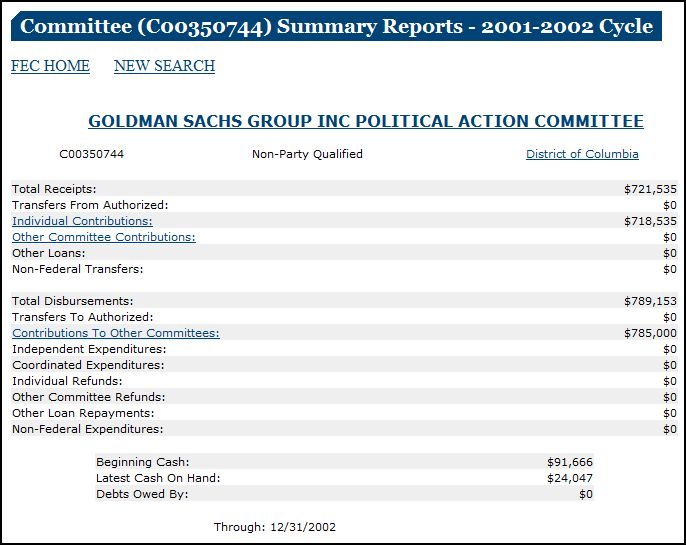
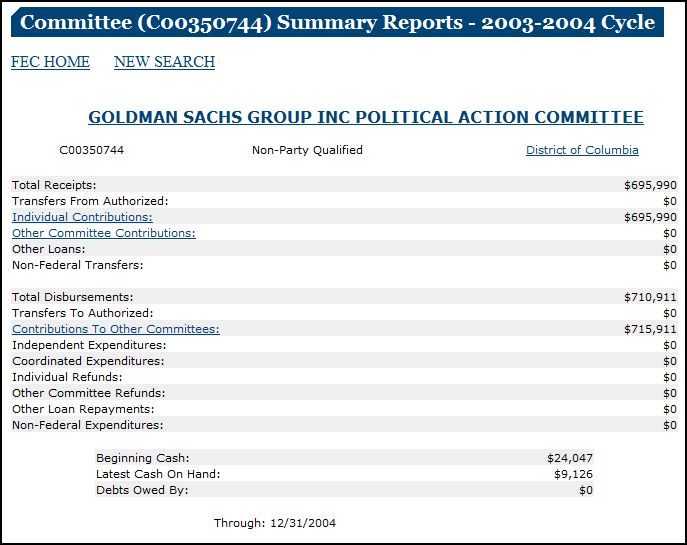
Did you know that Goldman Sachs has an associated political action committee? It's called the Goldman Sachs Group, Inc., Political Action Committee.

This PAC buys a lot of influence in Congress for the various election cycles: 2000, 2002, 2004, 2006, 2008, and 2010

Can you guess which way this series is going?


Perhaps more to the point, can you smell a few rats?

Sunday, January 9, 2011

Sleight of Hand, Part 2

Chronicles is a magazine that I cannot recommend highly enough. I try to swing by and read what is written there at least once a week. The analysis is excellent and, even if I disagree with what is written there, I find I still learn something.

Pat Buchanan has an article from December 31, 2010, entitled Is a Bond Crisis Inevitable? Here we review some excerpts:

With Christmas shoppers out in force and the stock market surging to a two-year high, talk is spreading that the long-awaited recovery is at hand.

Perhaps.

But gleaning the news from Europe and Asia as U.S. cities, states and the federal government sink into debt, it is difficult to believe a worldwide financial crisis that hammers governments, banks and bondholders alike can be long averted. Consider.

[snip]

If anyone is an alarmist, it is The New York Times. In an editorial the day after Christmas, "The Looming Crisis in the States," the Times writes, "Illinois, California and several other states are at increasing risk of being the first states to default since the 1930s."

California and Illinois are to America what Germany and Spain are to the European Union—the first and fifth largest states.

Illinois, writes the Times, "is faced with $4 billion in overdue payments." The state "has lacked the money to pay its bills. Some of its employees have been evicted from their offices for nonpayment of rent, social service groups have laid off hundreds of workers while waiting for checks, pharmacies have closed for lack of Medicaid payments." Illinois is also still borrowing to finance half of its budget.

By Sept. 30, the U.S. government will have run three straight deficits of close to 10 percent of GDP. And Barack Obama and the GOP just passed $858 billion in new and extended tax cuts and fresh spending.

[snip]

In America, it is the Fed that is the last line of defense and has shown a disposition to act in a financial crisis.

Since 2008, it has doubled the money supply and taken a trillion dollars in bad debt off the books of U.S. banks. Secretly, it has lent trillions to banks and businesses all over the world and is now buying U.S. bonds to inject more dollars into the economy.

But how does the Fed prevent a state like Illinois from failing to meet its debt obligations and defaulting? How does the Fed prevent a series of municipal bond defaults by cities and counties that lack the tax revenue to pay their bills and whose credit rating has reached a junk-bond status where they can no longer borrow?

Congress would have to vote the bailout money. But will a House that owns its majority to the Tea Party approve half a trillion dollars to bail out Democratic-run cities or Obama's home state or Jerry Brown's California?

This June, the stimulus money runs out, and as housing prices continue to fall across America, property tax revenue will fall.

The Feds are about to stop bailing out the states, and the states, on shortening rations, will stop bailing out counties, cities and towns.

We may be closer to the falls than we imagine.

The first commentator seemed rather optimistic, explaining that a crisis is not a mistake, but rather the correction of a mistake. In principle, the commentator's logic is correct, but attempts to apply such logic to our financial system tend to shipwreck on the rocky shores of our monetary system. My response:

The trouble is, this crisis is not the correction of a mistake. Instead, it is the perpetuation of a mistake. The international banking elite peddles debt to us, on which they charge us interest, and call that debt "money". They create "money" with an entry on a computer; most of it they don't even have to print.

Since the "money" is debt - a loan - any "money" they create is the principle on the loan; not enough "money" is created to pay the interest on the loan. To do that, they have to "print" more "money" - in other words, give us a new loan, on which we pay interest. Since the loan we need to pay the interest is itself another loan accumulating interest, we need yet another loan to pay that.

We are in perpetual debt to those who control the US money supply and the money supplies of significant parts of the industrialized world. The situation is engineered so that the way out is difficult to find. Control of the money supply by these elites have made our economies the de facto slaves of these elites and, since our ability to own the fruits of our labors has been so fundamentally compromised, the net result is our gradual enslavement at the hands of these banking elites.

These crises are not corrections of mistakes; they are symptoms of an extremely significant underlying problem.

Debt being peddled as "money", with Congress taking its Constitutional authority to coin money for the United States and outsourcing that authority to self-interested private enterprise operations under the auspices of the Federal Reserve, is a federal problem that requires a federal fix. And while there are some elected officials in Washington who are addressing the issue, you can bet the bulk of them will not back a bill to fix the problem, nor will the financiers' White House lapdog sign it.

So, what can be done?

From Fear of defaults putting pressure on municipal bonds, January 3, 2011:

Investors are panicky about losing their money in municipal bonds and have been calling their financial advisers for assurances since a recent "60 Minutes" TV show predicted massive bond defaults by local governments over the next 12 months.

"When people hear 'defaults,' they imagine bankruptcy like a Madoff event, with their money gone," said Lewis Altfest, a New York financial adviser who's been getting some of those nervous calls. "It's difficult for individuals psychologically because they think of bonds as their safe area, their no-worry zone."

Instead of safe, financial analyst Meredith Whitney said in the "60 Minutes" interview that there "is not a doubt in my mind" that there will be defaults, perhaps totaling hundreds of billions of dollars, because many states, cities and counties can't pay their bills.

Whitney commands national attention because she ignored Wall Street's smiling faces prior to the 2008 financial crisis and detailed the underlying banking messes that ultimately led to a near collapse of the system. Now, she said, the economy is threatened by ongoing declines in housing values and unwillingness by states, counties and cities to take their financial problems seriously.

Since her interview, critics have challenged the size of her default prediction, which some estimate at about 10 percent of the $3 trillion municipal bond market.

Still, they do not argue with her underlying concern: For a decade or more, many state and local governments have been pretending they could afford pension promises and spending without coming to grips with how they would pay.

Now, many are obligated to meet promises but have less tax money than imagined as layoffs and plunging home and real estate values leave tax coffers deficient. The problem could get worse as the year goes on because billions in help from the federal government will end.

"All they have to do is raise taxes, and the whole thing goes away, but that may be more difficult to do than to think about doing," Altfest said. So he's been telling clients that their concerns are legitimate within reason.

Raising taxes is not the answer. The economy is already suffering. Burdening it further with increased taxes might just kill the goose that lays the golden eggs.

Very few people understand that (up to a point) lowering the tax rate increases productivity, and thus raises tax revenue.

From Bond Default Is About Too Much Debt, Too Little Time: Joe Mysak, July 20, 2010:

The last time a state defaulted on its bonds, it took eight years and the federal government's help to come up with a remedy.

When Arkansas defaulted on its bonds in 1933, the politicians and investors talked about the same things we would talk about today. The state blamed underwriters for allowing it to sell too many bonds. Investors compared the willingness to repay debt with the ability to pay, and weighed the advantages of bonds backed by a pledge of taxing powers to those secured by specific revenue.

Unlike today, nobody thought the federal government should come to the rescue.

The author goes on to describe how Arkansas rebounded without help from the federal government. Please read the entire article.

But, there is still that issue of debt being peddled as money, and the federal government's outsourcing of its Constitutional power to coin money, making us all pay interest as the fee collected by private enterprise to create "money" for us to use.

Saturday, January 1, 2011

Sleight of Hand, Part 1

In this series, we examine the Bush-Obama Bank Bailout Scheme and related topics.

First, we consider an excerpt from Are U.S. Treasury Bond Sales a Ponzi Scheme?, September 19, 2009:

I have heard at least 5 different theories by very smart people about how U.S. treasury bond sales are being faked.

I do not have either the background or the inside knowledge to be able to comment on whether any of them are true.

(1) PhD professor of economics Michel Chossudovsky - who is a very savvy observer of international dynamics - claims in an interesting 8-minute video:

[snip]

We are dealing with a pernicious circular relationship. When the banks pressured the Treasury to assist them in the form of a major bank rescue operation, it was understood from the outset that the banks would in turn assist the Treasury in financing the handouts of which they are the recipients.

To finance the bank bailout, the Treasury needs to run a massive budget deficit, which in turn requires a staggering increase of the US public debt.

Public opinion has been misled. The US government is in a sense financing its own indebtedness: the money granted to the banks is in part financed by borrowing from the banks.

The banks lend money to the government and with the money they lend to the government, the Treasury finances the bailout. In turn, the banks impose conditionalities on the management of the US public debt. They dictate how the money should be spent. They impose "fiscal responsibility"; they dictate massive cuts in social expenditures which result in the collapse and/or privatization of public services. They impose the privatization of urban infrastructure, roads, sewer and water systems, public recreational areas, everything is up for privatization.


In other words, the government had to borrow from the bankers the money needed to bail the bankers out, placing the American people further in debt and, if this analysis is correct, American public property may need to be sold to service the debt.

Think about that...

Can these banks that we bailed out, with money we borrowed from them (money that they created out of thin air, with nothing more than an entry on a (probably electronic) ledger), now require us to give them public property - a federal park, for example - to pay off the debt?

Let me quote from Union Dry Goods Co. v. Georgia Public Service Corporation - in the excerpt, I have added links to more detailed information on the cases cited.

15 That private contract rights must yield to the public welfare, where the latter is appropriately declared and defined and the two conflict, has been often decided by this court. Thus in Manugault v. Springs, 199 U. S. 473, 480, 26 Sup. Ct. 127, 130 (50 L. Ed. 274), it was declared that:

16 'It is the settled law of this court that the interdiction of statutes impairing the obligation of contracts does not prevent the state from properly exercising its police powers 'for the general good of the public, though contracts previously entered into between individuals may thereby be affected.'

17 This on authority of many cases which are cited.

18 In Hudson Water Co. v. McCarter, 209 U. S. 349, 357, 28 Sup. Ct. 529, 531 (52 L. Ed. 828, 14 Ann. Cas. 560), it is said that:

19 'One whose rights, such as they are, are subject to state restriction, cannot remove them from the power of the state by making a contract about them. The contract will carry with in the infirmity of the subject-matter.' In L. & N. R. R. Co. v. Mottley, 219 U. S. 467, 482, 31 Sup. Ct. 265, 270 (55 L. Ed. 297, 34 L. R. A. [N. S.] 671), this is quoted with approval from Knox v. Lee, 12 Wall. 457, 550, 551, 20 L. Ed. 287, viz.:

20 'Contracts must be understood as made in reference to the possible exercise of the rightful authority of the government, and no obligation of a contract can extend to the defeat of legitimate government authority.'

21 In the same report, in Chicago, B. & Q. R. R. Co. v. McGuire, 219 U. S. 567, 31 Sup. Ct. 259, 262 (55 L. Ed. 328), it is said:

22 'There is no absolute freedom to do as one wills or to contract as one chooses. The guaranty of liberty does not withdraw from legislative supervision that wide department of activity which consists of the making of contracts, or deny to government the power to provide restrictive safeguards. Liberty implies the absence of arbitrary restraint, not immunity from reasonable regulations and prohibitions imposed in the interests of the community.'

23 In Atlantic Coast Line R. R. Co. v. Goldsboro, 232 U. S. 548, 558, 34 Sup. Ct. 364, 368 (58 L. Ed. 721), the court said:

24 'It is settled that neither the 'contract' clause nor the 'due process' clause has the effect of overriding the power of the state to establish all regulations that are reasonably necessary to secure the health, safety, good order, comfort, or general welfare of the community; that this power can neither be abdicated nor bargained away, and is inalienable even by express grant; and that all contract and property rights are held subject to its fair exercise.'

25 And in Rail & River Coal Co. v. Ohio Industrial Commission, 236 U. S. 338, 349, 35 Sup. Ct. 359, 362 (59 L. Ed. 607), the state of the law upon the subject is thus aptly described:

26 'This court has so often affirmed the right of the state in the exercise of its police power to place reasonable restraints, like that here involved, upon the freedom of contract, that we need only to refer to some of the cases in passing.' These decisions, a few from many to like effect, should suffice to satisfy the most skeptical or belated investigator that the right of private contract must yield to the exigencies of the public welfare when determined in an appropriate manner by the authority of the state, and the judgment of the Supreme Court of Georgia must be

27 Affirmed.

In other words, the Supreme Court has consistently upheld that contracts (such as any scheme to borrow money from bankers in order to give the money to those same bankers to "bail out" their banks?) must yield to legitimate government authority, and that government power "to secure the ... general welfare ... can neither be abdicated nor bargained away, and is inalienable even by express grant".

That would tell me that the Bush-Obama Bank Bailout Scheme is (as it should be) completely unlawful.