Showing posts with label Albania. Show all posts

Sunday, August 19, 2012

Down the Rabbit Hole, Part 4

We continue from Part 3, where we saw how the Clinton Administration's foreign policy initiatives in the Balkans resulted in Islamic organized crime cartels controlling most of the world's heroin production and distribution, beginning in the poppy fields of Afghanistan, through refining in Turkey, to distribution in Europe and North America, mainly by establishing ethnic Albanian organized crime - the Albanian Mafia - firmly in the Balkans under cover of internationally-sanctioned interventions in the 1990's wars there.

We now examine connections between the ethnic Albanian organized crime cartels in the Balkans and the political scene in the United States.

I reproduce this first excerpt from The Worst GOP Candidate In History by Srdja Trifkovic, September 20, 2010; links are in the original:

"Conservative" Joseph DioGuardi's "sensational" election as the GOP Senate candidate in New York has shaken up the Republican Party, gloats the Tropoja-based Albanian Minerals President M. Mujaj in the Wall Street Journal Blog. "The American people have spoken," this self-styled compatriot of ours is telling us. "The American way of life needs to be rebalanced. Households need to stop spending what they don't have. Local and state governments need to slash their budgets to live off whatever tax revenues they generate [...] The American people voted for change."

What Mr. Mujaj does not mention is that former Congressman DioGuardi is the founder and well-endowed president of the Albanian American Civic League, a lobby group for the KLA-run "independent" province of "Kosova." This is a significant fact, crucial to the funding of his candidacy, which he curiously does not mention on his campaign website. Even more curiously, the League's aacl.com site — full of information on DioGuardi's KLA connections — has been mysteriously dormant for weeks. There is, nevertheless, ample evidence out there that DioGuardi and his wife have been, for years, key fundraisers and apologists for the terrorist KLA in this country. It is unsurprising that he omits this aspect of his career from his pitch to the voters of New York, but it is curious that no one has called attention to the fact thus far.

Since that was written, the AACL has migrated its website, and much of the information is no longer accessible.

However, the very first post at my blog was about Mr. DioGuardi and his links to ethnic Albanian organized crime - and that predates Dr. Trifkovic's article. In return, the information I had was based on newspaper articles and blogposts from years earlier.

Mr. DioGuardi's ties to American politicians and to the Albanian Mafia go way back.

On one side, Mr. DioGuardi and his wife, Shirley Cloyes, are the major players at the Albanian American Civic League. The AACL characterizes itself as a lobby group:

The Civic League is registered to lobby the legislative and executive branches of the federal government for the purpose of influencing U.S. foreign policy to bring lasting peace and stability to the Balkans. For more than twenty years, the organization has worked with the foreign policy leaders in the U.S. Congress, including Congressmen Ben Gilman, the late Henry Hyde, the late Tom Lantos, Dana Rohrabacher, and Ileana Ros-Lehtinen, Senators Charles Schumer and John McCain, and former Senators Joe Biden, Bob Dole, and Claiborne Pell, to bring independence to Kosova, equal rights to Albanians in Macedonia, Montenegro, the Presheva Valley, and Chameria, and genuine democracy and economic development to Albania.

Notice among the names are Joe Biden, currently the Democrat Vice President of the United States, and John McCain, Republican Senator from Arizona.


The AACL's website also tells about Ms. Cloyes and how she has worked to change the image of the KLA in the United States:

In 1998, Cloyes developed the Civic League’s strategy to oppose the international attempt to unfairly criminalize the Kosova Liberation Army. During the 1999 NATO bombing campaign against Serbia, she appeared, individually and with Joe DioGuardi, on more than fifty radio and television broadcasts. During this period, she also worked with the lawyers who prepared the indictment of Slobodan Milosevic for genocide in Bosnia and Kosova that led to his extradition to the War Crimes Tribunal for the Former Yugoslavia in The Hague.


Joe DioGuardi has fronted for the KLA in the US for many years. From McCain and the KLA Connection, February 25, 2000:

Please direct your attention to the photo below: the caption informs us that [Republican Senator from Arizona and then-Presidential candidate John] McCain is speaking at "a pro-Kosovo, pro-McCain rally across the street from his New York City hotel Friday morning, Feb. 11, 2000. McCain is in New York for the day to attend fundraisers and to talk to the press before returning to South Carolina Friday night." But who is the man on the right, with the colorful KLA scarf and his big mouth wide open? The caption-writer is mute on this point, but to anyone who knows anything about New York's ethnic politics, the face is all-too-familiar: it is none other than former Republican Congressman Joe DioGuardi, now the loquacious leader of the Albanian-American Civic League (AACL) – a group that not only actively represents the Kosovo Liberation Army (KLA) in America, but whose leader has become a spokesman for the most radical fringe elements of the KLA.


DioGuardi is an extremist who lost his seat in Congress because his growing preoccupation with creating a "Greater Albania" did not exactly fit in with the pothole-fixing skills that must be the first concern of New York City politicians. Most Albanian-Americans support independence for Kosovo, and look with disdain and bewilderment at the US government's official position that Kosovo is still an "autonomous" province of Yugoslavia. But DioGuardi goes one step – indeed, several steps – further, and envisions a "Greater Albania."
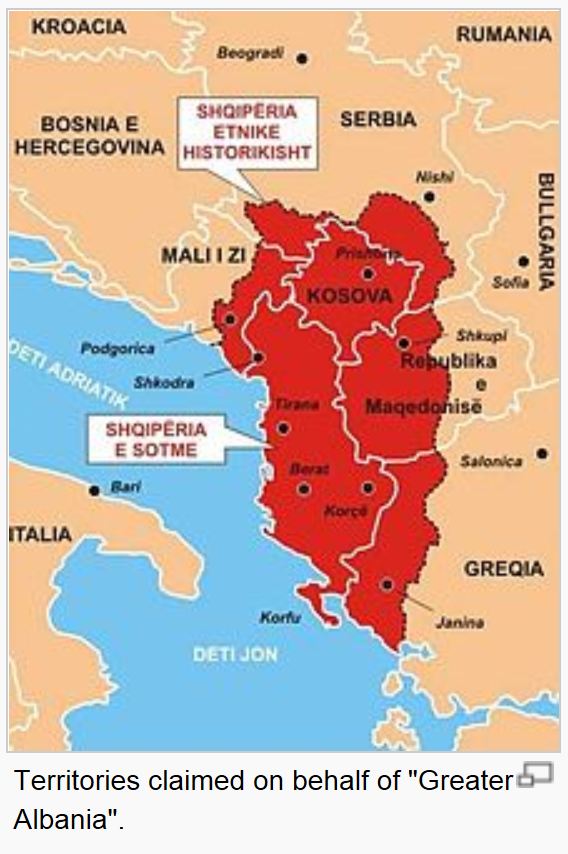

This leads us back to what was established in the first three parts of this series.

Continuing now with The Worst GOP Candidate In History by Srdja Trifkovic:

For perhaps the first time in history, the mainstream media have deemed the dismemberment of Serbs newsworthy. More accurately, they have deemed newsworthy the dismemberment of the Serb and non-Serb victims of our friends, and almost all living Albanians' great heroes, the KLA … The new information is revealed in the forthcoming book The Hunt by Carla Del Ponte, former chief prosecutor for the Hague Tribunal. A few reports, starting with — gasp — the AP (which both the International Herald Tribune and Fox News deigned to carry), Albanian trafficking in organs of killed Kosovo Serbs investigated... Del Ponte said her investigators had been informed that some 300 Serbs were killed for organ trafficking.

Del Ponte — not known as a friend of the Serbs by any token — was the first to reveal that the imprisoned Serbs were taken to a camp in Tropoja where the younger ones were picked out, and their organs were later sold abroad. Even high KLA members were involved in the operation of smuggling of organs, Del Ponte explained. She attested that her investigators and UNMIK officials were made aware that in mid-1999 the KLA moved some 300 abducted non-Albanians to Tropoja’s "yellow house" where in one room that was used as an operating theater, the surgeons were removing organs from the victims. The organs were transported by air from Tirana to clinics abroad for clients and medical institutions that paid for them. The victims left with one kidney were kept locked, and later on killed for other organs. "Other prisoners in the barrack knew what was to happen to them," Del Ponte added.

I mentioned the organ-trafficking in Part 2. Now, back to the United States.

The AACL has an associated political action committee, the the Albanian American Public Affairs Committee. Its treasurer is Shirley Cloyes.


The Albanian American Public Affairs Committee long cultivated Senator John McCain, giving money to him in 1999, in 2000, and in 2009. This was certainly a quid pro quo, as McCain was instrumental in getting US arms and support for the KLA. From John McCain armed Kosovo Islamic terrorists, February 13, 2008:

"Even in 1998 when we had problems with Milosevic, McCain did everything that we asked of him to the benefit of the Albanian people, including arming the KLA", announced DioGuardi. "We are American Albanians and we need a leader who will strengthen this country... We must support John McCain because he did everything we asked of him for Kosovo, from supporting the Kosovo Liberation Army to supporting the independence of Kosovo. Two years ago he spoke in Brussels and said that independence is the only solution", concluded this former congressman who has been fighting for the independence of Kosovo and Metohija for more than twenty years.


The Albanian American Public Affairs Committee also cultivated President George W. Bush and, in return, when Kosovo declared independence from Serbia on February 17, 2008, Bush made sure the US was quick to support this move.


The Albanian American Public Affairs Committee gave money to Joe Biden for his run in the Democrat Presidential Primary for 2008.


Of course, Shirley Cloyes has contributed directly to Biden's campaigns, in 2002 and in 2007.


Consequently, the ties between Vice President Biden and the AACL/AAPAC go back a decade. What is the AACL/AAPAC getting in return from Biden and the Obama Administration?

Always hedging its bets, AAPAC gave to Mitt Romney:


So, the incumbent Democrat Vice President has long had money laundered to him from the Albanian Mafia via the same channels that are now laundering Albanian Mafia money to Mitt Romney's campaign.

On the surface, the campaign is very entertaining; Romney has many good issues to beat up on Obama with, and, in return, all Obama can do is play the race card, blame Bush, and ask for Romney's tax returns (while millions have been spent to conceal Obama's records).

But, under the surface, both sides are on the payroll of the same ethnic Albanian transnational organized crime cartel, which traffics in heroin, arms, human body parts from involuntary living donors... just like what was going on in 2008.

Saturday, August 11, 2012

Down the Rabbit Hole, Part 2

At the end of Part 1, I pointed out that the Clinton Administration's decision to support Islamic terrorists in the Balkans was not by chance. This is significant, because the same dynamic is in play right now during the 2012 Presidential election campaign.

According to a May, 2002, report by the Library of Congress Federal Research Division, entitled A Global Overview of Narcotics-Funded Terrorist and Other Extremist Groups, when the KLA converted to the KPC (see Part 1), many of the KLA's personnel and weapons went somewhere else. KLA criminals, now legitimized by their positions in the KPC, had additional power and opportunity to further criminal endeavors. However, others formed newer, smaller terrorist groups, receiving money from the KLA's support pipeline. These groups included the National Liberation Army (NLA), which tried to get ethnic Albanians from the southernmost regions of Serbia adjacent to Kosovo incorporated into Kosovo. A successor group, the Albanian National Army, known by its initials in Albanian AKSh, continued an insurgency on behalf of ethnic Albanians in Macedonia, where Albanians were one quarter of the population.


Eventually, a rivalry broke out between the AKSh and remaining elements of the NLA. Picking up with an excerpt from the report (pgs 82-83):

According to a February 2002 report in the Daily Telegraph and the Macedonian daily Nova Makedonija, Western police records and United Nations reports confirm that the leaders of the AKSh and the NLA are involved in large-scale smuggling of weapons, human beings, narcotics, and other goods. Money from those transactions is used to finance terrorist activities in Macedonia and Kosovo. Narcotics, reportedly the most important of the smuggled items, are moved through what is known as the Balkan Drug Route, which begins in Afghanistan and passes through Turkey, Bulgaria, Macedonia, Albania, and Italy to reach markets in Western Europe. An alternate route goes from Afghanistan into Western Europe via Turkey, Bulgaria, Serbia, and Slovenia. Primary locations for the exchange of drugs for guns are Kumanovo and Skopje (both in northern Macedonia), which are points along the Balkan route to which weapons are smuggled. From those cities, weapons move into Kosovo.201

In September 2001, the Canadian Centre for Peace in the Balkans reported that Osama bin Laden was channeling profits from the sale of narcotics arriving in Western Europe via the Balkan Route to local governments and political parties, with the goal of gaining influence in Albania or Macedonia or both. The report theorized that Macedonia presents an ideal target because of its large Albanian minority (about one in three Macedonians is an ethnic Albanian) and its strategic position between east and west, along the new pipeline proposed between Burgas (Bulgaria) and Drac (Albania).202

In the same period, the Washington Times reported that bin Laden was the "biggest financial supporter" of the NLA, which has received $6 to $7 million from that source to supplement its narcotics income in supporting terrorist activities. In January 2001, the Stratfor intelligence organization reported that bin Laden had contributed and trained fighters for the KLA, citing the strategic importance of this link for the operation of his terrorist network in Europe. That report quoted the Albanian intelligence service as calling Albania the most important transit point for Islamic militants into Europe. In 1999 and 2000, Albania arrested ten individuals identified as Islamic terrorists.203

A February 2002 report in the Herald of Glasgow noted that al Qaeda had acted as a middleman in the movement of heroin from warehouses in Afghanistan via Chechen mafia conduits and into the Balkan narcotics pipeline. (The Taliban had prohibited the growing of poppies but had not confiscated the large stores of heroin already existing, and in fact profited from the heroin trade by taxing growers and dealers.) Al Qaeda took a percentage of the drug profits for this service.204 Between 1996 and 1998, the volume of drugs confiscated by Italian police from Albanian dealers in Italy rose from 5,500 kilograms to 23,000 kilograms.205

According to a February 2002 report, former KLA guerrillas and Albanian liberation extremists have used profits from their participation in Taliban-sponsored narcotics smuggling to re-arm themselves after the disarmaments that occurred from 1999 to 2001. The new arms, estimated to be worth about $4 million, include SA-18 and SA-7 surface-to-air missiles capable of bringing down Macedonian helicopters.206 According to a subsequent report, "the weapons were paid for by Albanian criminals with the proceeds of selling Afghan heroin on the streets of a dozen European capitals."207

There was a dynamic interplay between the rise of the KLA and the rise of the ethnic Albanian cartels based in Kosovo. From Heroin Heroes, from January/February of 2000:

The ascent of the Kosovar families to the top of the trafficking hierarchy coincided with the sudden appearance of the KLA as a fighting force in 1997. As Serbia unleashed its campaign of persecution against ethnic Albanians, the diaspora mobilized. Hundreds of thousands of expatriate Kosovars around the world funneled money to the insurrection. Nobody sent more than the Kosovar traffickers -- some of the wealthiest people of Kosovar extraction in Europe. According to news reports, Kosovar Albanian traffickers launder $1.5 billion in profits from drug and arms smuggling each year through a shadowy network of some 200 private banks and currency exchange offices. A congressional briefing paper obtained by Mother Jones indicates: "We would be remiss to dismiss allegations that between 30 and 50 percent of the KLA's money comes from drugs."

Elements of the KLA associated with criminal cartels - the so-called "15 families" - quickly became the best-equipped forces the KLA could field. In turn, they leveraged the KLA's ties with the West into increased business opportunities for the Albanian cartels. As the influence of the cartels increased, the KLA and its daughter organizations became better-funded and better-equipped.

In Congressional testimony on December 13, 2000, Frank Cilluffo had this to say (The Threat Posed from the Convergence of Organized Crime, Drug Trafficking, and Terrorism):

During the NATO campaign against the former Yugoslavia in the Spring of 1999, the Allies looked to the Kosovo Liberation Army (KLA) to assist in efforts to eject the Serbian army from Kosovo. What was largely hidden from public view was the fact that the KLA raise part of their funds from the sale of narcotics. Albania and Kosovo lie at the heart of the "Balkan Route" that links the "Golden Crescent" of Afghanistan and Pakistan to the drug markets of Europe. This route is worth an estimated $400 billion a year and handles 80 percent of heroin destined for Europe.

The ethnic Albanian cartels were sitting along the route of a drug trade worth $400 billion per year. On top of that, there was trafficking in arms and other commodities. Returning now to A Global Overview of Narcotics-Funded Terrorist and Other Extremist Groups (pgs 83-84):

Beginning in the 1990s, the "official" network of organized crime in Albania has grown and become more sophisticated. In a January 2001 report, British-based criminologist Vicenzo Ruggiero said, "joint ventures between southern Italian organized crime and groups operating in Albania are frequent, and such partnerships are imposed by local criminal entrepreneurs who expect to be given a percentage of the profits earned by their Albanian counterparts." According to Italian prosecutor Piero Luigi Vigna, Albanian groups have found a specific niche in the growing multinational organized crime network: "Albanian criminal groups fulfill the functions of a kind of service agency, establishing, for the management of clandestine immigration toward [sic] Italy, ties with the Chinese mafia and with its Turkish and Russian counterparts." Thus cooperative agreements and the development of specific roles appear to be replacing traditional bloody territorial rivalries between crime groups from various nations (most importantly for the Balkan and Adriatic regions, groups from Albania and Italy).208

Trafficking in human beings is an expanding activity for this international network. According to the International Organisation for Migration, the Balkans is a major route (and source) for trafficking in women and children for sexual exploitation. The organization characterizes such trafficking as "the fastest-growing crime in the Balkans."209 Albania's geographical position and its chaotic political situation mean that it plays an important role in such trade. One factor in the expansion of this commerce has been the presence in the Balkans of foreign soldiers, who in 2000 accounted for 80 percent of the profits of brothels in Kosovo and Bosnia.210 Many women are moved across the Albanian border into the coastal tourist areas of Greece. Reportedly, the young women of entire villages in Albania, Bulgaria, Moldova, and Romania have been forcibly moved into this system, many with the promise of reaching Western Europe. Corrupt police in Albania have aided this practice, even escorting women through the country.211 The port of Vlore, characterized as "lawless" in 2001, has been the home port of a large fleet of boats that have smuggled hundreds of thousands of immigrants and tons of drugs across the Adriatic Sea into Italy, and thence into the rest of Western Europe.212

By the end of the last century, the ethnic Albanian cartels were the quintessential middlemen: they had connections with Turkish cartels moving heroin, South Asian Islamic cartels producing heroin, Russian cartels, Chinese cartels... they had connections with ethnic Italian cartels in Europe and in the US, though the Albanian groups were taking market share, sometimes by contracting out for the Cosa Nostra, sometimes by simply muscling in.

One key are of expansion was the use of women for forced prostitution. Thousands of international peacekeepers in the region made for a captive audience with needs that the Albanian cartels would be happy to meet. Women did not remain in the Balkans; they got passed on to Italy, to the Middle East, to any place with a willing buyer. Better than narcotics, which were sold and then consumed, women were essentially "rented", then sold on to new buyers; the fact that a woman had been previously "rented" generally had only marginal impact on her value, so she could be bought, forced to work as a prostitute, then sold to another pimp, with nearly all her earnings as a prostitute being net profits.

Of course, whole people were not the only commodity; the Albanian cartels also trafficked in body parts. From leaked UNMIK documents dated 2003:


SUMMARY

Beginning in mid-1999 (and possibly earlier), between 100 and 300 people were abducted and taken by truck and van to detention facilities in or near the northern Albanian towns of Kukes and Tropoje. Most of these people were Serbian men from Kosovo taken captive between June and October 1999. Beginning in August 1999, some of these captives (24-100) were transferred from northern Albania to secondary detention facilities (private homes and rough industrial compounds) in central Albania, mainly near the town of BUrrel (or Burreli), about 110 kilometers southwest of Kukes. Captives were also moved to detention facilities near Peshkopi, about 50 kilometers east of Burrel.

The captives taken to central Albania were again moved, in small groups, to a private house south of Burrel that was set up as a makeshift clinic. There, medical equipment and personnel were used to extract body organs from the captives, who then died. Their remains were buried nearby. The organs were transported to Rinas airport near Tirana (approximately 75 kilometers southwest of Burrel) and flown abroad. Other captives taken to the house/clinic near Burrel included a smaller number of females from Kosovo, Albania and eastern Europe. The last delivery of captives to the house/clinic was reorted in spring or early summer of 2000.

In addition to captives taken to Albania alive, an unknown number of bodies of Serbian civilians killed in Kosovo were transported to Albania and buried in remote locations.

This summary is based on interviews with at least eight sources, all ethnic Albanians from Kosovo or Montenegro who served in the Kosovo Liberation Army. Four sources directly participated in the transport of at least 90 ethnic Serbs and others to detention facilities in northern and central Albania. Of these, three sources delivered captives to the house/clinic south of Burrel, two sources claim to have participated in the disposal of human remains near the house and one source claims to have participated in the delivery of body parts and/or organs to Rinas airport near Tirana. None of the sources witnessed the medical operations.

According to all sources, the transports and surgical procedures were carried out with the knowledge and/or active involvement of mid-level and senior KLA officers as well as doctors from Kosovo and abroad. THe operation was supported by men with links to Albanian secret police operatives of the former government of Salih Berisha.


The report gives a specific location.


Google imagery of the area shows little of interest:


To be sure, not everyone associated with the KLA was involved in all of this, or even knew of it. Of the people who were involved with it, some did what they could to at least not participate, and a few later came forward to tell what they knew - hence, the reports to the international community.

Similarly, most of the people in the Albanian diaspora who contributed money to the cause felt, and with good reason, that they were helping ethnic Albanians defend themselves against Serb excesses. Some heard rumors of alleged illegal activities, but understandably dismissed these as hostile propaganda.

But, at the top, the key players knew what was going on: they controlled a criminal empire, with ties going from the poppy fields in South Asia to the streets of Western Europe and the United States. The value of the heroin trafficking alone was $400 billion, but add in the value of the arms, the women who were forced to work as prostitutes and then sold on to new pimps, and the other contraband, and this was a big criminal empire.

And, a big criminal empire needed political protection - protection which it could afford to buy.