I have been rather actively involved in the social media. Lately, I have not done so many blog posts here as I have created images and made comments for posting on social media.
There, I notice a trend of patriotic Americans who are complaining about Senator McCain. McCain's viewpoints and proposals on many issues have people outraged. They call it treason. The more polite commentary blame it on senility. They want him imprisoned.
I have done tremendous research on the crowd in Washington. What got me started was hearing about Sibel Edmonds case. Honestly, I think I have forgotten more about her case than most of my readers will ever know, unless someone actually bothers to read her book - and that person may have to read it more than once to know more than I have forgotten.
However, I did not stop there. I began my own research. I dug. I mean I really dug. I mean, I really, really dug, looking in places other people do not look, for things other people do not seek, and cross-referencing a wide variety of data. A quick glance at the sidebar here at the blog should convince anyone of the possibility that, when I do research, I do way more than most bloggers, and way more than nearly anyone in our mainstream media.
I present this as factual, but make no effort to prove my statements. In many of my posts, I give links, I show images from documents... here, I merely tell you what I know, and hope you will independently verify the information and conclusions provided.
Based on the material I have seen, some of it posted on the internet by other bloggers and by competent journalists from outside the mainstream, there is no doubt in my mind that the problem of corruption in Washington, DC, goes far beyond the extensive situation described by Sibel Edmonds.
In particular, I am convinced that Senator John McCain of Arizona has been connected to foreign organized crime for nearly two decades. The cartel in question is of primarily ethnic Albanian origin, and is based in the Balkans. This cartel was closely linked to ethnic Albanian and Islamic terrorists who have also operated in the Balkans, but who operate elsewhere as well.
If you go back to the Cold War, terrorism was easy to understand: the Soviet Union was behind much of it, and it was aimed at the West. Whenever a terrorist organization tried to bite the hand that fed it, the KGB, whose job was protections of Soviet assets worldwide, would spare no expense to teach that organization a lesson and redirect its activities.
In the 1980's terrorist organizations began to diversify their sources of funding. In particular, they teamed up with drug trafficking organizations (DTO's). The alliance was natural: they both had the same enemy - the government - though one fought for an ideological reason, and the other for monetary profit.
The DTO's discovered that terrorists were ready-made anti-government militarized forces, trained and equipped, which could provide considerable balance in the fight to protect drug trafficking operations against government counternarcotics forces which themselves were becoming heavily militarized in much of the drug-producing and drug-transiting regions of the world.
For their part, the terrorist organizations saw the profit in the production and trafficking of drugs. Cocaine, in particular, is so profitable that even if a small percentage of the total amount produced gets sold rather than interdicted, the DTO is still making good money. DTO's have always been able to get several times more product through to buyers than the bare minimum needed for solvency. Terrorists saw that production and trafficking of drugs exacerbated problems for their enemies in the government, a situation which could then be leveraged politically and militarily. Furthermore, the immense profits available in drug trafficking could finance terrorist activities in a way that state sponsors never could: virtually unlimited money was available, with practically no strings attached.
Narcoterrorism was born, and the monster had the "DNA" of both its parents.
It was in Latin America, in places like Colombia and Peru, where some of the earliest innovations in this area took place. But, it happened elsewhere. The Palestine Liberation Organization - the well-known PLO - was trouble for its Arab and Soviet sponsors - so much so that Jordanian security forces drove it from Jordanian territory across from the West Bank. The PLO landed in Lebanon, where it found the Bekaa Valley a perfect place to produce narcotics. This was when the PLO began to become less ideologically-centered, and more centered on profit. Its nickname was the "Poppy Lovers' Organization"; suffice it to say that its leader, Nobel Peace Prize Winning Yassir Arafat, died a very rich man indeed - and its award to a drug-trafficking terrorist should tell you something about the Nobel Peace Prize.
The US government was not immune to the lures of easy money.
In Latin America, the US was dealing with the threat of communist subversion. Maoist rebels were fighting to take over Peru, and other communist groups were battling the government in Colombia; both nations had an extensive problem with DTO's as well.
But, Nicaragua was special. There, taking its name from a legendary bandit of the late 1920's whose forces were defeated with the help of the US Marines, a group called the Sandinistas deposed President Somoza and established a communist regime. This regime was a threat to the security of the whole region.
In particular, Costa Rica, Nicaragua's neighbor to the south, did not even have an army, rightly concerned that standing armies and the constant coups they produce were a scourge to Latin American countries. Costa Rica's neighbor farther south, Panama, considered contingency plans to move Panamanian troops north into Costa Rica, should this become necessary to answer communist aggression from Nicaragua.
To Nicaragua's north, communist infiltration through a stretch of Honduran jungle supported an attempt by communist-backed forces to seize power in El Salvador, resulting in a long, brutal civil war there.
All this trouble could easily be traced back to Managua, and from there to Havana and Moscow.
The US had to do something to keep the cancer of communism from spreading, so the US began supporting the "contras", people who were against the Sandinista revolution and the resulting communist regime.
However, the Reagan Administration had to deal with a deeply-entrenched Democrat Congress - one which too often sympathized with the communists.
The "solution" discovered by certain relatively low-ranking players was to traffic cocaine to America. The money could be used to fund the contras, and since the money was illegal, it was "black" money for black ops, out of reach of Congress. It was far from an ideal solution, but the reality was that Americans were getting their cocaine - they were going to buy from someone - and if the intelligence community provided some of it, then at least the profits could be channeled to a productive purpose, the defeat of communist subversion in the Americas. The laudable ends "justified" the criminal means.
Predictably, the drug money soon corrupted the laudable ends. Drug trafficking became an end itself, with support for the contras becoming merely a cover story for corruption. According to some accounts, the operation worked so well that corrupt US intelligence operatives had to start supplying arms to the Sandinistas, lest they be defeated, the war would end, and there would be no need for the profitable drug trafficking black op to continue. According to some accounts, the DTO's were caught in the middle between heavily-armed communist forces and heavily armed anti-communist forces, so corrupt US intelligence operatives had to supply arms to the DTO's so the drugs could continue to be produced and shipped. If all of this is true, US intelligence operatives were supplying all sides and making real money doing so, all under a cover story of stopping communist subversion.
The same recipe was used in response to the Soviet invasion of Afghanistan, to greater effect, and with greater official sanction. Poppies grown along the Durand Line (the border between Afghanistan and Pakistan) could be refined into heroin, and much of this heroin could be shipped into the Soviet Union and "sold" there. The Soviet ruble was not considered hard currency, but barter to rogue Soviet officials for arms and supplies could always be arranged. The heroin destroyed the infidel godless communist regime from the inside, while the arms helped support the jihad in Afghanistan. Once again, it was black money for black ops, well out of reach of Congress, but this time with fatwas avowing Allah's approval. The war in Afghanistan, fought right outside the Soviet border, became Moscow's "Vietnam", and kept Moscow from dealing more harshly with Poland and from causing problems elsewhere; in fact, the war in Afghanistan and the resulting stress in the Soviet Union proved to be the straw that broke the communist camel's back in Russia.
By the 1990's, the guys who came up with this recipe had moved up in rank in government service. Add to that the intrinsic corruption of the Clintons and their Administration, and the Clinton Administration became the most corrupt Administration in US history: no one else was even close. The cold war was over, but government officials were dealing with DTO's which, in turn, were connected to terrorist groups, including Islamic terrorist groups connected to the Arab-Afghan Mujahideen - "Al Qaeda" - and to the Poppy Lovers' Organization.
Bush-43 took was inaugurated in January, 2001. As a dedicated Republican, I was happy to vote for him after the outrages of the Clinton era, and I was confident America was on the right track again. Little did I realize...
Information that these Arab-Afghan Mujahideen were planning terrorist strikes against the US was not lacking. They had planned many attacks involving aircraft, including the Bojinka plot. They had attempted to crash planes into buildings, kamikaze style.
And, information was coming in that something was afoot for later in 2001. Blueprints to US skyscrapers had been sent to the Middle East - and, if you are going to crash a plane into a building, why do you need blueprints of the building? Guys affiliated with Islamic terrorist organizations were learning how to fly big commercial jets, and the way they were doing it looked suspicious.
So, there was background to this - Condoleezza Rice lied when she said she didn't "think anyone could have predicted" this - and there was hard intelligence coming in that it may have been about to happen.
The trouble is, an attack this big had never happened before. It was considered very unlikely.
Much more importantly, though, the intelligence coming that it could be about to happen was not coming in through counterterrorism channels; it was coming in through counternarcotics channels: the intelligence apparatus targeting DTO's was picking up information about possible ops being planned by terrorist organizations affiliated with the DTO's.
This was a major problem. An investigation into this could conceivably lead to highly-placed US officials, both elected and appointed, who were on the payroll of these DTO's. By this time - mid-2001 - this included Republican Dennis Hastert, who at the time was the 59th Speaker of the House, and who was on the payroll of Turkish organized crime.
It should be noted that by this time, Senator John McCain was already doing favors for the Albanian cartel described above. McCain was steering US policy in a direction favorable to the cartel and its terrorist allies; in return, a PAC affiliated with that foreign cartel was laundering illicit money from foreign organized crime activities into McCain's campaign coffers.
This illicit money wasn't just from moving Afghan heroin into Western Europe and America; it included the profits of operations for trafficking arms, for trafficking women for forced prostitution, and for trafficking in human body parts from living non-volunteers - Serbian prisoners of war and even civilians captured in the fighting in the former Yugoslavia. This money was mixed in with legitimate, legal campaign contributions from decent, honest, hard-working Americans of ethnic Albanian descent, and given to McCain. In return, McCain, who as a Republican in the Senate was aware of the reports about these terrorists and criminals that the Clinton Administration had been supporting (and that the Bush-43 Administration was now supporting - oh, yes, Bush-43 and even Joe Biden took money from the same guys), was helping Clinton to support them.
McCain went into this with his eyes open, he knew what he was doing, he knew where the money was coming from, and he knew that he was hurting innocent people in the Balkans and betraying US security interests.
An investigation into the intelligence about upcoming terrorist attacks - intelligence that was mainly coming in through counternarcotics channels - would inevitably lead to highly-placed, powerful people in the US government, and would be very embarrassing for them, implicating them in extensive, treasonous corruption.
So, they buried it, instead.
Then, when 9/11 hit, the cover-up began, and from the very beginning, Bush-43 was deeply involved in steering the investigation away from the corruption.
Meanwhile, these guys who came up with the idea to fund anti-communist groups with drug money in the 1980's... they had moved up in rank, and now found themselves under another Republican administration. They were calling the shots now.
This, coupled with the Bush-43 Administration's cronyism, made the Bush-43 Administration more corrupt than the Clinton Administration. And, when one considers how Clinton was giving critical military technology to Communist China in exchange for Chinese money laundered into Democrat campaign coffers, that's saying something.
I mentioned Condoleezza Rice above... she was involved in the Chinese espionage. While working at Stanford, she discretely failed to investigate a Chinese spy ring that was stealing critical technology there. But, that's another story.
Fast forward to the Obama Administration: we now have a "President" who openly, obviously hates America. He was raised by communists and nursed with communist propaganda. He received a strong dose of Islamic indoctrination - and Islam, like communism, is antithetical to everything America stands for.
On top of that, he has no integrity, no honor, no moral compass... in short, he's a perfect example of the worst the far left has to offer.
The treasonous corruption is now so bad, even the Clinton years look good by comparison.
Back to McCain.
As far as I'm concerned, McCain served his time in prison in the Hanoi Hilton. Provided he will cooperate fully with the investigation, I believe his time should be served restricted to the grounds of senior officer's quarters on a military base, where his family can stay with him and visit him, and where he will be safe from the criminals he will need to betray to recuperate some degree of honor.
The others... well, I want them in a federal prison. And, I think we need to build a new one, one big enough to house them all. We need honest investigators, answerable to an honest President, a real American, and we need those investigators to go through Washington, DC, with a fine-toothed comb.
Showing posts with label Government Corruption. Show all posts
Saturday, September 7, 2013
Sunday, August 19, 2012
Down the Rabbit Hole, Part 4
We continue from Part 3, where we saw how the Clinton Administration's foreign policy initiatives in the Balkans resulted in Islamic organized crime cartels controlling most of the world's heroin production and distribution, beginning in the poppy fields of Afghanistan, through refining in Turkey, to distribution in Europe and North America, mainly by establishing ethnic Albanian organized crime - the Albanian Mafia - firmly in the Balkans under cover of internationally-sanctioned interventions in the 1990's wars there.
We now examine connections between the ethnic Albanian organized crime cartels in the Balkans and the political scene in the United States.
I reproduce this first excerpt from The Worst GOP Candidate In History by Srdja Trifkovic, September 20, 2010; links are in the original:
Since that was written, the AACL has migrated its website, and much of the information is no longer accessible.
However, the very first post at my blog was about Mr. DioGuardi and his links to ethnic Albanian organized crime - and that predates Dr. Trifkovic's article. In return, the information I had was based on newspaper articles and blogposts from years earlier.
Mr. DioGuardi's ties to American politicians and to the Albanian Mafia go way back.
On one side, Mr. DioGuardi and his wife, Shirley Cloyes, are the major players at the Albanian American Civic League. The AACL characterizes itself as a lobby group:
Notice among the names are Joe Biden, currently the Democrat Vice President of the United States, and John McCain, Republican Senator from Arizona.
The AACL's website also tells about Ms. Cloyes and how she has worked to change the image of the KLA in the United States:
Joe DioGuardi has fronted for the KLA in the US for many years. From McCain and the KLA Connection, February 25, 2000:
This leads us back to what was established in the first three parts of this series.
Continuing now with The Worst GOP Candidate In History by Srdja Trifkovic:
I mentioned the organ-trafficking in Part 2. Now, back to the United States.
The AACL has an associated political action committee, the the Albanian American Public Affairs Committee. Its treasurer is Shirley Cloyes.
The Albanian American Public Affairs Committee long cultivated Senator John McCain, giving money to him in 1999, in 2000, and in 2009. This was certainly a quid pro quo, as McCain was instrumental in getting US arms and support for the KLA. From John McCain armed Kosovo Islamic terrorists, February 13, 2008:
The Albanian American Public Affairs Committee also cultivated President George W. Bush and, in return, when Kosovo declared independence from Serbia on February 17, 2008, Bush made sure the US was quick to support this move.
The Albanian American Public Affairs Committee gave money to Joe Biden for his run in the Democrat Presidential Primary for 2008.
Of course, Shirley Cloyes has contributed directly to Biden's campaigns, in 2002 and in 2007.
Consequently, the ties between Vice President Biden and the AACL/AAPAC go back a decade. What is the AACL/AAPAC getting in return from Biden and the Obama Administration?
Always hedging its bets, AAPAC gave to Mitt Romney:
So, the incumbent Democrat Vice President has long had money laundered to him from the Albanian Mafia via the same channels that are now laundering Albanian Mafia money to Mitt Romney's campaign.
On the surface, the campaign is very entertaining; Romney has many good issues to beat up on Obama with, and, in return, all Obama can do is play the race card, blame Bush, and ask for Romney's tax returns (while millions have been spent to conceal Obama's records).
But, under the surface, both sides are on the payroll of the same ethnic Albanian transnational organized crime cartel, which traffics in heroin, arms, human body parts from involuntary living donors... just like what was going on in 2008.
We now examine connections between the ethnic Albanian organized crime cartels in the Balkans and the political scene in the United States.
I reproduce this first excerpt from The Worst GOP Candidate In History by Srdja Trifkovic, September 20, 2010; links are in the original:
"Conservative" Joseph DioGuardi's "sensational" election as the GOP Senate candidate in New York has shaken up the Republican Party, gloats the Tropoja-based Albanian Minerals President M. Mujaj in the Wall Street Journal Blog. "The American people have spoken," this self-styled compatriot of ours is telling us. "The American way of life needs to be rebalanced. Households need to stop spending what they don't have. Local and state governments need to slash their budgets to live off whatever tax revenues they generate [...] The American people voted for change."
What Mr. Mujaj does not mention is that former Congressman DioGuardi is the founder and well-endowed president of the Albanian American Civic League, a lobby group for the KLA-run "independent" province of "Kosova." This is a significant fact, crucial to the funding of his candidacy, which he curiously does not mention on his campaign website. Even more curiously, the League's aacl.com site — full of information on DioGuardi's KLA connections — has been mysteriously dormant for weeks. There is, nevertheless, ample evidence out there that DioGuardi and his wife have been, for years, key fundraisers and apologists for the terrorist KLA in this country. It is unsurprising that he omits this aspect of his career from his pitch to the voters of New York, but it is curious that no one has called attention to the fact thus far.
Since that was written, the AACL has migrated its website, and much of the information is no longer accessible.
However, the very first post at my blog was about Mr. DioGuardi and his links to ethnic Albanian organized crime - and that predates Dr. Trifkovic's article. In return, the information I had was based on newspaper articles and blogposts from years earlier.
Mr. DioGuardi's ties to American politicians and to the Albanian Mafia go way back.
On one side, Mr. DioGuardi and his wife, Shirley Cloyes, are the major players at the Albanian American Civic League. The AACL characterizes itself as a lobby group:
The Civic League is registered to lobby the legislative and executive branches of the federal government for the purpose of influencing U.S. foreign policy to bring lasting peace and stability to the Balkans. For more than twenty years, the organization has worked with the foreign policy leaders in the U.S. Congress, including Congressmen Ben Gilman, the late Henry Hyde, the late Tom Lantos, Dana Rohrabacher, and Ileana Ros-Lehtinen, Senators Charles Schumer and John McCain, and former Senators Joe Biden, Bob Dole, and Claiborne Pell, to bring independence to Kosova, equal rights to Albanians in Macedonia, Montenegro, the Presheva Valley, and Chameria, and genuine democracy and economic development to Albania.
Notice among the names are Joe Biden, currently the Democrat Vice President of the United States, and John McCain, Republican Senator from Arizona.
The AACL's website also tells about Ms. Cloyes and how she has worked to change the image of the KLA in the United States:
In 1998, Cloyes developed the Civic League’s strategy to oppose the international attempt to unfairly criminalize the Kosova Liberation Army. During the 1999 NATO bombing campaign against Serbia, she appeared, individually and with Joe DioGuardi, on more than fifty radio and television broadcasts. During this period, she also worked with the lawyers who prepared the indictment of Slobodan Milosevic for genocide in Bosnia and Kosova that led to his extradition to the War Crimes Tribunal for the Former Yugoslavia in The Hague.
Joe DioGuardi has fronted for the KLA in the US for many years. From McCain and the KLA Connection, February 25, 2000:
Please direct your attention to the photo below: the caption informs us that [Republican Senator from Arizona and then-Presidential candidate John] McCain is speaking at "a pro-Kosovo, pro-McCain rally across the street from his New York City hotel Friday morning, Feb. 11, 2000. McCain is in New York for the day to attend fundraisers and to talk to the press before returning to South Carolina Friday night." But who is the man on the right, with the colorful KLA scarf and his big mouth wide open? The caption-writer is mute on this point, but to anyone who knows anything about New York's ethnic politics, the face is all-too-familiar: it is none other than former Republican Congressman Joe DioGuardi, now the loquacious leader of the Albanian-American Civic League (AACL) – a group that not only actively represents the Kosovo Liberation Army (KLA) in America, but whose leader has become a spokesman for the most radical fringe elements of the KLA.
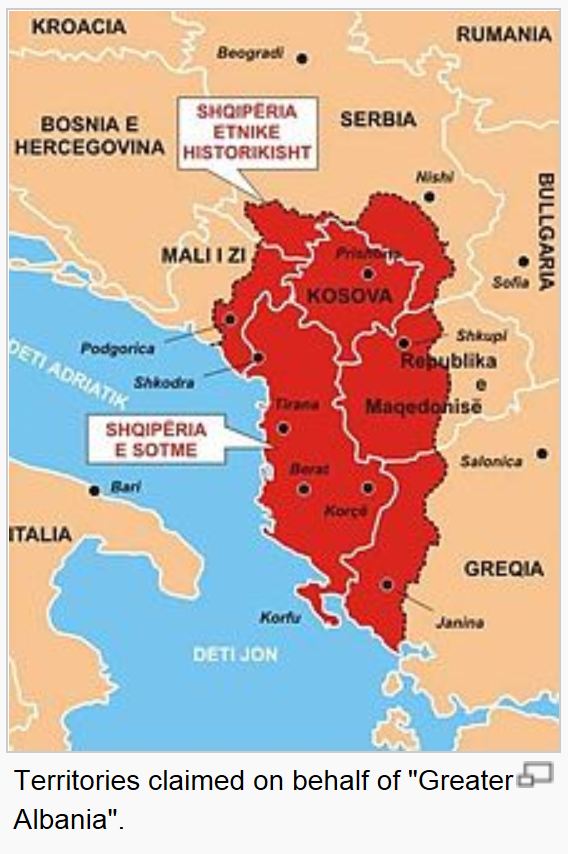
DioGuardi is an extremist who lost his seat in Congress because his growing preoccupation with creating a "Greater Albania" did not exactly fit in with the pothole-fixing skills that must be the first concern of New York City politicians. Most Albanian-Americans support independence for Kosovo, and look with disdain and bewilderment at the US government's official position that Kosovo is still an "autonomous" province of Yugoslavia. But DioGuardi goes one step – indeed, several steps – further, and envisions a "Greater Albania."
This leads us back to what was established in the first three parts of this series.
Continuing now with The Worst GOP Candidate In History by Srdja Trifkovic:
For perhaps the first time in history, the mainstream media have deemed the dismemberment of Serbs newsworthy. More accurately, they have deemed newsworthy the dismemberment of the Serb and non-Serb victims of our friends, and almost all living Albanians' great heroes, the KLA … The new information is revealed in the forthcoming book The Hunt by Carla Del Ponte, former chief prosecutor for the Hague Tribunal. A few reports, starting with — gasp — the AP (which both the International Herald Tribune and Fox News deigned to carry), Albanian trafficking in organs of killed Kosovo Serbs investigated... Del Ponte said her investigators had been informed that some 300 Serbs were killed for organ trafficking.
Del Ponte — not known as a friend of the Serbs by any token — was the first to reveal that the imprisoned Serbs were taken to a camp in Tropoja where the younger ones were picked out, and their organs were later sold abroad. Even high KLA members were involved in the operation of smuggling of organs, Del Ponte explained. She attested that her investigators and UNMIK officials were made aware that in mid-1999 the KLA moved some 300 abducted non-Albanians to Tropoja’s "yellow house" where in one room that was used as an operating theater, the surgeons were removing organs from the victims. The organs were transported by air from Tirana to clinics abroad for clients and medical institutions that paid for them. The victims left with one kidney were kept locked, and later on killed for other organs. "Other prisoners in the barrack knew what was to happen to them," Del Ponte added.
I mentioned the organ-trafficking in Part 2. Now, back to the United States.
The AACL has an associated political action committee, the the Albanian American Public Affairs Committee. Its treasurer is Shirley Cloyes.
The Albanian American Public Affairs Committee long cultivated Senator John McCain, giving money to him in 1999, in 2000, and in 2009. This was certainly a quid pro quo, as McCain was instrumental in getting US arms and support for the KLA. From John McCain armed Kosovo Islamic terrorists, February 13, 2008:
"Even in 1998 when we had problems with Milosevic, McCain did everything that we asked of him to the benefit of the Albanian people, including arming the KLA", announced DioGuardi. "We are American Albanians and we need a leader who will strengthen this country... We must support John McCain because he did everything we asked of him for Kosovo, from supporting the Kosovo Liberation Army to supporting the independence of Kosovo. Two years ago he spoke in Brussels and said that independence is the only solution", concluded this former congressman who has been fighting for the independence of Kosovo and Metohija for more than twenty years.
The Albanian American Public Affairs Committee also cultivated President George W. Bush and, in return, when Kosovo declared independence from Serbia on February 17, 2008, Bush made sure the US was quick to support this move.
The Albanian American Public Affairs Committee gave money to Joe Biden for his run in the Democrat Presidential Primary for 2008.
Of course, Shirley Cloyes has contributed directly to Biden's campaigns, in 2002 and in 2007.
Consequently, the ties between Vice President Biden and the AACL/AAPAC go back a decade. What is the AACL/AAPAC getting in return from Biden and the Obama Administration?
Always hedging its bets, AAPAC gave to Mitt Romney:
So, the incumbent Democrat Vice President has long had money laundered to him from the Albanian Mafia via the same channels that are now laundering Albanian Mafia money to Mitt Romney's campaign.
On the surface, the campaign is very entertaining; Romney has many good issues to beat up on Obama with, and, in return, all Obama can do is play the race card, blame Bush, and ask for Romney's tax returns (while millions have been spent to conceal Obama's records).
But, under the surface, both sides are on the payroll of the same ethnic Albanian transnational organized crime cartel, which traffics in heroin, arms, human body parts from involuntary living donors... just like what was going on in 2008.
Thursday, August 9, 2012
Down the Rabbit Hole, Part 1
By popular demand, I begin a new series...
The only thing I will tell you about where this series is going is this: whether you are Democrat or Republican, Muslim or Infidel, crook or cop; whether you are a proud American or a card-carrying charter member of the hate-America-first crowd... you will not like the destination. ;)
We will begin by reviewing the background of the Kosovo Liberation Army, or KLA. The KLA was the main armed group on the ethnic Albanian side in the fighting that resulted in the province of Kosovo declaring its independence from Serbia; this fighting was supported by NATO, and Kosovo's independence was widely recognized by the international community. (As of 1999, as part of the internationally-sponsored end to hostilities in the area, the KLA was transformed into the Kosovo Protection Corps, which was disbanded in early 2009, with many of its personnel becoming part of the Kosovo Police.)
An article entitled Heroin Heroes, from January/February of 2000, provided extensive background on the KLA. One key excerpt is this one:
Though the article Heroin Heroes put many pieces of the puzzle together, the story was hardly hidden previously. Two years earlier, the UN published Resolution 1160 (1998), which had this to say regarding the KLA:
About this time, the matter was being addressed in Washington, though, since the Democrat Clinton Administration was siding with the KLA, it was up to Republicans in the Senate to try to get the story out.
A press release entitled Bosnia II: The Clinton Administration Sets Course for NATO Intervention in Kosovo, by the United States Senate Republican Policy Committee and dated August 12, 1998, had this to say:
Less than a year later, more information was out about the developing situation in the Balkans; from The Kosovo Liberation Army: Does Clinton Policy Support Group with Terror, Drug Ties?, from March 31, 1999:
Skipping down:
Skipping down:
The Clinton Administration's decision to support Islamic terrorists was not by chance; it was pre-meditated. The reason was simple: Islamic terrorists were closely connected to the big money of the narcotics traffickers; this money went in one direction to fund jihad, and in the other to buy political influence in Washington.
Stay tuned for more...
The only thing I will tell you about where this series is going is this: whether you are Democrat or Republican, Muslim or Infidel, crook or cop; whether you are a proud American or a card-carrying charter member of the hate-America-first crowd... you will not like the destination. ;)
We will begin by reviewing the background of the Kosovo Liberation Army, or KLA. The KLA was the main armed group on the ethnic Albanian side in the fighting that resulted in the province of Kosovo declaring its independence from Serbia; this fighting was supported by NATO, and Kosovo's independence was widely recognized by the international community. (As of 1999, as part of the internationally-sponsored end to hostilities in the area, the KLA was transformed into the Kosovo Protection Corps, which was disbanded in early 2009, with many of its personnel becoming part of the Kosovo Police.)
KLA, Terrorism, Organized Crime
An article entitled Heroin Heroes, from January/February of 2000, provided extensive background on the KLA. One key excerpt is this one:
For hundreds of years, Kosovar Albanian smugglers have been among the world's most accomplished dealers in contraband, aided by a propitious geography of isolated ports and mountainous villages. Virtually every stage of the Balkan heroin business, from refining to end-point distribution, is directed by a loosely knit hierarchy known as "The 15 Families," who answer to the regional clans that run every aspect of Albanian life.
The Kosovar Albanian traffickers are so successful, says a senior U.S. State Department official, "because Albanians are organized in very close-knit groups, linked by their ethnicity and extended family connections."
The clans, in addition to their drug operations, maintained an armed brigade that gradually evolved into the KLA. In the early 1990s, as the Kosovar uprising in Yugoslavia grew, ethnic Albanian rebels there faced increased financial needs. The 15 Families responded by boosting drug trafficking and channeling money and weapons to the rebels in their clans. As traffickers started taking bigger risks, drug seizures by police across Europe skyrocketed from a kilo or two in the early 1980s to multimillion-dollar hauls, culminating in the spectacular 1996 arrest at Gradina, Yugoslavia, of two truckers running a load of more than half a ton of heroin worth $50 million.
Though the article Heroin Heroes put many pieces of the puzzle together, the story was hardly hidden previously. Two years earlier, the UN published Resolution 1160 (1998), which had this to say regarding the KLA:
The Security Council,
[snip]
Conndemning the use of excessive force by Serbian police forces against civilians and peaceful demonstrators in Kosovo, as well as all acts of terrorism by the Kosovo Liberation Army or any other group or individual and all external support for terrorist activity in Kosovo, including finance, arms and training,
[snip]
2. Calls also upon the Kosovar Albanian leadership to condemn all terrorist action, and emphasizes that all elements in the Kosovar Albanian community should pursue their goals by peaceful means only;
About this time, the matter was being addressed in Washington, though, since the Democrat Clinton Administration was siding with the KLA, it was up to Republicans in the Senate to try to get the story out.
A press release entitled Bosnia II: The Clinton Administration Sets Course for NATO Intervention in Kosovo, by the United States Senate Republican Policy Committee and dated August 12, 1998, had this to say:
Whitewashing the KLA
But in order to make the case for U.S./NATO intervention, the Clinton Administration, as in Bosnia, must rely on the ethnic justification of one side in the conflict to the exclusion of the other side's case. Contributing to the success of this strategy to date has been the negligible attention given to the KLA's ties to organized crime elements in the Albanian diaspora [See: "Speculation plentiful, facts few about Kosovo separatist group," Baltimore Sun, 3/16/98; "Germany 'can take no more refugees'," The Guardian (London), 6/17/98; "My plan to save Kosovo now," by Paddy Ashdown, The Independent (London), 8/5/98] and indications that the KLA may be receiving assistance (as did the Muslim regime in Bosnia) from Iran [See: "Radical groups 'arming Kosovo Albanians'," Financial Times (London), 5/8/98; "Italy Become's Iran's New Base for Terrorist Operations," Defense and Foreign Affairs Strategic Policy (London), February 1998].
In addition, there are media reports that the recent embassy bombings in Kenya and Tanzania may be connected to the deportation from Albania of several members of an Islamic terrorist cell connected to Saudi expatriate Osama Bin Laden; questions are now being raised as to the activities of radical Islamic groups in Albania, particularly in the region around the town of Tropoje, a known KLA staging area ["U.S. Blasts Possible Mideast Ties: Alleged Terrorists Investigated in Albania," Washington Post, 8/12/98]. This possible connection raises serious implications for the Clinton Administration's regional policy: "One of the most disturbing aspects of the present [terrorism] crisis is that it may have been triggered by our own inept foreign policy in Bosnia and Kosovo. There, beyond all common sense, we find ourselves championing Muslim factions who draw support from the very Islamic fundamentalist terrorist groups who are our mortal enemies elsewhere" ["Bringing terrorists to justice," by Col. Harry G. Summers (USA-Ret.), Distinguished Fellow, U.S. Army War College, Washington Times, 8/12/98].
Less than a year later, more information was out about the developing situation in the Balkans; from The Kosovo Liberation Army: Does Clinton Policy Support Group with Terror, Drug Ties?, from March 31, 1999:
The KLA: from 'Terrorists' to 'Partners'
The Kosovo Liberation Army "began on the radical fringe of Kosovar Albanian politics, originally made up of diehard Marxist-Leninists (who were bankrolled in the old days by the Stalinist dictatorship next door in Albania) as well as by descendants of the fascist militias raised by the Italians in World War II" ["Fog of War -- Coping With the Truth About Friend and Foe: Victims Not Quite Innocent," New York Times, 3/28/99]. The KLA made its military debut in February 1996 with the bombing of several camps housing Serbian refugees from wars in Croatia and Bosnia [Jane's Intelligence Review, 10/1/96]. The KLA (again according to the highly regarded Jane's,) "does not take into consideration the political or economic importance of its victims, nor does it seem at all capable of seriously hurting its enemy, the Serbian police and army. Instead, the group has attacked Serbian police and civilians arbitrarily at their weakest points. It has not come close to challenging the region's balance of military power" [Jane's, 10/1/96].
The group expanded its operations with numerous attacks through 1996 but was given a major boost with the collapse into chaos of neighboring Albania in 1997, which afforded unlimited opportunities for the introduction of arms into Kosovo from adjoining areas of northern Albania, which are effectively out of the control of the Albanian government in Tirana. From its inception, the KLA has targeted not only Serbian security forces, who may be seen as legitimate targets for a guerrilla insurgency, but Serbian and Albanian civilians as well.
In view of such tactics, the Clinton Administration's then-special envoy for Kosovo, Robert Gelbard, had little difficulty in condemning the KLA (also known by its Albanian initials, UCK) in terms comparable to those he used for Serbian police repression:
"'The violence we have seen growing is incredibly dangerous,' Gelbard said. He criticized violence 'promulgated by the (Serb) police' and condemned the actions of an ethnic Albanian underground group Kosovo Liberation Army (UCK) which has claimed responsibility for a series of attacks on Serb targets. 'We condemn very strongly terrorist actions in Kosovo. The UCK is, without any questions, a terrorist group,' Gelbard said." [Agence France Presse, 2/23/98]
[snip]
Among the most troubling aspects of the Clinton Administration's effective alliance with the KLA are numerous reports from reputable unofficial sources -- including the highly respected Jane's publications -- that the KLA is closely involved with:
The extensive Albanian crime network that extends throughout Europe and into North America, including allegations that a major portion of the KLA finances are derived from that network, mainly proceeds from drug trafficking; and
Terrorist organizations motivated by the ideology of radical Islam, including assets of Iran and of the notorious Osama bin-Ladin -- who has vowed a global terrorist war against Americans and American interests.
Skipping down:
Reports on KLA Drug and Criminal Links
Elements informally known as the "Albanian mafia," composed largely of ethnic Albanians from Kosovo, have for several years been a feature of the criminal underworld in a number of cities in Europe and North America; they have been particularly prominent in the trade in illegal narcotics. [See, for example,"The Albanian Cartel: Filling the Crime Void," Jane's Intelligence Review, November 1995.] The cities where the Albanian cartels are located are also fertile ground for fundraising for support of the Albanian cause in Kosovo. [See, for example, "Albanians in Exile Send Millions of Dollars to Support the KLA," BBC, 3/12/99.]
The reported link between drug activities and arms purchases for anti-Serb Albanian forces in Kosovo predates the formation of the KLA, and indeed, may be seen as a key resource that allowed the KLA to establish itself as a force in the first place:
"Narcotics smuggling has become a prime source of financing for civil wars already under way -- or rapidly brewing -- in southern Europe and the eastern Mediterranean, according to a report issued here this week. The report, by the Paris-based Observatoire Geopolitique des Drogues, or Geopolitical Observatory of Drugs, identifies belligerents in the former Yugoslav republics and Turkey as key players in the region's accelerating drugs-for-arms traffic. Albanian nationalists in ethnically tense Macedonia and the Serbian province of Kosovo have built a vast heroin network, leading from the opium fields of Pakistan to black-market arms dealers in Switzerland, which transports up to $2 billion worth of the drug annually into the heart of Europe, the report says. More than 500 Kosovo or Macedonian Albanians are in prison in Switzerland for drug- or arms-trafficking offenses, and more than 1,000 others are under indictment. The arms are reportedly stockpiled in Kosovo for eventual use against the Serbian government in Belgrade, which imposed a violent crackdown on Albanian autonomy advocates in the province five years ago." ["Separatists Supporting Themselves with Traffic in Narcotics," San Francisco Chronicle, 6/10/94]
Skipping down:
Reports on Islamic Terror Links
The KLA's main staging area is in the vicinity of the town of Tropoje in northern Albania [Jane's International Defense Review, 2/1/99]. Tropoje, the hometown and current base of former Albanian president Sali Berisha, a major KLA patron, is also a known center for Islamic terrorists connected with Saudi renegade Osama bin-Ladin. [For a report on the presence of bin-Ladin assets in Tropoje and connections to anti-American Islamic terrorism, see "U.S. Blasts' Possible Mideast Ties: Alleged Terrorists Investigated in Albania, Washington Post, 8/12/98.]
The Clinton Administration's decision to support Islamic terrorists was not by chance; it was pre-meditated. The reason was simple: Islamic terrorists were closely connected to the big money of the narcotics traffickers; this money went in one direction to fund jihad, and in the other to buy political influence in Washington.
Stay tuned for more...
Tuesday, March 27, 2012
Got No Heart, Part 4
I wasn't sure if there was going to be a Part 4 to this series. I should have known to just give them time.
In Part 1 we saw how the UK government was intervening early on in the lives of children that government bureaucrats decided might become problems for society at some point in the future, with a goal of preventing those problems from ever cropping up. How early?
We also speculated whether government bureaucrats might not be getting into the baby business under cover of the public interest.
Well, in Part 2 we saw this was indeed the case:
In Part 3, we stopped short of actually saying that the UK government was involved in human trafficking of the babies of UK citizens, only because I produced no evidence documenting a money trail of kickbacks to government officials.
However, you can argue that it is human trafficking nonetheless.
Now, this: I reproduce in its entirety from March 19, 2012:
I'm not making this up.
(See also UK Schools Ban Children From Making Best Friends, March 22, 2012.)
First, take a moment and research the UK's gun laws. Basically, you aren't supposed to have them - except certain kinds under very limited conditions.
Now, step back and put this all together.
The British people, who more than seven decades ago basically stood alone in the West to stop Hitler, were first disarmed by their own government late in the last century.
Next, secret government courts make the most important decisions about who will raise your children, and if you speak out about it, you go to prison. People no longer have a right to have families, and they do not have a right to complain about this fact or protest it.
Finally, schools are beginning to prevent children from having best friends.
The direction this is moving in is that people will be in trouble if they have close associates; relationships are intended to be casual.
This is important, because a very close friend will risk his life for you, and will help you when you are in trouble. But, when a casual acquaintance sees government goons coming after you, he will step back and let them take you. And, since your "friendships" are all shallow, you won't know whom to trust, so you can't make any effective plans to retake Britain from those who now control it.
Understand, this banning of best friends is in its infancy, but make no mistake about what will happen when this policy grows up.
The people of the United Kingdom fought off the Nazis, they were integral in winning the Cold War and defeating communism... but, the bad guys won. Children in the UK are growing up in a world every bit as bad as Hitler or Stalin ever sought to create.
And, my fellow Americans, don't think this won't happen on our side of the Atlantic.
The US government is already building its database of who your friends are...
In Part 1 we saw how the UK government was intervening early on in the lives of children that government bureaucrats decided might become problems for society at some point in the future, with a goal of preventing those problems from ever cropping up. How early?
Predictably, by one year later, the situation was out of control with secret government courts to decide who was a fit parent. From The unnatural justice of secret family courts, August 27, 2007:
The Sunday Telegraph highlights today yet another case in which a mother has been threatened with losing her baby to local authority care. The mother had not shown any sign at all of harming her child, for her baby has not yet been born.
Understand, the child is not yet born.
Insofar as abortion rights are concerned, this is not a child, but a fetus, and may be destroyed.
But, insofar as the government being able to intervene, this is not just a child, but one that will turn out bad unless the government does something.
We also speculated whether government bureaucrats might not be getting into the baby business under cover of the public interest.
Well, in Part 2 we saw this was indeed the case:
So, local government entities were promised more money from London if they increased the number of adoptions. In turn, using excuses like "a chance [the parent] might shout at [the baby] when he was older", they started taking babies from innocent families, because babies are easier to adopt out.
In Part 3, we stopped short of actually saying that the UK government was involved in human trafficking of the babies of UK citizens, only because I produced no evidence documenting a money trail of kickbacks to government officials.
However, you can argue that it is human trafficking nonetheless.
Now, this: I reproduce in its entirety from March 19, 2012:
Instead, the primary pupils are being encouraged to play in large groups.
Educational psychologist Gaynor Sbuttoni said the policy has been used at schools in Kingston, South West London, and Surrey.
She added: "I have noticed that teachers tell children they shouldn't have a best friend and that everyone should play together.
"They are doing it because they want to save the child the pain of splitting up from their best friend. But it is natural for some children to want a best friend. If they break up, they have to feel the pain because they're learning to deal with it."
Russell Hobby, of the National Association of Head Teachers, confirmed some schools were adopting best-friend bans.
He said: "I don't think it is widespread but it is clearly happening. It seems bizarre.
I don't see how you can stop people from forming close friendships. We make and lose friends throughout our lives." The Campaign for Real Education, which wants more parental choice in state education, said the "ridiculous" policy was robbing children of their childhood.
Spokesman Chris McGovern added: "Children take things very seriously and if you tell them they can't have a best friend it can be seriously damaging to them. They need to learn about relationships."
I'm not making this up.
(See also UK Schools Ban Children From Making Best Friends, March 22, 2012.)
First, take a moment and research the UK's gun laws. Basically, you aren't supposed to have them - except certain kinds under very limited conditions.
Now, step back and put this all together.
The British people, who more than seven decades ago basically stood alone in the West to stop Hitler, were first disarmed by their own government late in the last century.
Next, secret government courts make the most important decisions about who will raise your children, and if you speak out about it, you go to prison. People no longer have a right to have families, and they do not have a right to complain about this fact or protest it.
Finally, schools are beginning to prevent children from having best friends.
The direction this is moving in is that people will be in trouble if they have close associates; relationships are intended to be casual.
This is important, because a very close friend will risk his life for you, and will help you when you are in trouble. But, when a casual acquaintance sees government goons coming after you, he will step back and let them take you. And, since your "friendships" are all shallow, you won't know whom to trust, so you can't make any effective plans to retake Britain from those who now control it.
Understand, this banning of best friends is in its infancy, but make no mistake about what will happen when this policy grows up.
The people of the United Kingdom fought off the Nazis, they were integral in winning the Cold War and defeating communism... but, the bad guys won. Children in the UK are growing up in a world every bit as bad as Hitler or Stalin ever sought to create.
And, my fellow Americans, don't think this won't happen on our side of the Atlantic.
The US government is already building its database of who your friends are...
Director of National Intelligence Gains New Powers, Expands Datamining of US Citizens
Under revised guidelines for the National Counterterrorism Center, the intelligence agency officials will be able to profile and track American citizens, suspected of no crime, for up to five years. The change represents a dramatic expansion of government surveillance and appears to violate the Privacy Act of 1974, which limits data exchanges across federal agencies and establishes legal rights for US citizens. In 2003, Congress put an end to a similar program. For more information, see EPIC - Total Information Awareness.
Friday, December 30, 2011
Qiya
Some time ago, in the country of Fuxiuguo, in a beautiful valley along a river, there was a village called Qiya. The river had been subject to flooding, but the people of Qiya had built a dam to control the river, and now the village was prosperous.
There in Qiya, Mr. Nuli worked very hard, and provided a nice home for his family. They had a nice piece of land along the river, with livestock and beautiful gardens. Under Mr. Nuli, the land was very productive. Working it was both lucrative and pleasant.
Mr. Tantu saw Mr. Nuli's land, and realized that if he bought the land and developed it, then sold the development to people who wanted to live and work along the river, he could make a great deal of money. But, he knew Mr. Nuli had no desire to sell his family's home and business.
Near Mr. Nuli's land lived one Mr. Zhisou. Mr. Zhisou had lived in Fuxuiguo a very long time. In fact, he lived in this country when it was known as Meiguo, and remembered the time when everyone worked hard like Mr. Nuli, dreaming that one day their work would pay off, and they would have a good life like Mr. Nuli does now. But that was before Emperor Haowan came to power. Under Emperor Haowan and his minister, Mr. Fushisixiang, Meiguo changed. People became so enamored with having a good life that they no longer wanted to work for it and earn it; they just wanted to have it, and their desires knew no bounds. The country changed so dramatically that one day a new emperor came to power, Fubai, and he declared that the country would now be known as Fuxuiguo.
Now, Mr. Zhisou kept a low profile. He lived in a very modest hut with very few possessions. The emperor's administrator, Mr. Haoshou, saw to the needs of the people, and felt sorry for Mr. Zhisou. When the emperor's men were giving out rice, Mr. Haoshou made sure Mr. Zhisou got an extra bag of rice; when the emperor's men were giving out firewood, Mr. Haoshou saw to it that Mr. Zhisou got an extra bundle.
One day there began a great rainstorm. The rain lasted for days and days, and the water level behind the dam began to get higher and higher. Mr. Tantu talked with Mr. Haoshou about the water level behind the dam. Mr. Haoshou assured Mr. Tantu that the dam was very strong, and would not break, even if the rains lasted for many weeks. Mr. Tantu was not convinced, though, and went to Mr. Zhizhang, who was Mr. Haoshou's supervisor. Mr. Tantu explained that he was concerned the dam might break, and that the ensuing flood would destroy the entire village. Mr. Zhizhang agreed that this was a grave concern, and asked Mr. Tantu for advice. Mr. Tantu told Mr. Zhizhang that it would be better to release some of the water, and wash out a few of the homes along the river, than to let the water accumulate until the dam broke and the flood destroyed the entire village. Mr. Zhizhang agreed that they must immediately release a great quantity of water in order to preserve the dam which would, in turn, preserve the village.
Meanwhile, Mr. Haoshou was making the rounds on the dam, checking it to make sure it was holding up to the flood. When Mr. Zhizhang's emergency order to release the water came through, Mr. Tanzang was on watch at the dam. Sadly, he was unaware that Mr. Haoshou was on the dam, and when the water was released, it swept Mr. Haoshou away, drowning him. The sudden surge of water crashed down the river, and destroyed Mr. Nuli's garden, sweeping Mr. Nuli and much of his livestock downstream, where their bodies were never recovered. Other people who lived near the river had their homes destroyed, too, and lost loved ones.
Mrs. Nuli was devastated at the loss of her beloved husband and her way of life, but she and her children were still alive, and she was thankful for this.
The disaster in the village was so great that Emperor Fubai himself came to the village to console the people. He told them how terrible it was, and how thankful he was that things did not turn out worse. He promised the people help so they could have a fresh start. He said that, in time, people would look for reasons as to why this happened, and would begin to invent wild stories. Emperor Fubai said that it was a terrible rainstorm that caused this tragedy, and warned people not to believe the crazy conspiracy theories that they would inevitably hear, as believing these stories would dishonor the memories of those who died as a result of this tragic rainstorm.
Mr. Tanzang was promoted to become the administrator. Under Mr. Zhizhang's supervision, he conducted an investigation, and determined that the decision to release the water was the correct one, as it preserved the dam intact, and saved the village. Per the emperor's instructions, he offered a generous amount of money to the people who had suffered, so they could rebuild their lives. He bought the Nuli family's land from Mrs. Nuli for a generous price, so she could take her family and establish a new life somewhere else.
Mr. Zhisou's home was very modest, but surprisingly, it was never in any danger from the rainstorm or from the sudden flood of water. The land that had belonged to Mr. Nuli, though, was used for a public project. Mr. Tantu's company got the contract from Mr. Tanzang to redevelop the land in the public interest. The project was very profitable to Mr. Tantu's company.
Time passed, and Mrs. Nuli began to establish her new life. But, as she talked to other people from Qiya, she heard stories about how Mr. Tantu had wanted her family's land. She also heard stories about how Mr. Tantu recommended that some of the water be released to preserve the dam and thus protect the village. She also heard stories about how Mr. Haoshou, who was very respected in Qiya, thought the dam was far stronger than necessary to save the village, even if the rain got much worse. And, she was puzzled about how Mr. Haoshou so tragically drowned when Mr. Tanzang released the water from the dam, and about how Mr. Tanzang was then promoted into Mr. Haoshou's job. Finally, it broke her heart to think of her home being completely destroyed as the land was redeveloped, and the stories she heard about how profitable the redevelopment project was to Mr. Tantu pushed her over the edge.
Distraught, Mrs. Nuli went to see Mr. Kungfutse, better known to his students as Confucius, to inquire of the Master's opinion on these events.
The Master told her that it was a terrible tragedy, and that a thorough investigation by the emperor's administrator showed it could not have been prevented. The Master explained that it is common, in the wake of such tragedies, to seek reasons why they occur, but that the simplest explanation is always the best. Confucius told her that she should get on with her life and take care of her children, rather than sacrificing their future to dwell on a past that she cannot change.
Saddened, Mrs. Nuli began to leave, as Mr. Zhisou arrived outside the Master's residence. She looked at Mr. Zhisou, whom the whole village knew to be crazy, as he yelled to Confucius:
"The peacock is killed for its beautiful plummage! Great trees in the forest are cut down for their wood! Does a candle not burn itself out? Everyone understands the value of having so much worth, but who understands the value of having so little?"
Mrs. Nuli looked at crazy old Mr. Zhisou, and asked him what all that meant.
"Dams do indeed break under too much stress, but it is not the dam that contains the river's water over which the emperor needs to concern himself."
There in Qiya, Mr. Nuli worked very hard, and provided a nice home for his family. They had a nice piece of land along the river, with livestock and beautiful gardens. Under Mr. Nuli, the land was very productive. Working it was both lucrative and pleasant.
Mr. Tantu saw Mr. Nuli's land, and realized that if he bought the land and developed it, then sold the development to people who wanted to live and work along the river, he could make a great deal of money. But, he knew Mr. Nuli had no desire to sell his family's home and business.
Near Mr. Nuli's land lived one Mr. Zhisou. Mr. Zhisou had lived in Fuxuiguo a very long time. In fact, he lived in this country when it was known as Meiguo, and remembered the time when everyone worked hard like Mr. Nuli, dreaming that one day their work would pay off, and they would have a good life like Mr. Nuli does now. But that was before Emperor Haowan came to power. Under Emperor Haowan and his minister, Mr. Fushisixiang, Meiguo changed. People became so enamored with having a good life that they no longer wanted to work for it and earn it; they just wanted to have it, and their desires knew no bounds. The country changed so dramatically that one day a new emperor came to power, Fubai, and he declared that the country would now be known as Fuxuiguo.
Now, Mr. Zhisou kept a low profile. He lived in a very modest hut with very few possessions. The emperor's administrator, Mr. Haoshou, saw to the needs of the people, and felt sorry for Mr. Zhisou. When the emperor's men were giving out rice, Mr. Haoshou made sure Mr. Zhisou got an extra bag of rice; when the emperor's men were giving out firewood, Mr. Haoshou saw to it that Mr. Zhisou got an extra bundle.
One day there began a great rainstorm. The rain lasted for days and days, and the water level behind the dam began to get higher and higher. Mr. Tantu talked with Mr. Haoshou about the water level behind the dam. Mr. Haoshou assured Mr. Tantu that the dam was very strong, and would not break, even if the rains lasted for many weeks. Mr. Tantu was not convinced, though, and went to Mr. Zhizhang, who was Mr. Haoshou's supervisor. Mr. Tantu explained that he was concerned the dam might break, and that the ensuing flood would destroy the entire village. Mr. Zhizhang agreed that this was a grave concern, and asked Mr. Tantu for advice. Mr. Tantu told Mr. Zhizhang that it would be better to release some of the water, and wash out a few of the homes along the river, than to let the water accumulate until the dam broke and the flood destroyed the entire village. Mr. Zhizhang agreed that they must immediately release a great quantity of water in order to preserve the dam which would, in turn, preserve the village.
Meanwhile, Mr. Haoshou was making the rounds on the dam, checking it to make sure it was holding up to the flood. When Mr. Zhizhang's emergency order to release the water came through, Mr. Tanzang was on watch at the dam. Sadly, he was unaware that Mr. Haoshou was on the dam, and when the water was released, it swept Mr. Haoshou away, drowning him. The sudden surge of water crashed down the river, and destroyed Mr. Nuli's garden, sweeping Mr. Nuli and much of his livestock downstream, where their bodies were never recovered. Other people who lived near the river had their homes destroyed, too, and lost loved ones.
Mrs. Nuli was devastated at the loss of her beloved husband and her way of life, but she and her children were still alive, and she was thankful for this.
The disaster in the village was so great that Emperor Fubai himself came to the village to console the people. He told them how terrible it was, and how thankful he was that things did not turn out worse. He promised the people help so they could have a fresh start. He said that, in time, people would look for reasons as to why this happened, and would begin to invent wild stories. Emperor Fubai said that it was a terrible rainstorm that caused this tragedy, and warned people not to believe the crazy conspiracy theories that they would inevitably hear, as believing these stories would dishonor the memories of those who died as a result of this tragic rainstorm.
Mr. Tanzang was promoted to become the administrator. Under Mr. Zhizhang's supervision, he conducted an investigation, and determined that the decision to release the water was the correct one, as it preserved the dam intact, and saved the village. Per the emperor's instructions, he offered a generous amount of money to the people who had suffered, so they could rebuild their lives. He bought the Nuli family's land from Mrs. Nuli for a generous price, so she could take her family and establish a new life somewhere else.
Mr. Zhisou's home was very modest, but surprisingly, it was never in any danger from the rainstorm or from the sudden flood of water. The land that had belonged to Mr. Nuli, though, was used for a public project. Mr. Tantu's company got the contract from Mr. Tanzang to redevelop the land in the public interest. The project was very profitable to Mr. Tantu's company.
Time passed, and Mrs. Nuli began to establish her new life. But, as she talked to other people from Qiya, she heard stories about how Mr. Tantu had wanted her family's land. She also heard stories about how Mr. Tantu recommended that some of the water be released to preserve the dam and thus protect the village. She also heard stories about how Mr. Haoshou, who was very respected in Qiya, thought the dam was far stronger than necessary to save the village, even if the rain got much worse. And, she was puzzled about how Mr. Haoshou so tragically drowned when Mr. Tanzang released the water from the dam, and about how Mr. Tanzang was then promoted into Mr. Haoshou's job. Finally, it broke her heart to think of her home being completely destroyed as the land was redeveloped, and the stories she heard about how profitable the redevelopment project was to Mr. Tantu pushed her over the edge.
Distraught, Mrs. Nuli went to see Mr. Kungfutse, better known to his students as Confucius, to inquire of the Master's opinion on these events.
The Master told her that it was a terrible tragedy, and that a thorough investigation by the emperor's administrator showed it could not have been prevented. The Master explained that it is common, in the wake of such tragedies, to seek reasons why they occur, but that the simplest explanation is always the best. Confucius told her that she should get on with her life and take care of her children, rather than sacrificing their future to dwell on a past that she cannot change.
Saddened, Mrs. Nuli began to leave, as Mr. Zhisou arrived outside the Master's residence. She looked at Mr. Zhisou, whom the whole village knew to be crazy, as he yelled to Confucius:
"The peacock is killed for its beautiful plummage! Great trees in the forest are cut down for their wood! Does a candle not burn itself out? Everyone understands the value of having so much worth, but who understands the value of having so little?"
Mrs. Nuli looked at crazy old Mr. Zhisou, and asked him what all that meant.
"Dams do indeed break under too much stress, but it is not the dam that contains the river's water over which the emperor needs to concern himself."
Sunday, November 13, 2011
This One Before, Part 4
We continue from Part 3 considering the connections between the US government and Mexico's Sinaloa Cartel.
This map, from Mexico's Drug-Related Violence, a report by June S. Beittel of the Congressional Research Service dated May 27, 2009, shows the geographic extent of the Sinaloa Cartel's activity as of 2009; notice that the Sinaloa Cartel had the greatest geographic area of activity.
Some recent news and analysis came out in an article entitled US Prosecutors Seeking to Prevent Dirty Secrets of Drug War From Surfacing in Cartel Leader's Case, from November 5, 2011; we quote the beginning:
The analysis goes on, at one point quoting from an affidavit dated October 24, 2011, entitled DECLARATION OF FERNANDO X. GAXIOLA, and filed in the ongoing case UNITED STATES OF AMERICA v. JESUS VICENTE ZAMBADA-NIEBLA, which the article addresses. Here I quote an excerpt from the same part of the affidavit quoted by the article:
Basically, the DEA teamed up with the Sinaloa Cartel. The Sinaloa Cartel would help provide information that the DEA would use to take down the Sinaloa Cartel's rivals; in return, certain key Sinaloa Cartel figures would be immune from prosecution. This relations ship was going back several years.
Of course, the predictable outcome would be that the Sinaloa Cartel would come to dominate the drug-trafficking in Mexico.
Might this arrangement help explain the greater extent of geographic influence of the Sinaloa Cartel as opposed to the other cartels in Mexico?
We now consider excerpts from Mexico's Drug Cartels by the Congressional Research Service, updated February 25, 2008, from pages 13-15 (of 21) (I fixed some misspellings):
This might put into perspective a recent report entitled Neither Rights Nor Security: Killings, Torture, and Disappearances in Mexico's "War on Drugs". The report made a splash in some circles about rampant torture and other abuses by Mexican authorities during recent years.
Of course, it could be that authorities on both sides of the border have been corrupted, with key officials allowing the trafficking of arms to the Sinaloa Cartel and obstructing justice on its behalf, and steering the conduct of counternarcotics operations to take down the Sinaloa Cartel's competitors.
That might also explain not just the... uh... aggressive law enforcement tactics... :) being used by Mexican authorities, but also the rise of some apparent vigilantes in some parts of Mexico. From Shadowy group says it targets cartel; some in Veracruz are glad, October 19, 2011, by Tracy Wilkinson:
Or, are these vigilantes that are fed up with the excessive crime and with the excessive government corruption? Skipping down:
The case against Jesus Vicente Zambada Niebla - and several related cases - are being prosecuted in northern Illinois. In fact, according to a February 18, 2010, press release from the US Attorney's office in the Northern District of Illinois, several Chicago-area-based agencies were key in cooperating to bring Mr. Zambada's case to court:
It sure looks suspicious that the current President, under whose administration much of this gun-trafficking scandal has occurred, is from the same part of the country as key law enforcement agencies that helped put together this case against Zambada.
What might have happened that US authorities are now prosecuting a guy they supposedly had a deal with? And, what classified information might the government be trying to keep under wraps during the course of this prosecution?
This map, from Mexico's Drug-Related Violence, a report by June S. Beittel of the Congressional Research Service dated May 27, 2009, shows the geographic extent of the Sinaloa Cartel's activity as of 2009; notice that the Sinaloa Cartel had the greatest geographic area of activity.
Some recent news and analysis came out in an article entitled US Prosecutors Seeking to Prevent Dirty Secrets of Drug War From Surfacing in Cartel Leader's Case, from November 5, 2011; we quote the beginning:
US Government Using National Security to Conceal Evidence, Attorneys for Narco-Trafficker Zambada Niebla Claim
The criminal case of accused Sinaloa drug organization leader Jesus Vicente Zambada Niebla is straying even further into the path of a cover-up under the guise of national security, if pleadings filed by his attorneys are to be believed.
Lawyers for the alleged Mexican narco-trafficker, son of one of the top figures in the Sinaloa "cartel," recently filed a motion asking the court to block U.S. prosecutors' efforts to exclude the defense from discussions with the judge over the treatment of evidence deemed classified material. Zambada Niebla's attorneys contend they must be part of those discussions since the supposed classified material goes to the heart of their client's claims in the case.
The information the US government is seeking to withhold from Zambada Niebla's attorneys, they believe, is likely related to a key figure in the case, an informant, Mexican attorney Humberto Loya Castro, who served as an intermediary between the Sinaloa Cartel leadership and US government agents seeking to obtain information on rival narco-trafficking organizations.
The analysis goes on, at one point quoting from an affidavit dated October 24, 2011, entitled DECLARATION OF FERNANDO X. GAXIOLA, and filed in the ongoing case UNITED STATES OF AMERICA v. JESUS VICENTE ZAMBADA-NIEBLA, which the article addresses. Here I quote an excerpt from the same part of the affidavit quoted by the article:
9. Mr. Loya-Castro stated that agents told him that, in exchange for information about rival drug trafficking organizations, the United States government agreed to dismiss the prosecution of the pending case against Mr. Loya-Castro, not to interfere with his drug trafficking activities and those of the Sinaloa Cartel, to not actively prosecute him, Chapo, Mayo, and the leadership of the Sinaloa Cartel, and to not apprehend them. The agents stated that this arrangement had been approved by high-ranking officials and federal prosecutors. Mr. Loya-Castro told Chapo and Mayo about this arrangement, and they agreed and relied on this agreement by providing the requested information. Mr. Zambada-Niebla was told of this agreement and relied on this arrangement by providing the requested information to Mr. Loya-Castro, who would then pass along the information to the agents. The agents told Mr. Loya-Castro that, when he went to meet with Chapo, he should notify the agents in advance. The agents assured Mr. Loya-Castro that they would not follow him and would not interfere with the meetings so that he could be calm and obtain as much information as possible, and Mr. Loya-Castro informed Chapo that the agents would be aware that he was going to meet with him. The agents also told Mr. Loya-Castro to be careful when he spoke on the telephone with Chapo because they could be heard by Mexican authorities, and therefore he should not be explicit about the information that he gave Chapo over the telephone. The agents also allowed Mr. Loya-Castro to be present at confidential meetings where information about the Sinaloa Cartel was being discussed and allowed him to pass the information along to Chapo.
10. Mr. Loya-Castro stated that he gave the agents significant information that he relayed from Chapo, Mayo, and Mr. Zambada-Niebla, which resulted in numerous arrests of major figures in rival drug trafficking organizations. He said he was present when Chapo received a call from Mr. Zambada-Niebla in which Mr. Zambada-Niebla provided information about a major rival drug trafficker for the purpose of passing on to the DEA, which he did pass on and which helped lead to the apprehension of that individual. Mr. Loya-Castro stated that, under his agreement with the government, the charges against him were dismissed in 2008.
11. Mr. Loya-Castro stated that, in 2007, he asked his main handler, a DEA agent named "Manny," to help him obtain the same deal that he had received for Mr. Zambada-Niebla who had outstanding federal charges in the District of Columbia, in exchange for information. Thereafter, Mr. Loya-Castro negotiated the same deal for Mr. Zambada-Niebla. In 2009, Manny informed Loya-Castro that the federal prosecutor in Washington D.C. and the DEA had agreed that Mr. Zambada-Niebla's charges would also be dismissed and he would not be subject to prosecution in exchange for information. As a result, they arranged a meeting between the DEA agents and Mr. Zambada-Niebla in Mexico City so that the parties could establish a more personal relationship and so they could deal directly under the same arrangement that Mr. Loya-Castro had. Mr. Loya-Castro told Mr. Zambada-Nieble that he was immune from arrest and prosecution under the existing agreement and that the agents wanted to continue the same arrangement with him.
Basically, the DEA teamed up with the Sinaloa Cartel. The Sinaloa Cartel would help provide information that the DEA would use to take down the Sinaloa Cartel's rivals; in return, certain key Sinaloa Cartel figures would be immune from prosecution. This relations ship was going back several years.
Of course, the predictable outcome would be that the Sinaloa Cartel would come to dominate the drug-trafficking in Mexico.
Might this arrangement help explain the greater extent of geographic influence of the Sinaloa Cartel as opposed to the other cartels in Mexico?
We now consider excerpts from Mexico's Drug Cartels by the Congressional Research Service, updated February 25, 2008, from pages 13-15 (of 21) (I fixed some misspellings):
Enforcer Gangs
[snip]
Sinaloa Cartel
In response to the Zetas, the Sinaloa cartel established its own heavily-armed enforcer gangs, the Negros and Pelones. Both are less sophisticated than the Zetas, and focused on attacks against adversaries.39 Edgar "La Barbie" Valdés Villarreal is alleged to be the head of the Negros. The Negros are believed to be "responsible for the recent rise in attacks against police officers in Nuevo Laredo, in an attempt to wrest control over the local police from the Zetas."40
In recent turf wars in Tamaulipas, Guerrero, Michoacán, Nuevo León, and Tabasco, the Zetas have alleged that the Sinaloa cartel and Negros leader "La Barbie," enjoy police protection. The Mexican government dismissed these charges, noting that it has at varying times focused on prosecutions of different cartels, and each time the affected cartel charges that the government is working on behalf of a rival organization.41 In May 2006, "La Barbie" made similar allegations of police protection of the Zetas in a full-page ad in a Mexico City daily.42
Police Corruption
Mexican cartels advance their operations, in part, by corrupting or intimidating law enforcement officials. For example, Nuevo Laredo municipal police have reportedly been involved in the kidnapping of Gulf cartel competitors to hand over to the Zetas. The Zetas then hold them for ransom or torture them for information about their drug operations.43 The International Narcotics Control Board44 (INCB) reports that although Mexico has made concerted efforts to reduce corruption in recent years, it remains "a serious problem."45 Recent efforts to combat corruption include promoting professionalism in law enforcement agencies and inclusion of rule of law lessons in training. Nevertheless, the INCB recommends that Mexico continue to promote efforts to combat corruption.46
Some agents of Mexico's Federal Investigative Agency (AFI) are believed to work as enforcers for the Sinaloa cartel, and the Attorney General's Office (PGR) reported in December 2005 that one-fifth of its officers are under investigation for criminal activity. The PGR reported in late 2005 that nearly 1,500 of AFI's 7,000 agents were under investigation for suspected criminal activity and 457 were facing charges. In November 2005, a video depicting the interrogation of four Zetas who revealed their methods of torture, ties to Mexican law enforcement agencies, and recruitment techniques, was given to the Dallas Morning News. The video ends with the murder of one of the Zetas. The Mexican government sent mixed signals about the involvement of AFI agents in the kidnapping of the Zetas, first announcing that eight agents were under investigation, and then announcing that AFI agents had no connection to the kidnapping and murder of the four Zetas.47 However, a report from a non-governmental organization says that "subsequent U.S. and Mexican press reports based on Mexican court files have concluded that AFI agents probably kidnapped the Zetas in the resort city of Acapulco, then handed them over to members of the Sinaloa cartel to be interrogated and executed."48
This might put into perspective a recent report entitled Neither Rights Nor Security: Killings, Torture, and Disappearances in Mexico's "War on Drugs". The report made a splash in some circles about rampant torture and other abuses by Mexican authorities during recent years.
Of course, it could be that authorities on both sides of the border have been corrupted, with key officials allowing the trafficking of arms to the Sinaloa Cartel and obstructing justice on its behalf, and steering the conduct of counternarcotics operations to take down the Sinaloa Cartel's competitors.
That might also explain not just the... uh... aggressive law enforcement tactics... :) being used by Mexican authorities, but also the rise of some apparent vigilantes in some parts of Mexico. From Shadowy group says it targets cartel; some in Veracruz are glad, October 19, 2011, by Tracy Wilkinson:
Reporting from Veracruz, Mexico— The callers to the radio program were voicing their support for the Matazetas, the Zeta killers.
Better they fight among themselves. Let them kill each other. Anything to rid us of the thugs who long ago took control of our city and are slaughtering our people.
It is a sign of the desperation and deep outrage over surging drug-war violence that a shadowy group of vigilante killers is not only tolerated but welcomed by many here in Mexico's third-most populous state.
Yet it also comes with a disturbing question: Just who is behind the killings of Zetas — another drug gang? Agents acting on behalf of the government or military? An ad hoc group whose presence is being tolerated by authorities as well as the public?
Or, are these vigilantes that are fed up with the excessive crime and with the excessive government corruption? Skipping down:
Their sudden rise and the surgical precision with which the killers systematically picked off nearly 100 people in 17 days has led to conjecture among some people that they may be operating with implicit or direct support of the government or military. Some suggest that the June kidnapping, torture and killing of three marine cadets in Veracruz might have propelled the marine corps to begin acting outside the law. Officials dismiss such speculation, and others wonder why a group aspiring to be a clandestine death squad would post videos on YouTube.
The case against Jesus Vicente Zambada Niebla - and several related cases - are being prosecuted in northern Illinois. In fact, according to a February 18, 2010, press release from the US Attorney's office in the Northern District of Illinois, several Chicago-area-based agencies were key in cooperating to bring Mr. Zambada's case to court:
The DEA led the investigation in Chicago, together with the Internal Revenue Service Criminal Investigation Division and the Chicago Police Department. Also assisting in the overall investigation were DEA's National Drug Intelligence Center (NDIC), the High-Intensity Drug Trafficking Area (HIDTA) task force, the U.S. Attorney's Office in Milwaukee and the Milwaukee Police Department; the U.S. Attorney's Office for the Central District of Illinois; the Chicago and Peoria offices of the Federal Bureau of Investigation; the Chicago offices of the Bureau of Alcohol, Tobacco, Firearms and Explosives, U.S. Immigration and Customs Enforcement, the U.S. Marshals Service, the Cook County Sheriff's Department, and other state and local law enforcement agencies. The investigation was coordinated by the U.S. Attorney's Office in Chicago, and with the assistance of agents and analysts of the Special Operations Division (SOD), and attorneys from the Criminal Division's Narcotic and Dangerous Drug Section (NDDS), which is prosecuting related cases.
It sure looks suspicious that the current President, under whose administration much of this gun-trafficking scandal has occurred, is from the same part of the country as key law enforcement agencies that helped put together this case against Zambada.
What might have happened that US authorities are now prosecuting a guy they supposedly had a deal with? And, what classified information might the government be trying to keep under wraps during the course of this prosecution?
Saturday, October 22, 2011
Pearls of the Sun God, Part 2
We continue from Part 1 examining the events in Somalia, which have taken an interesting turn.
Anyone following the news from the Horn of Africa knows that the TFG, together with AMISOM, launched an offensive to clear Al Shabaab terrorists from Mogadishu and its environs.
From AMISOM PRESS RELEASE: TFG/AMISOM Commence Operations to Secure Final Sector of Mogadishu, October 10, 2011:
And, more recently, from AMISOM PRESS RELEASE: Control of Deynile Critical to Security of Mogadishu, October 21, 2011:
The offensive has had some success - which generates new problems. As we previously pointed out, control of key economic areas in Mogadishu served as a source of income for Al Shabaab, as the organization "taxed" merchants and businesses.
Of course, we have also been told a big part of the problem in Somalia now is a famine.
But, then, the famine is starting to look a little suspicious.
We now consider an article entitled Somalia: Manufacturing a famine by Rasna Warah, October 19, 2011:
Skipping down:
Rasna then goes on to explain how the European Union has invested a considerable amount of money - 175 million Euros over the past 15 years - to develop the agricultural infrastructure of the Shabelle region of Somalia - "Somalia's breadbasket" - and the question presents itself as to how a famine could occur in a "breadbasket" whose infrastructure has been built up with so much investment over more than a decade. Later on, Rasna points out that the EU funds this through the UN, and relies on UN reports to assess the effectiveness of the program - without any independent or EU audits.
An opportunity for someone? To divert and profit from control of international aid? And, perhaps more... after all, there is international traffic of ships, aircraft, and trucks moving that international aid, from developed countries to Somalia, and then the ships, aircraft and trucks go back... I wonder if they are empty when they go back.
The interesting turn, though, is a Kenyan armed invervention, prompted - supposedly - by lawlessness that spilled over from Somalia into Kenya.
From Kibaki gambles on regional war with Al Shabaab, October 21, 2011 (also available here):
Kismayo... in Part 1 we discussed how Al Shabaab taxes, among other things, the charcoal industry, which exports charcoal to the Arabian Peninsula. But, a port town is important for moving other commodities, as well.
By the way: the Kenyan attack seems to be supported by US drone activity which has resulted in losses of some of our drones.
Either way, Kismayo is important to Al Shabaab, and Al Shabaab is preparing to defend it. From Kenya-Somalia: A risky intervention, October 20, 2011:
Al Shabaab has time to dig in to defend Kismayo, conscripting local people to fight. The time is available because heavy rains are slowing the movement of the military forces trying to seize the town... heavy rains in a region that has a famine caused by drought.
Of course, it is not uncommon for an area devastated by drought to have heavy rain, which still does not make up for an extended time of below-average rainfall. And, it is not uncommon in arid regions of the world for sudden heavy rain to bring vehicular movement to a standstill.
We consider an excerpt from an article entitled Taliban Heroin Flooding Kenya on its Way To Europe and The Americas from December 14, 2009 (the post appears to be a copy of an article from The Standard (Kenya), to which I link in the sidebar, but I have (curiously) not been able to find the article there; italics, boldface and other formatting are in the original):
This last comment is interesting; if the Afghan opium fields were suddendly destroyed, for example, by spraying herbicide on or by burning the opium plants, there is still enough Afghan heroin in the "pipeline" to supply the world until another harvest - and, perhaps, for longer. This stuff has been getting stockpiled under the watch of US-led international forces in Afghanistan.
Skipping down:
Obviously, this development of Kenya becoming a hub for drug-trafficking is not something that happened over night. For example, drug-trafficking through Kenya was addressed in an article entitled Traffickers' drugs haven in Kenya by Karen Allen, May 9, 2006
The travel industry is used to move drugs from Kenya to Europe.
It is interesting that the previously-described "panic in Lamu" is resulting in a dramatically-decreased number of tourists coming in from Europe to Kenya. Decreased business might have an impact on the travel industry... at a minimum, fewer tourists means that honest customs and immigration officials (assuming some can be found) have more time to examine aircraft, passengers and cargo, and thus to detect drug shipments.
We now consider an excerpt from a recent report, Termites at Work: Transnational Organized Crime and State Erosion in Kenya by Peter Gastrow, September, 2011:
I wonder if the corruption includes collaborating with transnational cartels that traffic in Afghan heroin (and Latin American cocaine)?
Kenya's intervention in Somalia is not about stabilizing Somalia, a neighbor which has been in chaos for decades. The intervention is about control of a route for moving heroin from Afghanistan where it is produced, via Iran and Pakistan, to the Somali port of Kismayo, from which heroin is trafficked through the lawless areas of southern Somalia and across the border into Kenya, and from there smuggled to lucrative markets in Europe and elsewhere.
And, the US is actively supporting this intervention, just like the US occupies Afghanistan, where the heroin is now comfortably produced and even stockpiled.
Anyone following the news from the Horn of Africa knows that the TFG, together with AMISOM, launched an offensive to clear Al Shabaab terrorists from Mogadishu and its environs.
From AMISOM PRESS RELEASE: TFG/AMISOM Commence Operations to Secure Final Sector of Mogadishu, October 10, 2011:
10 civilian deaths from continued Al Shabaab mortaring in Heliwa and Karaan Districts last week have prompted the Somali National Army, supported by AMISOM, to undertake operations in the North of the Mogadishu.
Operations are aimed at securing the former Arafat Hospital and the Pasta Factory on the Industrial Road, and driving the Al Qaeda linked extremists out of the city.
And, more recently, from AMISOM PRESS RELEASE: Control of Deynile Critical to Security of Mogadishu, October 21, 2011:
Mogadishu, 21 October, 2011; AMISOM Force Commander, Maj. Gen. Fred Mugisha, today undertook a tour of the frontline following the commencement yesterday of operations in support of the Somali National Army, aimed at pushing al-Qa'ida linked extremists from the strategic Deynile district on the outskirts of Mogadishu.
"Deynile is of vital strategic importance as it controls access to the Afgoye Corridor which links the capital to the terrorist-controlled areas of southern Somalia, allowing them to reinforce and resupply their fighters in Masla and Balaad in the far northeastern edges of the city," he said following his tour.
"The Afgoye Corridor is also home to hundreds of thousands of internally displaced persons and securing it will allow humanitarian aid, which the extremists have so far been restricting, to finally reach them," he said. "The extremists have also been using the suburbs of Deynile as a base to assemble improvised explosive devices, including car and truck bombs such as those recently employed to target civilians in the capital."
He said that the success of this operation was critical for the security of Mogadishu. "As was to be expected, given Deynile's significance, the operation has encountered heavy resistance but steady progress is being made. In the face of this resistance, AMISOM has suffered casualties," he added.
The offensive has had some success - which generates new problems. As we previously pointed out, control of key economic areas in Mogadishu served as a source of income for Al Shabaab, as the organization "taxed" merchants and businesses.
Of course, we have also been told a big part of the problem in Somalia now is a famine.
But, then, the famine is starting to look a little suspicious.
We now consider an article entitled Somalia: Manufacturing a famine by Rasna Warah, October 19, 2011:
On July 18 this year, the United Nations Monitoring Group on Somalia and Eritrea tabled a report to the UN Security Council.
The report stated that United Nations agencies, international humanitarian aid organisations and local Somali non-governmental organisations had been forced to move their operations or cease them entirely in many parts of Somalia, mainly due to "an alarming void in international humanitarian aid and development assistance," and also because of "threats from elements of Al Shabaab," who control much of southern Somalia.
Two days later, the UN's World Food Programme — the largest distributor of food aid to Somalia — declared that Bakool and Lower Shebelle, two regions in southern Somalia, had been hit by the worst famine in 20 years.
The UN agency further claimed that 3.7 million people across the country — almost half the total Somali population – were in danger of starving, of which 2.8 million were in the south.
This declaration led to a massive multimillion-dollar fund-raising campaign by UN and international humanitarian agencies. Meanwhile, journalists began referring to the famine as a "biblical event." By September, Time magazine was reporting that the famine had expanded and that a full 12.4 million people in Djibouti, Ethiopia, Eritrea, Kenya, Somalia and Uganda were at risk from hunger.
The magazine also stated that in southern Somalia, 63 per cent of the population was either starving or at risk of it.
These figures did not convince many Somali analysts, including Ahmed Jama, a Nairobi-based agricultural economist and former consultant with the UN's Food and Agricultural Organisation.
"I was disturbed by the WFP announcement because Lower Shebelle is Somalia's breadbasket and had even experienced a bumper harvest last year," he told this writer.
Skipping down:
But was there really widespread famine, or were the famine figures exaggerated or misinterpreted? FSNAU's estimates for Somali populations "in crisis" in the period August-September 2011 were highest in the most fertile southern parts of Somalia, and were highest in those areas controlled by Al Shabaab.
Significantly, there were only 490,000 people (less than one-eighth of Nairobi's population) in Somalia who were experiencing what the IPC classifies as "famine" or a "humanitarian catastrophe."
In fact, about half of the nearly four million people that the WFP claims are starving are actually experiencing what is known as a "humanitarian emergency"; the rest are in an "acute food and livelihood crisis."
Therefore, I think the widely reported "famine" in Somalia is highly exaggerated. What Somalia is experiencing is generalised food insecurity, not widespread famine. Unfortunately, most media organisations have failed to mention or comprehend this fact.
Is it possible that the "famine" in Somalia was "manufactured" to raise funds? The sequence of events leading to the famine appeal certainly raises suspicions. According to Jama, the timing of the famine declaration in July was probably a response to the shortfall of funds that WFP has recently been experiencing and also to divert attention from the criticism that the UN agency was subjected to after the UN Monitoring Group on Somalia released its 2010 report in March last year.
Then, WFP was castigated by the UN Monitoring Group for colluding with corrupt Somali contractors who are known to sell or divert food aid. Sources interviewed by the Monitoring Group — an entity mandated by the UN Security Council to monitor arms embargo violations in Somalia — estimated that up to half of the food aid reaching Somalia was regularly diverted, not just by Somali transport contractors, but by WFP personnel and NGOs operating in Somalia. That 2010 report led some donors, notably the US, to withdraw funding to WFP’s operations in Somalia.
Rasna then goes on to explain how the European Union has invested a considerable amount of money - 175 million Euros over the past 15 years - to develop the agricultural infrastructure of the Shabelle region of Somalia - "Somalia's breadbasket" - and the question presents itself as to how a famine could occur in a "breadbasket" whose infrastructure has been built up with so much investment over more than a decade. Later on, Rasna points out that the EU funds this through the UN, and relies on UN reports to assess the effectiveness of the program - without any independent or EU audits.
An opportunity for someone? To divert and profit from control of international aid? And, perhaps more... after all, there is international traffic of ships, aircraft, and trucks moving that international aid, from developed countries to Somalia, and then the ships, aircraft and trucks go back... I wonder if they are empty when they go back.
The interesting turn, though, is a Kenyan armed invervention, prompted - supposedly - by lawlessness that spilled over from Somalia into Kenya.
From Kibaki gambles on regional war with Al Shabaab, October 21, 2011 (also available here):
Panic in Lamu
Some witnesses say the kidnappings along Kenya's coast were carried out by groups linked to the Somali pirates whose operations have come under pressure from heavier international maritime policing in the region. The kidnappings generated panic. The resort town of Lamu, favoured by (relatively) wealthy European tourists, emptied within days and this at the start of the tourist high season, which this year was forecast to generate a record US$1 billion in revenue.
Those abductions were further aggravated by the kidnapping of two Spanish aid workers in the sprawling Dadaab refugee camp. This was the shot that sent Kenya's armed forces into south-central Somalia. Invoking Article 61 of the United Nations charter on territorial integrity, some 1,600 Kenyan troops launched their first cross-border military offensive, Operation Linda Nchi (Protect the Nation), since the end of the Shifta War in 1967. Derided in the region for their lack of fighting experience, the Kenyan armed forces have deployed mechanised infantry with aerial cover from fighter aircraft and helicopter gunships. We hear that Somali TFG troops will be joining them in the battle for Afmadow.
The real prize, though, is the port city of Kismayo. Both Kenya's military and its Amisom counterparts believe that the capture of Kismayo, from which Al Shabaab now derives much of its revenue, will choke off the militants.
Kismayo... in Part 1 we discussed how Al Shabaab taxes, among other things, the charcoal industry, which exports charcoal to the Arabian Peninsula. But, a port town is important for moving other commodities, as well.
By the way: the Kenyan attack seems to be supported by US drone activity which has resulted in losses of some of our drones.
Either way, Kismayo is important to Al Shabaab, and Al Shabaab is preparing to defend it. From Kenya-Somalia: A risky intervention, October 20, 2011:
On the move
"Many people have been leaving in the last three days. No-one wants to get caught up in the fighting, I have sent my family to the villages," said a resident of Afmadow, a town 140km north of Kenya's border.
Describing the intervention as a "joint Kenya-Somali operation", the commander of Somalia's Transitional Federal Government (TFG) forces in the border area, Gen. Yusuf Hussein Dhumal, told IRIN from his base in Tabta, 65km north of the Kenyan border, that his forces were in control of Qoqani, 50km south of Afmadow town.
"We are being delayed by heavy rains. Our aim was to be in Afmadow by now but the rains have made that impossible. We will push until we chase them [Al-Shabab] from Kismayo."
Mohamed Ahmed Ilkase, a reporter for Somali national TV travelling with the Somali forces, told IRIN Al-Shabab was reportedly regrouping in Afmadow.
A resident of the port city of Kismayo, 500km south of the Somali capital, Mogadishu, said Al-Shabab had been reinforcing its positions in the city and conscripting people "to fight the enemy. They have been bringing many militias since Monday [17 October] and have been calling on residents to register to fight."
He said families had started leaving the city. "Some are going south [towards Kenya], while many others are going north to Mogadishu."
Al Shabaab has time to dig in to defend Kismayo, conscripting local people to fight. The time is available because heavy rains are slowing the movement of the military forces trying to seize the town... heavy rains in a region that has a famine caused by drought.
Of course, it is not uncommon for an area devastated by drought to have heavy rain, which still does not make up for an extended time of below-average rainfall. And, it is not uncommon in arid regions of the world for sudden heavy rain to bring vehicular movement to a standstill.
We consider an excerpt from an article entitled Taliban Heroin Flooding Kenya on its Way To Europe and The Americas from December 14, 2009 (the post appears to be a copy of an article from The Standard (Kenya), to which I link in the sidebar, but I have (curiously) not been able to find the article there; italics, boldface and other formatting are in the original):
Kenya is fast becoming a key hub for trafficking of drugs from Afghanistan to the rest of the world.
According to reports by the United Nations, "30 to 35 metric tonnes" of Afghan heroin pass through East Africa each year.
This is two-thirds the volume going through West Africa. The largest ever drug haul in Kenya, in December 2004, was 1.1 metric tonnes with a street value of over Sh13 billion.
The proceeds from the drugs are used to finance terrorism activities in Northern Africa and some other sub-Saharan states. It is also suspected that the illicit drug trade supports the unending conflict in neighbouring Somalia.
The Taliban, among whom the world's most notorious terrorist Osama bin Laden hides, are reported to earn $100 million (Sh8 billion) a year from protecting the drug trade. Drug barons are rumoured to sit in Afghan government positions raking in billions more. The UN puts the potential export value of Afghan narcotics at about $3.4 billion (Sh270 billion) a year. So much is grown that destroying it all is impossible: With stockpiles of 10,000 metric tonnes awaiting export, the UN this year proposed creating a "flood of drugs" in the country to destroy the value of opium.
This last comment is interesting; if the Afghan opium fields were suddendly destroyed, for example, by spraying herbicide on or by burning the opium plants, there is still enough Afghan heroin in the "pipeline" to supply the world until another harvest - and, perhaps, for longer. This stuff has been getting stockpiled under the watch of US-led international forces in Afghanistan.
Skipping down:
On November 24, a ministerial declaration supporting UN efforts against drugs and organised crime was signed in Kenya. Dated December 8, the report quotes Antonio Maria Costa, the Executive Director on the UN Office on Drug and Crime (UNODC) as saying: "Drugs are enriching not only organized crime but also terrorists and other anti-Government forces,"
He describes the situation as a worrisome development.
"In East Africa... 30 to 35 tonnes of Afghan heroin [are] trafficked each year causing a dramatic increase in heroin addiction and spreading of HIV and Aids in the slums of Nairobi and Mombasa."
The official said the rise is also connected to state failure in Somalia.
"Mainly because of the drastic situation in Somalia, he said, East Africa was becoming a free economic zone for all sorts of trafficking — drugs, migrants, guns, hazardous wastes and natural resources."
West Africa has traditionally been associated with the international drug trade but Kenya now leads states in East Africa that have emerged as favourites for drug traffickers.
Obviously, this development of Kenya becoming a hub for drug-trafficking is not something that happened over night. For example, drug-trafficking through Kenya was addressed in an article entitled Traffickers' drugs haven in Kenya by Karen Allen, May 9, 2006
Mules
It is something that worries Titus Naikuni, chief executive of Kenya Airways.
His airline crews have been amongst those used as drug mules.
Five of his staff have been arrested over the past year, trying to bring narcotics into Europe.
With extra security measures now in place, he says his employees are aware that international drug cartels are now targeting them.
The travel industry is used to move drugs from Kenya to Europe.
It is interesting that the previously-described "panic in Lamu" is resulting in a dramatically-decreased number of tourists coming in from Europe to Kenya. Decreased business might have an impact on the travel industry... at a minimum, fewer tourists means that honest customs and immigration officials (assuming some can be found) have more time to examine aircraft, passengers and cargo, and thus to detect drug shipments.
We now consider an excerpt from a recent report, Termites at Work: Transnational Organized Crime and State Erosion in Kenya by Peter Gastrow, September, 2011:
While to the onlooker Kenya appears to be in a relatively healthy state, it is in fact weakening due to a process of internal decay. Endemic corruption and powerful transnational criminal networks are “white-anting” state institutions and public confidence in them. Termites are at work, hollowing out state institutions from the inside. As a result, development is being hampered, governance undermined, public trust in institutions destroyed, and international confidence in Kenya’s future constantly tested.
The country is perceived as one of the most corrupt in the world, ranked far down at 154th on a list of 178 countries that feature in the 2010 Transparency International Corruption Perceptions Index.5 Close to 90 percent of Kenyans surveyed rated their country as being between corrupt and extremely corrupt, while only 8.5 percent regarded it as slightly corrupt.6 Bribery has become a normal part of life. In 2010, 58.6 percent of persons who sought the services of the Nairobi City Council paid bribes, 54.4 percent of those who sought the services of the police did the same, and 47.8 percent who sought the services of the judiciary also resorted to bribes.7 It is this corruption- ridden environment that enables criminal networks to thrive. They can buy protection, information, and power.
I wonder if the corruption includes collaborating with transnational cartels that traffic in Afghan heroin (and Latin American cocaine)?
Kenya's intervention in Somalia is not about stabilizing Somalia, a neighbor which has been in chaos for decades. The intervention is about control of a route for moving heroin from Afghanistan where it is produced, via Iran and Pakistan, to the Somali port of Kismayo, from which heroin is trafficked through the lawless areas of southern Somalia and across the border into Kenya, and from there smuggled to lucrative markets in Europe and elsewhere.
And, the US is actively supporting this intervention, just like the US occupies Afghanistan, where the heroin is now comfortably produced and even stockpiled.
Subscribe to:
Posts (Atom)