Showing posts with label Arms Trafficking. Show all posts

Saturday, August 11, 2012

Down the Rabbit Hole, Part 2

At the end of Part 1, I pointed out that the Clinton Administration's decision to support Islamic terrorists in the Balkans was not by chance. This is significant, because the same dynamic is in play right now during the 2012 Presidential election campaign.

According to a May, 2002, report by the Library of Congress Federal Research Division, entitled A Global Overview of Narcotics-Funded Terrorist and Other Extremist Groups, when the KLA converted to the KPC (see Part 1), many of the KLA's personnel and weapons went somewhere else. KLA criminals, now legitimized by their positions in the KPC, had additional power and opportunity to further criminal endeavors. However, others formed newer, smaller terrorist groups, receiving money from the KLA's support pipeline. These groups included the National Liberation Army (NLA), which tried to get ethnic Albanians from the southernmost regions of Serbia adjacent to Kosovo incorporated into Kosovo. A successor group, the Albanian National Army, known by its initials in Albanian AKSh, continued an insurgency on behalf of ethnic Albanians in Macedonia, where Albanians were one quarter of the population.
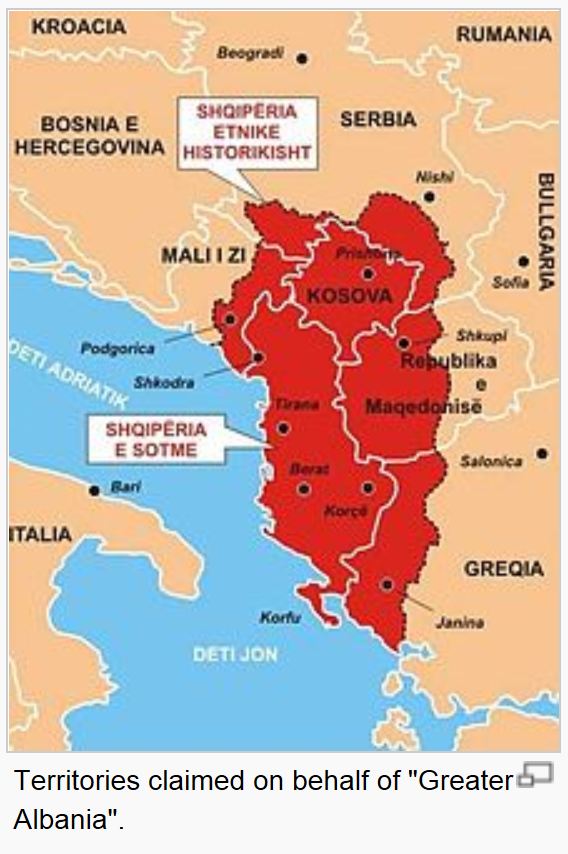


Eventually, a rivalry broke out between the AKSh and remaining elements of the NLA. Picking up with an excerpt from the report (pgs 82-83):

According to a February 2002 report in the Daily Telegraph and the Macedonian daily Nova Makedonija, Western police records and United Nations reports confirm that the leaders of the AKSh and the NLA are involved in large-scale smuggling of weapons, human beings, narcotics, and other goods. Money from those transactions is used to finance terrorist activities in Macedonia and Kosovo. Narcotics, reportedly the most important of the smuggled items, are moved through what is known as the Balkan Drug Route, which begins in Afghanistan and passes through Turkey, Bulgaria, Macedonia, Albania, and Italy to reach markets in Western Europe. An alternate route goes from Afghanistan into Western Europe via Turkey, Bulgaria, Serbia, and Slovenia. Primary locations for the exchange of drugs for guns are Kumanovo and Skopje (both in northern Macedonia), which are points along the Balkan route to which weapons are smuggled. From those cities, weapons move into Kosovo.201

In September 2001, the Canadian Centre for Peace in the Balkans reported that Osama bin Laden was channeling profits from the sale of narcotics arriving in Western Europe via the Balkan Route to local governments and political parties, with the goal of gaining influence in Albania or Macedonia or both. The report theorized that Macedonia presents an ideal target because of its large Albanian minority (about one in three Macedonians is an ethnic Albanian) and its strategic position between east and west, along the new pipeline proposed between Burgas (Bulgaria) and Drac (Albania).202

In the same period, the Washington Times reported that bin Laden was the "biggest financial supporter" of the NLA, which has received $6 to $7 million from that source to supplement its narcotics income in supporting terrorist activities. In January 2001, the Stratfor intelligence organization reported that bin Laden had contributed and trained fighters for the KLA, citing the strategic importance of this link for the operation of his terrorist network in Europe. That report quoted the Albanian intelligence service as calling Albania the most important transit point for Islamic militants into Europe. In 1999 and 2000, Albania arrested ten individuals identified as Islamic terrorists.203

A February 2002 report in the Herald of Glasgow noted that al Qaeda had acted as a middleman in the movement of heroin from warehouses in Afghanistan via Chechen mafia conduits and into the Balkan narcotics pipeline. (The Taliban had prohibited the growing of poppies but had not confiscated the large stores of heroin already existing, and in fact profited from the heroin trade by taxing growers and dealers.) Al Qaeda took a percentage of the drug profits for this service.204 Between 1996 and 1998, the volume of drugs confiscated by Italian police from Albanian dealers in Italy rose from 5,500 kilograms to 23,000 kilograms.205

According to a February 2002 report, former KLA guerrillas and Albanian liberation extremists have used profits from their participation in Taliban-sponsored narcotics smuggling to re-arm themselves after the disarmaments that occurred from 1999 to 2001. The new arms, estimated to be worth about $4 million, include SA-18 and SA-7 surface-to-air missiles capable of bringing down Macedonian helicopters.206 According to a subsequent report, "the weapons were paid for by Albanian criminals with the proceeds of selling Afghan heroin on the streets of a dozen European capitals."207

There was a dynamic interplay between the rise of the KLA and the rise of the ethnic Albanian cartels based in Kosovo. From Heroin Heroes, from January/February of 2000:

The ascent of the Kosovar families to the top of the trafficking hierarchy coincided with the sudden appearance of the KLA as a fighting force in 1997. As Serbia unleashed its campaign of persecution against ethnic Albanians, the diaspora mobilized. Hundreds of thousands of expatriate Kosovars around the world funneled money to the insurrection. Nobody sent more than the Kosovar traffickers -- some of the wealthiest people of Kosovar extraction in Europe. According to news reports, Kosovar Albanian traffickers launder $1.5 billion in profits from drug and arms smuggling each year through a shadowy network of some 200 private banks and currency exchange offices. A congressional briefing paper obtained by Mother Jones indicates: "We would be remiss to dismiss allegations that between 30 and 50 percent of the KLA's money comes from drugs."

Elements of the KLA associated with criminal cartels - the so-called "15 families" - quickly became the best-equipped forces the KLA could field. In turn, they leveraged the KLA's ties with the West into increased business opportunities for the Albanian cartels. As the influence of the cartels increased, the KLA and its daughter organizations became better-funded and better-equipped.

In Congressional testimony on December 13, 2000, Frank Cilluffo had this to say (The Threat Posed from the Convergence of Organized Crime, Drug Trafficking, and Terrorism):

During the NATO campaign against the former Yugoslavia in the Spring of 1999, the Allies looked to the Kosovo Liberation Army (KLA) to assist in efforts to eject the Serbian army from Kosovo. What was largely hidden from public view was the fact that the KLA raise part of their funds from the sale of narcotics. Albania and Kosovo lie at the heart of the "Balkan Route" that links the "Golden Crescent" of Afghanistan and Pakistan to the drug markets of Europe. This route is worth an estimated $400 billion a year and handles 80 percent of heroin destined for Europe.

The ethnic Albanian cartels were sitting along the route of a drug trade worth $400 billion per year. On top of that, there was trafficking in arms and other commodities. Returning now to A Global Overview of Narcotics-Funded Terrorist and Other Extremist Groups (pgs 83-84):

Beginning in the 1990s, the "official" network of organized crime in Albania has grown and become more sophisticated. In a January 2001 report, British-based criminologist Vicenzo Ruggiero said, "joint ventures between southern Italian organized crime and groups operating in Albania are frequent, and such partnerships are imposed by local criminal entrepreneurs who expect to be given a percentage of the profits earned by their Albanian counterparts." According to Italian prosecutor Piero Luigi Vigna, Albanian groups have found a specific niche in the growing multinational organized crime network: "Albanian criminal groups fulfill the functions of a kind of service agency, establishing, for the management of clandestine immigration toward [sic] Italy, ties with the Chinese mafia and with its Turkish and Russian counterparts." Thus cooperative agreements and the development of specific roles appear to be replacing traditional bloody territorial rivalries between crime groups from various nations (most importantly for the Balkan and Adriatic regions, groups from Albania and Italy).208

Trafficking in human beings is an expanding activity for this international network. According to the International Organisation for Migration, the Balkans is a major route (and source) for trafficking in women and children for sexual exploitation. The organization characterizes such trafficking as "the fastest-growing crime in the Balkans."209 Albania's geographical position and its chaotic political situation mean that it plays an important role in such trade. One factor in the expansion of this commerce has been the presence in the Balkans of foreign soldiers, who in 2000 accounted for 80 percent of the profits of brothels in Kosovo and Bosnia.210 Many women are moved across the Albanian border into the coastal tourist areas of Greece. Reportedly, the young women of entire villages in Albania, Bulgaria, Moldova, and Romania have been forcibly moved into this system, many with the promise of reaching Western Europe. Corrupt police in Albania have aided this practice, even escorting women through the country.211 The port of Vlore, characterized as "lawless" in 2001, has been the home port of a large fleet of boats that have smuggled hundreds of thousands of immigrants and tons of drugs across the Adriatic Sea into Italy, and thence into the rest of Western Europe.212

By the end of the last century, the ethnic Albanian cartels were the quintessential middlemen: they had connections with Turkish cartels moving heroin, South Asian Islamic cartels producing heroin, Russian cartels, Chinese cartels... they had connections with ethnic Italian cartels in Europe and in the US, though the Albanian groups were taking market share, sometimes by contracting out for the Cosa Nostra, sometimes by simply muscling in.

One key are of expansion was the use of women for forced prostitution. Thousands of international peacekeepers in the region made for a captive audience with needs that the Albanian cartels would be happy to meet. Women did not remain in the Balkans; they got passed on to Italy, to the Middle East, to any place with a willing buyer. Better than narcotics, which were sold and then consumed, women were essentially "rented", then sold on to new buyers; the fact that a woman had been previously "rented" generally had only marginal impact on her value, so she could be bought, forced to work as a prostitute, then sold to another pimp, with nearly all her earnings as a prostitute being net profits.

Of course, whole people were not the only commodity; the Albanian cartels also trafficked in body parts. From leaked UNMIK documents dated 2003:


SUMMARY

Beginning in mid-1999 (and possibly earlier), between 100 and 300 people were abducted and taken by truck and van to detention facilities in or near the northern Albanian towns of Kukes and Tropoje. Most of these people were Serbian men from Kosovo taken captive between June and October 1999. Beginning in August 1999, some of these captives (24-100) were transferred from northern Albania to secondary detention facilities (private homes and rough industrial compounds) in central Albania, mainly near the town of BUrrel (or Burreli), about 110 kilometers southwest of Kukes. Captives were also moved to detention facilities near Peshkopi, about 50 kilometers east of Burrel.

The captives taken to central Albania were again moved, in small groups, to a private house south of Burrel that was set up as a makeshift clinic. There, medical equipment and personnel were used to extract body organs from the captives, who then died. Their remains were buried nearby. The organs were transported to Rinas airport near Tirana (approximately 75 kilometers southwest of Burrel) and flown abroad. Other captives taken to the house/clinic near Burrel included a smaller number of females from Kosovo, Albania and eastern Europe. The last delivery of captives to the house/clinic was reorted in spring or early summer of 2000.

In addition to captives taken to Albania alive, an unknown number of bodies of Serbian civilians killed in Kosovo were transported to Albania and buried in remote locations.

This summary is based on interviews with at least eight sources, all ethnic Albanians from Kosovo or Montenegro who served in the Kosovo Liberation Army. Four sources directly participated in the transport of at least 90 ethnic Serbs and others to detention facilities in northern and central Albania. Of these, three sources delivered captives to the house/clinic south of Burrel, two sources claim to have participated in the disposal of human remains near the house and one source claims to have participated in the delivery of body parts and/or organs to Rinas airport near Tirana. None of the sources witnessed the medical operations.

According to all sources, the transports and surgical procedures were carried out with the knowledge and/or active involvement of mid-level and senior KLA officers as well as doctors from Kosovo and abroad. THe operation was supported by men with links to Albanian secret police operatives of the former government of Salih Berisha.


The report gives a specific location.


Google imagery of the area shows little of interest:


To be sure, not everyone associated with the KLA was involved in all of this, or even knew of it. Of the people who were involved with it, some did what they could to at least not participate, and a few later came forward to tell what they knew - hence, the reports to the international community.

Similarly, most of the people in the Albanian diaspora who contributed money to the cause felt, and with good reason, that they were helping ethnic Albanians defend themselves against Serb excesses. Some heard rumors of alleged illegal activities, but understandably dismissed these as hostile propaganda.

But, at the top, the key players knew what was going on: they controlled a criminal empire, with ties going from the poppy fields in South Asia to the streets of Western Europe and the United States. The value of the heroin trafficking alone was $400 billion, but add in the value of the arms, the women who were forced to work as prostitutes and then sold on to new pimps, and the other contraband, and this was a big criminal empire.

And, a big criminal empire needed political protection - protection which it could afford to buy.

Thursday, August 9, 2012

Down the Rabbit Hole, Part 1

By popular demand, I begin a new series...

The only thing I will tell you about where this series is going is this: whether you are Democrat or Republican, Muslim or Infidel, crook or cop; whether you are a proud American or a card-carrying charter member of the hate-America-first crowd... you will not like the destination. ;)

We will begin by reviewing the background of the Kosovo Liberation Army, or KLA. The KLA was the main armed group on the ethnic Albanian side in the fighting that resulted in the province of Kosovo declaring its independence from Serbia; this fighting was supported by NATO, and Kosovo's independence was widely recognized by the international community. (As of 1999, as part of the internationally-sponsored end to hostilities in the area, the KLA was transformed into the Kosovo Protection Corps, which was disbanded in early 2009, with many of its personnel becoming part of the Kosovo Police.)


KLA, Terrorism, Organized Crime


An article entitled Heroin Heroes, from January/February of 2000, provided extensive background on the KLA. One key excerpt is this one:

For hundreds of years, Kosovar Albanian smugglers have been among the world's most accomplished dealers in contraband, aided by a propitious geography of isolated ports and mountainous villages. Virtually every stage of the Balkan heroin business, from refining to end-point distribution, is directed by a loosely knit hierarchy known as "The 15 Families," who answer to the regional clans that run every aspect of Albanian life.

The Kosovar Albanian traffickers are so successful, says a senior U.S. State Department official, "because Albanians are organized in very close-knit groups, linked by their ethnicity and extended family connections."

The clans, in addition to their drug operations, maintained an armed brigade that gradually evolved into the KLA. In the early 1990s, as the Kosovar uprising in Yugoslavia grew, ethnic Albanian rebels there faced increased financial needs. The 15 Families responded by boosting drug trafficking and channeling money and weapons to the rebels in their clans. As traffickers started taking bigger risks, drug seizures by police across Europe skyrocketed from a kilo or two in the early 1980s to multimillion-dollar hauls, culminating in the spectacular 1996 arrest at Gradina, Yugoslavia, of two truckers running a load of more than half a ton of heroin worth $50 million.

Though the article Heroin Heroes put many pieces of the puzzle together, the story was hardly hidden previously. Two years earlier, the UN published Resolution 1160 (1998), which had this to say regarding the KLA:

The Security Council,

[snip]

Conndemning the use of excessive force by Serbian police forces against civilians and peaceful demonstrators in Kosovo, as well as all acts of terrorism by the Kosovo Liberation Army or any other group or individual and all external support for terrorist activity in Kosovo, including finance, arms and training,

[snip]

2. Calls also upon the Kosovar Albanian leadership to condemn all terrorist action, and emphasizes that all elements in the Kosovar Albanian community should pursue their goals by peaceful means only;

About this time, the matter was being addressed in Washington, though, since the Democrat Clinton Administration was siding with the KLA, it was up to Republicans in the Senate to try to get the story out.

A press release entitled Bosnia II: The Clinton Administration Sets Course for NATO Intervention in Kosovo, by the United States Senate Republican Policy Committee and dated August 12, 1998, had this to say:

Whitewashing the KLA

But in order to make the case for U.S./NATO intervention, the Clinton Administration, as in Bosnia, must rely on the ethnic justification of one side in the conflict to the exclusion of the other side's case. Contributing to the success of this strategy to date has been the negligible attention given to the KLA's ties to organized crime elements in the Albanian diaspora [See: "Speculation plentiful, facts few about Kosovo separatist group," Baltimore Sun, 3/16/98; "Germany 'can take no more refugees'," The Guardian (London), 6/17/98; "My plan to save Kosovo now," by Paddy Ashdown, The Independent (London), 8/5/98] and indications that the KLA may be receiving assistance (as did the Muslim regime in Bosnia) from Iran [See: "Radical groups 'arming Kosovo Albanians'," Financial Times (London), 5/8/98; "Italy Become's Iran's New Base for Terrorist Operations," Defense and Foreign Affairs Strategic Policy (London), February 1998].

In addition, there are media reports that the recent embassy bombings in Kenya and Tanzania may be connected to the deportation from Albania of several members of an Islamic terrorist cell connected to Saudi expatriate Osama Bin Laden; questions are now being raised as to the activities of radical Islamic groups in Albania, particularly in the region around the town of Tropoje, a known KLA staging area ["U.S. Blasts Possible Mideast Ties: Alleged Terrorists Investigated in Albania," Washington Post, 8/12/98]. This possible connection raises serious implications for the Clinton Administration's regional policy: "One of the most disturbing aspects of the present [terrorism] crisis is that it may have been triggered by our own inept foreign policy in Bosnia and Kosovo. There, beyond all common sense, we find ourselves championing Muslim factions who draw support from the very Islamic fundamentalist terrorist groups who are our mortal enemies elsewhere" ["Bringing terrorists to justice," by Col. Harry G. Summers (USA-Ret.), Distinguished Fellow, U.S. Army War College, Washington Times, 8/12/98].


Less than a year later, more information was out about the developing situation in the Balkans; from The Kosovo Liberation Army: Does Clinton Policy Support Group with Terror, Drug Ties?, from March 31, 1999:

The KLA: from 'Terrorists' to 'Partners'

The Kosovo Liberation Army "began on the radical fringe of Kosovar Albanian politics, originally made up of diehard Marxist-Leninists (who were bankrolled in the old days by the Stalinist dictatorship next door in Albania) as well as by descendants of the fascist militias raised by the Italians in World War II" ["Fog of War -- Coping With the Truth About Friend and Foe: Victims Not Quite Innocent," New York Times, 3/28/99]. The KLA made its military debut in February 1996 with the bombing of several camps housing Serbian refugees from wars in Croatia and Bosnia [Jane's Intelligence Review, 10/1/96]. The KLA (again according to the highly regarded Jane's,) "does not take into consideration the political or economic importance of its victims, nor does it seem at all capable of seriously hurting its enemy, the Serbian police and army. Instead, the group has attacked Serbian police and civilians arbitrarily at their weakest points. It has not come close to challenging the region's balance of military power" [Jane's, 10/1/96].

The group expanded its operations with numerous attacks through 1996 but was given a major boost with the collapse into chaos of neighboring Albania in 1997, which afforded unlimited opportunities for the introduction of arms into Kosovo from adjoining areas of northern Albania, which are effectively out of the control of the Albanian government in Tirana. From its inception, the KLA has targeted not only Serbian security forces, who may be seen as legitimate targets for a guerrilla insurgency, but Serbian and Albanian civilians as well.

In view of such tactics, the Clinton Administration's then-special envoy for Kosovo, Robert Gelbard, had little difficulty in condemning the KLA (also known by its Albanian initials, UCK) in terms comparable to those he used for Serbian police repression:

"'The violence we have seen growing is incredibly dangerous,' Gelbard said. He criticized violence 'promulgated by the (Serb) police' and condemned the actions of an ethnic Albanian underground group Kosovo Liberation Army (UCK) which has claimed responsibility for a series of attacks on Serb targets. 'We condemn very strongly terrorist actions in Kosovo. The UCK is, without any questions, a terrorist group,' Gelbard said." [Agence France Presse, 2/23/98]

[snip]

Among the most troubling aspects of the Clinton Administration's effective alliance with the KLA are numerous reports from reputable unofficial sources -- including the highly respected Jane's publications -- that the KLA is closely involved with:

The extensive Albanian crime network that extends throughout Europe and into North America, including allegations that a major portion of the KLA finances are derived from that network, mainly proceeds from drug trafficking; and

Terrorist organizations motivated by the ideology of radical Islam, including assets of Iran and of the notorious Osama bin-Ladin -- who has vowed a global terrorist war against Americans and American interests.


Skipping down:

Reports on KLA Drug and Criminal Links

Elements informally known as the "Albanian mafia," composed largely of ethnic Albanians from Kosovo, have for several years been a feature of the criminal underworld in a number of cities in Europe and North America; they have been particularly prominent in the trade in illegal narcotics. [See, for example,"The Albanian Cartel: Filling the Crime Void," Jane's Intelligence Review, November 1995.] The cities where the Albanian cartels are located are also fertile ground for fundraising for support of the Albanian cause in Kosovo. [See, for example, "Albanians in Exile Send Millions of Dollars to Support the KLA," BBC, 3/12/99.]

The reported link between drug activities and arms purchases for anti-Serb Albanian forces in Kosovo predates the formation of the KLA, and indeed, may be seen as a key resource that allowed the KLA to establish itself as a force in the first place:

"Narcotics smuggling has become a prime source of financing for civil wars already under way -- or rapidly brewing -- in southern Europe and the eastern Mediterranean, according to a report issued here this week. The report, by the Paris-based Observatoire Geopolitique des Drogues, or Geopolitical Observatory of Drugs, identifies belligerents in the former Yugoslav republics and Turkey as key players in the region's accelerating drugs-for-arms traffic. Albanian nationalists in ethnically tense Macedonia and the Serbian province of Kosovo have built a vast heroin network, leading from the opium fields of Pakistan to black-market arms dealers in Switzerland, which transports up to $2 billion worth of the drug annually into the heart of Europe, the report says. More than 500 Kosovo or Macedonian Albanians are in prison in Switzerland for drug- or arms-trafficking offenses, and more than 1,000 others are under indictment. The arms are reportedly stockpiled in Kosovo for eventual use against the Serbian government in Belgrade, which imposed a violent crackdown on Albanian autonomy advocates in the province five years ago." ["Separatists Supporting Themselves with Traffic in Narcotics," San Francisco Chronicle, 6/10/94]


Skipping down:

Reports on Islamic Terror Links

The KLA's main staging area is in the vicinity of the town of Tropoje in northern Albania [Jane's International Defense Review, 2/1/99]. Tropoje, the hometown and current base of former Albanian president Sali Berisha, a major KLA patron, is also a known center for Islamic terrorists connected with Saudi renegade Osama bin-Ladin. [For a report on the presence of bin-Ladin assets in Tropoje and connections to anti-American Islamic terrorism, see "U.S. Blasts' Possible Mideast Ties: Alleged Terrorists Investigated in Albania, Washington Post, 8/12/98.]

The Clinton Administration's decision to support Islamic terrorists was not by chance; it was pre-meditated. The reason was simple: Islamic terrorists were closely connected to the big money of the narcotics traffickers; this money went in one direction to fund jihad, and in the other to buy political influence in Washington.


Stay tuned for more...

Friday, November 25, 2011

Men of Integrity, Part 2

In Part 1, we considered a brief recent history of Burkina Faso. Highlights included how Thomas Sankara led a military coup in 1983 (one of a series the country had seen), seizing power with the help of his friend Blaise Compaoré. Sankara established a Castro-style revolutionary government, complete with revolutionary committees and torture, defying the powers of international bankers and French neo-colonialists. Sankara was trying to establish Upper Volta, as the country was then known, as a truly independent nation - independent of the manipulating foreign powers that seek to keep so many African nations subdued.


Compaoré murdered his childhood friend, seizing power in 1987 in a country that Sankara had renamed "Burkina Faso", and began to align his country's policies more closely with the goals and desires of these international puppet masters. As a result of Compaoré's new policies, Burkina Faso supported bands of armed thugs who stirred up trouble in Sierra Leone and Liberia, as well as in neighboring Côte d'Ivoire, where strongman Alassane Ouattara, a fellow Burkinabé countryman, was this year installed as "president" with assistance from French military power operating under UN auspices, and in violation of Ivoirian law.


Guillaume Soro, another Burkinabé who owns very nice houses ;) in Burkina Faso and France, is one of Ouattara's chief lieutenants in what I might call an occupation of Côte d'Ivoire.


So, what we have is an obvious attempt by foreign powers, including neo-colonial France and international bankers, to use the power they have consolidated in Burkina Faso to spread their influene throughout western Africa, with their most recent conquest being Côte d'Ivoire.

Needless to say, relations between Compaoré and Ouattara are cordial. The text of Burkina Faso: President, Ouattara Aim to Boost Ties, November 18, 2011:

Burkina Faso's President Blaise Compaore, who backed Alassane Ouattara during Ivory Coast's political crisis, hosted a joint cabinet meeting with the Ivorian leader Friday to boost bilateral cooperation.

Compaore said the joint meetings were designed to foster stronger integration between the neighbouring west African states.

Speaking at the opening ceremony, Compoare added that he was "happy about the return of peace and institutional stability in our sister republic, Ivory Coast".

Compaore was firmly behind Ouattara in the impasse that arose from the November 2010 elections, when Laurent Gbagbo refused to accept he had lost, although Compaore's mediation efforts appeared to achieve little.

The crisis ended with the arrest in April of Gbagbo, whose resistance gave rise to clashes that left thousands dead.

At the joint meeting, Ouattara thanked Burkina's leader for his "personal involvement ... in the denouement of the Ivorian crisis".

Some three million Burkinabe work in Ivory Coast, mostly on cocoa plantations.

An estimated 80,000 Burkinabe fled Ivory Coast during the country's political unrest. - ANP/AFP

But, the main thing they are working on bilaterally is the consolidation of power.

For some background, we consider an excerpt from COTE D'IVOIRE: Barakissa Ouédraogo, "We must talk, otherwise we’ll keep killing one another", from earlier this year:

OUAGADOUGOU, 4 July 2011 (IRIN) - As Ivoirian and international officials discuss truth, reconciliation and trying those suspected of war crimes, Barakissa Ouédraogo, one of more than 100,000 Burkinabé who fled Côte d'Ivoire for Burkina Faso during the post-election violence, says helping families rebuild destroyed homes would do more to foster stability.

Ouédraogo said she regularly received death threats and that Burkinabé friends in Côte d’Ivoire were killed and maimed. "The violence just got to be too much - so many killed, so many injured. We had to flee." She said presidents come and go, and that it is the people who must decide not to let politics lead to killing. Ouédraogo was born in Côte d’Ivoire, where Burkinabé have lived for generations. Having fled to Burkina in January, she recently returned to Abidjan's Abobo District to assess the damage at her shelled home.

"I think these truth and reconciliation processes are just theatre, decoration. If you ask me, the money that would go into organizing such things could be used to fix holes in roofs, to help families who are really destitute. If you see your home repaired, you get some relief. Whatever your ethnicity, whatever your politics, that would ease your pain. There are still people living outdoors.

"You're going to go to talk to a commission, tell them how your family was killed and you want to forgive, then what? You return to the street because your home is flattened."

One of the main causes of "flattened" homes was the use of French firepower - helicopter gunships, for example - to support Ouattara's thugs as they ousted President Gbagbo. The "truth and reconciliation processes" mentioned, for which another of my series on events in the region is named (see sidebar), is an attempt to whitewash the crimes of Ouattara's thugs and their French allies, and blame everything on Gbagbo's supporters.

So, Burkina Faso under Blaise Compaoré played a key role in destabilizing the region and in particular in overthrowing the legitimate government of Ivoirian President Laurent Gbagbo.

But, as we saw in Part 1, what goes around comes around.

First, we consider the backdrop to the drama that is about to play out in the region. From WEST AFRICA: Sahel the danger zone for food insecurity:

DAKAR, 27 October 2011 (IRIN) - Erratic rains and high imported rice and wheat prices against a backdrop of chronic food insecurity and malnutrition in parts of the Sahel, will leave millions of people at risk of food insecurity, according to the latest crop assessments.

"We are definitely going to have a difficult year," said Patricia Hoorelbeke, West Africa head of NGO Action Against Hunger (ACF), adding that the NGO is considering expanding its food and nutrition programmes in the region.

Food production

Food production is expected to be lower than usual in parts of western Niger, Chad's Sahelian zone, southern Mauritania, western Mali, eastern Burkina Faso, northern Senegal and Nigeria, according to a report by the World Food Programme (WFP) and the Food and Agriculture Organization (FAO), and a separate assessment by USAID's food security monitor FEWS NET.

The link at the end of the passage has some interesting infographics. In the short term (i.e., for the rest of this year) there will be food supply "stress" in Mauritania - fairly distant from Burkina Faso:


But, as 2012 opens, the situation will worsen, engulfing the entire country of Mali (where there are other troubles) and spreading to the other side of Burkina Faso.


As the passage itself indicates, eastern parts of Burkina Faso will become directly affected.

A stressed food supply, caused by drought, has been known to help generate fairly chaotic conditions; Somalia is a classic example of this.

For some additional background on the developing food insecurity situation throughout the Sahelian region of Africa, which includes the area we are considering, I suggest an article by Alex Thurston, published in The Christian Science Monitor, entitled Sahel Grapples with Food Insecurity, November 21, 2011, and cross-posted at Thurston's blog: Focus on Sahelian Food Shortages.

The food insecurity situation is noteworthy in Chad, where there are chronic problems with malnutrition and food shortages, and is of real concern in Niger, already shaded in the graphic above to have a stressed area near its capital, which is near the border with Burkina Faso. Skipping down in WEST AFRICA: Sahel the danger zone for food insecurity:

Returnees from Libya

The return to Niger and Chad of migrants from Libya who previously sent money home to help mitigate crop deficit is already pushing some families into further food insecurity, according to the International Organization for Migration (IOM). "These returns have aggravated extreme poverty and hunger which is affecting more than half of Niger's 2.5 million people threatened with food insecurity this year," said IOM.

While international attention and government involvement has been relatively high in Niger compared to the devastating drought of 2005, Oumarou Lalo Keita, principal adviser to the prime minister, said international agencies have been slow to respond to government appeals for increased aid over recent months as a result of the return of some 90,000 migrants from Libya. "There is clearly cause for concern," he said. Following the 2009-2010 drought, the country does not have sufficient emergency food stocks, he said. "We experience difficulties year-on-year, and there is still a gap between needs and the support we receive."

While governments and aid agencies in West Africa are for the most part well-versed in responding to food insecurity, readiness and capacity is still low in some areas.

Part of the Chadian Sahel and eastern Burkina Faso are not receiving as much international attention, said ACF's Hoorelbeke. "Chadian Sahel is hardly covered - there are not enough agencies there... If there is a situation that we hear very little about, it is eastern Burkina Faso, where we are likely to see a real problem this year," she told IRIN.

The same guys who pull strings in western Africa have been busy in Libya. And now, people returning from Libya are going to be a problem, and not just because they are refugee mouths to feed instead of wage-earners as they were under Gaddafi. From Burkina Faso, Niger - Libya weapons fear, November 14, 2011:

Ouagadougou - Burkina Faso and Niger are concerned about regional insecurity following the conflict in Libya which they fear has led to new arms trafficking, Niger's prime minister said Monday.

"It is a major concern, the trafficking of arms is a real threat to the region," Rafini Briji said on a visit to Ouagadougou.

"The conflict in Libya has created very complicated situations since the arms depots were opened and people from all quarters helped themselves and took them [arms] in all directions," he said.

Briji said Niger and Burkina Faso were worried about armed groups and the concentration of weapons all around their two countries.

In response they have decided to reinforce their co-operation to ensure security in the Sahel-Saharan zone, Briji added.

During a visit to South Africa on Friday, Niger's President Mahamadou Issoufou asked for military aid to help fight armed groups and traffickers, saying the Libyan conflict had aggravated terrorist threats.

Since the overthrow and killing of Libyan strongman Muammar Gaddafi, experts have expressed concern that part of Gaddafi's considerable stock of weapons could end up in the hands of al-Qaeda's branch in North Africa which has bases in the Sahel and is currently holding several foreign hostages.

To be sure, the Sahara/Sahel region was already a crossroads for smugglers moving South American cocaine to Europe, moving Asian heroin to the Americas, and moving arms to anyone with a means to pay for them. But, Libya was well-stocked with arms, and the area is now going to be flooded with weapons - and not just with military-grade automatic rifles.

Perhaps the potential for trouble is why Compaoré's government in Burkina Faso is taking a page from the playbook of Compaoré's childhood friend Thomas Sankara, whom Compaoré murdered to seize power, and trying a new plan to alleviate food insecurity problems. From BURKINA FASO: “Blue revolution” needed to boost dry-season harvest:

OUAGADOUGOU, 17 November 2011 (IRIN) - The Burkina Faso government is attempting for the first time to implement a nationwide dry-season agricultural campaign to counteract possible food insecurity in areas that received poor or erratic rainfall this year. But the government, alongside others in the region, also needs to invest in a "blue revolution" - small-scale irrigation systems to help farmers grow crops in drought-prone zones - says the International Food Policy Research Institute (IFPRI)

Some 146 out of 351 communes across 10 of Burkina Faso's 13 regions were affected by low grain outputs, according to the government's provisional estimates. The regions most affected by poor rains were the northern millet-producing zone, the Sahel, the Centre north, the Centre west, the East and the Centre east.

"At the moment the food security situation is not alarmist, but there are pockets spread out across the country that could be in a critical situation, and that need to be closely monitored," the Deputy-director of the World Food Programme (WFP) in Burkina Faso, Ariane Waldvogel, told IRIN.

One thing is for sure: If food insecurity in and around Burkina Faso develops into a real crisis, this could be the spark that allows all these nomadic mercenaries with all their new Libyan toys to ignite a real flame in Burkina Faso - a country that has in recent months experienced unrest - bringing the troubles that Compaoré helped cause elsewhere home to roost.

Sunday, October 16, 2011

This One Before, Part 3

In Part 1 we began to examine an incident in which US government agents were ambushed in Mexico, and reviewed how most of the weapons the Mexican drug cartels use are in fact military-grade weapons that cannot have come from gunshops and gunshows on the US side of the border. In Part 2 we considered the attack more in-depth, and saw how it must have been a deliberate attack targeting US agents, and how those agents were likely sold out by US authorities.

In a related series, we saw in Take A Long Holiday, Part 1 how the Palestinian Authority's key leaders have been involved in trafficking heroin for decades, and we saw some of the impact this has on Palestinians in the West Bank. In Take A Long Holiday, Part 2, we considered the movement of drugs through western Africa, looking at cocaine moving from Latin America to Europe, and connections from Islamic terrorist groups leading the other way through Latin America, all the way to the US border.

There have been a great many very predictable developments since then. In fact, I have not blogged about this because it is playing out pretty much the way I had anticipated. I do feel, though, that it is time for an update.

We now consider in its entirety an article entitled Mexico unlikely base for terrorism, from October 14, 2011:

MEXICO CITY –The alleged Iranian plot to assassinate Saudi Arabia's ambassador to the United States has cast Mexico into the news as a potential staging area for a terrorist operation.

But experts say the likelihood of such a plot going undetected in Mexico by U.S. authorities is low and that Mexico's drug cartels would be unlikely to become involved in such a plot.

U.S. officials alleged Tuesday that an Iranian-American and a member of Iran's Quds Force sought to enlist a Mexican drug cartel in a plot to kill Saudi Ambassador Adel Al-Jubeir in Washington, perhaps by bombing a restaurant he was known to frequent.

One of the men, Manssor Arbabsiar, 56, a naturalized U.S. citizen holding Iranian and U.S. passports, was said to have met in the Mexican border city of Reynosa with a Drug Enforcement Administration informant who he thought was a member of a violent drug cartel.

The barrage of 251,287 unredacted U.S. diplomatic cables that WikiLeaks released more than a month ago suggest that American diplomats maintain a steady focus on Iran's activities in Latin America. In Mexico, that meant keeping an eye on a mosque in Torreon, watching the impact of Iran's "dynamic" new ambassador, gauging public attitudes toward Iran and coaching agents at Mexico's National Security and Investigation Center – CISEN in its Spanish initials – the domestic intelligence agency.

Strategic Forecasting Inc., an Austin, Texas, global intelligence firm commonly called Stratfor, on Wednesday described as unlikely any use of Mexico as a staging ground for a terrorist attack emanating from the Middle East.

It noted that while the U.S.-Mexico border is porous and prone to security breaches, the U.S. government has "extremely active intelligence capabilities" embedded in Mexico. It added that Mexico is generally hostile to enemies of the United States, not wanting to risk possible intervention by U.S. forces should its territory be used in any attack.

The cartels have pragmatic interests in maintaining their core business of narcotics smuggling without greater interference, it added.

"Any plan to use Mexican drug cartels to carry out attacks against the U.S. would threaten the very existence of the cartel," a Stratfor analysis said.

"Mexican drug cartels are already facing challenges – struggling with one another and with the Mexican government for control over transportation routes that will allow them to transit cocaine from South America to the U.S. Any foray into international terrorism would be bad for business," Stratfor said.


So, the experts feel that Mexican drug cartels are not getting in bed with terrorists from the Middle East and Southwest Asia - at least not to the point of being willing to commit terrorist attacks on their behalf.

Of course, this opens up a whole line of questions regarding what could result in the Persian Gulf based on the allegations of this plot, and that, in turn, opens the door to speculation about who might be telling how much of the truth and who might benefit from the lies. But, this series does not deal with the Persian Gulf.

Then there is the question about illegal activities in the Western Hemisphere: drug trafficking, trafficking of weapons and other contraband, bribery and corruption... all these things go hand-in-hand. And, terrorism is financed through these activities. Terrorist organizations are big into trafficking drugs to fund their activities - so much so that they often lose sight of their political agenda, and focus on their profit motive - and into trafficking arms, which they use for terrorist attacks and for security for their other illegal activities.

It is increasingly difficult to separate terrorism from other illegal activities.

For an overview of what is publicly known about the "Fast and Furious" scandal, we consider excerpts from NRA's LaPierre: 'Fast and Furious' Was Plot Against Second Amendment, dated October 14, 2011:


The government-sanctioned gunrunning operation Fast and Furious was a plot to undermine Second Amendment rights in the United States, National Rifle Association officerWayne LaPierre charged on Friday in an exclusive interview with Newsmax.TV.

"It's the only thing that makes any sense," LaPierre said. "Over a period of two or three years they were running thousands and thousands of guns to the most evil people on earth. At the same time they were yelling '90 per cent... of the guns the Mexican drug cartels are using come from the United States.'

That was a phony figure from the very start. Even the Wikileaks cables from our own State Department prove they are coming from Central America, they are not coming from the U.S. Every police officer will tell you that they're coming from Russia, they're coming from China, most of them are coming from Central America and a lot of them are coming from defections from the Mexican Army," said LaPierre, the NRA's executive vice president and CEO.

But LaPierre said that President Barack Obama, Attorney General Eric Holder, and Secretary of State Hillary Clinton were determined to make it appear that most weapons used by the Mexicans came from north of the border, "so they could stick more gun legislation on honest American gun owners of the United States."

LaPierre insisted that the whole Fast and Furious scandal, in which he said "thousands and thousands" of weapons were allowed to cross into Mexico, would never have come to light at all if it hadn't been for the murder of U.S. Border Patrol Agent Brian Terry in Arizona in December.

"We wouldn't know about this at all if [Terry] had not been killed and some of the good, honest, decent federal agents down the line had enough of the stench coming out of Washington and started to use the Whistleblower Act to go public and call the Justice Department out on this whole rotten, stinking scheme.

"Otherwise thousands of guns would still be going over the border into the Mexican drug cartels and the president and the attorney general and the secretary of state would all be running around going '90 percent of the guns come from America' in an attempt to seek political advantage and in an attempt to enact more gun control laws on honest American citizens and use this whole issue politically against the Second Amendment of the United States."

LaPierre summarizes the scandal nicely:

"Look at what has happened," he said. "We had our Department of Justice under the Obama administration running thousands and thousands of guns over the border and watching them go directly into the hands of some of the most evil people on earth, the Mexican drug cartels.

"At the same time they were letting the reputation of good, honest, decent Americans, law-abiding American gun dealers, be ruined.

"They ordered these sales to be made, they even overrode the InstaCheck system and ordered the dealers to make the sales. Then, when it all starts coming out, there's a massive cover-up."!

LaPierre compares the activities of the Obama Administration with those of a Latin American dictatorship, then offers an excellent assessment:

"What has happened in Fast and Furious is the equivalent of our Justice Department becoming willing co-conspirators with the Mexican drug cartels in their crimes."

Our Justice Department has become willing co-conspirators with the Mexican drug cartels.

Keep that in mind.

The claim that 90% of the arms used in the drugs wars come from the US has documentation that seems to support the claim, until one parses the supporting passages.


For example, in an excerpt from FIREARMS TRAFFICKING: U.S. Efforts to Combat Arms Trafficking to Mexico Face Planning and Coordination Challenges, dated June, 2009, pages 14-16 (pgs 19-21 of 83 in the pdf):

According to U.S. and Mexican government and law enforcement officials and data from ATF on firearms seized in Mexico and traced from fiscal year 2004 to fiscal year 2008, a large portion of the firearms fueling the Mexican drug trade originated in the United States, including a growing number of increasingly lethal weapons. As is inherently the case with various types of illegal trafficking, such as drug trafficking, the extent of firearms trafficking to Mexico is unknown;10 however, according to ATF, a large number of guns are seized from criminals by the military and law enforcement in Mexico, and information on many of these guns is submitted to ATF for the purposes of tracing their origins and uncovering how the guns arrived in Mexico.11 ATF maintains data on the firearms that are seized in Mexico and submitted for a trace, and, from these firearms trace requests, ATF officials told us, they are often able to detect suspicious patterns and trends that can help identify and disrupt arms trafficking networks on both sides of the U.S.-Mexico border.

Using ATF's eTrace data, which currently serves as the best data we found available for analyzing the source and nature of firearms trafficked and seized in Mexico, we determined over 20,000, or 87 percent, of firearms seized by Mexican authorities and traced from fiscal year 2004 to fiscal year 2008 originated in the United States. Figure 3 shows the percentages of firearms seized in Mexico and traced from fiscal year 2004 to fiscal year 2008 that originated in the United States. Over 90 percent of the firearms seized in Mexico and traced over the last 3 years have come from the United States.

Around 68 percent of these firearms were manufactured in the United States, while around 19 percent were manufactured in third countries and imported into the United States before being trafficked into Mexico. ATF could not determine whether the remaining 13 percent foreign sourced arms had been trafficked into Mexico through the United States, due to incomplete information.

While the eTrace data only represents data from gun trace requests submitted from seizures in Mexico and not all the guns seized, it is currently the only systematic data available, and the conclusions from its use that the majority of firearms seized and traced originated in the United States were consistent with conclusions reached by U.S. and Mexican government and law enforcement officials involved personally in combating arms trafficking to Mexico. In 2008, of the almost 30,000 firearms that the Mexican Attorney General’s office said were seized, only around 7,200, or approximately a quarter, were submitted to ATF for tracing.

The report goes on to explain difficulties in how the system operates, and how those difficulties prevent a greater number of weapons from being traced. Furthermore, the report then indicates that experience of law enforcement personnel on both sides of the border supports this conclusion that 90% of the firearms come from the US.

However, look at what the report actually says. For 2008, 30,000 firearms were seized. Only 7,200 were submitted for tracing. Only 90% of those - about 6,480 firearms - were traced back to the US. That leaves over 23,000 firearms - 78% of the total seized - unaccounted-for regarding origins, and it means only a little over 20% of the firearms are actually traced back to the US.

Footnote 10 from the above passage is educational:

10While there is no data on the total number of firearms trafficked to Mexico, the Government of Mexico maintains data on the number of firearms seized in Mexico. Information, such as serial numbers, on many of these seized firearms is submitted to ATF's National Tracing Center for tracing. ATF's National Tracing Center attempts to trace the firearms using the information submitted. Between fiscal years 2004-2008, around 52 percent of trace requests from Mexico that were submitted to ATF's National Tracing Center identified the first retail dealer. Furthermore, according to ATF, the identification of the country of manufacturing origin of a firearm does not depend on identifying the first retail dealer but rather on the initial description of the firearm.

Again, there are no statistics on the total number of weapons trafficked to Mexico. There are only statistics from the US side of the border regarding what has been submitted to US authorities for tracing, and in this case, the number that came up was 52% of the trace requests identified a retailer, presumably in the US.

Let's go with the higher 90% figure, which is really 90% of 24% - because only 24% of the weapons seized in Mexico are submitted to US authorities for tracing.

That still leaves over three-quarters of the weapons seized in Mexico coming from somewhere else.

In other words, the Obama Administration is misleading everyone.

The political reason is obvious. As LaPierre points out (and as we knew), the political agenda is to generate propaganda that can be used to destroy our right to keep and bear arms. And, when all the dust settles, this is what the Obamanistas will plead guilty to.

But what is really going on?

LaPierre mentions - as have I, previously - that the cartels are mainly getting their weapons from Russia, China, and Central America, in addition to through defections from the Mexican Army.

Of course, this trend was noticed years ago. We consider an excerpt from Globalization and Transnational Organized Crime: The Russian Mafia in Latin America and the Caribbean by Bruce Michael Bagley, dated November 15, 2002, pages 9-10:

The third prong of the Russian mafia's strategy of expansion abroad over the 1990s focused on penetration of the Western Hemisphere, initially the United States and Canada. By the mid-1990s, frustrated by the disappointing results of their Asian strategy, Russian organized crime groups became increasingly interested in and focused on new opportunities for criminal activity in Latin America and the Caribbean. Specifically, they realized that the region offered open markets for Russian and Soviet bloc arms in exchange for drugs to be smuggled back to Europe and Russia and easy access to global financial networks for money laundering purposes. Moreover, the region's relatively weak states and deeply imbedded "culture of corruption" provided a familiar environment reminiscent of the one in post-Soviet Russia in which Russian criminal organizations had originally arisen and flourished. In effect, the Russian mafia adapted the previous Soviet-era tactics of forging ties in the Americas via attractive offers of cheap weapons and "technical assistance." This time around, however, the technical assistance proffered was in the realm of money laundering rather than in the use of sophisticated Soviet weaponry.

These arms-trafficking ties go back for years.

Military-grade weapons move one way, drugs move back the other way.

As I have stated, criminals get firearms the way they get drugs - illegally. If a plane, boat or truck goes one way carrying drugs, why can't it go back the other way carrying firearms. This is what they would have us believe regarding the US - drugs come north, weapons move south.

But, the drug trade is not confined to the US/Mexican border.

As I have repeatedly pointed out - and as anyone should know - the drug trade is global. Particularly, I have repeatedly pointed out how cocaine moves from Latin America through Africa to Europe, and how heroin moves from South Asia through the Balkans to Europe, and now through Africa to Europe and the Americas. Military-grade weapons move through Africa, too; Islamic terrorist organizations use them for jihad in Africa and against Israel, but some of the weapons make it to the Americas where they equip drug cartels.

So, why don't we hear about all this - the drugs moving through Africa, the ties that Islamic terrorists have with Latin America, the weapons-trafficking to Mexico of Russian and Chinese arms...? Sure, when it was politically convenient, we hear about an alleged Iranian plot, though there are questions that are raised regarding that, which are outside the scope of this series. But, Hezbollah - an Iranian proxy - has been active in Latin America for many years. Why don't we hear about that?

It is a question of money.

"What has happened in Fast and Furious is the equivalent of our Justice Department becoming willing co-conspirators with the Mexican drug cartels in their crimes."

From US Prosecutors Confirm Classified Information Colors Zambada Niebla's Case, dated October 4, 2011:

Prosecutors in the Jesus Vicente Zambada Niebla case on Monday, Oct. 3, filed a motion in federal court in Chicago rebutting the accused Mexican narco-trafficker's argument that he has been denied access to critical evidence in preparing his defense due to a tardy call by the prosecution for national-security procedures to be invoked in his case.

In their pleadings, prosecutors again affirm the government's position that there was no immunity deal offered to the accused narco-trafficker or to the leadership of the Sinaloa drug-trafficking organization.

The pleadings filed by the prosecution do not address directly why the government is seeking to invoke national-security procedures for Zambada Niebla's case.

However, the government's motion does confirm that "classified materials" related to the case do exist, but also insists those classified materials do not support Zambada Niebla's immunity claims.

To date, no U.S. media outlet, other than Narco News, has reported on the US government's effort to invoke national security in the Zambada Niebla case.

Monday's filing by prosecutors confirms that Zambada Niebla's case does raise national security issues that require, according to those prosecutors, that special procedures be established by the court — under a 30-year-old law known as the Classified Information Procedures Act — to assure that classified materials do not become public during the court proceedings.

Zambada Niebla, son of one of the leaders of the Sinaloa "Cartel," arguably the most powerful international narco-trafficking organization on the planet, argues in his criminal case that he and the other leadership of Mexico's Sinaloa drug-trafficking organization, were, in effect, working for the U.S. government for years by providing US agents with intelligence about rival drug organizations.

The Sinaloa Cartel is in bed with the US government.

From Court Pleadings Point to CIA Role in Alleged "Cartel" Immunity Deal, September 11, 2011:

The fingerprints of the CIA have surfaced in a controversial federal criminal case pending in Chicago against Jesus Vicente Zambada Niebla, an alleged kingpin in the Sinaloa "drug cartel."

US government prosecutors filed pleadings in the case late last week seeking to invoke the Classified Information Procedures Act (CIPA), a measure designed to assure national security information does not surface in public court proceedings.

[snip]

"That is a very reasonable conclusion [that the CIA is likely involved in this case in some way]," says a former federal agent familiar with national security procedures. "Seeking CIPA protection, yup, there is hot stuff to hide."

Does this look like something we have seen before?

From Cracking the Case: An Interview With Sibel Edmonds by Scott Horton, August 22, 2005:

SH: Okay, and you mention when you talk about criminal activity, drug-running, money-laundering, weapons-smuggling...

SE: And these activities overlap. It's not like okay, you have certain criminal entities that are involved in nuclear black market, and then you have certain entities bringing narcotics from the East. You have the same players when you look into these activities at high-levels you come across the same players, they are the same people.

SH: Well, when we're talking about those kind of levels of liquid cash money we probably also have to include major banks too, right?

SE: Financial institutions, yes.

And, from 'The Stakes Are Too High for Us to Stop Fighting Now' An interview with FBI whistleblower Sibel Edmonds by Christopher Deliso August 15, 2005:

SE: The fact that there are no investigations -- I will give you an analogy, okay? Say if we decided to have a "war on drugs," but said in the beginning, "right, we're only going to go after the young black guys on the street level." Hey, we already have tens of thousands of them in our jails anyway, why not a few more? But we decided never to go after the middle levels, let alone the top levels...

It's like this with the so-called war on terror. We go for the Attas and Hamdis -- but never touch the guys on the top.

CD: You think they [the government] know who they are, the top guys, and where?

SE: Oh yeah, they know.

CD: So why don't they get them?

SE: It's like I told you before -- this would upset "certain foreign relations." But it would also expose certain of our elected officials, who have significant connections with high-level drugs- and weapons-smuggling -- and thus with the criminal underground, even with the terrorists themselves.

The analogy with the "war on drugs" is right on the money, because it is really the same war these days.

Here is what is going on: the drug cartels are paying off the Obama Administration at the highest levels. The Obamanistas are assisting one cartel in eliminating its rivals. The Sinaloa Cartel passes intelligence to the US on the other cartels; US and Mexican authorities eliminate these rivals. Agencies get drug busts, and politicians get paid to steer government operations against some cartels and away from another. And, the Obamanistas help arm one cartel in its fight against the others, in addition to taking direct action against the other cartels. In return, the Obamanistas get an opportunity to disarm the American people, and this becomes the cover story if they get caught.

I wonder... how much foreign drug-trafficking money is being laundered to the Democrats to accomplish this? And, I wonder how many Republicans are involved? Maybe there are no Republicans involved in this scandal, and that is why it is not being hushed up... unlike the Sibel Edmonds case, which involved corruption on both sides of the aisle, and was effectively silenced under Bush-43, despite Democrats who promised to follow up on it.

Saturday, May 7, 2011

Men of Integrity, Part 1

Though this is a new series (one of many), you might wish to review the posts from the series Truth and Reconciliation before beginning this: Part 1, Part 2 and Part 3.

We begin by reviewing the history of Burkina Faso.


The current president, Blaise Compaoré, seized power there in 1987 by murdering his childhood friend, Thomas Sankara.


From Sankara 20 years later: A tribute to integrity, October 15, 2008, by Demba Moussa Dembélé:

Sankara was one of the first heads of State, perhaps the only one in his time, to condemn female excision, a position that reflected his unwavering commitment to the emancipation of women and the struggle against all forms of discrimination against women.

He was a relentless advocate of gender equality and the recognition of the role of women in all spheres of economic and social life. In his famous speech of 2 October 1983, he stated: 'We cannot transform society while maintaining domination and discrimination against women who constitute over half of the population.'

His unrelenting struggle against corruption, long before the World Bank and the IMF picked up on this issue, made Sankara an enemy of all corrupt presidents on the continent and of the international capitalist mafia for whom corruption is a tool for conquering markets and pillaging the resources of the global South.

Labeled a socialist, Sankara has been called "Africa's Che Guevara", and indeed ran his government in a manner reminding one of Cuba's Fidel Castro - complete with revolutionary committees and torture.


All except for one thing - Sankara was right about corrupt foreign powers enslaving African countries.

Sankara rejected the inevitability of 'poverty,' and was one of the first proponents of food security. He achieved the spectacular feat of making his country food self-sufficient within four years, through sensible agricultural policy and, above all, the mobilisation of the Burkinabé peasantry. He understood that a country that could not feed itself ran the risk of losing its independence and sovereignty.

In July 1987, Sankara, close on the heels of Fidel Castro two years earlier, called on African countries to form a powerful front against their continent's illegitimate and immoral debt and to collectively refuse to pay it.

Once again, he understood before others that the debt was a form of modern enslavement for Africa; a major cause of poverty and deep suffering for African populations. Sankara famously stated: 'If we do not pay the debt, our lenders will not die. However, if we do pay it, we will die...'

He was also right about debt. This problem is serious even today in the US, where every dollar in circulation (whether electronic or paper; all except coins, which are a tiny fraction of the money supply) brings with its existence an interest-bearing debt to the Federal Reserve; there is not enough US dollars in existence to pay back the loan of the dollars that exist, plus the interest being charged on them.

To understand how it works for African nations, go look at your credit card bills, and see how much interest is being charged. How deeply in debt is the typical American? You start to get an idea how hopeless the situation is for many African nations.

On the international stage, Sankara was the first African head of State, indeed the first in the world, to denounce the UN Security Council's right of veto and to condemn the lack of democracy within the United Nations system as well as the hypocrisy that characterised international relations. Today, all of these ideas have become self-evident truths and are at the heart of popular resistance movements, including the World Social Forum that has become one of the most powerful major rallying points.

He also had a point about the UN, which has in recent months obviously become a rubber stamp for this corrupt "international capitalist mafia" that Sankara decried. Hypocritically, the international community will label one African leader a "strongman" and authorize force to remove him from power, handing the country to another man who is not eligible under local law for the presidency and who, in any case, heads a guerrilla force determined for years to gain power any way they can.

We now pick up the story with an excerpt from Echoes of Revolution: Burkina Faso's Thomas Sankara, dated January 13, 2008, describing Sankara's program:

In Burkina Faso, on a national level, there was an effort to establish a model of self-reliant development in regards to food, education and healthcare; within four years, the national political mentality and national production model were shifted in a progressive direction that no other African nation has succeeded in achieving before.

This political process had an enormous impact on the imagination of the youth, while also had an impact in regards to the neo-colonial framework of development within Africa, mainly in regards to the ongoing French influence over African development.

France, in reality, hasn't granted independence to the former colonies due to the neo-colonial economic development framework that it continues to impose on Africa. France utilizes mainstream development models to smuggle resources from Africa, to have easy access to valuable minerals, to have access and influence over the maintenance of a system of capitalist development in Africa. An economic development system that can only be maintained with the support of local puppets that are totally reluctant to listen to the grievances and demands of their own population.

The coup that brought Sankara to power was masterminded by Compaoré who, in 1987, staged another coup that deposed Sankara. Sankara was executed and, to this day, no one has been held accountable for his murder. In fact, in a proceeding brought before the UN by Sankara's widow and children regarding the failure of Burkinabé authorities to deliver justice in the case of Sankara's murder, the UN ruled against the plaintiffs (warning: big pdf); though he was hacked to pieces in a military installation, Sankara's death was listed as being by natural causes.

We pick up the story with an excerpt from Background Note: Burkina Faso, updated May 5, 2011:

Sankara and Compaore established the National Revolutionary Committee with Sankara as President, and he vowed to "mobilize the masses." But the committee's membership remained secret and was dominated by Marxist-Leninist military officers. In 1984, Upper Volta changed its name to Burkina Faso, meaning "the country of honorable people." But many of the strict security and austerity measures taken by Sankara provoked resistance. Despite his initial popularity and personal charisma, Sankara was killed in a coup which brought Capt. Blaise Compaore to power in October 1987.

Compaore pledged to pursue the goals of the revolution but to "rectify" Sankara's "deviations" from the original aims. In fact, Compaore reversed most of Sankara's policies and combined the leftist party he headed with more centrist parties after the 1989 arrest and execution of two military officers, Major Jean-Baptiste Boukary Lingini and Captain Henri Zongo, who had supported Compaore and governed with him up to that point.

In addition to killing his childhood friend Sankara when he got in the way, Burkina Faso's current strongman Compaoré has also killed other associates of his when they got in the way.

This all made Compaoré the perfect man for the job that he ultimately wound up with. Sankara's goal was to liberate Burkina Faso from the influence of France, which could be considered a giant leach sucking the economies of its former colonies dry in an effort to remain a global power. When Compaoré overthrew and executed Sankara, Compaoré reversed the Marxist-Leninist and anti-neo-colonial policies of Sankara, returning Burkina Faso to the fold of the international community, and putting the Burkinabé neck back under the fangs of the French vampire.

But, this was not enough; as the new Paris-backed strongman, Compaoré used his position to fortify French neo-colonial power throughout the region. Burkina Faso has also become a transit country for contraband, its senior government leadership whores not just for foreign economic concerns, but for organized crime as well. From Burkina Faso country profile, last updated April 19, 2011:

Burkina Faso has faced domestic and external concern over the state of its economy and human rights, and allegations that it was involved in the smuggling of diamonds by rebels in Sierra Leone.

Troubles in neighbouring Ivory Coast have raised tensions. Ivory Coast has accused Burkina Faso of backing rebels in its north, a claim denied by Ouagadougou, which accuses its neighbour of mistreating Burkinabes living in Ivory Coast.

Burkina Faso is also a transit country for illegal arms smuggling. From U.S. Accuses 2 Nations of Aiding Sierra Leone War / Smuggling network pays for rebels' arms, dated August 1, 2000:

2000-08-01 04:00:00 PST United Nations -- U.S. and British diplomats accused the presidents of Liberia and Burkina Faso yesterday of taking a personal role in trading arms for diamonds in violation of a U.N. embargo. The Americans and British also said the two presidents had helped Sierra Leone rebels to continue fighting a brutal civil war.

Richard Holbrooke, who was then the US Ambassador to the United Nations, was quoted in the article alleging that Charles Taylor of Liberia was "fueling the conflict in Sierra Leone" and "threatening to destabilize west Africa".

A British diplomat said yesterday at a U.N. hearing on the role of diamonds in the Sierra Leone war that that Taylor had personally taken command of rebel forces fighting there against U.N. peacekeepers and that he has in recent weeks sent arms to the rebels and taken smuggled diamonds in payment.

"In effect, President Taylor has been directing strategy meetings of the rebels," said the diplomat, Stephen Pattison.

Pattison also made unusually specific allegations against President Blaise Compaore of Burkina Faso, saying that in return for diamonds Compaore has sent mercenaries from Burkina Faso to fight with rebels in Sierra Leone against U.N. peacekeepers. Compaore has repeatedly allowed airports in Burkina Faso to be used for supplying the rebels with arms bought in Ukraine, Pattison added.

This ties in with current events in Côte d'Ivoire; from The Ivory Coast: The Country in Full Extension of Nomadic War?, May 3, 2011:

In 1989 about a hundred warriors led by Charles Taylor and armed by Burkina Faso, crossed the Ivory Coast border to put Liberia to fire and sword. Then came Foday Sankoh's RUF who conquered Sierra Leone and massacred more than 2,000 people in their successful assault on Freetown, the capital. The very same who, in 2002, started off the Ivory Coast rebellion, taking over two thirds of the country thanks to a coup that all the evidence now extant proves to have benefited Alassane Ouattara.

Those border-blind "nomadic warriors" have made this roaming form of pillaging into a permanent way of life, or even of government. In the Northern parts of the Ivory Coast, a kind of "rebellious dictatorship" has been set up since 2002 where all forms of opposition are barred and gratuitous violence is standard currency while the services normally dispensed by the State have practically disappeared and total economic deregulation allows for all kinds of racketeering. A kind of military feudalization has begun to spread under the rule of the notorious "comzones", those rebel commanders that reap gigantic profits from their looting.

Sherpa and others like it might well call them to account with respect to their "ill-gotten gains": it is indeed public knowledge in Ouagadougou in Burkina Faso that the luxurious houses in the "Millionnaire district" were built thanks to the pillaging of the northern part of the Ivory Coast; the first among these comzones, Guillaume Soro, also has his place among the rich, being the owner of several flats in Paris, the purchase of which is unlikely to have been entirely financed by his first minister's salary.

And, it begins to come full circle. Ouattara benefits from all the unrest in West Africa in recent years, even as Ouattara - who incidentally was originally a citizen of Upper Volta, since 1983 known as Burkina Faso - was himself engineering the problems in Côte d'Ivoire that ultimately led to the unrest that led to the civil war that led to the cease fire and north-south division that was resolved by the fraudulent election that provided the cover for Ouattara's rebels to seize power under cover of UN auspices and with support from French aircraft and armor... (are you following all this?)

This guy Soro mentioned here, the corrupt guy with all the money stolen from Côte d'Ivoire, the guy who owns mansions in Burkina Faso and France - he's one of Ouattara's important lieutenants.


But, this is all coming back to bite Compaoré in the behind. Skipping down:

As was the case during the previous nomadic wars, armed bands from Liberia serve the two camps and indulge in blind atrocities and systematic racketeering on their own initiative; taking into account the current ebb and flow, and even without ruling out the rather optimistic possibility that peace may be restored in the Ivory Coast, groups are likely to roam toward Sierra Leone and especially Liberia.

But what to do about those notorious "dozos" who, like Sierra Leone's "kamajors" are a native brand of northern neo-hunters in the Ivory Coast, with their idiosyncratic dress and mystique derived from the age-old Madinka [1] ethnic base (and its belief in invisibility and invulnerability)? They specialize above all in mass massacres as those perpetrated in Duékoué and in the bush will treat their enemies like animals and dismember them accordingly...

This nomadic war seems to be expanding and by one of African history's typically crafty tactics, to be boomeranging against the very criminal behind those various conflicts, namely Burkina Faso's president Blaise Compaoré. Having pushed Charles Taylor, Foday Sankoh, Guillaume Soro to destabilize their respective countries, he is now facing a military, but also social and political, movement that might sweep him away; and so, with hindsight, the assassination of Thomas Sankara [2] turns out to have been the original trauma that repeated itself in the surrounding countries before eventually striking back home.


Full circle... from BURKINA FASO: What next for Compaoré?:

OUAGADOUGOU, 28 April 2011 (IRIN) - President Blaise Compaoré is increasingly cornered, and must adopt a series of urgent reforms to avoid further waves of unrest in the country, say West African analysts.

In the latest uprising, police fired their guns in the air in the capital, Ouagadougou, on 27 and 28 April, and in the second largest city Bobo-Dioulasso in the west, calling for a new salary scheme, approved by parliament this year, to be implemented. This followed protests by shop-keepers in Koudougou in the centre-west on 27 April, who burned the mayor's house, parts of the local market, and the military headquarters. Earlier this month, soldiers in the capital staged protests over unequal pay.

[snip]

Background

On 14 and 15 April the president's security regiment opened fire in the presidential compound in Ouagadougou. They were then joined by two additional regiments, which took to the streets and fired into the houses of higher-ranking army officers, including the former head of the army, the then defence minister, and former chief of the army.

Soldiers called for their daily subsistence allowance to be increased from 1,300 CFA (US$2.60) to 1,500 CFA ($3), and for the military hierarchy to be dismantled.

The president then dismantled the government, and on 18 April, appointed a new prime minister, Luc-Adolphe Tiao, who pledged to meet soldiers' demands, within the limits of the existing budget.

Since 22 and 23 March 2011, when soldiers originally took up arms, fractures between the military's top and bottom echelons have widened, as lower-ranked officers feel they receive few of the benefits of their superiors, said Marius Ibriga, legal professor at the University of Ouagadougou.

Shop-keepers and business owners in Ouagadougou added their voice to the anger after their properties were looted or destroyed. The government promised to allocate money for damaged property.

Oh, did I mention the cocaine? From SAHEL: Traffickers targeting poorest countries:

DAKAR, 23 April 2007 (IRIN) - Organised crime is on the rise across the Sahel region of West Africa as traffickers target the ancient trading region's remote desert routes and cities to move drugs, people and illicit goods across borders and to Europe, officials and analysts warn.

In Niger, where earlier this month twelve men with three container trucks loaded with drugs and guns were arrested, President Mamadou Tandja on Monday evening declared that Niger's army will step up its policing to stop the country being "entrenched" by drug and arms traffickers who he said pose a "real threat" to Niger.

Meanwhile, in Burkina Faso, the amount of drugs intercepted over the last three months is "astounding", according to Christophe Compaore, coordinator of the Committee Against Illicit Drug Trafficking in Burkina Faso, who warns of an emerging drug transit road in the west and south west of his country.

49 kg of cocaine worth 5 billion CFA (US $10m) was intercepted by Burkina Faso's authorities on the border with Mali earlier this month.

And in Mali, Gao, a city in the remote north of Mali, has become a well-known grouping point for migrants hoping to take the overland trans-Sahara route to migrate illegally into Europe. Malian officials last month publicised their interception of 46 boys from Cote d'Ivoire being trafficked to Europe, but experts say thousands more get through unhindered.

The Sahara desert and its fringes from Algeria [in the west] to Mali, Niger and Chad, a vast, desert region that today includes the world's most impoverished countries, have been a major trading route since at least 1000BC.

But according to the United Nations Office on Drugs and Crime (UNODC) in Dakar that trade today means less of the spices, food and cloth than in the old days than modern vices like cigarettes, arms, drugs and humans.

"In recent months, we have found an increased use of Sahelian countries like Mali and Niger for cocaine trafficking," said Antonio Razzitelli, West Africa director of the United Nations Office on Drugs and Crime (UNODC) in Dakar.

According to UNODC, traffickers bring drugs to coastal towns including Guinea Conakry, Dakar, and Lome, then travel to inland capitals like Bamako and Ouagadougou, and continue their trip towards Europe, "in order to divert the attention of law enforcement agencies at the arrivals".

More of this stuff is going to move through Côte d'Ivoire and Burkina Faso. And, these countries are going to see more unrest, including blowback from all the armed groups that rape, pillage, plunder, work as hired thugs, traffic in weapons, people and drugs, and do business with terrorists.

And, if Burkina Faso is making a cocaine bust, I wonder which drug cartel the "blow" belonged to...

From UN World Drug Report, 2010 (as you download the pdf, it will be page 246 of 313, right column, in the middle):

The greatest danger posed by cocaine is its enormous value compared to that of local economies. This allows traffickers to penetrate to the very highest levels of government and the military. Law enforcement officials can be offered more than they could earn in a lifetime simply to look the other way. This extreme leverage has allowed traffickers to operate with very little resistance from the state, and therefore, there is little need to resort to violence. There appears to have been some violence in elite circles as rivals compete for access to these profits, however.

Traffickers have penetrated the very highest levels of government, not just in Burkina Faso, but even in France. They have installed a man that they, French business conglomerates and international bankers agree on as "president" of Côte d'Ivoire. And organized crime and Islamic terrorists will be among those who benefit the most.