Showing posts with label Kyrgyzstan. Show all posts

Sunday, November 28, 2010

The South Country, Part 8

You may wish to review the previous installments in this series: Part 1, Part 2, Part 3, Part 4, Part 5, Part 6, and Part 7. I begin by quoting an excerpt from Part 2:

An excellent article by STRATFOR blames [this year's trouble in Kyrgyzstan] on Moscow, with excellent analysis of the rationale that would lead to the Kremlin's involvement. I present here only an excerpt, and very highly recommend that you read the article, Kyrgyzstan and the Russian Resurgence, in its entirety.

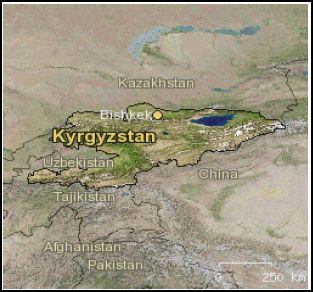
Central Asia largely comprises a massive steppe of more than a million square miles, making the region easy to invade. The one major geographic feature other than the steppe are the Tien Shan mountains, a range that divides Central Asia from South Asia and China. Nestled within these mountains is the Fergana Valley, home to most of Central Asia's population due to its arable land and the protection afforded by the mountains. The Fergana Valley is the core of Central Asia.


To prevent this core from consolidating into the power center of the region, the Soviets sliced up the Fergana Valley between three countries. Uzbekistan holds the valley floor, Tajikistan the entrance to the valley and Kyrgyzstan the highlands surrounding the valley. Kyrgyzstan lacks the economically valuable parts of the valley, but it does benefit from encircling it. Control of Kyrgyzstan equals control of the valley, and hence of Central Asia's core.

Moreover, the Kyrgyz capital of Bishkek is only 120 miles from Kazakhstan's largest city (and historic and economic capital), Almaty. The Kyrgyz location in the Tien Shan also gives Kyrgyzstan the ability to monitor Chinese moves in the region. And its highlands also overlook China's Tarim Basin, part of the contentious Xinjiang Uighur Autonomous Region.

Given its strategic location, control of Kyrgyzstan offers the ability to pressure Kazakhstan, Uzbekistan, Tajikistan and China. Kyrgyzstan is thus a critical piece in Russia's overall plan to resurge into its former Soviet sphere.


Last summer, the following series appeared: "'A Completely Lawless Place' Kyrgyzstan Has Become an Ungovernable Country" by Erich Follath and Christian Neef in Osh, Kyrgyzstan: Part 1, Part 2, Part 3, and Part 4.

Here are excerpts. From Part 1:

A country without leadership is an ideal haven for extremists and criminals. Fundamentalists fighting the government in neighboring Tajikistan are in the country, as are Uighur activists from China's troubled Xinjiang Province. Drug traffickers use Kyrgyzstan as an important transport route, which passes from Afghanistan straight through Osh. For the world's major powers, Kyrgyzstan is a dangerous weak link in the region.

But the foreign powers also need this small country. China hopes to use Kyrgyzstan to satisfy its demand for natural resources. Moscow needs the region as a buffer zone against the advances of fundamentalist Islam, and the United States uses it as the site of a resupply base for its war against al-Qaida and the Taliban. Chaos and anarchy in Kyrgyzstan are the last thing the Americans, Russians and Chinese need. Ironically, the Western press only recently referred to this country as "the Switzerland of Central Asia."

From Part 3:

"It doesn't matter who started it," says Cholpon Jakupova. "The far more serious problem is that we are turning this country into another Afghanistan."

Jakupova, a 51-year-old lawyer and Kyrgyzstan's best-known human rights activist, heads the Adilet human rights organization. She too has been in the city for days, searching for victims of the pogroms.

[snip]

The whole thing may have been a calculated game, says Jakupova. "A few people in the government of President Otunbayeva pushed through the new constitution to get themselves into the parliament, which will be Kyrgyzstan's new center of power starting this month. After that, they are the ones who will decide what happens in the country, not Otunbayeva. But the constitution would never have been approved if the pogroms hadn't happened in Osh. People were desperate to restore the peace after that, and so they voted yes. It was a farce."

Kyrgyzstan is "turning... into another Afghanistan".

Or, perhaps, Kosovo is the better model?

How does this compare with Mexico these days? And the US southern border?

From The South Country, Part 7:

Next, we consider an excerpt from Kyrgyzstan Destined To Become Another Narco-State?, April 18, 2010:

[snip]

As a matter of fact, Kyrgyzstan, once a 'model Central Asian democracy', as it used to be regarded in 1990s, and the first (!) post-Soviet state that joined WTO back in 1998, has ended up with two illegitimate coup d'etat in 5 years. It makes us believe that the events we witnessed in early April are only partly a result of mismanagement by the Kyrgyz ruling clan, their reckless appropriation of the state funds, international credits and national assets at the expense of their own people. We can assume that the tragedy in Kyrgyzstan reflects a wider diabolic strategy.

The theory of 'manageable chaos' as a perfect instrument for dominating the world 'after tomorrow' is thoroughly scrutinized by the leading Western minds and political practitioners. The old London's and later Washington's habit to impose 'puppet' dictators anywhere in the world has proved its ineffectiveness. Sooner or later the dictator starts playing his own game, as it was in case of Saddam Hussein. Much more promising are configurations with a sequence of weak and irresponsible 'democratic' governments holding office exclusively thanks to propaganda support from the media centers of global power. Such scheme allows maintaining 'controllable conflicts' in any zone, making up ideal environment for elusive 'terrorist cells' and drug cartels, targeting the strategic adversaries in the neighborhood.

Manageable chaos... an ideal environment for terrorist cells and drug cartels....

What we're seeing is a phenomenon known as State Capture.

Do an Internet search on that expression and see what you come up with.

More to follow.

Friday, July 23, 2010

The South Country, Part 7

Not surprising...

First, we review the first half of What Role Did Crime Kingpins Play in Southern Kyrgyzstan’s Violence?, dated July 23, 2010:

Criminal networks have long maintained a strong presence in southern Kyrgyzstan, given the region's status as a trade hub. In the weeks since inter-ethnic violence in the region left hundreds dead, observers have been wondering about what role, if any, criminal groups played in stoking the violence?

Some experts believe that a breakdown of state authority in the region in the months leading up to the mid-June violence helped touch off an underworld turf war, which, in turn, played a key role in inciting broader inter-ethnic violence. Others say gangs simply reacted to the violence, using the inter-ethnic clashes as cover for their own actions, which were aimed at altering the local criminal balance-of-power.

Kyrgyzstan's criminal networks generally fit into one of two categories, local experts tell EurasiaNet.org. The first – prison-based hierarchical networks – comprise professional criminals who follow an established code of conduct. Kamchi Kolbaev, an ethnic Kyrgyz, was reportedly one of the most influential criminal figures in the South. Authorities detained him on June 16, days after the outbreak of inter-ethnic violence in Osh and Jalal-abad. He has been undergoing interrogations since then.

Athletes – sportsmen, in local parlance – form the second type of networks. These groups are widely believed to engage in racketeering, money laundering, drug trafficking and fraud. Their leaders reportedly fund youth sports clubs, leisure facilities and private enterprises to attract crowds of young and unemployed men.

Osh-based observers, speaking to EurasiaNet.org on condition of anonymity due to fear of repercussions, say that while various links between the two types of networks exist, the sportsmen-led networks do not have the same kind of clearly delineated hierarchy and strong code of conduct that exists in the prison networks. Sportsmen are also known to lend muscle to Kyrgyz political factions during protests, and to form groups along ethnic lines.

"There is no doubt that criminals played a part [in the June 10-14 clashes]," said Abdurahman, an Osh-based expert on ethnic and religious tensions, who asked his surname not be printed.

Abdurahman suggested that the June 7 assassination of Aibek Mirsidikov – a drug lord also known as Black Aibek – was directly linked with the mid-June violence. A Jalal-abad based Kyrgyz criminal gang reportedly killed Mirsidikov, an Uzbek, to neutralize his Uzbek gang. Mirsidikov was believed to have played a role in fomenting protests in May, according to a report distributed by the 24.kg news agency.

Sabyr, an economics professor at an Osh university who also spoke on the condition that only his first name is printed, contended that there was only tenuous evidence to support the hypothesis that criminal groups initiated the mid-June violence. But he acknowledged that former president Kurmanbek Bakiyev's demise destroyed a fragile balance and unleashed a power struggle among various criminal gangs.

"They have been clashing over control of the bazaars and drug trade for a long time," Sabyr said.

Recently, some government officials have faced allegations of involvement with criminal elements. Timur Kamchibekov and Bakyt Amanbaev, two former top officials in Osh’s municipal government accused Osh Mayor Melis Myrzakmatov of maintaining links with criminal gang members, Ferghana.ru reported on June 17. Myrzakmatov is a Bakiyev appointee whom the interim government appears unable to remove. He is also widely reviled in the Uzbek community.

Local criminals battling over turf, with the involvement of corrupt government officials (and a superpower or two)... now what blogger do I know who suggested this?

Next, an excerpt from The Pseudostate of Kyrgyzstan, dated July 16, 2010:

In recent years, ordinary citizens of the Republic have received daily surprises in the form of assassinations of members of parliament, businessmen and sports personalities; continual, ineptly hidden disputes among the elite; mob rule and corporate raids; and, more recently, ethnic riots in which hundreds of the country’s citizens are brutally murdered.

Conflict follows conflict without a break, and there is no end in sight. As the sad joke goes in Bishkek, "a brutal mob paid another working visit on Government House."

Everybody now knows that the criminal element facilitated both the first "revolution" (to a greater extent) and the second (to a lesser extent) with the resources and manpower needed to carry out protests and capture Government House. Therefore, it is not surprising that the criminal element has become a major component of everything that happens in the Republic. The hand of criminals can be clearly seen in the riots that took place in Osh, Jalal-Abad and near Suzak. And it appears that Kyrgyzstan's elite sees nothing out of the ordinary in that.

It looks like Bakiyev and his family were the instigators of what happened in southern Kyrgyzstan, but that is not certain. Perhaps even more to blame is the "new" government itself, which is capable of nothing more than idle talk.

A low-intensity civil war of the type seen in Central Asia is going on in Kyrgyzstan—ethnic violence. It is hardly the first in the region; it has been going on in the Ferghana Valley since the middle of the 19th century. In this case, incited by their own leaders and by Bakiyev's hired provocateurs, the Kyrgyz have been working off their frustrations over their poor economic conditions and robbing the slightly more affluent Uzbeks. In addition, for years homegrown ideologues have instilled ideas about the greatness of the Kyrgyz, Manas the Benevolent and their native land. They have been told that invading Sarts set their sights on it and that behind them looms the shadow of Tashkent (which has its own mythology about that great humanitarian consolidator, Tamerlane). Kyrgyz politics and politics in general are overly emotional and hysterical. As rightly noted by Russian analyst Vitaly Khlyupin, "For the most part, those who carried out the massacres in Osh are extremely cruel adolescents who do not understand anything or anybody and who got out of control. Only a very good machine gun can rein them in." The provocateurs got the ball rolling, but ordinary people carried on with enthusiasm and rage.

If you don't know about the Ferghana Valley, take my advice and research it. The United States will, in my opinion, not cease to exist prior to having to send troops there to fight.

Think about that comment.

The region is a crossroads for trade, most emphatically including illegal trade ("contraband"), including arms, people, controlled technologies and, of course, drugs - including opiates from Afghanistan.

The region is also a potential powderkeg due to the different ethnicities involved, and due to variations in culture, an important element of which is the Religion of Peace.

Consequently, there is a potent mix of business opportunities - on whatever side of the law - and corruption and influence-peddling to control it, all set against a volatile ethnic and ideological background, in a region contested by all the world's powers.


Next, we consider an excerpt from Kyrgyzstan Destined To Become Another Narco-State?, April 18, 2010:

First, Kyrgyzstan is indeed a country of unique geopolitical location. It encircles Fergana valley – a heavily populated oasis at the core of Central Asia, shared with Uzbekistan and Tajikistan. Besides the vital Russian interest to control Fergana as the first outpost defending vast and open deserts and steppes on the way to the Volga, all Chinese moves in Uyghur Autonomous Region can be easily monitored from Kyrgyz Tien Shan highlands as well. Perhaps that is the main reason why the USAF installed Manas military base few kilometers away from Bishkek soon after the start of NATO operations in Afghanistan in 2001. The base is still operating there in full fledge as the 'US military transit centre'.

Another key point is that since then Kyrgyzstan became the most notable hub for distribution of the Afghan drugs to Eurasian 'markets', a business that had multiplied in times under the NATO guardianship in Afghanistan. The town of Osh, the 'southern capital of Kyrgyzstan', has long ago become a major cross-point for the Great Heroin Way through non-controllable mountainous Tajik-Kyrgyz border and transparent way to the north-west. Most likely the illicit profits proceeding from narco-trafficking were the main sources of spectacular enrichment of Bakiev's clan during his presidency in 2005-2010. There were numerous evidences that the very arrival of Kurmanbek Bakiev to power in March 2005 as a result of 'Tulip revolution' was financed and supported by prosperous international narco-mafia. It is also notable that while in office Bakiev liquidated Kyrgyz Anti-Drug Agency.

As a matter of fact, Kyrgyzstan, once a 'model Central Asian democracy', as it used to be regarded in 1990s, and the first (!) post-Soviet state that joined WTO back in 1998, has ended up with two illegitimate coup d'etat in 5 years. It makes us believe that the events we witnessed in early April are only partly a result of mismanagement by the Kyrgyz ruling clan, their reckless appropriation of the state funds, international credits and national assets at the expense of their own people. We can assume that the tragedy in Kyrgyzstan reflects a wider diabolic strategy.

The theory of 'manageable chaos' as a perfect instrument for dominating the world 'after tomorrow' is thoroughly scrutinized by the leading Western minds and political practitioners. The old London’s and later Washington’s habit to impose 'puppet' dictators anywhere in the world has proved its ineffectiveness. Sooner or later the dictator starts playing his own game, as it was in case of Saddam Hussein. Much more promising are configurations with a sequence of weak and irresponsible ‘democratic’ governments holding office exclusively thanks to propaganda support from the media centers of global power. Such scheme allows maintaining 'controllable conflicts' in any zone, making up ideal environment for elusive 'terrorist cells' and drug cartels, targeting the strategic adversaries in the neighborhood.

Manageable chaos... an ideal environment for terrorist cells and drug cartels....

From Former FBI Translator Sibel Edmonds Calls Current 9/11 Investigation Inadequate by Jim Hogue, dated May 7, 2004:

JH: Here's a question that you might be able to answer: What is al-Qaeda?

SE: This is a very interesting and complex question. When you think of al-Qaeda, you are not thinking of al-Qaeda in terms of one particular country, or one particular organization. You are looking at this massive movement that stretches to tens and tens of countries. And it involves a lot of sub-organizations and sub-sub-organizations and branches and it's extremely complicated. So to just narrow it down and say al-Qaeda and the Saudis, or to say it's what they had at the camp in Afghanistan, is extremely misleading. And we don't hear the extent of the penetration that this organization and the sub-organizations have throughout the world, throughout their networks and throughout their various activities. It's extremely sophisticated. And then you involve a significant amount of money into this equation. Then things start getting a lot of overlap -- money laundering, and drugs and terrorist activities and their support networks converging in several points. That's what I'm trying to convey without being too specific. And this money travels. And you start trying to go to the root of it and it's getting into somebody's political campaign, and somebody's lobbying. And people don't want to be traced back to this money.

This is exactly what is going on in the Balkans, and in the Caucasus, and even in Latin America these days. In fact, down south, it isn't just terrorism, but Islamic terrorist organizations are getting a foothold, establishing themselves and making connections with the criminal underworld, preparing for their future jihad in the Americas.

And this criminal activity brings with it illicit money, and that money travels...

More to follow.

Saturday, July 3, 2010

The South Country, Part 6

Hmmm...

From Kyrgyzstan: Anatomy Of A Conflict, by Bruce Pannier, dated July 3, 2010:

Longstanding tensions between Kyrgyz and Uzbeks had been simmering for months in southern Kyrgyzstan before violence broke out. But interviews with scores of witnesses in Osh and officials in Bishkek suggest that it was more than ethnic resentment that triggered the fighting.

Various factions in the ongoing struggle that has roiled Kyrgyzstan since President Kurmanbek Bakiev was ousted in a popular uprising in April appear to have stoked and manipulated ethnic tensions in the south as they attempted to gain political advantage. The interim government, led by Roza Otunbaeva, blames forces loyal to Bakiev for sparking the violence as part of an effort to discredit Kyrgyzstan's new rulers. But a number of analysts, human rights activists, and other observers present a more complicated picture.

While not denying a possible role for Bakiev and other instigators in sparking the violence, these observers say that police and military in the south appear to have participated in attacks on ethnic Uzbeks, suggesting that as ethnic kinship trumped loyalty to the state, the authorities in Bishkek lost control of at least some of their own armed forces.

Government forces went "rogue" on Kyrgyzstan's central government, participating in ethnic violence - violence said to have been instigated, at least in part, by the former Kyrgyzstan president, who was run out of town on a rail.

But, what is the motive?

Clearly, there was an undercurrent of ethnic tensions, to some extent turning southern parts of Kyrgyzstan into a tinder box. The predominantly rural Kyrgyz resented the relative affluence of the urbanized Uzbeks; the Uzbeks resented the political power of the Kyrgyz.

But what other undercurrents were there?

Skipping down:

Kyrgyzstan's south, which is a known haven for drug traffickers, has long been difficult for authorities in Bishkek to control.

The latest round of fighting in Osh began in the predawn hours of June 10-11, when two youth gangs -- one Kyrgyz and one Uzbek -- were gambling in a local casino. Each accused the other of cheating and a scuffle broke out. The fighting spilled out onto the street as reinforcements on both sides -- alerted by text messages -- joined the brawl.

Texting is a neat way to get the homies together for a good fight.

A haven for drug traffickers... guaranteed low-level local distribution of drugs - especially heroin from nearby Afghanistan - is a source of business for local gangs.

Of course, the big money is to be made shipping Afghan heroin through Kyrgyzstan to Russia, Europe and perhaps elsewhere.

Rumors quickly spread -- which were later debunked in a Human Rights Watch report -- that an Uzbek mob raped as many as 12 Kyrgyz girls and killed three at a nearby dormitory. The false reports stoked Kyrgyz anger as mobs took to the streets to exact revenge.

Women have always been of use in wartime - abusing them has been seen as the spoils of war (codified in Islamic law for Islam's holy warriors), but they serve as a propaganda tool as well: nothing like accusing "them" of raping "our" women to get the fight going strong.

In that atmosphere, engineering an ethnic violence crisis that the government would lose control of seems easy to do.

Skipping down:

Kyrgyz officials deny the armed forces were involved and allege that criminal groups stole military uniforms, vehicles, and munitions before staging the attacks. The authorities, however, have provided no evidence to support that claim and appear to have made no effort to investigate wrongdoing on the part of rogue elements in the armed forces and security services.

If this were engineered, with adequate resources, then it would be expected that there would be some false flag operations. A foreign government or even an organized crime cartel would have the resources to acquire some uniforms and hire some thugs with military training - and this would embarrass the government and greatly further the ethnic unrest.

Reports indicate the "random mob violence" was confined to areas where supporting sniper fire could take out any Uzbeks trying to defend themselves; outside this safe zone, there was no "random mob violence" on the part of the Kyrgyz mobs.

Skipping down:

Kyrgyz law-enforcement officials say they arrested 20 snipers, seven of whom they claim are foreigners. The authorities, however, have provided no additional information about the alleged snipers' identities.

This is not beyond the capabilities of a drug cartel....

The government blamed the former president for starting the trouble. From farther down:

The government's case is somewhat bolstered by an intercepted telephone conversation in May, which was posted on the Internet, in which Maksim Bakiev, the ousted former president's son, said he planned to bring down the government by provoking unrest in the south. According to press reports, he is currently seeking asylum in Britain.

Officials in the interim government say the Bakievs hired mercenaries from Tajikistan and Afghanistan to do the job. Kurmanbek Bakiev, for his part, denies playing any role in the violence. Otunbaeva has also alleged that drug traffickers in Osh also contributed to the violence.

The government also claimed that militants from the Islamic Movement of Uzbekistan had infiltrated Uzbek neighborhoods and were provoking the violence. Mainstream Muslim leaders, however, appeared to be going out of their way to urge restraint.

At Friday Prayers at Osh's Imam al-Buhari Mosque on June 18, a week after the fighting broke out, the loudspeakers blared out the imam's message. "Kyrgyz and Uzbeks are Muslims and Muslims are brothers," the imam said in Uzbek. "Do not give into provocations. If you do, you are doing the work of Satan."

At the conclusion of the prayers both Uzbeks and Kyrgyz exited the mosque together.

It is true that, in theory, all Muslims are supposed to be brothers to each other (women are kind of discriminated against in Islam); however, Muslims are not immune to racial and ethnic divisions.

Importantly, though, if Islamic extremists were involved, it is easy to make takfir out of the other side; Islamic texts offer plenty of encouragement and excuses, and with heroin trafficking up for grabs, there is plenty of motivation.

Skipping down:

Mirzakmatov also said the authorities suspected that Islamic terrorists were hiding in Uzbek neighborhoods, adding that "all the barricades" protecting these quarters must be removed by the next day or security forces would "resort to force."

The interim government has been unable, or unwilling, to exert control over Mirzakmatov.

Osh Mayor Melis Mirzakmatov is widely viewed as a crony holdover from the previous regime; he's a powerful Uzbek who is viewed suspiciously by the local Uzbek community.

At least two Uzbeks were killed when security services targeted the ethnic Uzbek neighborhood of Nariman. Another operation targeted Otkhona, an untouched area where those fleeing violence in the adjacent Cheryomushki neighborhood had taken refuge.

Security forces said they found heroin in humanitarian supplies in Otkhona and detained an ethnic Uzbek businessman there who had been helping the displaced. Residents said security forces also took food, money, and jewelry.

Heroin just keeps cropping up in this.

Meanwhile, from Kyrgyzstan's interim leader sworn in as president, also dated July 3, 2010:

Roza Otunbayeva was sworn in as Kyrgyzstan's president on Saturday, making her the first female leader in the history of the ex-Soviet Central Asian nation.

In front of more than 1,000 cheering onlookers at a packed concert hall in the capital Bishkek, Otunbayeva somberly took her oath and promised a new political era for crisis-ridden Kyrgyzstan.

"As president, I will spare no effort to create a new political culture for the country based on a strict adherence to the rule of law," she told the assembled crowd.

"I must be principled and consistently make demands on all branches of government to ensure it. The new policy can not be built on fantasies and illusions. It must be real and effective."

Madame President, the Turkic peoples may think that Kyrgyzstan is the South Country, but you are perhaps thinking your problems stem from a country that is south of you.

The reality is that many of your most serious problems are rooted in a land far to the west of you.

Worth by some estimates a half a trillion US dollars per year, the first reality you, as the new Kyrgyz president, will have to take into consideration is the Afghan heroin industry: the proximity of your country to it, and corruption it fuels from Kabul to Washington. Run afoul of this cartel, and you might wake up dead, or at least finding Washington-backed Islamic terrorists trained by and allied with Al-Qaeda trying to oust you while the world looks cluelessly on, unable to put two and two together.

Tuesday, June 15, 2010

The South Country, Part 5

See? I told you so!

From UN says violence in Kyrgyzstan was orchestrated, By Yuras Karmanau and Sergei Grits, June 15, 2010:

From self-imposed exile in Belarus, Bakiyev has denied any ties to the violence, but Otunbayeva insisted Tuesday his supporters had stoked the conflict.

"Many instigators have been detained and they are giving evidence on Bakiyev's involvement in the events. No one has doubts that he is involved," she said.

The region around Osh, a city of 250,000, is a top conduit for heroin flowing out of Afghanistan, and thus a hotbed for gangs and guns. Some observers said the violence could have been rooted in the fight for control over drug trafficking.

Mars Sariyev, a Bishkek-based analyst, said figures from Bakiyev's entourage might have encouraged the ethnic violence in order to regain control over the drug flow.


Afghanistan is now the major world producer of heroin.  Afghan heroin is very high quality, and the price has come down dramatically in recent years; in short, Afghan heroin is literally driving other producers out of the world market.


One major route to market for Afghan heroin is through Central Asia to Russia and Europe; destination countries and countries along the route are suffering increased rates of heroin usage, along with all the problems that accompany heroin use.


Heroin production supports our enemies in the War on Terror - or whatever we're calling it today under Obama.

Our enemies just call it a jihad against the Great Satan. Perhaps Obama should adopt that term as well.

But, heroin production doesn't just support our enemies.

Terrorist organizations such as Al Qaeda, like organized crime, are involved in criminal activities; terrorists want to kill and destroy, organized crime wants to make money. But, illegal is illegal, and they have common enemies: governments and nations seeking to protect themselves and their citizens.

So, as you go high enough up the chain in either terrorist or criminal organzations, you get to a point where their support networks converge; arms-trafficking, narcotics-trafficking and other criminal activities converge with terrorist activities, and the money-laundering that supports it all.

These criminal activities need to be protected from law enforcement, so money is diverted to paying off law enforcement and government officials.

Consequently, if you investigate government corruption deeply enough, it is easy to trace much of it to drug trafficking, and then to terrorism; similarly, if you investigate terrorism and terrorism financing deeply enough, it is easy to trace it to drug trafficking, and then to corrupt government officials.

That is why there was no serious investigation of the Oklahoma City Bombing; they prosecuted McVeigh and Nichols, who were guilty, and they ended it there, even though the trail also led to Al Qaeda via the Philippines, and to Saddam Hussein's regime in Iraq.

That is why the Crime of the Century - the 9/11 attacks - were not investigated by the FBI, and to this day, Osama bin Laden is not wanted for 9/11. Look at the FBI's wanted poster for Osama: no mention of 9/11.

That is why they didn't prevent 9/11, even though they had plenty of fairly specific, actionable intelligence about it: had they acted, the investigation would have turned up corrupt US government officials on the payroll of foreign organized crime, so these officials derailed the warnings before 9/11, and the investigation afterwards, to protect themselves.

From Cracking the Case: An Interview With Sibel Edmonds by Scott Horton, August 22, 2005:

SH: And as you pointed [out], some of this information has been confirmed in the public. I know when you speak about the Iranian informant...

SE: Correct.

SH: ...who warned in April of 2001 -- that was even confirmed by Mueller, the director of the FBI.

SE: Absolutely there was actually an article in the Chicago Tribune in July 2004 saying that even Mueller expressed surprise that during the hearings, the commissioners didn't ask about this. And guess what, nobody reported all these omissions. What would happen if you hit them with 20 cases? And I'm talking about 20 affidavits from experts and veteran agents.

SH: This is all about the question of prior knowledge and who knew what, when before the attack.

SE: And also what happened afterward. I started working three days after Sept. 11 with a lot of documents and wiretaps that I was translating. Some of them dated back to 1997, 1998. Even after Sept. 11, covering up these investigations and not pursuing some of these investigations because the Department of State says, "You know what, you can't pursue this because that may deal with this particular country. If this country that the investigation deals with are not one of the Axis of Evil, we don't want to pursue them." The American people have the right to know this. They are giving this grand illusion that there are some investigations, but there are none. You know, they are coming down on these charities as the finance of al-Qaeda. Well, if you were to talk about the financing of al-Qaeda, a very small percentage comes from these charity foundations. The vast majority of their financing comes from narcotics. Look, we had 4 to 6 percent of the narcotics coming from the East, coming from Pakistan, coming from Afghanistan via the Balkans to the United States. Today, three or four years after Sept. 11, that has reached over 15 percent. How is it getting here? Who are getting the proceedings from those big narcotics?

One of those countries which if mentioned cannot be investigated is Kyrgyzstan, because, if you investigated it, and really dug down deep... from 'The Stakes Are Too High for Us to Stop Fighting Now' An interview with FBI whistleblower Sibel Edmonds by Christopher Deliso, August 15, 2005:

SE: The fact that there are no investigations -- I will give you an analogy, okay? Say if we decided to have a "war on drugs," but said in the beginning, "right, we're only going to go after the young black guys on the street level." Hey, we already have tens of thousands of them in our jails anyway, why not a few more? But we decided never to go after the middle levels, let alone the top levels...

It's like this with the so-called war on terror. We go for the Attas and Hamdis -- but never touch the guys on the top.

CD: You think they [the government] know who they are, the top guys, and where?

SE: Oh yeah, they know.

CD: So why don't they get them?

SE: It's like I told you before -- this would upset "certain foreign relations." But it would also expose certain of our elected officials, who have significant connections with high-level drugs- and weapons-smuggling -- and thus with the criminal underground, even with the terrorists themselves.

The South Country, Part 4

At the end of Part 3, we saw how deposed Kyrgyz President Bakiyev had arranged for his son's company to pay no taxes on a no-bid contract awarded to him by the US government.

I wonder if this is true....

You can go to the Federal Procurement Data System and look up these contracts.

Here's what I found.

First, a contract worth well over $14 million USD for fuel - apparently part of an ongoing deal:


This did seem to have been competitively bid:


But, when that contract expired on August 31, 2009, another contract came into effect. This one was worth almost a quarter of a billion dollars...


And, unlike the previous contract, this bid had no competition:


If you look closely at the third image, though, you will notice that the total value, with all the options, etc., wound up being some $730 million USD.

At this point, support for fuel to Manas Airbase is a business deal that is approaching $1,000,000,000 in value - no-bid, and tax-free.

Hypothetically speaking, now...

If a popular uprising in Kyrgyzstan should install a new government, headed by an interim President named Otunbayeva, and if that new government should begin investigating this and link it all to a corrupt deal arranged by the deposed president for his son who owns this company (and five others!), that could really upset somebody's business deal, couldn't it?

Now, hypothetically speaking...

With nearly $1 billion USD riding on the deal of one company, plus five more companies involved in the corruption - and this just of one son of the deposed Kyrgyz president; nevermind other family members and friends - that could be powerful motivation to engineer well-organized "ethnic violence", couldn't it?

From Kyrgyzstan crisis spreads as 100,000 Uzbeks try to flee, by Kristen Chick, June 15, 2010:

The son of former President Kurmanbek Bakiyev was arrested in England on Tuesday for alleged links to the Kyrgyzstan violence. Nearly 200 have died and 100,000 ethnic Uzbeks have fled to the border with Uzbekistan.

As China and Turkey send in planes to retrieve their nationals from Kyrgyzstan, ethnic Uzbeks are being told they can't flee despite deadly violence that has so far killed 171 and wounded nearly 1,800, according to the government, though the real numbers are likely much higher.

Meanwhile, suspicions continue to grow that the ousted president has links to the violence, with his son being arrested in England on Tuesday on charges that he is instigating the unrest that has largely targeted ethnic Uzbeks in the cities of Osh and Jalalabad.

From Kyrgyz interim gov't warns of violence around capital, Xinhua News, June 15, 2010:

BISHKEK, June 15 (Xinhua) -- Kyrgyz interim Deputy Prime Minister Almazbek Atambayev warned on Tuesday that the riots in southern Kyrgyzstan, which had killed at least 170 people, could spread to the country's capital Bishkek and Chui region in the north.

Speaking to reporters in Bishkek, Atambayev described violence in southern city Osh as "premeditated," but said that the interim government was well prepared for possible violence in Bishkek and Chui.

You don't suppose somebody is trying to start a counterrevolution in order to protect hundreds of millions - maybe billions - of dollars worth of business deals, do you?

And, considering that in Part 2 this was also linked to organized crime, you don't suppose that heroin from nearby Afghanistan is at stake as well, do you?

From Trouble Down South, dated June 14, 2010:

Kyrgyz military officials say that agents of Bakiyev dispatched well-trained mercenary snipers to Osh and Jalalabad who shot indiscriminately at locals to spread chaos. While it's not surprising that the new government would seek to pin the blame on its predecessor, there is compelling evidence to suggest that the unrest may have been carefully orchestrated. These include attempts by unidentified armed groups to seize control of TV channels, universities, and local government buildings during the fighting, unlikely targets for a mob driven purely by ethnic animosity.

The South Country, Part 3

Starting in this post, we begin to dig a little deeper into what might be happening in Kyrgyzstan. I shall attempt to develop the story chronologically.

Please note that there are different ways of spelling the name of the deposed Kyrgyz president; in my previous post on the subject, I had it "Bakiev" and here it is "Bakiyev".


On April 6, an opposition protest against government corruption and the high cost of living turned violent. The next day, Kyrgyz President Kurmanbek Bakiyev declared a state of emergency. As the situation worsened, Russia was accused of being behind the unrest - a charge Moscow denied. On April 15, President Bakiyev fled the country with his family.

Please note that in Part 2, Bakiyev was said to be allied to Washington, and his replacement, interim President Otunbayeva, was said to be allied to Moscow.

Meanwhile, President Bakiyev's son, Maxim, by this time facing criminal charges for corruption, was in the United States as this situation developed in Kyrgyzstan.

Now, we first consider excerpts from Kyrgyzstan: Possible Diplomatic Debacle Looms for US Government over Manas Base, dated April 9, 2010, by Deirdre Tynan:

It is unclear if the provisional government led by Roza Otunbayeva has made a formal request to the United States for the return of Maxim Bakiyev. A spokeswoman for the US embassy in Bishkek said on April 10: "It is the US government's long standing position not to comment on extradition matters." The State Department in Washington referred all inquiries back to the embassy.

Beyond the immediate issue of Maxim Bakiyev's status in the United States, Washington's engagement with the Bakiyev family seems to have the potential to develop into a diplomatic disaster for the US government, political analysts say.

The sudden turn of events in Bishkek has created a near-term crisis for US strategic interests in Central Asia and Afghanistan. The United States had cultivated a cozy relationship with Bakiyev and his family, with the apparent aim of ensuring access to the transit center at Manas airport outside Bishkek, an important support hub for military operations in Afghanistan.

The US government's close relationship with the Bakiyevs has quickly emerged as a sore point in US relations with the new Kyrgyz leadership. Maxim Bakiyev's presence in the United States could exacerbate hard feelings in Bishkek, potentially making it more difficult for the United States to hold on to Manas basing rights.

Maxim Bakiyev's presence in the United States also could invite heightened scrutiny of possible inappropriate financial dealings involving the US Defense Department and the Manas base. At the very least, Maxim may well become a lightning rod for criticism of the United States coming from within Kyrgyzstan.

Already, the Central Asian state's provisional government has expressed interest in reviewing US government contracts concerning Manas operations. In addition, EurasiaNet.org has learned that the US Congress is preparing its own probe of Manas contracts.

So, the people were protesting corruption, the protests got out of hand, and Kyrgyz President Bakiyev was deposed and forced to flee the country; meanwhile, his son is in the US, charged back home in Kyrgyzstan with criminal corruption, while the US Congress was about to open its own investigation of the alleged corruption.

Skipping to the end:

It would seem that the Kyrgyz provisional government is intent on following the money.

The corruption surrounding Maxim, it seems, centers on the US Airbase at Manas, a Kyrgyz airport just outside the capital Bishkek, and named for an epic Kyrgyz hero. The Manas Airbase is a main transshipment point for support of US and allied operations in Afghanistan.


We now consider an excerpt from Kyrgyzstan: US Congressional Committee to Probe Manas Deals, by Deirdre Tynan, April 13, 2010 (please see original for links I did not reproduce):

A US congressional subcommittee is opening a wide-ranging investigation into the Defense Department's fuel contracting practices at the Manas Transit Center in Kyrgyzstan.

The investigation, to be conducted by the National Security and Foreign Affairs Subcommittee of the House Committee on Oversight and Government Reform, will seek to determine what relationship, if any, existed between Red Star Enterprises Ltd., its affiliate Mina Corp. and the family of nominal president Kurmanbek Bakiyev, whose administration collapsed amid political violence in Bishkek on April 7.

Mina Corp. currently holds the contract for fuel deliveries to Manas. The contracts previously were held by Red Star. Manas is a key hub for US and NATO troops and materiel going to and from Afghanistan.

The subcommittee will also probe what, if anything, the Pentagon, the State Department and the US Embassy in Bishkek knew about suspected contracting irregularities.

[snip]

Sources have asserted to EurasiaNet.org that US Embassy personnel in Bishkek were aware of allegations concerning possible links between Maxim Bakiyev and Red Star/Mina Corp.

Now for an excerpt from Bishkek Fuel-Supply Corruption Probe Focusing on Maxim Bakiyev, by Deirdre Tynan, dated May 1, 2010 (again, see original for important links):

Kyrgyzstan's General Prosecutor's Office is focusing its corruption investigation concerning fuel supplies at Manas Transit Center on companies allegedly controlled by Maxim Bakiyev, the son of ousted president Kurmanbek Bakiyev.

Kyrgyz prosecutors are investigating six local suppliers that provided TS-1 jet fuel to Mina Corp and Red Star Enterprises Ltd., two entities that have held fuel supply contracts for Manas operations. Manas is a key logistics hub for US and NATO military operations in Afghanistan.

According to an April 30 statement released by the General Prosecutor's Office, the six Kyrgyz entities are suspected of having engaged in fraudulent practices to evade paying roughly $90 million in excise taxes over the past five years, a period that coincides with former president Bakiyev’s tenure in power.

The six companies under investigation were identified in the General Prosecutor's Office statement as "Manas Fuel Services, Kyrgyz Aviation, Central Asia Fuel, Aviation Fuel Service, Aircraft Petrol Ltd., [and] Central Asia Trade Group."

"It should be noted that all of the above companies belong to Maxim Bakiyev," the statement added. Bakiyev, the former head of the Kyrgyz Central Agency for Development, Investment and Innovation, was in Washington, DC, when unrest erupted in Bishkek in early April, resulting in his father's ouster. Kyrgyzstan's provisional leadership has authorized a warrant for Maxim's arrest. His current whereabouts have not been independently verified.

According to Kyrgyz prosecutors, the elder Bakiyev allegedly engineered parliamentary changes in tax regulations that were purportedly tailored to benefit his son's commercial interests.

So, Daddy Bakiyev was manipulating the government to enrich little Maxie Bakiyev.

Skipping down:

According to the US government's Federal Procurement Data System (FPDS) website, Mina Corp obtained the latest Manas fuel contract worth up to $730.9 million on July 29, 2009, to supply fuel to Manas under a no-bid contract. The justification cited was the "national security" clause of the Federal Acquisition Regulations system.

[snip]

Under the terms of the Manas Transit Center agreement, both Red Star and Mina Corp are exempt from Kyrgyz customs and taxes. Article 7 of the agreement signed last year states: "purchases of goods and services in the Kyrgyz Republic by the US government or on its behalf to implement this agreement are not subject to any taxes, customs fees and similar payments on the territory of the Kyrgyz Republic."

Wow - no taxes or customs on the proceeds from a no-bid contract. That's a pretty nice deal for a president's son!


Stay tuned for Part 4.

Saturday, June 12, 2010

The South Country, Part 2

In Part 1, we introduced the new rioting occurring in the southern part of Kyrgyzstan.

Here we take a look behind the headlines to see what is really going on.

At the end of the first post, I pointed out that the unrest was supposedly sparked by rival gangs.

Well, we now consider Kyrgyz South and Uzbek issue, dated June 9, 2010, by Sanobar Shermatova. The English is a little hard to decipher, since it is not the author's native language, so instead of quotes, I summarize.

Aibek Mirsidikov, known as "Black Aibek", was reputedly an organized crime boss. Government authorities recently announced that organized crime factions were becoming more active in southern Kyrgyzstan (which borders neighboring Uzbekistan in the Ferghana Valley, near the city of Osh); it appeared a mob war was breaking out.


When Black Aibek was murdered, the governor of Jalal-abad Oblast (the province north of Osh Province, where the city of Osh is located, and where the recent unrest has been occurring), Bektur Asanov, blamed the death on the mob war.

In Kyrgyzstan, the business and criminal worlds are closely linked, and organized crime provides important "services" to political factions in return for certain payments. Once the services are rendered, if the payment is not made on time, trouble ensues. A classic example of this was when the organized crime boss Ryspek Akmatbaev threatened to bombard the Kyrgyz White House if the previous president, Kurmanbek Bakiev (run out of Kyrgyzstan during violence this past April), did not pay what he owed to the underworld. It was scandalous as the people of Kyrgyzstan saw their president negotiating with a crime boss.


Black Aibek was an Uzbek. Another Uzbek, Kadyrzhan Batyrov, who is reputed to be a legitimate businessman with significant political clout, emerged as another popular leader in the community. Supposedly, Batyrov was losing power under exiled President Bakiev's regime, which was more closely tied to illegal business activities; when Bakiev left recently, Roza Otunbayeva became the interim president, and the situation began to reverse. So, in retaliation, Black Aibek blamed Batyrov for burning the houses of the ex-president and his relatives; these allegations of Kyrgyz suffering violence at the hands of Uzbeks had the anticipated incendiary effect, igniting the most recent round of ethnic violence.

The unrest that resulted in Bakiev's departure and Otunbayeva's accession to the interim presidency has, of course, been blamed on Russian intelligence and the CIA, depending upon who you listen to.

An excellent article by STRATFOR blames it on Moscow, with excellent analysis of the rationale that would lead to the Kremlin's involvement. I present here only an excerpt, and very highly recommend that you read the article, Kyrgyzstan and the Russian Resurgence, in its entirety.

Central Asia largely comprises a massive steppe of more than a million square miles, making the region easy to invade. The one major geographic feature other than the steppe are the Tien Shan mountains, a range that divides Central Asia from South Asia and China. Nestled within these mountains is the Fergana Valley, home to most of Central Asia's population due to its arable land and the protection afforded by the mountains. The Fergana Valley is the core of Central Asia.


To prevent this core from consolidating into the power center of the region, the Soviets sliced up the Fergana Valley between three countries. Uzbekistan holds the valley floor, Tajikistan the entrance to the valley and Kyrgyzstan the highlands surrounding the valley. Kyrgyzstan lacks the economically valuable parts of the valley, but it does benefit from encircling it. Control of Kyrgyzstan equals control of the valley, and hence of Central Asia's core.

Moreover, the Kyrgyz capital of Bishkek is only 120 miles from Kazakhstan's largest city (and historic and economic capital), Almaty. The Kyrgyz location in the Tien Shan also gives Kyrgyzstan the ability to monitor Chinese moves in the region. And its highlands also overlook China's Tarim Basin, part of the contentious Xinjiang Uighur Autonomous Region.

Given its strategic location, control of Kyrgyzstan offers the ability to pressure Kazakhstan, Uzbekistan, Tajikistan and China. Kyrgyzstan is thus a critical piece in Russia's overall plan to resurge into its former Soviet sphere.

If it is true that Russia saw Kyrgyzstan getting too close to the West under Bakiev, and if it's true that Otunbayeva is Moscow's woman in Bishkek, then allegations that Washington is behind the current unrest might make sense. The violence is allegely "clearly directed"; from Azimbek Beknazarov: Unrest in the south of Kyrgyzstan has well defined interethnic character and is clearly directed, dated June 11, 2010:

"The unrest in the 'south capital' of Kyrgyzstan has well defined interethnic character and is clearly directed", stated the Deputy Interim Leader, Curator of force structure Azimbek Beknazarov, who is in Osh city at the moment.

However, don't for a moment think that it ends with factionalism and strategic geopolitical considerations; Kyrgyzstan is just one of the many places where control of the world's heroin industry is being decided; but, more on that later.

For now, I suggest the following links for further information, though I do not necessarily endorse the information or conclusions to be found there:

CIA PUT ROZA INTO POWER? OIL, HEROIN, AIR BASES AND BANKERS IN KYRGYZSTAN

CIA SEEKS CHAOS IN KYRGYZSTAN?

more unrest in Kyrgystan follows hot on the heels of NATO visitor

The South Country, Part 1

An article appeared just a little while ago about renewed trouble in Kyrgyzstan, entitled Ethnic riots sweep Kyrgyzstan, govt begs for help by AP writers SASHA MERKUSHEV and LEILA SARALAYEVA.

OSH, Kyrgyzstan – Ethnic riots wracked southern Kyrgyzstan on Saturday, forcing thousands of Uzbeks to flee as their homes were torched by roving mobs of Kyrgyz men. The interim government begged Russia for troops to stop the violence, but the Kremlin offered only humanitarian assistance.

At least 75 people were reported killed and nearly 1,000 wounded in the violence spreading across the impoverished Central Asian nation that hosts both U.S. and Russian air bases.

Much of its second-largest city, Osh, was on fire Saturday and the sky overhead was black with smoke. Gangs of young Kyrgyz men armed with firearms and metal bars marched on minority Uzbek neighborhoods and set homes on fire. Stores were looted and the city was running out of food.

"It's a real war," said local political leader Omurbek Suvanaliyev. "Everything is burning, and bodies are lying on the streets."

Those driven from their homes rushed toward the border with Uzbekistan, and an Associated Press reporter there saw the bodies of children trampled to death in the panicky stampede. Crowds of frightened women and children made flimsy bridges out of planks and ladders to cross the ditches marking the border.

Interim President Roza Otunbayeva acknowledged that her government has lost control over Osh, a city of 250,000, even though it sent troops, armor and helicopters to quell the riots. Violence spread to the nearby city of Jalal-Abad later Saturday.

"The situation in the Osh region has spun out of control," Otunbayeva told reporters. "Attempts to establish a dialogue have failed, and fighting and rampages are continuing. We need outside forces to quell confrontation."

Otunbayeva asked Russia early Saturday to send in troops, but the Kremlin said it would not meddle into what it described as Kyrgyzstan's internal conflict.


A snip from Kyrgyz leader asks Russia to restore order in Osh, dated June 12, 2010:

Ethnic tensions

Kyrgyz TV reported that the country's borders with Tajikistan and China have been closed because of the unrest.

According to local reports, the violence broke out between rival gangs and developed into gun battles late on Thursday.

Riots and looting followed.

Rival gangs....

Now, I wonder what that is all about.