Showing posts with label Organized Crime. Show all posts

Saturday, September 7, 2013

Funding for Terrorism, Senator McCain, and Punishment for Treason

I have been rather actively involved in the social media. Lately, I have not done so many blog posts here as I have created images and made comments for posting on social media.

There, I notice a trend of patriotic Americans who are complaining about Senator McCain. McCain's viewpoints and proposals on many issues have people outraged. They call it treason. The more polite commentary blame it on senility. They want him imprisoned.

I have done tremendous research on the crowd in Washington. What got me started was hearing about Sibel Edmonds case. Honestly, I think I have forgotten more about her case than most of my readers will ever know, unless someone actually bothers to read her book - and that person may have to read it more than once to know more than I have forgotten.

However, I did not stop there. I began my own research. I dug. I mean I really dug. I mean, I really, really dug, looking in places other people do not look, for things other people do not seek, and cross-referencing a wide variety of data. A quick glance at the sidebar here at the blog should convince anyone of the possibility that, when I do research, I do way more than most bloggers, and way more than nearly anyone in our mainstream media.

I present this as factual, but make no effort to prove my statements. In many of my posts, I give links, I show images from documents... here, I merely tell you what I know, and hope you will independently verify the information and conclusions provided.

Based on the material I have seen, some of it posted on the internet by other bloggers and by competent journalists from outside the mainstream, there is no doubt in my mind that the problem of corruption in Washington, DC, goes far beyond the extensive situation described by Sibel Edmonds.

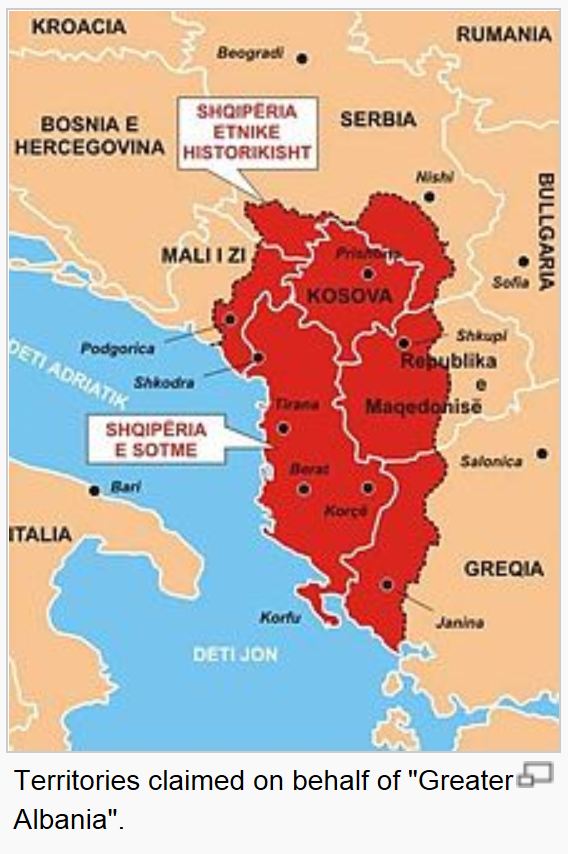
In particular, I am convinced that Senator John McCain of Arizona has been connected to foreign organized crime for nearly two decades. The cartel in question is of primarily ethnic Albanian origin, and is based in the Balkans. This cartel was closely linked to ethnic Albanian and Islamic terrorists who have also operated in the Balkans, but who operate elsewhere as well.

If you go back to the Cold War, terrorism was easy to understand: the Soviet Union was behind much of it, and it was aimed at the West. Whenever a terrorist organization tried to bite the hand that fed it, the KGB, whose job was protections of Soviet assets worldwide, would spare no expense to teach that organization a lesson and redirect its activities.

In the 1980's terrorist organizations began to diversify their sources of funding. In particular, they teamed up with drug trafficking organizations (DTO's). The alliance was natural: they both had the same enemy - the government - though one fought for an ideological reason, and the other for monetary profit.

The DTO's discovered that terrorists were ready-made anti-government militarized forces, trained and equipped, which could provide considerable balance in the fight to protect drug trafficking operations against government counternarcotics forces which themselves were becoming heavily militarized in much of the drug-producing and drug-transiting regions of the world.

For their part, the terrorist organizations saw the profit in the production and trafficking of drugs. Cocaine, in particular, is so profitable that even if a small percentage of the total amount produced gets sold rather than interdicted, the DTO is still making good money. DTO's have always been able to get several times more product through to buyers than the bare minimum needed for solvency. Terrorists saw that production and trafficking of drugs exacerbated problems for their enemies in the government, a situation which could then be leveraged politically and militarily. Furthermore, the immense profits available in drug trafficking could finance terrorist activities in a way that state sponsors never could: virtually unlimited money was available, with practically no strings attached.

Narcoterrorism was born, and the monster had the "DNA" of both its parents.

It was in Latin America, in places like Colombia and Peru, where some of the earliest innovations in this area took place. But, it happened elsewhere. The Palestine Liberation Organization - the well-known PLO - was trouble for its Arab and Soviet sponsors - so much so that Jordanian security forces drove it from Jordanian territory across from the West Bank. The PLO landed in Lebanon, where it found the Bekaa Valley a perfect place to produce narcotics. This was when the PLO began to become less ideologically-centered, and more centered on profit. Its nickname was the "Poppy Lovers' Organization"; suffice it to say that its leader, Nobel Peace Prize Winning Yassir Arafat, died a very rich man indeed - and its award to a drug-trafficking terrorist should tell you something about the Nobel Peace Prize.

The US government was not immune to the lures of easy money.

In Latin America, the US was dealing with the threat of communist subversion. Maoist rebels were fighting to take over Peru, and other communist groups were battling the government in Colombia; both nations had an extensive problem with DTO's as well.

But, Nicaragua was special. There, taking its name from a legendary bandit of the late 1920's whose forces were defeated with the help of the US Marines, a group called the Sandinistas deposed President Somoza and established a communist regime. This regime was a threat to the security of the whole region.

In particular, Costa Rica, Nicaragua's neighbor to the south, did not even have an army, rightly concerned that standing armies and the constant coups they produce were a scourge to Latin American countries. Costa Rica's neighbor farther south, Panama, considered contingency plans to move Panamanian troops north into Costa Rica, should this become necessary to answer communist aggression from Nicaragua.

To Nicaragua's north, communist infiltration through a stretch of Honduran jungle supported an attempt by communist-backed forces to seize power in El Salvador, resulting in a long, brutal civil war there.

All this trouble could easily be traced back to Managua, and from there to Havana and Moscow.

The US had to do something to keep the cancer of communism from spreading, so the US began supporting the "contras", people who were against the Sandinista revolution and the resulting communist regime.

However, the Reagan Administration had to deal with a deeply-entrenched Democrat Congress - one which too often sympathized with the communists.

The "solution" discovered by certain relatively low-ranking players was to traffic cocaine to America. The money could be used to fund the contras, and since the money was illegal, it was "black" money for black ops, out of reach of Congress. It was far from an ideal solution, but the reality was that Americans were getting their cocaine - they were going to buy from someone - and if the intelligence community provided some of it, then at least the profits could be channeled to a productive purpose, the defeat of communist subversion in the Americas. The laudable ends "justified" the criminal means.

Predictably, the drug money soon corrupted the laudable ends. Drug trafficking became an end itself, with support for the contras becoming merely a cover story for corruption. According to some accounts, the operation worked so well that corrupt US intelligence operatives had to start supplying arms to the Sandinistas, lest they be defeated, the war would end, and there would be no need for the profitable drug trafficking black op to continue. According to some accounts, the DTO's were caught in the middle between heavily-armed communist forces and heavily armed anti-communist forces, so corrupt US intelligence operatives had to supply arms to the DTO's so the drugs could continue to be produced and shipped. If all of this is true, US intelligence operatives were supplying all sides and making real money doing so, all under a cover story of stopping communist subversion.

The same recipe was used in response to the Soviet invasion of Afghanistan, to greater effect, and with greater official sanction. Poppies grown along the Durand Line (the border between Afghanistan and Pakistan) could be refined into heroin, and much of this heroin could be shipped into the Soviet Union and "sold" there. The Soviet ruble was not considered hard currency, but barter to rogue Soviet officials for arms and supplies could always be arranged. The heroin destroyed the infidel godless communist regime from the inside, while the arms helped support the jihad in Afghanistan. Once again, it was black money for black ops, well out of reach of Congress, but this time with fatwas avowing Allah's approval. The war in Afghanistan, fought right outside the Soviet border, became Moscow's "Vietnam", and kept Moscow from dealing more harshly with Poland and from causing problems elsewhere; in fact, the war in Afghanistan and the resulting stress in the Soviet Union proved to be the straw that broke the communist camel's back in Russia.

By the 1990's, the guys who came up with this recipe had moved up in rank in government service. Add to that the intrinsic corruption of the Clintons and their Administration, and the Clinton Administration became the most corrupt Administration in US history: no one else was even close. The cold war was over, but government officials were dealing with DTO's which, in turn, were connected to terrorist groups, including Islamic terrorist groups connected to the Arab-Afghan Mujahideen - "Al Qaeda" - and to the Poppy Lovers' Organization.

Bush-43 took was inaugurated in January, 2001. As a dedicated Republican, I was happy to vote for him after the outrages of the Clinton era, and I was confident America was on the right track again. Little did I realize...

Information that these Arab-Afghan Mujahideen were planning terrorist strikes against the US was not lacking. They had planned many attacks involving aircraft, including the Bojinka plot. They had attempted to crash planes into buildings, kamikaze style.


And, information was coming in that something was afoot for later in 2001. Blueprints to US skyscrapers had been sent to the Middle East - and, if you are going to crash a plane into a building, why do you need blueprints of the building? Guys affiliated with Islamic terrorist organizations were learning how to fly big commercial jets, and the way they were doing it looked suspicious.


So, there was background to this - Condoleezza Rice lied when she said she didn't "think anyone could have predicted" this - and there was hard intelligence coming in that it may have been about to happen.

The trouble is, an attack this big had never happened before. It was considered very unlikely.

Much more importantly, though, the intelligence coming that it could be about to happen was not coming in through counterterrorism channels; it was coming in through counternarcotics channels: the intelligence apparatus targeting DTO's was picking up information about possible ops being planned by terrorist organizations affiliated with the DTO's.

This was a major problem. An investigation into this could conceivably lead to highly-placed US officials, both elected and appointed, who were on the payroll of these DTO's. By this time - mid-2001 - this included Republican Dennis Hastert, who at the time was the 59th Speaker of the House, and who was on the payroll of Turkish organized crime.


It should be noted that by this time, Senator John McCain was already doing favors for the Albanian cartel described above. McCain was steering US policy in a direction favorable to the cartel and its terrorist allies; in return, a PAC affiliated with that foreign cartel was laundering illicit money from foreign organized crime activities into McCain's campaign coffers.

This illicit money wasn't just from moving Afghan heroin into Western Europe and America; it included the profits of operations for trafficking arms, for trafficking women for forced prostitution, and for trafficking in human body parts from living non-volunteers - Serbian prisoners of war and even civilians captured in the fighting in the former Yugoslavia. This money was mixed in with legitimate, legal campaign contributions from decent, honest, hard-working Americans of ethnic Albanian descent, and given to McCain. In return, McCain, who as a Republican in the Senate was aware of the reports about these terrorists and criminals that the Clinton Administration had been supporting (and that the Bush-43 Administration was now supporting - oh, yes, Bush-43 and even Joe Biden took money from the same guys), was helping Clinton to support them.

McCain went into this with his eyes open, he knew what he was doing, he knew where the money was coming from, and he knew that he was hurting innocent people in the Balkans and betraying US security interests.


An investigation into the intelligence about upcoming terrorist attacks - intelligence that was mainly coming in through counternarcotics channels - would inevitably lead to highly-placed, powerful people in the US government, and would be very embarrassing for them, implicating them in extensive, treasonous corruption.

So, they buried it, instead.

Then, when 9/11 hit, the cover-up began, and from the very beginning, Bush-43 was deeply involved in steering the investigation away from the corruption.

Meanwhile, these guys who came up with the idea to fund anti-communist groups with drug money in the 1980's... they had moved up in rank, and now found themselves under another Republican administration. They were calling the shots now.

This, coupled with the Bush-43 Administration's cronyism, made the Bush-43 Administration more corrupt than the Clinton Administration. And, when one considers how Clinton was giving critical military technology to Communist China in exchange for Chinese money laundered into Democrat campaign coffers, that's saying something.

I mentioned Condoleezza Rice above... she was involved in the Chinese espionage. While working at Stanford, she discretely failed to investigate a Chinese spy ring that was stealing critical technology there. But, that's another story.

Fast forward to the Obama Administration: we now have a "President" who openly, obviously hates America. He was raised by communists and nursed with communist propaganda. He received a strong dose of Islamic indoctrination - and Islam, like communism, is antithetical to everything America stands for.

On top of that, he has no integrity, no honor, no moral compass... in short, he's a perfect example of the worst the far left has to offer.


The treasonous corruption is now so bad, even the Clinton years look good by comparison.

Back to McCain.

As far as I'm concerned, McCain served his time in prison in the Hanoi Hilton. Provided he will cooperate fully with the investigation, I believe his time should be served restricted to the grounds of senior officer's quarters on a military base, where his family can stay with him and visit him, and where he will be safe from the criminals he will need to betray to recuperate some degree of honor.

The others... well, I want them in a federal prison. And, I think we need to build a new one, one big enough to house them all. We need honest investigators, answerable to an honest President, a real American, and we need those investigators to go through Washington, DC, with a fine-toothed comb.

Tuesday, August 14, 2012

Down the Rabbit Hole, Part 3

In Part 1 and Part 2 we looked at what was essentially the rise of the Albanian mafia to become a major player on the world scene. Hostilities between ethnic Albanians and Serbs in Kosovo, a province of Serbia now recognized by the United States and many other countries to be an independent nation, caused the Albanian diaspora to support Albanian "freedom fighters" defending against Serb "aggressions". To be sure, there were many excesses committed by ethnic Serbs in the Balkans during the 1990's, and many of the Albanians fighting against the Serbs were simply defending their people. But, another, more sinister situation had been developing beneath the surface.

We now begin by examining events in the United States.

For decades in the last century, ethnic Sicilian organized crime controlled a criminal empire. By the late 1970's, the people working for them included many ethnic Albanians. Heroin and cocaine was distributed through a network of pizzerias, which also helped launder the money received from sale of the drugs. In the mid-1980's, the Pizza Connection broke: the longest criminal trials in US federal court history began, with 35 defendents named in charges presented in court.

Excerpts from Gaetano Badalamenti and the Pizza Connection from July, 2004, describes the operation:

"Boston, May 2, 2004. Gaetano Badalamenti, once described by federal authorities as the 'boss of bosses' of the Sicilian mafia and ring leader of a billion-dollar drug smuggling operation, has died, a Justice Department spokesman said Friday. He was eighty. Mr. Badalamenti was sentenced in 1987 to 45 years in federal prison for being one of the ring leaders of the so-called Pizza Connection, a $1.65 billion heroin and cocaine operation that used pizzerias as fronts to distribute the drugs from 1975 to 1984. The trial of Mr. Badalamenti and nearly two dozen conspirators took seventeen months." (The Associated Press)

[snip]

"The nephews of Gaetano Badalamenti operated pizzerias — and distributed heroin — out of small mid-western towns. The Sicilians dominated the heroin trade, while the American mobsters received a cut for allowing the Sicilians to operate in their territory. Manufacturers of cheese, olive oil and tomatoes could also be useful export vehicles for smuggling drugs into the United States. Joe Pistone, an FBI agent who infiltrated the Bonanno family, quoted one Bonanno member: 'The zips are Sicilians brought into this country to distribute heroin. They set up pizza parlors, where they received and distributed heroin, laundered money. The zips were clannish and secretive... the meanest killers in the business.'" (A. Stille, 1995)

The trials resulted in four convictions in Italy, four convictions in Swizterland and twenty-one convictions in the US.

One Swiss prosecutor involved in the affair was Carla Del Ponte. She was working with Judge Giovanni Falcone; after discovering the link between the heroin trafficking and money laundering operations in Switzerland, Judge Falcone was killed by a bomb. Del Ponte herself was unsuccessfully targeted when a large amount of explosives was discovered under her home in Palermo. Remember her, because her name figures again in our story.


The extensive damage done to such a large criminal empire resulted in some repercussions. From Men of Purpose: The Growth of Albanian Criminal Activity by Gus Xhudo, Spring, 1996:

A not too well known consequence of the Pizza Connection Case, however, was that following the investigation and break-up of the pizzerias in New York many of them were sold to ethnic Albanians who continue to run them as pizzerias. Others have been converted to social clubs and cafes where organised elements meet to discuss operations. This is especially true in the Fordham section of the Bronx in New York (as it is in the Kosovor Albanian cafes in Brussels and Paris).

Back in the Balkans, trouble was brewing. By the early 1990's, the trouble was spreading to Kosovo. Many ethnic Albanian professionals were fired, police presence in Kosovo was increased, and Kosovo's status as an autonomous province was revoked; Kosovar authorities declared independence as the province came to be ruled by martial law directly from Belgrade. The result was active hostilities between Serb-dominated government forces and ethnic Albanian insurgents. As discussed previously in this series, ethnic Albanian organized crime cartels fielded some of the best-equipped forces to fight the Serbs. A dynamic synergy resulted in the Albanian cartels consolidating their military power on the ground in the Balkans, and their political power with the help of the Albanian diaspora in Europe in and North America.

But, why did the United States support the ethnic Albanians? To be sure, plenty of evidence was available indicating that Serb leaders were guilty of atrocious conduct, but the leaders of the Albanian insurgency, as we have seen, were also known to have been linked to extensive criminal activities.

It should be noted that the Albanians are generally Muslim.

Keeping that in mind, let us back up a few years to the Clinton Administration's activities in Bosnia-Herzegovina. From Clinton-Approved Iranian Arms Transfers Help Turn Bosnia into Militant Islamic Base, January 16, 1997:

In late 1995, President Bill Clinton dispatched some 20,000 U.S. troops to Bosnia-Hercegovina as part of a NATO-led "implementation force" (IFOR) to ensure that the warring Muslim, Serbian, and Croatian factions complied with provisions of the Dayton peace plan.

[snip]

Through statements by Administration spokesmen, notably Defense Secretary Perry and Joint Chiefs Chairman General Shalikashvili, the president firmly assured Congress and the American people that U.S. personnel would be out of Bosnia at the end of one year. Predictably, as soon as the November 1996 election was safely behind him, President Clinton announced that approximately 8,500 U.S. troops would be remaining for another 18 months as part of a restructured and scaled down contingent, the "stabilization force" (SFOR), officially established on December 20, 1996.

SFOR begins its mission in Bosnia under a serious cloud both as to the nature of its mission and the dangers it will face.

[snip]

The Iranian Connection

Perhaps most threatening to the SFOR mission -- and more importantly, to the safety of the American personnel serving in Bosnia -- is the unwillingness of the Clinton Administration to come clean with the Congress and with the American people about its complicity in the delivery of weapons from Iran to the Muslim government in Sarajevo. That policy, personally approved by Bill Clinton in April 1994 at the urging of CIA Director-designate (and then-NSC chief) Anthony Lake and the U.S. ambassador to Croatia Peter Galbraith, has, according to the Los Angeles Times (citing classified intelligence community sources), "played a central role in the dramatic increase in Iranian influence in Bosnia."

[snip]

1. The Clinton Green Light to Iranian Arms Shipments (page 3): In April 1994, President Clinton gave the government of Croatia what has been described by Congressional committees as a "green light" for shipments of weapons from Iran and other Muslim countries to the Muslim-led government of Bosnia. The policy was approved at the urging of NSC chief Anthony Lake and the U.S. ambassador to Croatia Peter Galbraith. The CIA and the Departments of State and Defense were kept in the dark until after the decision was made.

2. The Militant Islamic Network (page 5): Along with the weapons, Iranian Revolutionary Guards and VEVAK intelligence operatives entered Bosnia in large numbers, along with thousands of mujahedin ("holy warriors") from across the Muslim world. Also engaged in the effort were several other Muslim countries (including Brunei, Malaysia, Pakistan, Saudi Arabia, Sudan, and Turkey) and a number of radical Muslim organizations. For example, the role of one Sudan-based "humanitarian organization," called the Third World Relief Agency, has been well-documented. The Clinton Administration's "hands-on" involvement with the Islamic network's arms pipeline included inspections of missiles from Iran by U.S. government officials.

3. The Radical Islamic Character of the Sarajevo Regime (page 8): Underlying the Clinton Administration's misguided green light policy is a complete misreading of its main beneficiary, the Bosnian Muslim government of Alija Izetbegovic. Rather than being the tolerant, multiethnic democratic government it pretends to be, there is clear evidence that the ruling circle of Izetbegovic's party, the Party of Democratic Action (SDA), has long been guided by the principles of radical Islam. This Islamist orientation is illustrated by profiles of three important officials, including President Izetbegovic himself; the progressive Islamization of the Bosnian army, including creation of native Bosnian mujahedin units; credible claims that major atrocities against civilians in Sarajevo were staged for propaganda purposes by operatives of the Izetbegovic government; and suppression of enemies, both non-Muslim and Muslim.

[snip]

Not Just the Iranians

To understand how the Clinton green light would lead to this degree of Iranian influence, it is necessary to remember that the policy was adopted in the context of extensive and growing radical Islamic activity in Bosnia. That is, the Iranians and other Muslim militants had long been active in Bosnia; the American green light was an important political signal to both Sarajevo and the militants that the United States was unable or unwilling to present an obstacle to those activities -- and, to a certain extent, was willing to cooperate with them. In short, the Clinton Administration's policy of facilitating the delivery of arms to the Bosnian Muslims made it the de facto partner of an ongoing international network of governments and organizations pursuing their own agenda in Bosnia: the promotion of Islamic revolution in Europe. That network involves not only Iran but Brunei, Malaysia, Pakistan, Saudi Arabia, Sudan (a key ally of Iran), and Turkey, together with front groups supposedly pursuing humanitarian and cultural activities.

For example, one such group about which details have come to light is the Third World Relief Agency (TWRA), a Sudan-based, phoney humanitarian organization which has been a major link in the arms pipeline to Bosnia. ["How Bosnia's Muslims Dodged Arms Embargo: Relief Agency Brokered Aid From Nations, Radical Groups," Washington Post, 9/22/96; see also "Saudis Funded Weapons For Bosnia, Official Says: $300 Million Program Had U.S. 'Stealth Cooperation'," Washington Post, 2/2/96] TWRA is believed to be connected with such fixtures of the Islamic terror network as Sheik Omar Abdel Rahman (the convicted mastermind behind the 1993 World Trade Center bombing) and Osama Binladen, a wealthy Saudi emigre believed to bankroll numerous militant groups. [WP, 9/22/96] (Sheik Rahman, a native of Egypt, is currently in prison in the United States; letter bombs addressed to targets in Washington and London, apparently from Alexandria, Egypt, are believed connected with his case. Binladen was a resident in Khartoum, Sudan, until last year; he is now believed to be in Afghanistan, "where he has issued statements calling for attacks on U.S. forces in the Persian Gulf." [WP, 9/22/96])

Bill Clinton was a "de facto partner" of the Iranians and of Osama bin Laden!

Skipping down:

Stepping-Stone to Europe

The intended targets of the mujahedin network in Bosnia are not limited to that country but extend to Western Europe. For example, in August 1995, the conservative Paris daily Le Figaro reported that French security services believe that "Islamic fundamentalists from Algeria have set up a security network across Europe with fighters trained in Afghan guerrilla camps and [in] southern France while some have been tested in Bosnia." [(London) Daily Telegraph, 8/17/95] Also, in April 1996, Belgian security arrested a number of Islamic militants, including two native Bosnians, smuggling weapons to Algerian guerrillas active in France. [Intelligence Newsletter, Paris, 5/9/96 (No. 287)] Finally, also in April 1996, a meeting of radicals aligned with HizbAllah ("Party of God"), a pro-Iran group based in Lebanon, set plans for stepping up attacks on U.S. assets on all continents; among those participating was an Egyptian, Ayman al-Zawahiri, who "runs the Islamist terrorist operations in Bosnia-Herzegovina from a special headquarters in Sofia, Bulgaria. His forces are already deployed throughout Bosnia, ready to attack US and other I-FOR (NATO Implementation Force) targets." ["State-Sponsored Terrorism and The Rise of the HizbAllah International," Defense and Foreign Affairs and Strategic Policy, London, 8/31/96] Finally, in December 1996, French and Belgian security arrested several would-be terrorists trained at Iranian-run camps in Bosnia. ["Terrorism: The Bosnian Connection," (Paris) L'Express, 12/26/96]

All the major enemy players in the post-9/11 world had their fingers in the Bosnian pie. But, while the Repubicans warned of the threat to Western Europe, it appears the main goal was to consolidate power somewhere in the Balkans.


And it is worth keeping in mind that the Republicans in the Senate, whose policy committee authored this report, had access to classified briefings and information on these matters. They could not put classified information into their public report, but the classified information to which they had access helped cue their researchers what to look for when selecting background information for the content of the report.

But, in case you don't believe the Senate Republicans from the 1990's, let's check another source. United Nations Arms Embargoes: Their Impact on Arms Flows and Target Behaviour; Case study: Former Yugoslavia, 1991–96, by Mark Bromley, pgs 10-12 (superscripts are footnotes - see original):

Bosnian forces were disadvantaged by the physical location of Bosnia and Herzegovina, which was bordered by Croatia and the FRY. To obtain certain key armaments, including most types of heavy weaponry, Bosnian forces were largely dependent on shipments from two sources—via the smuggling network created by the Third World Relief Agency (TWRA) or large-scale shipments from Iran.

The TWRA was founded in 1987 in Vienna as a humanitarian agency for Muslims. In 1992 it opened offices in Sarajevo and began to cooperate with the Bosnian Government, quickly becoming the main organizer of arms shipments to Bosnian forces. Between 1992 and 1995 around $350 million was deposited in a Viennese TWRA bank account, of which around half was used to purchase arms for Bosnian forces. Benefactors included Brunei, Iran, Malaysia, Pakistan, Saudi Arabia, and Sudan.63 The majority of weapons bound for Bosnian forces were sourced from former Soviet and Warsaw Pact states and were transported by air to Slovenia for onward shipment to Bosnia and Herzegovina, via Croatia. During August and September 1992 more than 120 tonnes of weapons were shipped along this route, including rifles, mortars, mines, and ammunition.64 By late 1992 Croatian forces controlling the transport routes began to demand 50 to 70 per cent of the arms shipments that they permitted to transit Croatian territory.65 Following the outbreak of fighting between Bosnian Croat and Bosnian forces in late 1992, arms had to be shipped by more dangerous air routes directly into Bosnia and Herzegovina. The TWRA is also reported to have purchased $15 million of light weapons with the involvement of Turkish and Malaysian peacekeeping troops; it is even claimed that they facilitated the purchase of arms and ammunition in Serbia.66

TWRA activities began to decline in 1994, at which time Iran emerged as the main supplier of arms to Bosnian forces.67 According to media reports, between 1994 and 1996 Iran shipped between $150 and $200 million worth of arms and ammunition into Bosnia and Herzegovina.68 These shipments included large quantities of TNT, C4 plastic explosives along with fuses, 122-mm shell propellant and 120-mm and 130-mm shell cases.69 Following the signing of the Washington Agreement in March 1994, Bosnian and Croat forces began to again cooperate against the Serbs and the supply of weapons improved.70 Plane loads of Iranian arms began arriving at Zagreb airport, for onward shipment to Bosnia and Herzegovina.71 The number of flights ferrying arms and ammunition quickly reached an average of eight per month, with 30 per cent of the arms handed over to Croatia as payment for facilitating the deliveries.72 Iran also played a role in training Bosnian forces, with the CIA estimating that as many as 400 members of the Iranian Revolutionary Guard Corps were dispatched to Bosnia and Herzegovina.73

The role played by the USA in the shipment of arms to Bosnian forces has long been hotly debated. The US ambassador to Croatia, Peter Galbraith, is widely credited with playing a key role in forging the Bosnian–Croat Federation, partly as a means of reopening supply routes into Bosnia and Herzegovina. Following the signing of the deal, Croatian President Tudjman asked Ambassador Galbraith for the US position on Croatia acting as a conduit for arms shipments. Under instruction from Washington, Galbraith told Tudjman that the USA took no position, thereby signalling US approval.74 The US Government later acknowledged that it had allowed deliveries to Bosnian and Croatian forces to take place, even though it knew that these violated the UN arms embargo.75

More contentious is the allegation that the USA participated directly in the shipping of arms to Bosnia forces. Newspaper reports to this effect began to emerge in 1994,quoting UNPROFOR troops as well as French, British and other European officials.76 The most detailed allegations relate to a series of arms deliveries during February and March 1995 involving C-130 cargo planes flying night-time air drops to Tuzla air base in East Bosnia, the so-called ‘Black flights to Tuzla’. Many eyewitnesses described the drops, with numerous sources claiming they were US arms deliveries, possibly made with the involvement of private US companies. Other sources claimed that the C-130 planes were Turkish but that the deliveries were made with an element of ‘logistical patronage’ by the USA. The US Government has always denied that it was directly engaged in arming Bosnian forces until after the UN arms embargo was lifted. 77

Sudan, Pakistan, Saudi Arabia, Iran... the list of countries who shipped weapons to the Bosnian Muslims reads like a "who's who" of states that sponsor jihad and terrorism. And then, on top of that, the United States allegedly started supplying arms directly, no longer even needing the charade of looking the other way while somebody else did it.

Like the Kosovo War a few years later, the Bosnian War was a dirty war. The Serbs, Croats and Bosnian Muslims fought; generally, the Croats and Muslims were on the same side against the Serbs, but at time, the Croats fought against the Muslims. Publicly, the allegations of atrocities painted the Serbs - allies of our recent Cold War enemy in Moscow - as the bad guys, but privately, everybody knew the Bosnian Muslims had help from international jihadists, and that these jihadists were committing some of the worst atrocities ever - just like they had when allied with Hitler in World War II.

Why did the Clinton Administration go to such lengths to ensure the Bosnian Muslims and their jihadist allies were painted as the victims and the good guys, and were equipped to come out on top in the war?

The Albanian mafia gained market share in US heroin distribution as a result of the take-down of key elements of the Sicilian mafia. A base for Muslim jihad in the Balkans would result in the Albanian mafia controlling the Balkan Route for heroin trafficking in Europe, as well. This would leave heroin production and trafficking - from the growing of poppies in South Asia, to the transit across Iran into Turkey, to the refining of heroin in Turkey, to the movement through the Balkans and the distribution in Western Europe and North America by the Albanian mafia - all under the control of Islamic organized crime cartels.


Since that time, this is exactly what has happened, except for one further development: heroin is now refined in Afghanistan, rather than having to move the raw material to Turkey for refining.

President Clinton received money into Democrat campaign coffers from the Communist Chinese for letting critical military technology be exported for them, and this helped him win re-election in 1996. Earlier, Clinton was heavily implicated in trafficking of cocaine through Arkansas by clandestine government operations that were funding the Contras in Nicaragua. Why not use his political power to help establish Islamic cartels as the premier heroin-traffickers in the world?

But, what impact does this all have on politics in the US during 2012?

Stay tuned.

Thursday, August 9, 2012

Down the Rabbit Hole, Part 1

By popular demand, I begin a new series...

The only thing I will tell you about where this series is going is this: whether you are Democrat or Republican, Muslim or Infidel, crook or cop; whether you are a proud American or a card-carrying charter member of the hate-America-first crowd... you will not like the destination. ;)

We will begin by reviewing the background of the Kosovo Liberation Army, or KLA. The KLA was the main armed group on the ethnic Albanian side in the fighting that resulted in the province of Kosovo declaring its independence from Serbia; this fighting was supported by NATO, and Kosovo's independence was widely recognized by the international community. (As of 1999, as part of the internationally-sponsored end to hostilities in the area, the KLA was transformed into the Kosovo Protection Corps, which was disbanded in early 2009, with many of its personnel becoming part of the Kosovo Police.)


KLA, Terrorism, Organized Crime


An article entitled Heroin Heroes, from January/February of 2000, provided extensive background on the KLA. One key excerpt is this one:

For hundreds of years, Kosovar Albanian smugglers have been among the world's most accomplished dealers in contraband, aided by a propitious geography of isolated ports and mountainous villages. Virtually every stage of the Balkan heroin business, from refining to end-point distribution, is directed by a loosely knit hierarchy known as "The 15 Families," who answer to the regional clans that run every aspect of Albanian life.

The Kosovar Albanian traffickers are so successful, says a senior U.S. State Department official, "because Albanians are organized in very close-knit groups, linked by their ethnicity and extended family connections."

The clans, in addition to their drug operations, maintained an armed brigade that gradually evolved into the KLA. In the early 1990s, as the Kosovar uprising in Yugoslavia grew, ethnic Albanian rebels there faced increased financial needs. The 15 Families responded by boosting drug trafficking and channeling money and weapons to the rebels in their clans. As traffickers started taking bigger risks, drug seizures by police across Europe skyrocketed from a kilo or two in the early 1980s to multimillion-dollar hauls, culminating in the spectacular 1996 arrest at Gradina, Yugoslavia, of two truckers running a load of more than half a ton of heroin worth $50 million.

Though the article Heroin Heroes put many pieces of the puzzle together, the story was hardly hidden previously. Two years earlier, the UN published Resolution 1160 (1998), which had this to say regarding the KLA:

The Security Council,

[snip]

Conndemning the use of excessive force by Serbian police forces against civilians and peaceful demonstrators in Kosovo, as well as all acts of terrorism by the Kosovo Liberation Army or any other group or individual and all external support for terrorist activity in Kosovo, including finance, arms and training,

[snip]

2. Calls also upon the Kosovar Albanian leadership to condemn all terrorist action, and emphasizes that all elements in the Kosovar Albanian community should pursue their goals by peaceful means only;

About this time, the matter was being addressed in Washington, though, since the Democrat Clinton Administration was siding with the KLA, it was up to Republicans in the Senate to try to get the story out.

A press release entitled Bosnia II: The Clinton Administration Sets Course for NATO Intervention in Kosovo, by the United States Senate Republican Policy Committee and dated August 12, 1998, had this to say:

Whitewashing the KLA

But in order to make the case for U.S./NATO intervention, the Clinton Administration, as in Bosnia, must rely on the ethnic justification of one side in the conflict to the exclusion of the other side's case. Contributing to the success of this strategy to date has been the negligible attention given to the KLA's ties to organized crime elements in the Albanian diaspora [See: "Speculation plentiful, facts few about Kosovo separatist group," Baltimore Sun, 3/16/98; "Germany 'can take no more refugees'," The Guardian (London), 6/17/98; "My plan to save Kosovo now," by Paddy Ashdown, The Independent (London), 8/5/98] and indications that the KLA may be receiving assistance (as did the Muslim regime in Bosnia) from Iran [See: "Radical groups 'arming Kosovo Albanians'," Financial Times (London), 5/8/98; "Italy Become's Iran's New Base for Terrorist Operations," Defense and Foreign Affairs Strategic Policy (London), February 1998].

In addition, there are media reports that the recent embassy bombings in Kenya and Tanzania may be connected to the deportation from Albania of several members of an Islamic terrorist cell connected to Saudi expatriate Osama Bin Laden; questions are now being raised as to the activities of radical Islamic groups in Albania, particularly in the region around the town of Tropoje, a known KLA staging area ["U.S. Blasts Possible Mideast Ties: Alleged Terrorists Investigated in Albania," Washington Post, 8/12/98]. This possible connection raises serious implications for the Clinton Administration's regional policy: "One of the most disturbing aspects of the present [terrorism] crisis is that it may have been triggered by our own inept foreign policy in Bosnia and Kosovo. There, beyond all common sense, we find ourselves championing Muslim factions who draw support from the very Islamic fundamentalist terrorist groups who are our mortal enemies elsewhere" ["Bringing terrorists to justice," by Col. Harry G. Summers (USA-Ret.), Distinguished Fellow, U.S. Army War College, Washington Times, 8/12/98].


Less than a year later, more information was out about the developing situation in the Balkans; from The Kosovo Liberation Army: Does Clinton Policy Support Group with Terror, Drug Ties?, from March 31, 1999:

The KLA: from 'Terrorists' to 'Partners'

The Kosovo Liberation Army "began on the radical fringe of Kosovar Albanian politics, originally made up of diehard Marxist-Leninists (who were bankrolled in the old days by the Stalinist dictatorship next door in Albania) as well as by descendants of the fascist militias raised by the Italians in World War II" ["Fog of War -- Coping With the Truth About Friend and Foe: Victims Not Quite Innocent," New York Times, 3/28/99]. The KLA made its military debut in February 1996 with the bombing of several camps housing Serbian refugees from wars in Croatia and Bosnia [Jane's Intelligence Review, 10/1/96]. The KLA (again according to the highly regarded Jane's,) "does not take into consideration the political or economic importance of its victims, nor does it seem at all capable of seriously hurting its enemy, the Serbian police and army. Instead, the group has attacked Serbian police and civilians arbitrarily at their weakest points. It has not come close to challenging the region's balance of military power" [Jane's, 10/1/96].

The group expanded its operations with numerous attacks through 1996 but was given a major boost with the collapse into chaos of neighboring Albania in 1997, which afforded unlimited opportunities for the introduction of arms into Kosovo from adjoining areas of northern Albania, which are effectively out of the control of the Albanian government in Tirana. From its inception, the KLA has targeted not only Serbian security forces, who may be seen as legitimate targets for a guerrilla insurgency, but Serbian and Albanian civilians as well.

In view of such tactics, the Clinton Administration's then-special envoy for Kosovo, Robert Gelbard, had little difficulty in condemning the KLA (also known by its Albanian initials, UCK) in terms comparable to those he used for Serbian police repression:

"'The violence we have seen growing is incredibly dangerous,' Gelbard said. He criticized violence 'promulgated by the (Serb) police' and condemned the actions of an ethnic Albanian underground group Kosovo Liberation Army (UCK) which has claimed responsibility for a series of attacks on Serb targets. 'We condemn very strongly terrorist actions in Kosovo. The UCK is, without any questions, a terrorist group,' Gelbard said." [Agence France Presse, 2/23/98]

[snip]

Among the most troubling aspects of the Clinton Administration's effective alliance with the KLA are numerous reports from reputable unofficial sources -- including the highly respected Jane's publications -- that the KLA is closely involved with:

The extensive Albanian crime network that extends throughout Europe and into North America, including allegations that a major portion of the KLA finances are derived from that network, mainly proceeds from drug trafficking; and

Terrorist organizations motivated by the ideology of radical Islam, including assets of Iran and of the notorious Osama bin-Ladin -- who has vowed a global terrorist war against Americans and American interests.


Skipping down:

Reports on KLA Drug and Criminal Links

Elements informally known as the "Albanian mafia," composed largely of ethnic Albanians from Kosovo, have for several years been a feature of the criminal underworld in a number of cities in Europe and North America; they have been particularly prominent in the trade in illegal narcotics. [See, for example,"The Albanian Cartel: Filling the Crime Void," Jane's Intelligence Review, November 1995.] The cities where the Albanian cartels are located are also fertile ground for fundraising for support of the Albanian cause in Kosovo. [See, for example, "Albanians in Exile Send Millions of Dollars to Support the KLA," BBC, 3/12/99.]

The reported link between drug activities and arms purchases for anti-Serb Albanian forces in Kosovo predates the formation of the KLA, and indeed, may be seen as a key resource that allowed the KLA to establish itself as a force in the first place:

"Narcotics smuggling has become a prime source of financing for civil wars already under way -- or rapidly brewing -- in southern Europe and the eastern Mediterranean, according to a report issued here this week. The report, by the Paris-based Observatoire Geopolitique des Drogues, or Geopolitical Observatory of Drugs, identifies belligerents in the former Yugoslav republics and Turkey as key players in the region's accelerating drugs-for-arms traffic. Albanian nationalists in ethnically tense Macedonia and the Serbian province of Kosovo have built a vast heroin network, leading from the opium fields of Pakistan to black-market arms dealers in Switzerland, which transports up to $2 billion worth of the drug annually into the heart of Europe, the report says. More than 500 Kosovo or Macedonian Albanians are in prison in Switzerland for drug- or arms-trafficking offenses, and more than 1,000 others are under indictment. The arms are reportedly stockpiled in Kosovo for eventual use against the Serbian government in Belgrade, which imposed a violent crackdown on Albanian autonomy advocates in the province five years ago." ["Separatists Supporting Themselves with Traffic in Narcotics," San Francisco Chronicle, 6/10/94]


Skipping down:

Reports on Islamic Terror Links

The KLA's main staging area is in the vicinity of the town of Tropoje in northern Albania [Jane's International Defense Review, 2/1/99]. Tropoje, the hometown and current base of former Albanian president Sali Berisha, a major KLA patron, is also a known center for Islamic terrorists connected with Saudi renegade Osama bin-Ladin. [For a report on the presence of bin-Ladin assets in Tropoje and connections to anti-American Islamic terrorism, see "U.S. Blasts' Possible Mideast Ties: Alleged Terrorists Investigated in Albania, Washington Post, 8/12/98.]

The Clinton Administration's decision to support Islamic terrorists was not by chance; it was pre-meditated. The reason was simple: Islamic terrorists were closely connected to the big money of the narcotics traffickers; this money went in one direction to fund jihad, and in the other to buy political influence in Washington.


Stay tuned for more...

Monday, July 4, 2011

Conspiracy Theories

From a discussion on Facebook, I reproduce my extensive comment:

Sibel Edmonds has pretty much told us what is going on. For several years, she talked around a gag order, then she was ordered to do a deposition, and she named names. I have the links at my blog. The Sibel Edmonds Deposition
The first many minutes of the deposition are objections and so on, but then it gets interesting.

Sibel Edmonds was a low-level interpreter at the FBI's Washington, DC, Field Office; she speaks Turkish, among other important languages. She had applied to do work for the FBI, but only in the wake of 9/11 did they suddenly want to get caught up on their backlog of untranslated information.

In the information she translated, there was a great deal to clue us in that blueprints of US skyscrapers had been sent to the Middle East, and that Al Qaeda was going to crash airliners into US skyscrapers - not surprising, since Al Qaeda had been toying with the idea for a decade.

However, the information on this came in through channels that collect intelligence on narcotics and money-laundering operations, not on terrorism. The cartels that trafficked heroin through Turkey at the time, tied in to the Turkish Deep State, were connected to Al Qaeda, and that is how the information got passed; Al Qaeda, like other terrorist organizations since the end of the Cold War, funds its terrorist operations through organized crime, and trafficking Afghan heroin is a major aspect of this.

On the other end, though, the connections went to very important US officials, both elected and appointed, from both major parties, who were on the payroll of these Turkish organized crime groups.

Consequently, a serious investigation into 9/11 would have connected key Washington politicians to transnational organized crime and even to Al Qaeda itself. These officials derailed any attempts at such investigations by using State Secrets Privelege, telling the FBI that an investigation would hurt sensitive national security and foreign relations interests, when in fact the intervening officials were protecting their own criminal activity.

None of this is now secret; do an internet research, and you can confirm everything written here.

What I find interesting is her assertions that she saw papers that showed we knew Al Qaeda was going to attack with airplanes, and that she knew blueprints of skyscrapers had gone to the Middle East.
9/11 theories have it either 1) it was the Muslims, and stop being a conspiracy-theorist, the Musims are a threat, or 2) it was an inside job, and the Muslims were just the fall guys.

The truth is that Islam lends itself to terrorism, and, while there are good people who are Muslims, a disproportionate number of the world's terrorists are Muslims. They hate infidels, and they did attack us; the intelligence community was following the development of their plans to use aircraft to attack us for a decade prior to 9/11. Documents to support this were made available during the trial of Zacarias Moussaoui, and I have copies.

But, the Twin Towers were designed to be able to withstand multiple airliner hits per tower; yet, two hits took down the Twin Towers and WTC-7.

Islamic terrorists did indeed attack, but the hijacking of the aircraft and their crashing into buildings was only part of the plan; it succeeded against all odds, and did far more damage than was even remotely possible.

It is my belief they laundered drug money through computers in the towers that were still running while the people who were supposed to be operating them were contemplating jumping out of windows to escape the fire. The buildings were imploded; I believe this was in part to destroy the computers and cover up the evidence of money-laundering.

To do this required some inside help, but, as we established from the Sibel Edmonds case, there is enough corruption in the US tied to friends of Al Qaeda for the help to be available.

I have more information, and more theories that fit the facts.

The Plame case is connected to the Edmonds case; both cases give us a glimpse of the same iceberg by looking at different parts of it that broke the surface of the water.

The Terrance Yeakey case is more remote, and at first does not appear to be connected, but I believe very similar dynamics are involved.

Investigative reporter and author Jayna Davis connected the OKBOMB to the Middle East, specifically to Iraq intelligence operatives.

In my opinion, a thorough investigation of the OKBOMB would have connected the Clinton Administration to narcotics traffickers. Instead, Clinton declared that it was only right-wing terrorists, covering up the Middle East connection, and used the attack for domestic political purposes; he then won re-election, just barely.

Terrance Yeakey was a sergeant with the OKPD, a first responder at the OKBOMB. He saw something very suspicious, and was brutally murdered for what he saw. The OKBOMB and the TiNRATs, Part 1.

Do your own research. My theories are my theories, but the facts can be readily confirmed, and I tried to clearly identify what were my theories and hypotheses, and what are verifiable facts.

Thursday, June 2, 2011

Campaign for the Land of the Pure, Part 5

No sooner do I post Part 4 than the plot thickens.

The news today is that Marc Grossman helped smooth over relations between the US and Pakistan, which became "unsmooth" in the wake of the Osama bin Laden operation; the result is that a new anti-terrorism intelligence team is being established with both US and Pakistani members. From AP sources: US-Pakistan form an anti-terror squad, June 2, 2011:

WASHINGTON – Bruised from their latest diplomatic clash, the U.S. and Pakistan are trying to bandage their relationship by forging a new joint intelligence team to go after top terrorism suspects, officials say.

The move comes after Secretary of State Hillary Rodham Clinton presented the Pakistanis with the U.S. list of most-wanted terrorism targets, U.S. and Pakistani officials said Wednesday. The list includes some groups the Pakistanis have been reluctant to attack, U.S. officials said.

It's one of a host of confidence-building measures meant to restore trust blown on both sides after U.S. forces tracked down and killed al-Qaida mastermind Osama bin Laden during a secret raid in Pakistan last month.

But it also amounts to a new test of loyalty for both sides. The Pakistanis say the U.S. has failed to share its best intelligence, instead running numerous unilateral spying operations on its soil.

U.S. officials say they need to see the Pakistanis target militants they've long sheltered, including the Haqqani network, which operates with impunity in the Pakistani tribal areas while attacking U.S. troops in Afghanistan.

[snip]

A series of high-level U.S. visits has aimed to take the edge off. Marc Grossman, the special representative for Afghanistan and Pakistan, and CIA Deputy Director Mike Morell met with intelligence chief Lt. Gen. Ahmed Shuja Pasha last month. Last week, the secretary of state and the chairman of the Joint Chiefs, Adm. Mike Mullen, held a day of intensive meetings with top Pakistani military and civilian officials.

Marc Grossman, it will be recalled, was implicated in the Sibel Edmonds case for connections to the Turkish Deep State. He allegedly is on the payroll of Turkish organized crime which, in turn, is involved in trafficking Afghan heroin and various kinds of military technology.


For example, we have an excerpt from A Marc Too Far by Philip Giraldi, February 15, 2011:

Hillary Clinton has appointed Marc Grossman her special AfPak representative to replace Richard Holbrooke. Readers of TAC might well recall the Grossman saga as related by FBI whistleblower Sibel Edmonds. Per Edmonds, Grossman was involved in suspected illegal activity connected to the Turkish and Israeli governments and was under investigation by the FBI.

Part of Sibel Edmonds' interview went as follows, picking up the account after Grossman had to return to the United States from Turkey:

GIRALDI: So Grossman at this point comes back to the United States. He's rewarded with the third-highest position at the State Department, and he allegedly uses this position to do favors for "Turkish interests" — both for the Turkish government and for possible criminal interests. Sometimes, the two converge. The FBI is aware of his activities and is listening to his phone calls. When someone who is Turkish calls Grossman, the FBI monitors that individual's phone calls, and when the Turk calls a friend who is a Pakistani or an Egyptian or a Saudi, they monitor all those contacts, widening the net.

EDMONDS: Correct.

GIRALDI: And Grossman received money as a result. In one case, you said that a State Department colleague went to pick up a bag of money…

EDMONDS: $14,000

GIRALDI: What kind of information was Grossman giving to foreign countries? Did he give assistance to foreign individuals penetrating U.S. government labs and defense installations as has been reported? It's also been reported that he was the conduit to a group of congressmen who become, in a sense, the targets to be recruited as "agents of influence."

EDMONDS: Yes, that's correct. Grossman assisted his Turkish and Israeli contacts directly, and he also facilitated access to members of Congress who mig ht be inclined to help for reasons of their own or could be bribed into cooperation. The top person obtaining classified information was Congressman Tom Lantos. A Lantos associate, Alan Makovsky worked very closely with Dr. Sabri Sayari in Georgetown University, who is widely believed to be a Turkish spy. Lantos would give Makovsky highly classified policy-related documents obtained during defense briefings for passage to Israel because Makovsky was also working for the American Israel Public Affairs Committee (AIPAC).


And, in the words of Edmonds herself at a post entitled Resurrecting the Neocons: Marc Grossman in ... Richard Perle & Douglas Feith in Queue, February 16, 2011 (links and formatting are in the original):

And here is what many Americans won't be getting from the US media:

- The investigative reports on Marc Grossman and his role in planting moles in US nuclear facilities:

An unnamed high-ranking State Department official helps a nuclear smuggling ring connected to Pakistani nuclear scientist A. Q. Khan and Pakistan's ISI to plant "moles" in US military and academic institutions that handle nuclear technology, according to FBI translator Sibel Edmonds. The State Department official apparently arranges security clearance for some of the moles, enabling them to work in sensitive nuclear research facilities, including the Los Alamos nuclear laboratory in New Mexico, which is responsible for the security of the US nuclear deterrent. The high-ranking State Department official who is not named by Britain’s Sunday Times is said to be Marc Grossman...

- John M. Cole, a former FBI Counterintelligence and Counterespionage Manager, has publicly confirmed FBI's decade long investigation the former State Department Official, Marc Grossman:

John M. Cole, a former FBI Counterintelligence and Counterespionage Manager, has publicly confirmed the FBI's decade long investigation of the former State Department Official Marc Grossman. Cole worked for 18 years in the FBI's Counterintelligence Division. According to Cole, as in over one hundred cases involving Israeli espionage activities directed against the US government, the Grossman case was covered up and buried despite mountains of evidence that was collected.

Here is the public response from John Cole after the publication of The American Conservative magazine's cover story:

"I read the recent cover story by The American Conservative magazine. I applaud their courage in publishing this significant interview. I am fully aware of the FBI's decade-long investigation of the High-level State Department Official named in this article, Marc Grossman, which ultimately was buried and covered up. It is long past time to investigate this case and bring about accountability..."

-Marc Grossman was the originator of the Plame Leak:

Marc Grossman, the undersecretary of state for political affairs, prepares a memo about former ambassador Joseph Wilson's trip to Niger to ascertain the truth or falsity of claims that Iraq had attempted to purchase uranium from that nation (see February 21, 2002-March 4, 2002). The memo refers explicitly to Wilson’s wife, Valerie Plame Wilson, as a CIA official and identifies her as Wilson's wife, using the name "Valerie Wilson." The second paragraph of the memo is marked with an "S," denoting that Wilson is a covert operative for the agency.

-In late December 2005, Grossman joined Ihlas Holding, a large and alleged shady Turkish company which is also active in several Central Asian countries. Grossman is reported to receive $100,000 per month for his advisory position with Ihlas.

-In May 2010, DLA Piper, one of the world’s largest international lobby-law firms, hired Marc Grossman as their front man for their Turkish operations. The man in charge of one of DLA Piper major accounts-Turkey is none other than our good ole Dennis Hastert. That makes two former FBI criminal targets for one firm;-)

Grossman's career began at the US Embassy in Pakistan from 1976 to 1983; he was there when the Soviets invaded Afghanistan and the jihad began. From there, he went to NATO, then served in Turkey for years. As such, he had the opportunity to be in on the ground floor when heroin money began to be used to fund the insurgency against Soviet forces in Afghanistan, and had the opportunity to interface with the Turkish Deep State to help move that heroin westward.

In the Edmonds case, it was alleged that money from these organized crime activities gets moved into the political campaigns of important American officials, thus ensuring that higher-ups are in a position to kill any investigation into these criminal activities. For example, from Former FBI Translator Sibel Edmonds Calls Current 9/11 Investigation Inadequate by Jim Hogue, May 7, 2004:

JH: Here's a question that you might be able to answer: What is al-Qaeda?

SE: This is a very interesting and complex question. When you think of al-Qaeda, you are not thinking of al-Qaeda in terms of one particular country, or one particular organization. You are looking at this massive movement that stretches to tens and tens of countries. And it involves a lot of sub-organizations and sub-sub-organizations and branches and it's extremely complicated. So to just narrow it down and say al-Qaeda and the Saudis, or to say it's what they had at the camp in Afghanistan, is extremely misleading. And we don't hear the extent of the penetration that this organization and the sub-organizations have throughout the world, throughout their networks and throughout their various activities. It's extremely sophisticated. And then you involve a significant amount of money into this equation. Then things start getting a lot of overlap -- money laundering, and drugs and terrorist activities and their support networks converging in several points. That's what I'm trying to convey without being too specific. And this money travels. And you start trying to go to the root of it and it's getting into somebody's political campaign, and somebody's lobbying. And people don't want to be traced back to this money.

Is Edmonds credible? From Found in Translation FBI whistleblower Sibel Edmonds spills her secrets by Philip Giraldi January 28, 2008:

Both Senators Grassley and Leahy, a Republican and a Democrat, who interviewed her at length in 2002, attest to Edmonds's believability. The Department of Justice inspector general investigation into her claims about the translations unit and an internal FBI review confirmed most of her allegations. Former FBI senior counterintelligence officer John Cole has independently confirmed her report of the presence of Pakistani intelligence service penetrations within the FBI translators' pool.

Interestingly, Grossman met with Mahmud Ahmed, the head of Pakistan's ISI, on September 4, 2001. Seven days later, the 9/11 attacks occurred, and it was later learned that Ahmed had sent Mohammed Atta (on of the attackers) $100,000 prior to the attacks.

By the way: Hillary Clinton, who appointed Grossman to his position as AfPak Representative, is also connected to foreign organized crime, in particular to ethnic Albanian cartels that traffic Afghan heroin through the Balkans and on to the rest of Europe.

Based on all this, it looks to me like Grossman's job is to make sure that certain connections remain buried while the appearance is given that terrorists are being brought to justice. Some mid-level terrorists will be questioned and tortured, but the guys that finance terrorism through organized crime will be untouched, leaving the terrorist infrastructure basically intact. The reason is simple: upset this infrastructure, and key officials in Pakistan and in the US will have their connections to organized crime exposed.

From 'The Stakes Are Too High for Us to Stop Fighting Now' An interview with FBI whistleblower Sibel Edmonds by Christopher Deliso August 15, 2005:

CD: Can you elaborate here on what countries you mean?

SE: It's interesting, in one of my interviews, they say "Turkish countries," but I believe they meant Turkic countries – that is, Turkey, Azerbaijan, and all the 'Stans, including Tajikistan and Kyrgyzstan, and [non-Turkic countries like] Afghanistan and Pakistan. All of these countries play a big part in the sort of things I have been talking about.

CD: What, you mean drug-smuggling?

SE: Among other things. Yes, that is a major part of it. It's amazing that in this whole "war on terror" thing, no one ever talks about these issues. No one asks questions about these countries – questions like, "OK, how much of their GDP depends on drugs?"

CD: But of course, you're not implying...

SE: And then to compare that little survey with what countries we've been putting military bases in --


From 'The Stakes Are Too High for Us to Stop Fighting Now' An interview with FBI whistleblower Sibel Edmonds by Christopher Deliso August 15, 2005:

SE: You know how they always talk about these Islamic charities funding the terrorists, right?

CD: Yes...

SE: Well, and this is not a firm statistic, just a sort of ratio... but these charities are responsible for maybe 10 or 20 percent of al-Qaeda's fundraising. So where is the other 80 or 90 percent coming from? People, it's not so difficult!

Monday, May 2, 2011

Truth and Reconciliation, Part 2


Prior to reading this, you may wish to review Part 1, especially watching the vids there if you haven't already done so. Warning: it is over an hour total of vids, but enlightening and more than a little entertaining...

In Standing There on Freedom's Shore, Part 1, we looked briefly at events in Libya, in which the anti-Gaddafi (or however you want to spell his name) rebels were infiltrated with Al Qaeda and Hezbollah (or however you want to spell their name) terrorists.

We also considered briefly how forces loyal to Côte d'Ivoire's newly-installed strongman, Alassane Ouattara, were strongly implicated in atrocities committed during the fighting as they advanced against forces loyal to President Laurent Gbagbo, a subject we returned to in Part 1.

By the way, key elements of the international community, as well as the international media, consider Ouattara to be president and Gbagbo the now-deposed "strongman".


I dispute this. As I pointed out in other posts under the label Ivory Coast, for example in Côte d'Ivoire and 2012, Gbagbo was decided to be the winner under Ivoirian law, amid a great deal of alleged election fraud committed in areas subject to control of Ouattara's forces, which never disarmed as they were supposed to in the wake of the previous civil war. True, international observers certified the election as fair and Ouattara as the winner, but most of these observers represent powers that I think have a vested interest in supporting a guy that I now recognize as their puppet. Ouattara ultimately seized power under the facade of an election, but he did so by force, supported by French troops and by UN "peacekeepers" - and it is France that had the most to lose by a Gbagbo victory and a continued Gbagbo presidency. This has been and will continue to be addressed more in-depth at this blog.

In Standing There on Freedom's Shore, Part 2 we considered the Sahara/Sahel region, looking at it as a conduit for trafficking of contraband. In particular, we considered Niger's problem with Touareg rebels, and how each side (government and rebel) accuses the other of trafficking arms and drugs.


We now consider an excerpt from the October, 2009, paper entitled The Invisible Tide: Towards an International Strategy to Deal with Drug Trafficking Through West Africa by James Cockayne and Phil Williams. This excerpt is from page 4 of the report (when you download the pdf, it will show as page 8 / 44).

In the last half decade, West Africa has emerged as a major hub in the global drug economy.8 Between 2001 and 2006, annual cocaine seizures in the region increased from approximately 273 kilograms to just under 14,579 kilograms. Most of these seizures were made in Nigeria, reflecting that country's enhancement of its law enforcement and interdiction capabilities.9 But in the four years from 2005 to 2008, annual seizures of cocaine destined for or coming from West Africa — rather than seizures inside the region — have in turn amounted to an additional 11 tons.10 Some of these large seizures seem to have been discovered almost inadvertently, suggesting that the true volume of cocaine being moved through the region is much higher than previously thought. At the same time, West Africa remains a key source of cannabis in southern Europe,11 and is also emerging as an important transshipment point for heroin,12 and precursors of amphetamine-type stimulants.13

West Africa is now a "major hub" for drug trafficking! Who would have guessed?

Briefly skipping over to Africa Security Brief No 5 from July, 2010, by David O'Regan (page 2):

Cocaine traffic may prove to be a fixture in West Africa. Transshipment has emerged in part because demand is growing in Europe. According to the UN International Narcotics Control Bureau, cocaine use has doubled and tripled in some parts of Western Europe since 2000. Traffickers, it would seem, are not shifting traffic to service preexisting demand but establishing a new route for a growing market.


Skipping down to page 3:

Over the last decade West Africa has emerged from widespread instability and benefited from a period of declining violence and growing democracy. Sierra Leone, Liberia, and Côte d'Ivoire are emerging from civil wars. Mali, Ghana, and Benin continue to consolidate democratic gains. Cocaine traffic poses a direct threat to these advances.

Cocaine trafficking is doing exactly that - it has reenergized Côte d'Ivoire's civil war, even causing foreign intervention to secure the victory of one side.

Notice in the map above - the cocaine trafficking was around, not through, Côte d'Ivoire. That is going to change now with strongman Ouattara in charge.

Returning now to The Invisible Tide: Towards an International Strategy to Deal with Drug Trafficking Through West Africa, from page 5 (9 / 44):

There are some signs that increased interdiction efforts in West Africa are having some impact: cocaine seizures in the region rose in 2007, and the use of aerial couriers from the region appears to have fallen since then, resulting in lower seizures in Europe of drugs trafficked through West Africa.25 But by UNODC's own assessment, the value of cocaine trafficking through West Africa remains at least $1 billion.26 This may in fact understate the scale of the problem, because increased seizures in specific places in West Africa may well have led traffickers to develop new routes, including overland routes through the Sahel and on through the Mediterranean, or through more southerly parts of western Africa. There is anecdotal evidence suggesting that the intensified spotlight on Guinea-Bissau in recent years has led to traffickers moving their operations to neighboring countries.27 And by UNODC's own assessment, "[s]hould international attention waver, this region retains all of the attractions that drew traffickers here in the first place."28

Bingo! Organized crime cartels have recently been developing overland routes through the Sahel (and, of course, the Sahara), up to the Mediterranean, and from there to Europe.


Now we see the importance of having President Gbagbo, the highest levels of whose administration were not involved in narcotics trafficking, out of the picture, and strongman Ouattara in: as international attention gets focused on the ECOWAS countries, Côte d'Ivoire needed to be opened up as an entrance for cocaine into Africa. From there, the drugs will go through Burkina Faso and Mali, which have their own stability and contraband problems, and on into the Sahel and the Sahara.

But, how do these drugs get out of the Sahara and on to customers in Europe?

Well, control of Libya would leave plenty of miles of coastline for departures from Africa via boat and small aircraft, and there are already plenty of miles of coastline across the Mediterranean for the drugs to cross into Europe - and much of that coastline is already frequented by long-established organized crime groups, and new groups have sprouted up there in recent decades.

Could this be the real reason that France led the way to oust President Gbagbo, and is pushing so hard for regime change in Libya? Because, in both cases, rebel forces have the Islamic terrorist connections which go hand-in-hand with organized crime, especially trafficking of heroin and increasingly cocaine, the proceeds of which fund their terrorist attacks.

The cover story is to oust "dictators" and "strongmen" - Gaddafi and Gbagbo. Scratch the surface, and the West's political leaders will plead guilty to being interested in securing supplies of oil, cocoa or other resources. But, really dig, and this comes up drugs, weapons, and other contraband, and moving it all into Europe.

From pages 8-9 (12-13 / 44):

Yet exploitation of the region is not simply about access to Europe. The emergence of West Africa as a hub for cocaine trafficking should also be understood as part of the continuing dialectic between drug-trafficking organizations and state authorities. Using West Africa for transshipment allows Latin American traffickers to expand available trafficking routes and complicate the task of interdiction. This became increasingly urgent after first the Caribbean route, and then high-seas transshipment to Europe, were made significantly more perilous by interstate cooperation to improve maritime and aerial interdiction. The use of West Africa — which lacks effective coastguards and airspace control arrangements — adds additional maritime and aerial routes both out of Latin America, and into Europe.43 In fact, there is some evidence to suggest that drug-trafficking organizations are developing overland routes to ship cocaine from the West African hinterland to North Africa, where it can be smuggled by established routes across the Mediterranean and into southern Europe.44

It's what I have been pointing out at my blog - they are developing overland routes across Africa. The reasons are more than just what these scholarly reports address.

First, as addressed in the scholarly literature, with declining use of cocaine in America, and then a US dollar that is declining in value, America is a less attractive market. On top of that, there is reasonably effective interdiction against cocaine moving to North America.

So, with growing use in Europe, and a stronger Euro, Europe becomes a preferred destination for South America's cocaine.


Given this situation, more effective maritime interdiction between South America and Europe is driving the smuggling to go via Africa.

What is not addressed as much in this scholarly literature is the very significant and growing connection between Islamic terrorists and organized crime, to which the terrorists are turning to fund their jihad.

What else is not addressed as much is the tremendous, and relatively unnoticed (by the American public), presence of Islamic terrorists in South America, where the cocaine is being trafficked from.


In addition to cocaine flowing eastward through Africa, and from there up to Europe, weapons from Eastern Europe, the Middle East, Asia and Africa are flowing westward to South America, helping in part to fuel Mexico's civil war.

And, there is a flow of heroin from Afghanistan through Africa to various destinations.

More to follow....