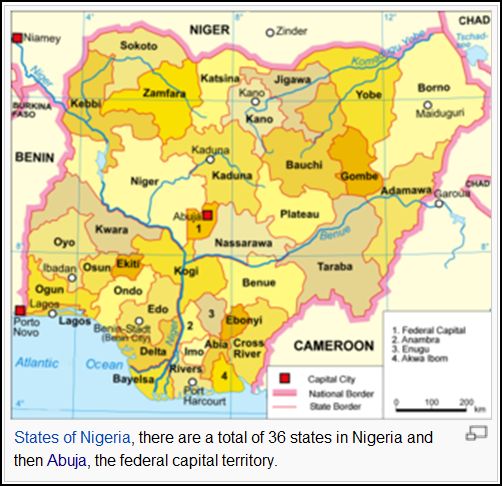
Showing posts with label Nigeria. Show all posts

Sunday, February 12, 2012

Peace and Progress, Part 1

We introduced the situation in Nigeria in a previous series, entitled "Unity and Faith". In Part 1 we began to examine the situation in Nigeria, suggesting a possible parallel to the violence that had been developing in Côte d'Ivoire. In Part 2 we saw how much of the unrest could be linked to difficulties between Muslims in the northern part of the country and Christians in the southern part, introducing the j-word. In Part 3 we examined the jihad more closely, also considering comments calling for a violent counterjihad and alleged abuses by authorities in the context of an anti-Muslim backlash.

In Part 4 we looked at which Muslims were responsible for the jihad, noticing that they were fairly well-educated Muslims from Nigeria's middle class that sought to embrace a stricter form of Islam and wanted to bring it about in Nigeria violently. These radical Muslims are not part of the downtrodden segment of society, but rather are connected to a corrupt northern Nigerian Muslim elite, and claim Islamic ideology as the motivation for their violence. Also, we considered possible connections to the illegal trafficking of heroin and arms, possibly even leading through the Sahara/Sahel to Burkina Faso and into Côte d'Ivoire. Also in Part 4, we saw how Boko Haram personnel were training in Somalia alongside Al Shabaab terrorists, and anticipated how this could lead to a more violent conflict in Nigeria.

Finally, in Part 5, we considered evidence that some of Nigeria's politicians were connected to Boko Haram, and links between Nigerian organized crime and international criminal operations.

At this point, the picture was complete. Ideology - not poverty - drives the front-line leadership of Boko Haram to jihad, but at the top, the connections to organized crime are clear, and organized criminal activities supply the money and the weapons for the jihad; this pattern is typical among Islamic terrorists today.


In this series, we examine the increasing violence in Nigeria.

We begin with excerpts from Soldiers Blow Up Suicide Bomber In Kaduna, February 8, 2012:

Residents of Kaduna metropolis scampered for safety yesterday as bombs exploded at military formations and on a bridge. Boko Haram claimed responsibility, saying that Sokoto is the next target. A lone suicide bomber who forced his way into the 1 Mechanized headquarters of Nigerian Army, Kaduna, at 11.45 am was shot dead following which the explosives went off shattering windows and injuring soldiers on duty.

[snip]

Confirming the incident, the Assistant Director, Army Public Relations, 1 Division, Lt. Col. Abubakar Edun, said in a statement that a suicide bomb attempt was made on the headquarters complex of 1 Mechanized Division. According to the statement titled, 'Failed suicide attack on headquarters complex of 1 Division Nigerian Army', he said, "at about 12.18pm on Tuesday, 7th February, 2012, a failed suicide bomb attempt was made on the headquarters complex of 1 Division Nigerian Army, Kawo, Kaduna.["]

[snip]

Musa Ilallah, an official with the National Emergency Management Agency in Kaduna who confirmed the explosion near the bridge, said rescue workers had been deployed in the affected areas but were being refused access by soldiers. "From all indications, they gate-crashed into the military barracks," said Ilallah. One resident said he saw soldiers being taken out of the barracks with cuts thought to be from the shattered glasses. "Virtually all the glasses had been shattered," the resident said. "I saw soldiers with glass cuts on their bodies being taken out, but it's difficult to say if there were any (more serious) casualties."

Boko Haram has been blamed for scores of bomb attacks in northern Nigeria, including Kaduna. It claimed responsibility for January 20 co-ordinated bombings and shootings in Kano that left at least 185 people dead. It was Boko Haram's deadliest attack yet.

Presumably, the increased tempo of violence including suicide attacks on military installations might be tied to the recent training Boko Haram militants received while in Somalia.


Elsewhere in Nigeria, other bombings have the clear goal to inflict casualties among innocent passers-by. From Two bomb blasts rock flashpoint Maiduguri, February 10, 2012

Two explosions went off Friday outside a customs building in Nigeria's flashpoint city of Maiduguri, the base of Boko Haram Islamists blamed for a series of attacks, residents said.

[snip]

The explosions went off near a station where locals board rickshaw taxis, located outside the customs building, witnesses said.

"The first bomb was planted at the foot of the wall of the customs office when commuters were waiting for rickshaws," said Halilu Adam.

"The second one went off some meters away... The whole area has now been cordoned off by soldiers and it is very difficult to have an idea of casualties."

Boko Haram now seeks to implement a targeted assassination program, as well. From Wole Soyinka On Boko Haram's Hit List, dated February 6:

Nobel Laureate, Prof. Wole Soyinka has disclosed that he is one of the prominent Nigerians on the list of Boko Haram sect marked for assassination.

[snip]

He said: "The reason for this programme (elimination) which I know is very much their third phase, is that those pushing this agenda know very well that this could be the last straw that will break the camel's back. And they would rather this country broke up and possibly in an inferno than continue to accept the loss, even though temporal loss of power in this country. For these people, government is the only business around."

Professor Soyinka


Also targeted for assassination now is the US Ambassador there. From Boko Haram threatens U.S. - Security tightened at American Embassy in Abuja, February 10:

FOLLOWING the recent Bi-National Commission meeting between Nigeria and the United States, the Boko Haram sect is reported to have issued terrorist threats against American targets within Nigeria, including the assassination of the US ambassador in Nigeria, Terence P. McCulley.

The Bi-National Commission had recently concluded a wide range of anti-terrorism plans and agreements in Abuja with a further move to embody the conclusions in a Memorandum of Understanding to be signed by the governments of Nigeria and the United States.

Findings by the Nigerian Tribune revealed that the sect is threatening multiple suicide attacks on American targets if the United States get involved in the sect`s battle with the Federal Government through the signing of the MoU.

It was learnt that the sect believed that the intervention of the United States will internationalise the conflicts and destroy all hopes of a dialogue with the Federal Government.

The report even went as far as threatening to kill the American ambassador while unleashing what the group called international jihadist on the country.


Of course, Professor Soyinka's comments regarding Boko Haram's sincerity in negotiations are very telling. Returning to Wole Soyinka On Boko Haram's Hit List, from February 6:

He added that dialogue does not require a group to constitute itself into a terror, stating that PRONACO which he joined during former President Obasanjo's administration successful organised its conference, amended the constitution of Nigeria and presented the document to the government without violence.

Soyinka said he cannot be cowed into submission by the Boko Haram or any other violent group, stressing, "I believe that one should not beg for existence. If the price of not coming to table is that you want to eliminate me, and you can do so, please do so. I am 77.

"Please, come to the debating table, but you will not persuade me simply because you have the capacity to blow me and my family up. You can simply go ahead, blow us up if you think that is the way you can do your conversation. But you will not bomb me to sit with you at table," he insisted.

Soyinka said President Jonathan is underestimating the desperation of the forces behind the Boko Haram sect not considering the Islamic struggle in countries like Iraq where fundamentalist Islamic groups attack one another even in their sanctuary of worship and they retaliate with higher casualty figure.

Boko Haram's desire to target a Nobel Laureate who decries the violence and wants to negotiate peace telescopes the terrorist organization's goal of eliminating peaceful negotiation as a means to end the violence there: by eliminating anyone who advocates and is willing to work for peace, military options are all that remain to deal with the Islamic terrorist jihad.

Politically-correct defenders of the Religion of Peace should take note of that.

Elsewhere, the governor of Adamawa State has presented checks to the widows of those killed by alleged Boko Haram militants.


From Boko Haram: Peter Obi gives 14 widows N1 million each, February 6:

No fewer than 14 widows whose husbands were murdered by suspected Boko Haram members in Mubi, Adamawa State yesterday, received N1 million each as compensation from Anambra State Governor, Mr. Peter Obi.

Of course, on the other side, it is common for Islamic terrorist groups to provide financial rewards for the families of suicide bombers. Still, even after the monetary compensation, the families of suicide bombers live nowhere near as lavishly as the leaders of the terrorist organizations, who make real money via the organized crime that funds the terrorist operations and which provides a pool of money to subsidize suicide bombings.

Sunday, November 27, 2011

Unity and Faith, Part 5

We continue our consideration of events in Nigeria. In Part 1 we looked at the broad political situation there, paying attention to the North/South divide in Nigerian politics. In Part 2 we saw how that North/South divide is, in large part, a Muslim/Christian divide. In Part 3, we considered in greater depth the religious aspect of violence in Nigeria, including accusations of police abuses - abuses which seemed to target Muslims more than Christians.

In Part 4, we saw a report from 2009 about how the leader of Boko Haram was captured in an operation by security forces, and then died in police custody. We went on to see how, though economic disparity is often blamed for unrest, Boko Haram has its base among an educated middle class, and its leaders themselves claim their motivation is Islam; we also saw how, in Nigeria's corruption, northern Muslim elites were the main perpetrators. Then, we saw how Boko Haram claimed earlier this year that their militants had arrived after training in Somalia, and Boko Haram was threatening attacks that would be both wider and fiercer than their previous attacks, which, as of 2009, they were saying were going to make Nigeria ungovernable. Finally, we began to look at Boko Haram's international connections, and introduced the smuggling operations involving Nigeria, including the movement of heroin from South Asia.

We now look at more recent developments, including connections between Boko Haram and other terrorist organizations, and accusations of connections between Boko Haram and government officials. We begin with Boko Haram claims al-Qaeda links, November 24, 2011:

Kano - A purported spokesperson for Islamist sect Boko Haram claimed on Thursday that the group, blamed for attacks including the suicide bombing of UN headquarters in Nigeria, has links with al-Qaeda.

"It is true we have links with al-Qaeda," the man identifying himself as Abul Qaqa told reporters in a phone conference in the Hausa language spoken throughout Nigeria's mainly Muslim north.

"They assist us and we assist them."

This is nothing new. We previously saw how Boko Haram had claimed to have people trained in Somalia, and, in general, we have in many posts considered how ideology, like contraband, moves across the Sahara and Sahel in Africa - it is not surprising if al Qaeda has connections with Boko Haram.

Skipping down:

The group is believed to have a number of factions with varying aims. Nigeria's secret police alleged this week that some Boko Haram members have links to politicians following the arrest of another alleged spokesperson for the group.

Abul Qaqa refuted the secret police claims during the phone conference.

For information on the alleged links to political leaders, we consider Boko Haram: How SSS established case against Senator Ndume from November 27, 2011:

The Department of State Service (SSS) appears to have established a strong connection between the detained Senator Mohammed Ali Ndume and the former spokesperson of the dreaded Boko Haram sect, Ali Sanda Umar Konduga (a.ka Al-Zawahiri).

Information pieced together by Sunday Vanguard, at the weekend, suggest that part of the evidence the SSS has assembled against the senator is what a security source described as "the two-way communication link, via telephone between the senator and the man known as Al-Zawahiri". It was learnt that the "connect is so strong that even the attempt by the senator's wife to address a press conference on Friday afternoon had to be quickly thwarted by the senator himself."

"When it was discovered that the woman (wife) was attempting to address the press on the matter of the detention of her husband", the source continued, "it was impressed on the husband that should such a press conference be addressed, the Department would go to town with details of its findings which allegedly link the senator to Al-Zawahiri.

"At that point, the man had to make a quick contact with the wife, putting a halt to the move for a press conference".

Sunday Vanguard was also made to understand that whereas further investigations were still on, "the evidence we have suggests that when the Police Headquarters was bombed, it was the same Al-Zawahiri who announced to the world claiming responsibility on behalf of Boko Haram and we also believe that, prior to that incident, the two men had communication or were in contact."

"If that is fully established, the puzzle we are attempting to solve is why the senator did not alert the authorities; but the investigations continue", the security source disclosed.


The allegations go so far as to suggest that Senator Ndume had prior knowledge of a terrorist attack, and did nothing. Farther down in the article, political leaders were interviewed about this issue. Generally, they called for honest investigations and a fair judicial process, seeking to avoid a media circus. (Oh, that our own political leaders in America had such wisdom and integrity!)

As touched on above, though, Boko Haram is denying connections to Senator Ndume. From Boko Haram threatens to attack PDP, CPC, ACN, others •Warns landlords to eject political parties •Denies links with Ndume •Boko Haram will end soon —Jonathan •JTF recovers 2 explosive devices in Maiduguri, November 25, 2011:

MEMBERS of the Islamic sect, Boko Haram, have said that they have no dealings with Senator Mohammed Ali Ndume, who was arrested in Abuja early this week for allegedly sponsoring the movement, according to various reports which they claimed they read on pages of newspapers.

Speaking in a telephone interview with the media in Maiduguri, the Borno State capital, on Thursday, spokesman for the sect, Abu Qaqa, who relayed the message to the press on behalf of the chief spokesman, Abu Dardam, said that the Yusufia movement was a religious sect, as such its members had no business with politics as being insinuated in government circles and among security agencies.


Qaqa further said that long before now, they were aware that Usman Al-Zawahiri, who was arrested and charged to court along with Ndume, was working for the State Security Service (SSS) and as such, what is happening is only a gimmick. He said that in order to prove to the world that the sect had no interest in politics or politicians, its next step was going to be attacks on all political party offices from national to the state levels.

He said the sect also read what the state chairman of the Peoples Democratic Party (PDP), Alhaji Baba Basharu, had been saying about how the movement came into being. According to him, everybody knew what the sect stood for and no politician or political party was associated with it in any way. Therefore, for lying about them, he said Alhaji Basharu had been marked for death.

Speaking on whether the sect had links with Al-Qaeda, Qaqa said wherever Muslim groups which shared the same ideology and were working for the cause of Allah, his sect was with such groups, saying whoever felt that his group had links with Al-Qaeda, based on their ideology in promoting Islam and fighting to free their people from Western claws, was right. But he insisted that any group that did not have his sect’s kind of ideology was not part of them and his sect was not with such a group. He said it was for that reason his group was insisting that it had no links with any political party; be it ANPP, PDP, ACN, CPC and others.

Making good on these threats, Boko Haram has recently targeted Geidam in the northern Nigerian state of Yobe.


We now review Boko Haram bombs Yobe, November 27, 2011:


Churches, homes and the police headquarters in the small northeast Nigerian town of Geidam of Yobe state were set ablaze in a wave of night time gun and bomb attacks by the radical Islamist sect, the police said on Sunday.

Boko Haram, whose name translates as "Western education is forbidden" from the local Hausa language, has claimed responsibility for dozens of shootings and attacks with improvised explosive devices this year.

The Hausa, a Sahelian people in Nigeria's north, are one of the country's major ethnic groups. They have communities in Niger and as far away as Sudan and Cote d'Ivoire. Boko Haram's roots among them may help explain connections to foreign terrorist organizations: the organizations would be foreign to Nigeria, but perhaps not to the Hausa.

Also, Boko Haram clarified the meaning of its name. In Part 4 we quoted an article from Niberia's Vanguard which quotes a statement made by Boko Haram:

WE SPEAK AS BOKO HARAM

For the first time since the Killing of Mallam Mohammed Yusuf, our leader, we hereby make the following statements.

1) First of all that Boko Haram does not in any way mean "Western Education is A sin" as the infidel media continue to portray us. Boko Haram actually means "Western Civilisation" is forbidden. The difference is that while the first gives the impression that we are opposed to formal education coming from the West, that is Europe, which is not true, the second affirms our believe in the supremacy of Islamic culture (not Education), for culture is broader, it includes education but not determined by Western Education.

Continuing with Boko Haram bombs Yobe:

"The Geidam divisional police headquarters and First Bank were bombed on Saturday evening by Boko Haram and fire was exchanged into the night between police and Boko Haram members," a police spokesman told reporters.

"Four policemen were killed, 20 wounded, eight churches and 20 market stalls as well as Geidam council secretariat are completely destroyed."

Geidam is a small town in Yobe state, which straddles the Nigeria-Niger border, and is the home of the powerful state governor. Boko Haram often targets politicians, who the sect say are corrupt and have left the northeast region impoverished.

Boko Haram's attacks have mostly taken place in and around Maiduguri, the capital of Borno state, which borders Yobe state and neighbouring countries Niger, Cameroon and Chad.

A boost in military numbers in recent months in Borno has pushed the sect's attacks further afield, security sources say.

Boko Haram claimed responsibility for an attack in Damaturu, the capital of Yobe, earlier this month that left at least 65 dead. It was also behind two bombings in the capital Abuja this year, the latest in August, a suicide attack at the U.N. building which killed 26 people.

Notice that one of the targets was a bank. From Boko Haram threat: Bauchi banks now close 2pm, dated November 11, 2011:

Bauchi— Commercial banks in Bauchi State are now panicking following alleged reports that members of the Boko Haram sect planned to bomb the financial houses in the state to protest the alleged freezing of the accounts of their late founder, Mohammed Yusuf, by the Federal Government.

The Police Public Relations Officer, Assistant Superintendent, Mohammed Barau, however, said they were unaware of the development, adding that security had been beefed up in the state to ensure safety of life and property.

Sources said that there had been panic withdrawals even as customers now visit their banks very early for business.


Boko Haram's attacks and threats of more are indeed inducing terror among the intended victims, and this most definitely includes the economic sector.

Next, we consider an excerpt from Page 10 of Key Issues in Nigeria's 2011 Elections, dated March 29, 2011, by Sola Tayo. The paper addresses Nigeria in the run-up to the recent elections, but I claim that the same dynamics are at play even now.

Nigeria is often spoken of as having unfulfilled potential. Analysts talk about it eclipsing South Africa to become the continent's largest economy,[5] but such plaudits mean little if a country continues to suffer the effects of poor wealth distribution. Growth needs to be combined with developmental improvement if Nigeria is to be a continental leader. Meaningful efforts to address wealth inequality could be the key to tackling violence; this is blamed on religious differences when poverty is often a bigger factor. Improving the overall quality of life for all Nigerians should mean fewer people feeling disadvantaged or marginalized, and the concept of national unity might be embraced.

However, there is a risk that any sense of national pride and unity will continue to dissipate and people may react to situations according to their religious or regional grouping rather than acting in the national interest. Ordinary, disaffected people are vulnerable to being manipulated into serving the interests of the richer and more powerful, whether in the name of religion or ethnicity. Elements of this manipulation are already evident in conflicts across Nigeria, including over oil, religion and citizenship.

The suggestion is that Nigeria's unrest is due to poor wealth distribution, but I have already made the point that in the case of Boko Haram, the core is middle class and claims Islam, not economics, is the driving force.

But, notice the initial part of the passage, about "unfulfilled potential", and the concluding part, about "manipulation" evident in conflicts over oil. Nigeria already is a regional power, and could become, as mentioned in the passage, a continental leader.

What other (potential) African continental leaders have met a tragic demise just this past year?

Considering now some analysis of the events in Nigeria, we review excerpts from Analysis: What will follow Boko Haram?

MAIDUGURI, 24 November 2011 (IRIN) - Across the road from Maiduguri railway station, in the corner of a now abandoned property, a leafy neem tree provides a canopy for the remains of a mosque flattened by the Nigerian army.

The mosque had belonged to Jama'atu Ahlis Sunna Lidda'awati wal-Jihad (People Committed to the Propagation of the Prophet's Teachings and Jihad), better known as Boko Haram - loosely translated from Hausa, the lingua franca of northern Nigeria, as "western education is forbidden".

Its destruction followed coordinated attacks by Boko Haram militants against police stations and government buildings in four northern states in July 2009. After several days of fighting, more than 800 people were dead, including the Salafist group's leader, 39-year-old cleric Mohamed Yusuf, killed while in police custody.

Boko Haram's revenge was dramatic. Seen initially as an insular local sect - one of many in the north - it reached out of Borno State, on the fringes of the Sahara Desert, to bomb the Nigerian capital, Abuja, and make common cause with the global Jihadist movement. Western governments are scrambling to provide counter-insurgency training to confront the group, which views the Nigerian state as illegitimate, and demands Sharia law even in the southern half of the country where the majority is non-Muslim.

The rank-and-file Boko Haram have no intentions of working within the political system - not even getting the support of corrupt political leaders who are selling the system out. Their goal is to replace the entire corrupt system, and institute strict Islamic law everywhere, forcing the Christian south into dhimmitude.

But, those who control and manipulate them have a different agenda. In Part 4 of this series, we saw mention of a "northern Muslim élite" that was responsible for much of the corruption. And, this could easily tie in with the allegations against Senator Ndume.

We now examine excerpts from the end of Boko Haram plans to bomb Defence Headquarters - Report dated September 9, 2011:

Illegal immigrants: Customs boss summons state comptrollers

The Comptroller-General of Immigration, Mrs Rose Uzoma, on Thursday, read the Riot Act to the state comptrollers of immigration and other top officers of the service for allowing illegal immigrants into the country and constituting a security risk to the nation.

Mrs Uzoma, who summoned the state comptrollers of immigration service to an emergency meeting in Abuja, on the growing insecurity in the country, was worried that intelligence reports had pointed to the fact that some of the people involved in the recent bomb blasts in Nigeria were foreigners.

[snip]

Mrs Uzoma, who emphasised that she would no longer tolerate excuses from any of the state comptrollers where there were noticeable lapses, particularly blamed the security lapses being experienced on the officers in charge of the northern states.

This northern Muslim élite clearly has ties in the security forces, and is pulling strings to facilitate the movement of people and contraband across the northern borders. These people include jihadis tied in with international terrorist organizations, and this contraband now includes weapons from Libya's vast arsenal that fell into the hands of the jihadis. But, that's not all.

A November, 2009, NATO research paper entitled An assessment of crime related risks in the Sahel has this to say on page 2 about Nigeria's other connections in the international underworld:

Nigerians, who are notoriously active in the Golden Crescent (Pakistan, India, Afghanistan), work closely with Latin American cartels. Nigeria is still the biggest regional producer of cannabis4, with plantations bringing farmers 200 million dollars and generating profits of 12 billion dollars for traffickers.

Finally, we consider another excerpt from Key Issues in Nigeria's 2011 Elections, Page 10:

If the hopes of the people for fairness and prosperity continue to be held to ransom by the interests of a very powerful minority, Nigeria is at increasing risk of a downward spiral of disenchantment, with potentially disastrous consequences. The uprisings in North Africa and the Middle East show that disillusioned people will only take so much. This has been acknowledged by the Governor of Nigeria's Central Bank, Lamido Sanusi, who warned that events like those in Egypt, Tunisia and Libya could be experienced in Nigeria if developmental issues were not addressed.

This "very powerful minority" includes infidels, to be sure, but it also includes a "northern Muslim élite" tied in to international narcotics-, arms- and human-trafficking, which it uses to finance jihad.

Who in the infidel world benefits from keeping Nigeria in a state of disarray, rather than allowing it to become a continental leader and major player on the world scene?

Perhaps I should rephrase the question.

Who pulled the strings of intervention in Libya and Côte d'Ivoire?

Thursday, June 30, 2011

Unity and Faith, Part 4

In Part 1 we had an overview of Nigeria and introduced the various angles of the north/south split in the country. Then in Part 2 we considered some of the various factors in the unrest in Nigeria. Next, in Part 3 we examined the jihad and counterjihad aspects of this unrest a little more closely, encountering reason to suspect Nigeria's security forces of committing excesses, including extrajudicial killings, in dealing with the trouble.


We now review excerpts from 'Nigeria's Taliban': How Big a Threat?, dated July 30, 2009. With the ongoing violence in Nigeria today, it is important to keep in mind this article is from two years ago.

The immediate crisis may be over in Nigeria, but the threat of violence remains. Government security forces today attacked a mosque filled with Islamist militants, killing scores of fighters and forcing more to flee. The militants, blamed for days of violence across the country's north, belong to a group known as Boko Haram, which aims to overthrow the federal government in Abuja and impose a strict version of Islamic law. The sect's leader Mohammed Yusuf escaped the raid along with some 300 of his men, but was later arrested and then died in custody according to police. Four days of clashes, sparked by attacks on police stations and government buildings, have killed at least 300 people.

The Boko Haram leader died in police custody; interesting in light of the allegations against Nigeria's security forces that we considered in Part 3.

Continuing:

Also known as Nigeria's Taliban, Boko Haram formed about eight years ago. A huge government operation against the group in 2004 ended with the police claiming victory. But five years on and the militants are back, stronger and more vicious. In the latest outbreak of violence, in Maiduguri, the capital of northeastern Borno state, militant gunmen assaulted police stations and engaged armored-personnel backed troops.

Africa's most populous country sits on a religious fault line. Its 150 million people are split almost evenly between Muslims in the north and Christians in the south. For many years, the northern Muslim élite have dominated Nigerian politics, using their positions to enrich themselves and their families.

The allegations are that it was a "northern Muslim élite" responsible for much of the corruption.

Skipping down a little:

Over the past few years a new breed of young Muslim activists, most of them educated and from the middle class, have aggressively embraced a stricter version of Islam, rejecting anything Western and Christian.

It seems this sect may have been founded by younger Muslims who were angry at corruption among their parents. Regardless, as if often the case, the terrorist organization has its foundation among educated, middle class Muslims.

The article concludes pointing out the concern that al Qaeda might gain a foothold here, and calling attention to a special place Osama bin Laden had assigned Nigeria in the world's jihad.

A month later, Nigeria's Vanguard reported that Boko Haram ressurects, declares total Jihad:

The Islamic sect Boko Haram has declared total Jihad in Nigeria, threatening to Islamise the entire nation by force of war.

[snip]

WE SPEAK AS BOKO HARAM
For the first time since the Killing of Mallam Mohammed Yusuf, our leader, we hereby make the following statements.

1) First of all that Boko Haram does not in any way mean "Western Education is A sin" as the infidel media continue to portray us. Boko Haram actually means "Western Civilisation" is forbidden. The difference is that while the first gives the impression that we are opposed to formal education coming from the West, that is Europe, which is not true, the second affirms our believe in the supremacy of Islamic culture (not Education), for culture is broader, it includes education but not determined by Western Education.

[snip]

2) That the Boko Haram is an Islamic Revolution which impact is not limited to Northern Nigeria, in fact, we are spread across all the 36 states in Nigeria, and Boko Haram is just a version of the Al Qaeda which we align with and respect. We support Osama bin Laden, we shall carry out his command in Nigeria until the country is totally Islamised which is according to the wish of Allah.

[snip]

Having made the following statement we hereby reinstate our demands:

1) That we have started a Jihad in Nigeria which no force on earth can stop. The aim is to Islamise Nigeria and ensure the rule of the majority Muslims in the country. We will teach Nigeria a lesson, a very bitter one.

[snip]

3) That we shall make the country ungovernable, kill and eliminate irresponsible political leaders of all leanings, hunt and gun down those who oppose the rule of Sharia in Nigeria and ensure that the infidel does not go unpunished.


It is not uncommon that analysts point to economic disparities as a source of the violence in Nigeria. But, the terrorists themselves point to Islamic ideology. Furthermore, at least some of the economic disparity is the fault of a corrupt "northern Muslim élite". Consequently, any analysis that does not factor in jihadist Islamic ideology is inadequate.

Fast forward to June 15, 2011, when an article in the Nigeria Daily News entitled Nigerian Islamist sect, Boko Haram vows fiercer, wider attacks quoted Boko Haram as declaring:

"Very soon, we will wage jihad...We want to make it known that our jihadists have arrived in Nigeria from Somalia where they received real training on warfare from our brethren who made that country ungovernable...," said the group in a handwritten statement.

"This time round, our attacks will be fiercer and wider than they have been," it said, adding it would target all northern states and the country's capital Abuja. The statement in Hausa, a widely spoken language in the North, was anonymously delivered to journalists in the North-eastern city of Maiduguri, capital of Borno State, where the attacks were concentrated.

The sect admitted links with a foreign Islamist group connected to Al-Qaeda, although security experts had already speculated that it had established ties with Islamists in North Africa.

Maiduguri featured in an attack only days later.


From Nigerian Boko Haram Islamists 'kill nurse' in Maiduguri, June 20, 2011:

Gunmen from Nigeria's radical Islamist sect Boko Haram have killed a nurse who was playing cards in the north-eastern city of Maiduguri, according to police.

Police said four people were also wounded in the shooting at a bus stop in the city.

Of interest is the connection to foreign terrorist groups; this is an international Islamic extremist ideology that is manifesting itself locally in Nigeria. Boko Haram's statement specifically mentioned Somalia, and there are reasons to suspect other connections.

First, we look at excerpts from Boko Haram Declares War, dated June 27, 2011:

Few seem convinced by President Goodluck Jonathan's assurances that the security situation is under control following the bombing on 16 June of Louis Edet House, the national police headquarters in Abuja. It killed at least two people and wounded seven. Agents of the United States Federal Bureau of Investigation arrived to help investigate claims of international terrorist links.

[snip]

Some immediate questions emerge from the latest round of attacks: Who is behind Boko Haram? How much foreign support has it got and how can it best be confronted? After downplaying its importance and regional ties for some years, Nigerian security officials now point to cross-border links.

[snip]

It seems their tactics are working: security sources speak of training camps of Hausa-speaking Nigerians in Burkina Faso and Niger as well as a wave of new recruits to Boko Haram across northern Nigeria. It's harder to trace the international links, but some officials are taking seriously claims from Boko Haram that their militants, including bomb-makers, have been training in Somalia alongside Al Shabaab and Al Qaida operatives. There are also small, highly mobile affiliates of Al Qaida in the Islamic Maghreb across the Sahel, which could provide the training and the materiel to launch the type of bombings and guerrilla attacks that Boko Haram favours.

Also, in Part 2 we began reviewing a paper entitled Key Issues in Nigeria's 2011 Elections, dated March 29, 2011, by Sola Tayo. We now pick up with an excerpt from page 7:

Concerns about internal security are common during electoral periods, but the possible action of outsiders is also causing concern within the government. In November 2010 a shipment of arms was intercepted in Lagos. The intended destination of the shipment was unclear, although it is claimed it was to be re-exported to The Gambia. However the trafficked rockets and explosives, which came from Iran, were the responsibility of a Nigerian and two Iranians who have been charged with the importation of prohibited firearms. The incident caused a diplomatic storm which resulted in Nigeria reporting Iran to the UN Security Council for a possible arms violation. Although Nigeria has not severed diplomatic ties with Iran, the relationship (on the Nigerian side at least) is tense.

Whatever the intended destination of that shipment, the Nigerian government is understandably wary of arms shipments entering the country and ending up in the possession of militant groups. It is equally suspicious of direct interference by outsiders. In March 2010 the Libyan leader, Muammar Gaddafi, suggested that Nigeria be split in two to end the violence between Muslims and Christians. His comments provoked a strong reaction from the Nigerian government, with Abuja recalling the Ambassador in Tripoli and accusing Libya of trying to destabilize the country. The issue of partitioning the country into a Muslim north and Christian south is a deeply sensitive subject in Nigeria.

Gaddafi is not the only one to suggest this division of Nigeria; there are calls among Nigerians for a north/south (= Muslim/infidel) "divorce" and I am sure recent events in Sudan will fuel these calls. Also, the situation in Côte d'Ivoire, where a "northerner" of questionable Ivoirian credentials was installed by force by the international community, in violation of Ivoirian law, may set a precedent that worries the southerners in Nigeria.


The arms shipment addressed in the quoted passage above was quite substantial, too.


In fact, it was so substantial that some analysts suggested it was a new way to supply anti-Israeli terrorists forces. From Nigerian arms seizure may indicate new Iran-Hamas route, October 29, 2010.

Weapons discovered in 13 shipping containers in the Port of Lagos earlier this week could signify that Iran is trying to develop a new route to smuggle arms and explosives to Hamas in the Gaza Strip, defense officials said on Thursday.

The ship, apparently from Iran, reportedly docked in the Lagos Port on Tuesday and, according to the bill of lading, was supposed to be carrying construction supplies. On inspecting the 13 containers, customs officials discovered rockets, mortars, bombs, rifles and heavy machine guns hidden among crates of building tiles.

Nigerian officials were quoted in the media claiming that the cargo had been under surveillance for some time. It was possible that the intelligence on the cargo was supplied by Western sources.

"On opening the first container, the service operatives discovered rocket launchers, grenades and other explosives; the weapons were concealed among crates of floor tiles," Nigerian State Security Service spokeswoman Marilyn Ogar was quoted as saying.

The largest rocket appeared to be a 107-mm. Katyusha, which Iran is known to manufacture and which makes up the backbone of Hizbullah's and Hamas's arsenals.

Even if most of the weapons, including the rockets, are intended for Palestinian terrorists, it is not unreasonable to expect that local Nigerian jihadists might take a cut for helping move them.

So, we have Iranian arms smuggled into Nigeria, resulting in an international incident reported to the UN.

But, the report previously quoted above, Key Issues in Nigeria's 2011 Elections, only mentions the smuggled arms; why don't we hear about the heroin?

From From Iran: Customs intercept container of heroin at Tin-Can port, November 19, 2010 (I fixed misspellings of "heroin"):

LAGOS—Nigerian Customs Service has intercepted a large quantity of heroin concealed in a 40-foot container, which was believed to have originated from Iran. The container which was brought into the Tin-can Island Port [Nigeria's Tin Can Port - EL] was concealed among machine parts.

[snip]

Also confirming the interception of the large quantity of hard drugs at the Tin-Can Island Port, Customs spokesman, Mr. Wale Adeniyi, said that about ten wraps of heroin each weighing 112kg had been off-loaded from the container.

It was also gathered that CMA-CGM, the shipping company that brought in the 13 containers of arms and ammunition intercepted recently at the Apapa Port, also brought the heroin-laden container.

The heroin and the arms were being moved via the same smuggling route, it appears.


Nigeria is a major oil-producing country. We now see arms- and heroin smuggling from Iran, and connections to international Islamic terrorist groups. Where have we seen this combination before: oil, heroin, and Islamic terrorists?

A November, 2009, NATO research paper entitled An assessment of crime related risks in the Sahel touches on the role played by Nigerian organized crime cartels, and points to increasing movement of marijuana and cocaine across the Sahel region. Of course, I have been pointing to the movement of arms, terrorism and heroin through this region, and alluding to (though not yet establishing) connections between events in Côte d'Ivoire and cocaine trafficking from South America to Europe.

Boko Haram is connected to international Islamic terrorists who, in turn, are connected to international arms- and narcotics traffickers. These connections run to Iran, to Somalia, and across the Sahara/Sahel region to Al Qaeda in the Islamic Maghreb. They of course run through nearby countries; Burkina Faso was specifically mentioned. Burkina Faso is a significant player in the world of transnational smuggling, and is implicated in the situation in Côte d'Ivoire; in fact, Côte d'Ivoire's new strongman, Ouattara, is from Burkina Faso. Nigerian groups are also connected to movement of South American cocaine.

Boko Haram's ideology is shared with terrorists all over the world; the "Religion of Peace" is in fact an ideology of terrorism. But, it would be cut off at the knees without all the transnational organized crime activities that fund it, via smuggling of cocaine, heroin, arms and other commodities, and that supply it with potent weapons.

Unfortunately, though, our "War on Terror", or whatever they call it these days, will only deal the most superficial aspects of terrorism. Political correctness will not allow us to connect terrorism to Islam, and corruption and illicit money which finds its way to important officials in Washington from transnational organized crime will not allow us to effectively address terrorism in any case.

Friday, May 6, 2011

Unity and Faith, Part 3

We continue from Part 1 and Part 2 considering the situation in Nigeria.


First, we consider Muslim Attackers Kill 16, Burn 20 Houses In Bauchi, dated May 6, 2011:

Police say attackers killed at least 16 people and burned down 20 houses in a northern Nigerian town with a history of sectarian violence.

The Bauchi state police chief told The Associated Press on Friday that the attack took place around dawn near Tafawa Balewa town.

Amanam Abakasanga said most of the victims are of the Sayawa ethnic group comprised mainly of Christians.

The Sayawas are in the majority in the town and its surrounding villages, but their traditional rulers have been of the predominantly Muslim Fulani ethnic group.

The Sayawas have demanded a separate traditional ruler, which has led to attacks and counterattacks over the past two decades.

The election-related violence in Nigeria is now showing clear signs of being a Muslim/Christian fight.


Next, we review segments of My friend's husband, brother, were slaughtered and her son thrown into burning car, dated May 6, 2011:

Every evening, before sunset, the entire Kaduna State is locked up: residents are forced indoors until the state is unlocked by its keepers at dawn. That is the huge price the residents now pay for the third week running for the indiscretion of some miscreants. But the authorities say the sacrifice is worth it.

Youths who claimed to be protesting the result of the last presidential election had sparked a full scale arson and mass murder that are unusual even by the records of the state.

An estimated 300 people were killed, hundreds of churches and mosques torched, homes and places of business ruined in one fell swoop.

Governor Patrick Yakowa, after an emergency Security Council Meeting of the state, imposed a 24 hour curfew in the state on the 17th April, 2011, then relaxed it from 5am to 8pm. Yet life is not yet back to normal.

The price of the violence is much appreciated in the vast physical destruction; in the human casualty that is far less than the trauma of some victims whose psyche, and even mental state are forever altered.

"I was in school when I heard rumours of war from some of my classmates who were receiving distress phone calls", Mrs Juliana Moses, a student of School of Nursing and Midwifery, Wusasa Zaria, told Saturday Vanguard at the Nigerian Army Depot, Zaria where she is taking refuge.

The military authorities do not allow journalists in, but Saturday Vanguard found its way in.

"I did not take it very serious, as I was busy in my ward attending to patients as part of my practicals", said the mother of a three year old girl who she left in care of a nanny at Wusasa, an area dominated by CPC (Congress for Progressive Change) supporters.

CPC youth supporters are accused of starting the violence.

"Then I heard cries all over the place", she said.

A pick-up van had just brought the corpses of three men battered to death by the rioters, their throats slit like a slaughtered sheep. She said they were Christians caught unawares in the Muslims dominated part of Zaria.

The article then explains how a woman's husband and younger brother were "slaughtered" in front of her, then the gang of assailants set fire to the family car, beat her, took her baby, and threw the baby into the burning car.


Skipping down, we get to another excerpt:

"My house and business have been burnt for a second time", said Ibraheem Jimoh who has been living in Kaduna since 1978 around Tudun Wada, a strong CPC enclave where a lot of bloodshed took place.

"They said, I was a supporter of PDP. And that as Yoruba Muslim I was not a pure Muslim.

"We are treated the same as Christians each time there is a problems here."

We ended Part 2 having come across the word jihad; now we are beginning to see what that means.

In Islam, jihad is not just a holy war against infidels; it is also a holy war against Muslims who think differently from the Muslims waging the jihad.

The comments are quite interesting; some call for a counterjihad, and receive approval:


In this context, it is interesting to consider allegations of improper conduct on the part of security forces. From Nigerian cops, troops accused of abuses, dated May 6, 2011:

Kano - Rights groups on Friday accused Nigerian troops and police of abuses, including extra-judicial killings, as they sought to quell deadly riots in northern Nigeria after the April 16 presidential poll.

Police and military officials could not be reached for comment, but a spokesman for the governor in the hard-hit state of Kaduna denied the allegations.

New York-based Human Rights Watch and Civil Rights Congress, a local rights group based in the city of Kaduna, have separately accused soldiers and police of extra-judicial killings and other abuses.

The abuses are alleged to have occurred in Kaduna and another northern city, Zaria, both of which were severely affected by the riots that Civil Rights Congress says killed more than 500 people.

Abuse of police power?

The Fund for Peace's Nigeria Profile, as of August 20, 2010, had this to say about Nigerian security forces:

The Nigerian police force is highly corrupt, poorly trained, and has been accused of committing widespread human rights abuses with near impunity. They have been unable to prevent violent riots in many major cities, and are well-known for their practice of extrajudicial killings of persons in custody, suspects, and rioters. The most recent struggle occurred in July 2009, in which 700 died (mostly Muslim civilians) when an Islamic fundamentalist sect and police clashed in the city of Maiduguri. Like much of the nation, the police force suffers from religious and ethnic divisions.

If the perception exists that security forces are taking sides (even if it is only a perception), that can cause further instability. And, there certainly seems to be reason to perceive such a thing.

Friday, April 22, 2011

Unity and Faith, Part 2

We started looking at the situation in Nigeria in Part 1. Considering the post-election violence there, and some things I see about the situation in Nigeria that remind me of other recent events in Africa, we will look a little deeper.

In a pre-election paper entitled Key Issues in Nigeria's 2011 Elections, dated March 29, 2011, author Sola Tayo makes the following observation about politics in Nigeria this election cycle:

Engaging young people

The political parties will also have to make greater efforts to engage the younger electorate. There is a gulf between Nigeria's leaders and the younger population. While still retaining the country's leaning towards social conservatism, young people are increasingly being influenced by other cultures. It could be argued that this is the nature of the power of information-sharing in the world today, but there is a danger in Nigeria of disengagement from mainstream politics in favour of extreme religious affiliations or material gains. Re-engaging young people with national political issues will take time, but could create an appetite in this generation not just to ask questions but actually to challenge the clique of a relatively few 'Big Men' who still dominate Nigerian political life.

If social conservatism means religion, then the danger that Nigeria's young people could be drawn to religious extremism is great indeed.

In recent years, money from the Middle East has gone to revitalize Islam around the world - building mosques, training mullahs - and the brand of Islam that has been spread is "true" Islam - very militant, mainly petrodollar-funded Saudi Wahhabism. At its core, Islam mandates that Islamic law be supreme; other cultures must be subjugated in a subservient status called dhimmitude, designed to make adhering to another religion so painful as to compel submission to Islam, even though Islam's apologists tirelessly repeat that there is no compulsion in religion.

Is the spread of this kind of ideology among Nigeria's Muslims - who comprise slightly more than half the population - a factor?


Tayo points out that today's world is characterized by information-sharing. This explains how Islamic militancy could be propagated, even in the absence of overt foreign involvement. It would only take a small minority of Muslims to adopt these kinds of beliefs and begin to capitalize on or steer unrest in a way that is advantageous. History is replete with examples of unrest that led to revolutionary change which was then hijacked by a small group of highly-motivated and well-organized people.

This question of influence from outside Nigeria is of interest. We now examine another excerpt from Key Issues in Nigeria's 2011 Elections (though we will get to the part dealing with outside interference in a subsequent post):

Internal security and outside interference

There are three main ongoing problems relating to security, all (currently) relatively localized: Niger delta militant groups in the south, Islamist groups in the northeast, and the social and religious flare-ups in Jos and Nigeria's middle belt. In the past, the violence has tended to be contained within local communities, which gives the impression that it is relatively easy to deal with by enforcing martial law, conducting large-scale police operations and through cooperation between the police and intelligence services. However, the 50th Anniversary Independence Day bombs in Abuja, on 1 October 2010, which for the first time targeted a national celebration attended by high-level international dignitaries, indicate that the containment of violence may be becoming a thing of the past.

These bomb attacks were claimed by the Movement for the Emancipation of the Niger Delta (MEND), a militant group based in the oil-producing south. MEND and other groups in the region are notorious for their acts of violence. These are mostly targeted at oil companies which they blame for polluting their environment and destroying their livelihoods while depriving local people of a fair share of oil revenues. Militant activity in the Niger Delta usually consists of attacks on oil pipelines and the kidnapping for ransom of employees of oil companies (foreign and local) and the families of local government officials. MEND has threatened in the past to take its attacks outside the Niger Delta, to Abuja and Lagos. The Independence Day bombs were a powerful reminder that once localized disputes can and will spread beyond their previous confines.

Security has been prioritized since the October bombings, but violent attacks have continued in the run-up to the elections. Worryingly, the use of bombs, previously unusual in Nigeria, has continued, and expanded to other disputes. In December 2010 at least 80 people were killed in a series of church bombings in Jos. Four people were killed in a similar attack in Abuja a week later. MEND had claimed responsibility for the October bombs, but Boko Haram, a northern-based militant Islamist group with an increasingly violent track record, has claimed responsibility for the Jos attacks. The human rights organization Amnesty International, in a recent report (Loss of Life, Insecurity and Impunity in the Run up to Nigeria's Elections) has warned of an escalation in pre-election violence.

Of course, the pre-election report warned of an escalation of pre-election violence. But, most of the election activity is over (there are still some regional elections coming up shortly). The dynamic, however, is largely the same. Since the election results returned an incumbent southerner from the ruling PDP to power, the northern factions may feel they have something to complain about.

Broady speaking, much of the violence in Nigeria is associated with a southern group, known as MEND. But, narrowing in on topics relevant to the post-election violence, Boko Haram is also mentioned as responsible for violence in Jos. The name "Jos" itself is interesting; according to some sources, the city is so named as an acronym for "Jesus Our Savior". Located right on the border between the Christian-dominated south, and the Muslim-dominated north, Jos has become a battlefield more than once in recent years.


Regarding violence in Jos early last year, an article entited What's behind Christian-Muslim fighting in Nigeria? dated January 19, 2010, had this to say:

Sectarian violence continued for a third day in the Nigerian city of Jos, and appeared to be spreading to surrounding suburbs, as the state government announced a 24-hour curfew to bring Christian-Muslim fighting to a halt.

Officials at Jos's Central Mosque, where most of the Muslim dead have been brought to be buried, say that 139 bodies have been found thus far, but other reports say that the death toll may be much higher, perhaps beyond 200. Residents told human rights workers that gunfire continued throughout the day, even after the Nigerian Army was called in to help police to rein in the violence.

"The cycle of violence is explained by the fact that both the two communities, Muslim and Christian, share many of the same problems, including lack of economic opportunities," says Corinne Dufka, an Africa researcher with Human Rights Watch, based in Dakar, Senegal.

Frustration among the young is often a tool in the hands of ambitious politicians, she adds, and even after courts are presented with evidence that violence is often orchestrated or manipulated, "nobody is held accountable."

Ms. Dufka says that calling in the Army could be a very positive step, "if the Army uses minimal force, such as tear gas to clear the streets," but the long-term solution will come only when the government is seen to be fair by both communities, and when "the choreographers of the violence, the ones who incite violence, are held accountable."

Claims that the violence is "choreographed", "orchestrated", "manipulated"... and no one is held accountable.

Nigeria has a north-south political split, as pointed out in Part 1. Skipping down in What's behind Christian-Muslim fighting in Nigeria? the de facto agreement to alternate between a northerner and a southerner as president is explained as alternating between a Muslim and a Christian; it should be noted that this excerpt is from a time when Goodluck Jonathan was vice president, and when the president was sick (see Part 1):

It is unclear how much the rioting in Jos is affected by national politics, but a political crisis in which the Muslim president Umaru Yar'Adua has spent the last two months in a hospital in Saudi Arabia, refusing to cede official power to his Christian vice president Goodluck Jonathan, cannot have helped relations between Christians and Muslims.

Many Muslim politicians say they would refuse to allow power to shift, even temporarily, to Vice President Jonathan, calling instead for a fresh round of elections in which only Muslim candidates could run. In order to keep peace, for many years there's been an unofficial agreement to alternate the presidency between Christians and Muslims.

It is likely the current violence, being painted in much of the mainstream media as a north/south issue, is, at its roots, a Muslim/Christian issue, and "north/south" is PC-speak for this religious problem.

The Jos rioting of 2010 resumed in March; at the time, the governor of Plateau State, where Jos is located, was Christian, as were many of the members of the security forces.


However, religion was only part of the cultural rift at the base of the rioting; from Nigeria violence: Muslim-Christian clashes kill hundreds, dated March 8, 2010:

The central city of Jos is on high alert after Sunday's violence in Nigeria in which a late-night attack by herdsmen killed up to 500 people from nearby farming villages. The attack has been seen as a reprisal for attacks in January, in which about 300 herdsmen were killed by youths from the farming community.

The town of Jos is all too often a focal point for competition over the use of arable land in central and northern Nigeria, where climate change has dried up pasture lands and forced animal herders closer and closer to farming communities, where their herds can destroy crops.

Jos is also right on the de facto fault line separating Nigeria's mainly Muslim north from its mainly Christian south. The farming community in Jos is primarily Christian of the Berom ethnic group, while the herders are ethnic Fulanis who practice Islam.

"Land is central to the conflict in Jos," says Ugar Ukandi Odey, a Jos-based news reporter for the Nigerian newspaper NEXT. Mr. Odey has been covering the attacks and the tense aftermath. "The Beroms are the original people of Jos, and the Fulanis are nomads moving around with cattle who have settled in amongst the Berom people. But it becomes ethnic and religious, because there are Christians on one side, and the Fulanis are Muslims on the other side."

Skipping down:

Working to keep violence from spreading Jonathan and state officials will have to work fast to keep the violence from spreading. The attacks were brutal, with mobs of young men passing through two villages outside Jos and hacking to death anyone they caught – women, the elderly, and even toddlers – with machetes. Some firebrand Christian leaders from Jos are condemning the Army for moving too slowly, and calling the attack on their parishioners a jihad against Christians.

Uh-oh: the j-word.


More to follow...

Wednesday, April 20, 2011

Unity and Faith, Part 1

Nigeria is an interesting country. It is the most populous country in Africa, and the 7th most populous country in the world. It is estimated that more than one fifth of the world's black population lives in Nigeria, and Nigeria has what is considered one of the world's major developing economies. Add to that its central location in Africa, with its own significant oil fields and adjacent to many other oil fields, and Nigeria is perhaps the major player in Africa, and a significant player on the world scene.


On April 16, Nigeria held presidential elections. For an overview of how the election process itself went, I refer you to Sahel Blog's article entitled International Observers Comment on Nigeria's Elections.

The election results are sparking some turbulence in a nation that already is simmering with other problems.

The incumbent, Goodluck Jonathan, was elected as vice president and sworn in on May 29, 2007. Due to illness, President Umaru Yar'Adua was unable to function as president, so Jonathan became acting president as of February 9, 2010; upon Yar'Adua's death, Jonathan took the oath of office to become president on May 6, 2010. President Jonathan is a member of the People's Democratic Party, which also controls Nigeria's National Assembly.

Re-elected: Incumbent President Goodluck Jonathan

2011 Nigerian Presidential Election Results

2011 Nigerian National Assembly Election Results

Now, for background, we consider an excerpt from a paper entitled Key Issues in Nigeria's 2011 Elections by Sola Tayo, dated March 29, 2011:

While other parties had a smoother journey in declaring their candidates the PDP spent much of the latter part of 2010 embroiled in a debate over the origin of its candidate. An agreement within the party dictates that the presidency should rotate between Nigeria's north and south – a system commonly known as 'zoning'. It appears in the party's constitution but without detail of its implementation, which casts doubt on whether it is legally enforceable.[2] On the basis of this, many people, particularly in the north, consider it to be the north's turn to hold the presidency as Nigeria's last president, northerner Umaru Yar'Adua, died before completing his first term in office, and his predecessor in office, Obasanjo, was a southerner. Yet Goodluck Jonathan, who as vice-president took over the presidency upon Yar'Adua's death, is himself also a southerner. A powerful coalition of northern interests combined to try to prevent Jonathan's assumption of the interim presidency, and subsequently his nomination to PDP candidate for these upcoming elections, precisely because they foresaw the north missing out on 'its turn'.

The excerpt tells of a north/south split within the ruling PDP. But, as I looked at results published by Nigeria's Independent National Electoral Commission, evidence of another kind of north-south political split was quite obvious.


The main runner-up for the presidency was a candidate from the Congress for Progressive Change, General Muhammadu Buhari. From Q&A: Nigeria elections, April 19, 2011:

Goodluck Jonathan from the governing People's Democratic Party (PDP) was declared the winner with 57% of the vote, taking 22.5 million votes.

The runner-up, General Muhammadu Buhari, of the Congress for Progressive Change (CPC), took 12.2 million votes.

International observers said polling was generally free and fair and there has been praise for the Independent National Electoral Commission.

The African Union observer team said it was Nigeria's best poll for decades, but this did not stop riots breaking out in many northern cities, where Gen Buhari is popular.

To win in the first round, a candidate needs at least 25% of the vote in two-thirds of Nigeria's 36 states, as well as a majority of the total votes cast.

The protesters accuse PDP politicians in the north of rigging to allow Mr Jonathan to reach this threshold.

They also claim there are discrepancies between turnout and results in some areas of the south, Mr Jonathan's powerbase.

From a March 7, 2011, article entitled Buhari Warns Of Arab-style Revolution In Nigeria, we have the following:

PRESIDENTIAL candidate of the Congress for Progressive Change (CPC), General Mohammadu Buhari, has warned that the current unrest in North Africa and Middle East would not elude Nigeria if the leadership remains unaccountable to the people.

Buhari, who was in Port Harcourt, Rivers State capital, yesterday to flag off the CPC presidential campaign rally for the South-South zone of the country, said no one should rule out the North African revolution in Nigeria, if the ruling Peoples Democratic Party (PDP) does not change its style of governance.

You know, it occurred to me that there also seems to be a split along religious lines, which is a roughly north-south split. In fact, skipping down in Q&A: Nigeria elections:

Is there always a north-south divide to politics?

Elections in Nigeria tend to be about ethnicity, religion and regionalism, not issues.

But it is the first time in Nigeria's recent history that the presidential election result has exposed the huge division between the mainly Muslim, Hausa-speaking north and Christian and animist south.

Often the winning candidate - irrespective of region, religion or ethnicity - has commanded a wide national spread in the first round.

Historically, this was due either to a formal alliance by political parties or - more recently - an informal agreement within the governing PDP party to alternate the presidency between the north and the south after two terms in office.

However, this rotation was broken when Mr Jonathan succeeded to the presidency last year after the death of Umaru Yar'Adua, a northerner. PDP powerbrokers wanted their candidate in this election to be a northerner.

And much of the anger being expressed by the young men rioting in northern cities comes down to frustration.

The north is far behind the south in terms of development, education and job opportunities - some of the issues politicians have often promised to address and failed to deliver.


Coupled with Buhari's warnings, this sounds like a recipe for big trouble.

I can't help but notice that Nigeria also has trouble with the Boko Haram militants, that half the country already has sharia as state law, and that Nigeria is along the Sahara/Sahel corridor that I have written about in previous posts - a corridor through which flow contraband, illegal arms, and people with political-religious agendas.


It seems to me I started a series about Côte d'Ivoire with a post kind of like this one, and look what happened there.

Of course, Nigeria is very different from Côte d'Ivoire...